

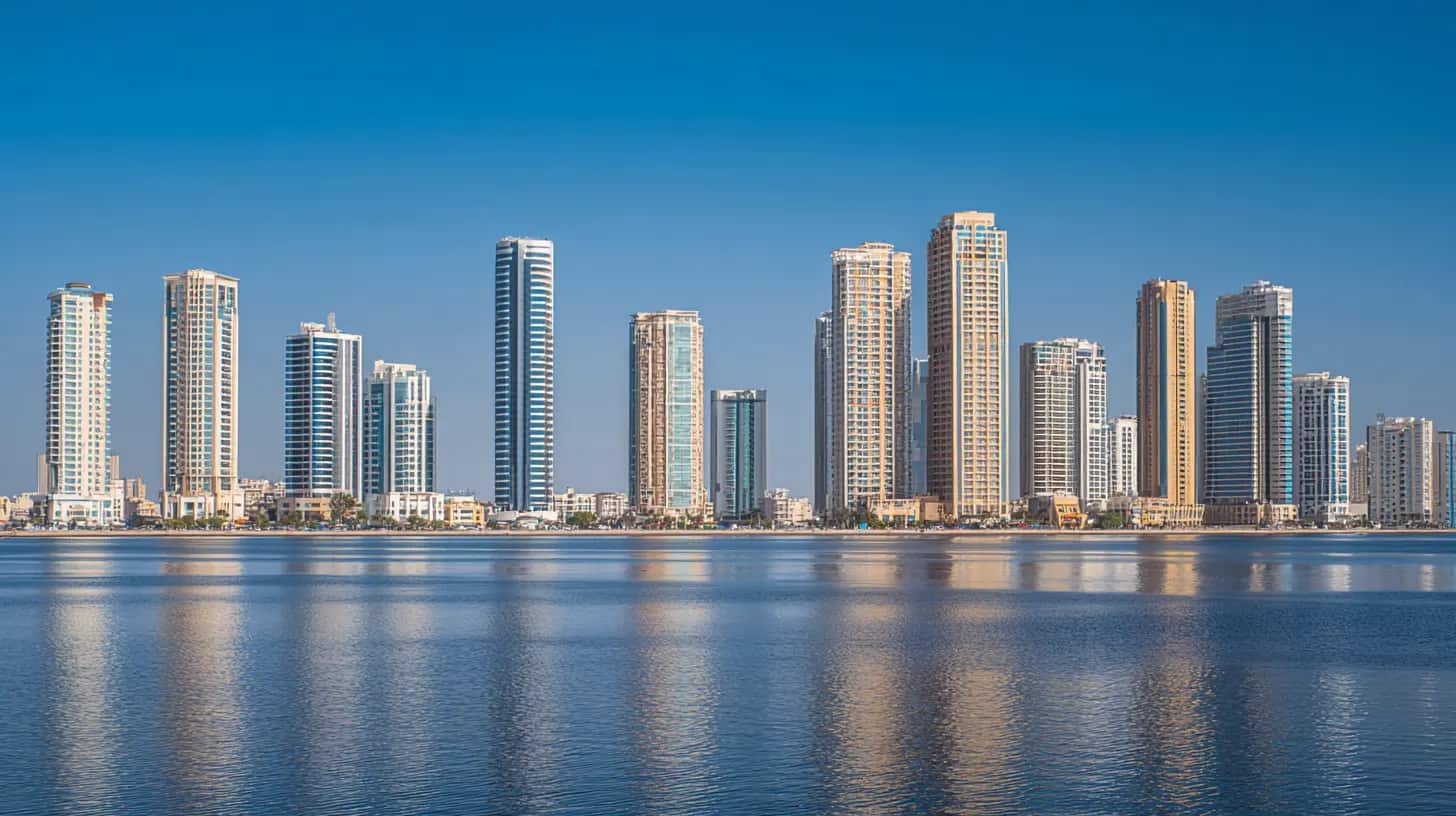
Ajman Real Estate Market Trends 2025
Ajman's property market is moving faster than most people realise. Here are the real trends shaping prices, yields, and buyer demand across the emirate in 2025.
Ajman does not have the same kind of headlines. The major transactions, the developer launches with celebrities, and the coverage of price per square foot milestones all take place within Dubai. Ajman simply sits quietly to the north, not as big, not as glamorous, and not as well-covered within the property market news and press.
But the market has been moving, and it has been moving quietly, steadily, and within the trends and statistics that matter for the buyer, the investor, and the renter who wants to pay attention. The number of transactions has risen. Prices have gone up for all residential property types. New developers have returned to the market after a long period of dormancy. More and more people who have been priced out of Dubai and Sharjah have begun to realize that Ajman has more to offer than it commonly lets on.
This guide will present the real trends within the property market of Ajman for the year 2025. That means not projections or hopes and dreams, but actual movements within the price points, the number of transactions, the rental rates, the developer activities, and the demographics of the buyers that indicate where the market has been and will give us a better idea of where it will go.
We will be covering the residential market, the rental market, the activities within certain areas and communities, the changing face of the investor, and the impact of the infrastructure projects currently under way and how they will impact the property market within the next three to five years. We will also be discussing the limitations of the opportunity because, while the property market within Ajman has certain strengths, it also has certain limitations, and it is the understanding of both that will be necessary for making the right decisions within this market.
Before we get into the numbers, a quick footnote: the property market within Ajman has not been as transparent as the one within Dubai, where the Dubai Land Department publicly releases all property transaction records. The data points used within this guide have been gathered from the Ajman Real Estate Regulatory Agency, the quarterly reports from the UAE market released by ValuStrat, and active market intelligence from the current transactions within the market. Where ranges have been used instead of precise figures, it has been due to the actual range within the market and not due to imprecision on our part.
What Has Actually Happened to Ajman Property Prices
The most important thing to understand about Ajman's price movement over the past three years is that it has been real, broad-based, and driven by genuine demand rather than speculative activity. That distinction matters because price rises driven by real demand tend to be more durable than those driven by investor momentum alone.
Residential apartment prices in Ajman's established areas have risen approximately 25% to 40% in nominal terms between 2021 and 2025. A one-bedroom that was available for AED 200,000 to AED 250,000 in 2021 now trades at AED 270,000 to AED 340,000 in comparable buildings. A two-bedroom that was AED 320,000 to AED 380,000 is now AED 400,000 to AED 500,000 in most established areas.
That appreciation has not been uniform. The Ajman Corniche and the newer buildings in Al Nuaimiya and Al Rashidiya have seen the strongest price growth, driven by genuine lifestyle demand from residents who want better-quality product and are willing to pay for it. Emirates City, the large residential development on the Ajman-Sharjah border, has had more muted appreciation — some segments have recovered from their post-2014 lows but others are still below the original launch prices from the mid-2000s.
Villa and townhouse prices have moved similarly to apartments in percentage terms, with three-bedroom villas in established areas now sitting in the AED 900,000 to AED 1.4 million range. This price point continues to attract buyers from Dubai and Sharjah who can't access equivalent space at those prices in their preferred emirate.
Rental rates have risen alongside sales prices. Annual rents for one-bedrooms in established Ajman communities are up approximately 20% to 30% since 2022. A one-bedroom that rented for AED 18,000 per year in 2022 is now achieving AED 22,000 to AED 26,000 in the same or comparable buildings. Two-bedrooms that were AED 28,000 have moved to AED 34,000 to AED 42,000. These increases follow the broader UAE rental market trend but have been somewhat more moderate than Dubai's sharp upward movement over the same period.
Price movement summary by area and type:
- One-bedroom apartments (established areas): up 25% to 35% from 2021 to 2025
- Two-bedroom apartments (established areas): up 20% to 35% from 2021 to 2025
- Studios (budget segment): up 15% to 25%, more modest growth reflecting supply depth
- Villas and townhouses (3 bed): up 25% to 40%, strongest demand from Dubai and Sharjah spillover
- Emirates City apartments: up 10% to 20%, lagging behind main Ajman market
- Ajman Corniche new stock: up 35% to 50%, premium location commanding strongest growth
- Al Nuaimiya commercial strips: up 15% to 25% for retail and office units
- Annual rental rates (one-bedroom): up 20% to 30% from 2022 levels
- Annual rental rates (two-bedroom): up 20% to 30% from 2022 levels
- Gross yields: broadly stable at 7% to 10% as rental and capital growth have moved together
Who Is Buying in Ajman and Why the Profile Is Shifting
Understanding who is driving demand in a market tells you more about its durability than any price chart. Ajman's buyer profile has been shifting over the past three years in ways that are worth paying attention to.
The traditional Ajman buyer was either a UAE-based South Asian expat purchasing an entry-level apartment as a first property investment, or an Ajman-based local buying for personal use or family provision. Both of those buyer cohorts are still active. But they've been joined by a growing number of buyers from Dubai and Sharjah who are making deliberate decisions to invest in Ajman rather than defaulting to the more expensive markets they're familiar with.
The Dubai spillover buyer is the most significant new entrant to the Ajman market. These are typically UAE residents — often professionals or small business owners — who have watched Dubai prices rise beyond what they can comfortably invest in and have turned their attention north. They're not settling for Ajman. They're choosing it, specifically because the yield numbers make sense at Ajman's price points in a way they no longer do in much of Dubai. A AED 400,000 Ajman apartment yielding 8% is a more attractve income investment than a AED 1.2 million Dubai apartment yielding 5.5% for a buyer who is optimising for current income rather than capital growth.
The investor from India, Pakistan, and other South Asian markets remains a consistent presence in Ajman. Ajman has historically had strong cultural and commercial ties to South Asian business communities, and this continues to drive both residential and commercial property demand. These buyers tend to have a longer time horizon than short-term speculators, which adds stability to the demand base.
A newer and smaller but growing buyer segment is the international investor who has heard about UAE property opportunity and is using Ajman as an entry point because the price points are more accessible than Dubai. This buyer is typically doing more research online than in person, which makes information quality and agent credibility particularly important in how they make decisions.
Buyer profile breakdown:
- UAE-based South Asian expats: largest and most consistent buyer cohort, primarily residential investment
- Dubai and Sharjah spillover buyers: fastest growing segment, yield-focused, AED 300,000 to AED 800,000 budget
- Ajman-based locals: consistent demand for villas and larger apartments, family-driven purchases
- International investors (India, Pakistan, UK, Europe): growing online-first segment, accessible price points
- Commercial investors: attracted by warehouse and office yields running 8% to 13%
- End-users from other emirates: renting elsewhere while building ownership position in Ajman
- First-time buyers: Ajman remains one of the few UAE markets accessible to buyers under AED 300,000
- Institutional investors: largely absent, market too small and illiquid for meaningful allocation
- GCC buyers: limited but present, particularly for Corniche-area product
- Developer-adjacent investors: buying in or near new development zones anticipating infrastructure-driven appreciation
Key Development and Infrastructure Trends Shaping the Market
Property values don't move in isolation. They respond to what's happening around them — new roads, new schools, new retail, new public investment. Ajman has several infrastructure and development initiatives underway that are worth understanding as a property buyer or investor.
The Ajman 2030 Vision is the emirate's long-term development framework, which sets targets across economic diversification, housing quality, transport infrastructure, and public amenities. The specifics of the plan include upgrades to the road network connecting Ajman to Dubai and Sharjah, investment in public facilities and parks, and the development of new mixed-use zones that add both residential and commercial capacity to the emirate. Plans of this kind are only as good as their implementation, but the directional commitment from Ajman's government to upgrading the emirate's infrastructure is genuine and has been backed by actual spending over the past three years.
Road connectivity improvements are probably the most impactful infrastructure investment for property values in the short to medium term. The E11 Emirates Road and the Ajman-Sharjah border connections are the primary commute routes for the large number of Ajman residents who work in Dubai or Sharjah. Any meaningful improvement to these corridors reduces the single biggest practical downside of living in Ajman relative to the more established emirates. Work has been ongoing on several road upgrades along these routes.
New retail and community infrastructure is filling in across the emirate. Several new community malls and retail strips have opened in the past two years in Al Nuaimiya, Al Rashidiya, and the Corniche area. The concentration of schools, medical clinics, and supermarkets within established residential areas has improved noticeably. These aren't dramatic changes but they are cumulative improvements that make Ajman a more functional place to live, which supports both rental demand and long-term price stability.
According to a 2024 report by ValuStrat, one of the UAE's leading property research and valuation firms, the Northern Emirates — including Ajman — showed the strongest rental yield performance in the UAE on a risk-adjusted basis, driven by the combination of low entry prices, growing tenant demand, and improving infrastructure relative to the starting point.
New developer activity is picking up after several quiet years. Several mid-market developers who were previously focused exclusively on Dubai have begun launching projects in Ajman's better-connected residential areas. This brings improved product quality and more buyer-friendly payment plan structures to a market that has historically been dominated by older, privately owned residential stock.
Infrastructure and development highlights:
- Ajman 2030 Vision: government framework committing to road, amenity, and economic infrastructure investment
- E11 road upgrades: ongoing improvements to main commute corridor toward Dubai and Sharjah
- New community retail: multiple new malls and retail strips opening across established residential areas
- School infrastructure: new international and private school capacity added in 2023 to 2025
- Medical facilities: expanding private clinic and hospital network serving growing population
- Corniche development: ongoing public realm investment along the seafront improving amenity value
- New residential launches: mid-market developers from Dubai entering the Ajman market
- Free zone expansion: Ajman Free Zone capacity additions supporting commercial property demand
- Utilities infrastructure: electricity and water network upgrades in developing areas
- Public park and recreation: Al Zorah nature reserve and public green space investment continues
Rental Market Trends and What They Mean for Investors
The rental market is where Ajman's investment case is most straightforward. High gross yields, consistent demand, and a tenant base that is growing rather than shrinking. Here's what's actually happening.
Demand for rental property in Ajman is being driven by two forces simultaneously. The first is population growth within the emirate itself — Ajman's population has been growing steadily as residents who work in Sharjah and the northern Dubai employment areas choose affordable Ajman housing over the more expensive options in their workplace emirate. The second is overflow demand from Sharjah, where rents have risen significantly following Dubai's sharp rental increases pushing more tenants northward along the cost curve.
Vacancy rates across Ajman's established residential areas have tightened noticeably since 2022. Buildings that previously carried persistent vacancy of 10% to 15% in their apartment inventory are now running closer to 5% to 8% in the better-located communities. That tightening directly supports yield sustainability — it's not just that rents are higher, it's that more units are occupied more of the time.
The two-cheque to four-cheque shift is a small but meaningful trend in Ajman's rental market that reflects improving tenant financial profiles. Historically, Ajman landlords asked for rent in one or two annual cheques — a practice that favoured landlords but limited the tenant pool to those who could produce large sums upfront. An increasing number of landlords are now accepting four or even six cheques per year as competition for quality tenants has increased. That flexibility makes Ajman's rental market accessible to a broader tenant base, which is good for long-term occupancy stability.
Short-term rental is a smaller but growing segment in Ajman compared to Dubai's well-developed holiday home market. The Ajman Corniche and some of the newer residential buildings attract short-stay demand from visitors to the emirate and from UAE residents looking for weekend escapes at prices below Dubai's hotel and holiday home rates. The infrastructure for short-term rental management in Ajman is less developed than in Dubai, but for investors willing to manage the additional complexity, achievable short-term rental revenues can be meaningfully above long-term rental equivalents.
Rental market data points:
- One-bedroom annual rent (established areas): AED 22,000 to AED 32,000 in 2025
- Two-bedroom annual rent (established areas): AED 32,000 to AED 48,000 in 2025
- Studio annual rent: AED 14,000 to AED 22,000 in 2025
- Three-bedroom villa annual rent: AED 55,000 to AED 85,000 depending on area and condition
- Rental growth 2022 to 2025: approximately 20% to 30% across established residential stock
- Vacancy rates (established areas): 5% to 8%, improved from 10% to 15% in 2021 to 2022
- Cheque flexibility: increasing acceptance of 4-cheque arrangements by landlords
- Gross yields on apartments: 7% to 10% across most established communities
- Short-term rental premium over long-term: 25% to 50% achievable in Corniche and newer stock
- Yield comparison to Dubai: Ajman runs 2% to 4% higher gross across comparable categories
The Honest Outlook: Where Ajman's Market Is Going
The property market in Ajman for 2025 is indeed in a far stronger place than it was three years ago. This is not spin – it is based on hard facts and evidence.
The issue for buyers and investors is what is going to happen next. The honest truth is that there is upside potential in Ajman, but it is limited – it is not going to become anywhere near as good as Dubai. Quite apart from the size of the market, the quality of infrastructure, and the quality of the job market, it is not going to increase anywhere near as quickly as it has done in central Dubai. What it is going to continue to offer is a good return on investment, a decent level of capital appreciation, and an entry price that is accessible to a wide range of people.
The risks, too, are as real as the opportunities. The primary practical limitation for residential demand for the Emirate of Ajman continues to be the commuting time to Dubai. The secondary market liquidity is also not as developed as Dubai, which means that the exit routes for investors can be longer and require more price elasticity. At the same time, the transparency of the market also continues to improve, and the effort required for due diligence for the prospective buyer in the Emirate of Ajman will be more pronounced than it would be for Dubai.
Andrew Baum, a professor at the Said Business School at the University of Oxford and one of the more prominent commentators on the subject of real estate investment strategy, has written that the best risk-adjusted returns for property markets can be found where the yield premium over prime locations exceeds the actual differential in risk by the right amount. The yield premium for the Emirate of Ajman over Dubai, which typically ranges from 2% to 4% for the majority of residential product types, is one area where the same kind of scrutiny will be required in 2025.
For the prospective buyer who understands the Emirate of Ajman for what it is—a value market with demand, infrastructure growth, and sustainable yields as opposed to growth potential—the opportunity for growth is as real as it has ever been, and the price point for entry is as accessible as ever. For the prospective buyer who believes he or she has found the next Dubai, this is not it, and they would be better off looking elsewhere.
If you want to explore current listings in Ajman or compare what's available across the Northern Emirates at your budget level, our team covers this market alongside Dubai and can give you a straight read on where the value sits right now. Reach out and we'll take it from there.
Related stories

The Productive Address in Dubai
The line between home and work has blurred for good. Discover the Dubai properties and communities designed for the focus, flexibility, and balance that modern professionals demand.

The Mortgage Effect: Your Guide to Dubai Rental Yields
Financing is the engine of your property investment. As a yield analyst, I'll walk you through how different mortgage structures can either supercharge your net cash flow or quietly erode your returns in the Dubai market.
Dubai Off-Plan Delays: Your Legal Rights
When your Dubai off-plan property is delayed, understanding your legal rights is critical. This guide details RERA's framework, options for contract breaches, and practical steps to protect your investment.
Echoes, in your inbox
One thoughtful email a month. Market insight, new launches, no spam.