

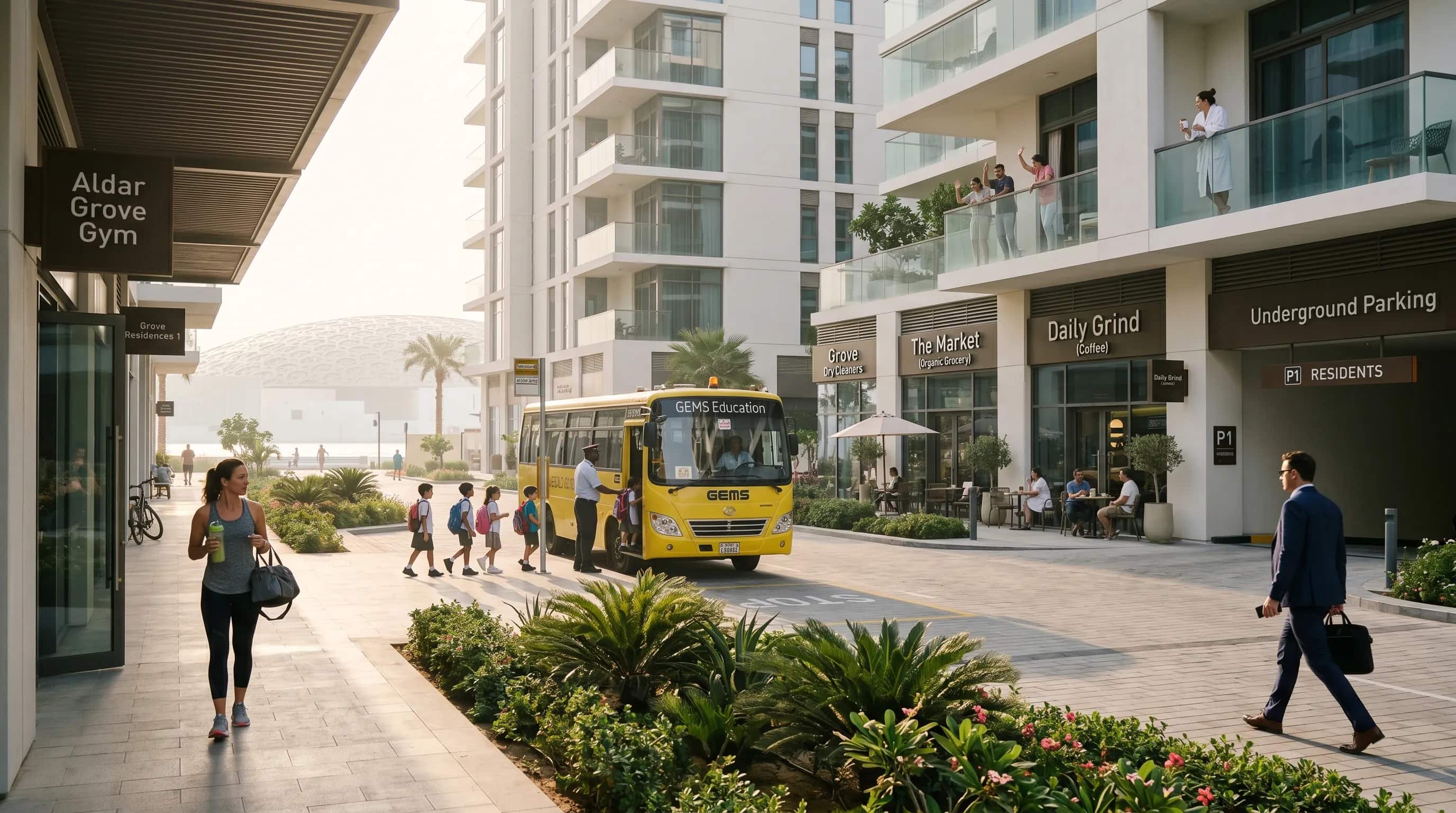
Aldar and Sustainability in Abu Dhabi: What They’re Actually Doing
Aldar talks a lot about sustainability. What does that actually look like in their buildings, certifications, and net zero plan? Here’s the honest breakdown.
Indeed, almost all major developers in the Gulf have a sustainability page. There are promises of being net zero, ESG reporting, pictures of solar panels installed on rooftops, water stewardship and efficient use of energy and material in the construction process, circular construction, and other such items. They are everywhere, all the time.
However, the question becomes, does any of it make a difference?
In this regard, Aldar Properties offers the best example worth investigating here. In recent years, it has been the biggest champion of sustainability. It made pledges, sold sustainability bonds, developed communities that it described as "net zero," and took structural measures in terms of construction practices. Some of these actions are real; others are mere positioning. We seek to identify which is which.
For this article, we spent several months analyzing Aldar's sustainability disclosures, comparing it to other developers in the Gulf, speaking to experts, and inspecting buildings. We attempted to be fair and objective here. In cases when Aldar leads the way among its peers, we will admit this openly. When it is just about empty talk, we will point this out without hesitation.
There is also another angle to discuss in this context, that of the consumer. Indeed, sustainability has much to do with operating costs and risks, resale to certain market segments, and long-term asset value. An energy-efficient building requires less expense to operate. Low water use buildings are more resilient to water scarcity restrictions. And in making decisions about sustainability, a developer builds value for property owners in 2035.
At the end of the day, readers will learn about Aldar's sustainable development strategy and what it means for those who would buy and rent properties in one of its communities.
The Net Zero by 2050 Pledge (and What That Means)
Aldar has publicly committed to reaching net zero emissions by 2050 across its entire operations and value chain. The commitment is aligned with the UAE’s broader Net Zero by 2050 Strategic Initiative, which was announced in 2021 as the first such commitment by a major oil-producing nation.
The framework includes interim targets. Aldar has committed to reducing scope 1 and 2 emissions by 30% by 2030 against a 2022 baseline. Scope 3 emissions, which include the embodied carbon in materials used in construction, are harder to control but are being measured and tracked.
CEO Talal Al Dhiyebi has been consistent in public statements that sustainability is core to the company’s strategy rather than a side initiative. The board has a dedicated ESG committee. Sustainability metrics flow into executive compensation. These are structural commitments, not just marketing claims.
The skeptical view is that 2050 is far enough away to be hard to verify, that interim targets are achievable through accounting choices, and that net zero claims by any developer in a country with one of the highest per-capita carbon footprints in the world require careful scrutiny. We have some sympathy with this view.
The realistic view is that Aldar has put more institutional structure behind its sustainability commitments than any other GCC developer we can identify. Whether that translates into actual emissions reductions at the timelines committed is the question. The track record so far is more positive than negative.
Aldar’s most recent ESG report is published annually and available on the corporate website. It includes verified emissions data from independent assurance providers. The data isn’t perfect but it’s better than what most peers provide.
The UAE national context matters too. Abu Dhabi has invested heavily in the Masdar renewable energy platform, the Barakah nuclear plant, and the grid decarbonization that those projects support. As the underlying electricity grid gets cleaner, the emissions associated with Aldar’s buildings drop without Aldar having to do anything. This is sometimes criticized as “free” decarbonization, but it reflects a real policy choice by the Abu Dhabi government to align with the broader 2050 commitment. The grid will be 70%+ low carbon by 2030 based on current build-out plans, which means Aldar’s scope 2 emissions will fall significantly even before its own efficiency measures are factored in.
Aldar has also been part of the regional shift toward measuring and reporting scope 3 emissions, which include the embodied carbon in concrete, steel, and other materials. This is the hardest category to address because regional supply chains for low-carbon cement and steel are still developing. Aldar’s reporting acknowledges this is the largest gap in their decarbonization path, which is honest in a way that some peer disclosures aren’t.
What Aldar Has Actually Built So Far
The track record matters more than the targets. What has Aldar actually built that demonstrates sustainability beyond marketing?
LEED and BREEAM Certified Aldar Communities
A growing share of Aldar’s project portfolio is certified to LEED (US-based) or BREEAM (UK-based) sustainability standards. The certifications cover energy use, water efficiency, materials, indoor environmental quality, and site impact.
Projects that have achieved or are pursuing certification include several Saadiyat developments, multiple Yas Island projects, and the newer Reem Hills villas. The certifications are independently verified, which gives them more credibility than self-reported claims.
What LEED certification actually means in practice:
• Higher energy efficiency in building systems (HVAC, lighting, appliances)
• Better thermal envelope design reducing cooling demand
• Water-efficient fixtures and irrigation systems
• Use of recycled or low-carbon construction materials where available
• Indoor air quality standards that affect resident health
• Waste management during construction with measurable diversion rates
• Site planning that protects natural features and reduces heat island effect
• Long-term operating cost reductions that flow to building owners
The financial benefit to homeowners and tenants is real. A certified building typically has 20% to 30% lower energy and water costs over its operating life compared to a conventional building of similar size and use.
Specific Aldar projects with notable certifications or sustainability features include several Mamsha Al Saadiyat buildings (LEED Gold), Reem Hills (LEED Silver targeted), Yas Acres Phase 2 (pursuing BREEAM), and the entire Hudayriyat Island master plan (designed to net zero operational standards). The certification levels and targets are public and verifiable through the relevant certification body databases. Buyers who care about this can look up the specific building they’re considering before signing.
What’s less impressive is that earlier Aldar projects (pre-2018) generally don’t carry sustainability certifications. The buildings function but don’t meet current standards. Refurbishing the existing portfolio to higher sustainability ratings is a slower process than building new to standard, and Aldar’s current refurbishment pace would take decades to bring the older stock up to certification level. This is a real gap.
The Sustainable City Yas Island
This is the flagship project on the sustainability side. The Sustainable City Yas Island is a residential community being developed in partnership with Diamond Developers (who built the original Sustainable City in Dubai). The community is designed to operate at net zero across its full lifecycle.
Features include:
• Solar PV panels providing significant portion of community electricity needs
• Greywater recycling for landscape irrigation
• Electric vehicle charging infrastructure throughout the community
• Pedestrian-first street design with reduced car dependency
• Native landscaping with minimal water requirements
• Composting and waste sorting infrastructure
• Community farms growing produce on site
• Building orientation and shading designed for passive cooling
• Smart home systems that optimize energy use automatically
• Materials sourced from low-carbon suppliers where feasible
The Sustainable City Yas Island is a real project, not a concept. Construction is underway. The first phase is expected to deliver in the next few years. Whether the operational performance matches the design intent is the test that hasn’t been run yet.
Solar, Water, and Building Tech
Beyond specific certified projects, Aldar has rolled out building technology across its portfolio that reduces operational impact. Smart meters that track energy use in real time. Centralized cooling systems that operate more efficiently than building-by-building units. LED lighting throughout common areas. Sensor-based water management in landscapes. Solar deployment on suitable rooftops across multiple communities.
The contribution of these measures is modest individually but cumulative across hundreds of buildings. Aldar has reported single-digit percentage reductions in portfolio-wide energy intensity each year since 2022. That’s the kind of progress that compounds over time.
What residents actually see from these measures in daily life:
• Lower monthly DEWA or Abu Dhabi Water and Electricity bills than comparable non-certified buildings
• Better indoor temperature stability with less cooling system noise
• More natural light penetration in well-designed sustainable buildings
• Smart thermostats and energy dashboards available in select newer projects
• EV charging available in common parking areas
• Recycling and composting infrastructure in newer community master plans
• Drought-tolerant landscaping that survives Abu Dhabi summers without intensive irrigation
• Community gardens or urban farms in newer master plans like the Sustainable City
• Reduced street parking and increased pedestrian zones in some newer designs
• Air quality monitoring in indoor public spaces of newer commercial Aldar properties
For most residents these are quality-of-life upgrades rather than dramatic sustainability statements. The cumulative effect over years of occupancy is meaningful even if no single feature is transformative on its own.
The Aldar Sustainability Bond
In 2022 Aldar became the first GCC developer to issue a green sukuk, raising USD 500 million for sustainability-aligned projects. The bond’s use of proceeds was independently certified and tied to specific eligible categories including green buildings, renewable energy, and clean transportation infrastructure.
The bond matters for two reasons. First, it demonstrated that capital markets accept Aldar’s sustainability claims as credible enough to allocate green-mandate capital. Second, it ties Aldar’s funding to sustainability performance. If the company fails to deliver on its commitments, the bond’s reputation is damaged and future green issuance becomes more expensive.
The bond was followed by additional sustainability-linked financing arrangements in 2023 and 2024. Aldar’s overall capital structure now includes meaningful sustainability conditions, which creates real financial discipline around the commitments.
The capital markets discipline is one of the strongest sources of accountability. Unlike voluntary sustainability commitments, sustainability-linked debt has financial consequences if targets aren’t met. Coupon rates step up if Aldar misses KPIs. Future refinancing becomes more expensive if performance lags. These mechanisms force a different kind of internal seriousness about the targets than a corporate ESG report alone would generate.
For investors who care about ESG factors, Aldar’s debt structure is itself a credibility signal. Major sustainability-mandated funds have allocated to Aldar’s green sukuk and other instruments. Those funds have their own due diligence requirements that Aldar has had to satisfy. The presence of those funds in the cap stack signals that independent third parties have evaluated and accepted the sustainability claims.
The Gaps and the Honest Critique
Where Aldar’s sustainability story is weaker than the marketing suggests:
• Embodied carbon in concrete and steel remains the largest source of construction emissions and there’s limited technology available in the region to reduce it meaningfully
• Tenant behavior accounts for a large share of operational emissions and Aldar has limited tools to influence how residents use energy and water
• The certification standards (LEED, BREEAM) are designed for cooler climates and credit some choices that don’t translate as well to Gulf conditions
• District cooling, while more efficient than building-level cooling, still consumes large amounts of energy and the underlying grid is largely fossil-fuel powered
• Some “sustainable” features (smart home tech, EV charging) require resident adoption that isn’t always happening
• The 2050 timeline is long enough that current leadership may not be accountable for the outcome
• Comparing Aldar’s per-square-foot emissions to European or Asian developers is unfavorable, though that’s largely a regional grid problem
• Scope 3 emissions, including supplier chains, are inherently difficult to measure and reduce
These aren’t reasons to dismiss the sustainability work. They’re reasons to read the disclosures carefully and understand where the commitments are strongest versus where they’re aspirational.
It’s also fair to note that the comparison to European or Asian developers isn’t entirely fair on Aldar. The starting point matters. A developer in Singapore or Munich operates in an environment with established renewable energy grids, regulatory pressure for decarbonization that’s existed for decades, and supply chains that have already partly transitioned. Aldar is operating in a region where most of the supporting infrastructure is being built simultaneously. Some of what looks like slow progress is actually faster progress than the region has historically managed on any other sustainability question.
The other underappreciated context is regional leadership. Aldar’s sustainability strategy is closely watched by other GCC developers. When Aldar adopts a new standard or disclosure framework, others tend to follow within 1 to 2 years. The ripple effects across the broader regional industry are real and matter beyond Aldar’s own footprint.
Our Research: How Aldar Compares to Other GCC Developers
We pulled publicly available ESG disclosures and sustainability commitments from major GCC developers to see how Aldar compares.
GCC developer sustainability snapshot, 2024 to 2025:
• Aldar Properties: Net zero by 2050, USD 500M green sukuk, multiple LEED/BREEAM certified projects, dedicated ESG committee, annual independent assurance
• Emaar Properties: Net zero by 2050 commitment, growing portfolio of certified buildings, sustainability disclosures less detailed than Aldar
• Nakheel: Sustainability program in early stages, fewer certified projects, less detailed reporting
• DAMAC: Limited public sustainability commitments compared to peers
• Sobha Realty: Quality-focused build approach with sustainability benefits, fewer formal certifications
• Omniyat: Boutique developer with limited public sustainability framework
Aldar consistently scores at the top of GCC developers on most ESG rating frameworks. MSCI’s ESG rating for Aldar has been at the higher end of regional peers for several years. Sustainalytics has rated Aldar similarly. The third-party assessments support Aldar’s positioning as the regional sustainability leader among developers.
The honest comparison to European or Asian peers is less favorable. Aldar’s sustainability commitments are strong by GCC standards. They would be middle-of-pack against major European REITs or Asian developers like CapitaLand or Mitsui Fudosan.
Why This Matters for Aldar Property Buyers in Abu Dhabi
The practical question for someone considering an Aldar property is whether sustainability translates into anything they should care about.
It does, in a few specific ways:
• Operating cost savings of 20% to 30% in certified buildings translate directly to lower utility bills
• Resale liquidity is increasing for certified buildings as ESG-mandated international buyers grow in number
• Regulatory exposure is lower in buildings that already meet or exceed emerging Abu Dhabi sustainability codes
• Comfort and indoor environmental quality are measurably better in well-designed sustainable buildings
• Community amenity quality tends to be higher in master plans where sustainability is designed in
If you’re considering an Aldar purchase and the sustainability characteristics matter to you specifically, the Aldar developer page has current listings across their portfolio. Or reach the Gaia Realty team for help identifying which specific projects have the strongest sustainability certifications and operating performance. Drop a message through the contact page and we’ll walk through the options.
Related stories

Beyond the Gates: Dubai's Boutique Villa Sanctuaries
I'm exploring the small, exclusive villa communities that offer a real sense of place, moving beyond the well-trodden path of Dubai's famous megaprojects to find homes with genuine character.

Off-Plan vs Ready: The Dubai Investor's Guide
A detailed comparison for apartment investors in Dubai, weighing the capital appreciation potential of off-plan against the immediate returns of ready properties.

Clearing Disputes for a Smooth Dubai Sale
Unseen property disputes or financial encumbrances can derail your Dubai property sale. I'll share my strategic playbook for identifying and resolving these issues before they cost you time and money.
Echoes, in your inbox
One thoughtful email a month. Market insight, new launches, no spam.