

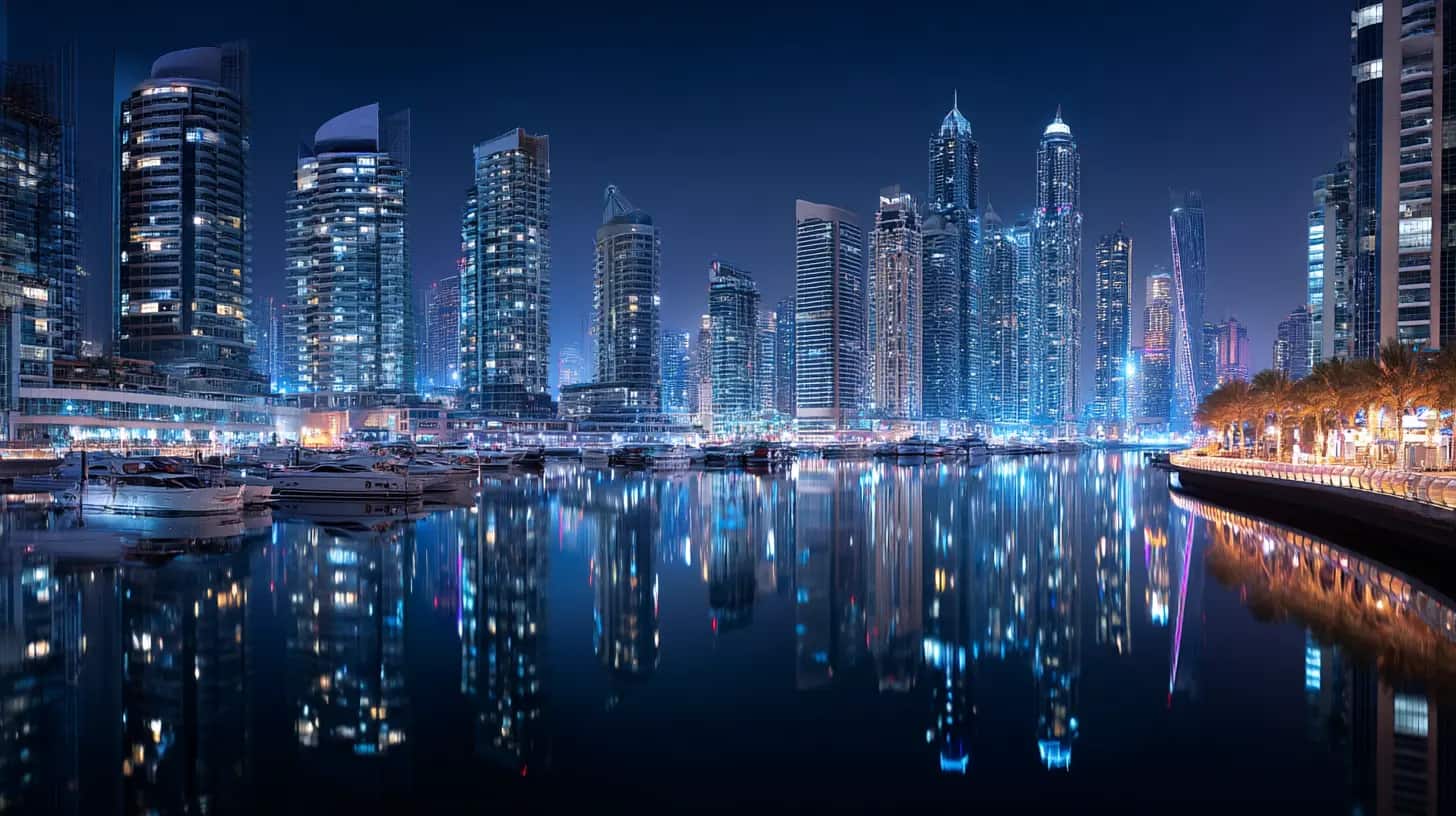
When Will Dubai Property Prices Go Up Again
Dubai prices are still rising in many segments but slower than 2022-2024. Here's the honest read on what could trigger the next acceleration and when.
First off, the "when will Dubai property prices go up again" question is based on an incorrect assumption. Dubai property prices have not stopped rising in absolute terms. In general city terms, the prices continued to rise, albeit moderately so, until early 2026. What we have seen is a deceleration in the strong price increases we saw since 2022 and until 2024, and some segments stabilizing and weakening, and people who used to see prices rise 20%-30% per year find themselves in a more selective and less aggressive market and wondering when their double-digit returns will come back.
Now the honest answer is that the question needs to be restated. The 2022-2024 was a structural reset in Dubai property pricing thanks to a number of one-off and semi-permanent factors that have resulted in one of the most impressive residential property rallies among global cities. Not all of these factors have been reversed yet but they have softened considerably. The next leg of Dubai real estate growth will be different from the last one in terms of dynamics – selectivity and segment-specific gains, while being modest, and some segments performing better than others.
We have followed Dubai property market dynamics over the years through transaction data, our internal deal flow, conversations with buyers and sellers, and the broader macro environment. Our take in early 2026 is that the Dubai market enters a selective growth stage after a rapid growth cycle. It is important to understand why the recent rally took place, what happened to bring changes, and what will have to happen for prices to move sharply up again – instead of simply trying to guess a point when "prices in Dubai will go up again". The time frames will be different for different segments, and the forces driving growth may vary for different segments.
In this article, we try to cover what has taken place during the 2022-2024 rally in Dubai residential prices, what is the current reality in Dubai real estate pricing, what will have to happen for another price rally to occur, what are the potential drivers, what are the potential timelines and the segments to look for if another rally happens, and what buyers and sellers should be doing in response to all of the above.
What Drove the 2022 to 2024 Dubai Property Boom
Understanding the recent rally is the foundation for understanding what comes next. The 2022 to 2024 boom wasn't a single phenomenon. It was the convergence of several distinct factors that compounded in unusual ways.
Russian and CIS capital flows. The geopolitical events of 2022 redirected substantial Russian and CIS individual and family wealth toward jurisdictions perceived as politically neutral and structurally welcoming to international capital. Dubai captured a meaningful share of this flow. The volume was significant enough to move prices in specific segments, particularly premium villas in Palm Jumeirah and Emirates Hills, branded residences in Downtown, and certain Marina towers.
Indian and broader South Asian capital. The continued growth of Indian wealth combined with persistent challenges around capital movement out of India produced sustained property buying in Dubai. The Indian buyer share of Dubai transactions grew throughout the period and supported pricing across multiple segments, particularly in mid-tier apartments and family-sized villas.
Western relocation acceleration. Post-pandemic, a substantial number of Western European, British, and American professionals relocated to Dubai. The combination of remote work normalisation, higher tax pressures in home jurisdictions, and Dubai's improved lifestyle infrastructure made the relocation calculus favourable for many buyers. This buyer pool drove demand at the AED 3M to AED 12M price point particularly.
The Golden Visa expansion. The introduction and expansion of the Golden Visa programme created a structural incentive for property purchases at the AED 2M+ threshold. Buyers who would have rented before now had a tangible reason to buy. The downstream effect on demand was measurable.
Constrained supply at certain price points. Despite Dubai's reputation for endless supply, specific product types (family-sized villas, premium townhouses, units in established walkable communities) were structurally undersupplied relative to the rapidly expanding demand. New launches couldn't deliver inventory fast enough at certain price points.
Strong economic fundamentals. The Dubai economy expanded strongly through the 2022 to 2024 period, with GDP growth, tourism numbers, business formation, and population growth all reaching record or near-record levels. The macroeconomic backdrop reinforced the property thesis.
Currency dynamics. The AED's USD peg meant that Dubai property remained competitively priced in USD terms even as it appreciated in AED terms. Non-USD foreign buyers (Russians, Indians, Europeans, British) saw Dubai property as either holding value or appreciating in their home currency terms throughout the period.
Off-plan launch dynamics. Aggressive off-plan launches with relatively small initial payments allowed buyers to commit to purchases at lower upfront cost. This pulled forward demand and amplified the price growth narrative as launch prices kept rising.
The combination of these factors produced a market environment unlike anything in recent Dubai history. Year-on-year price gains of 25% to 50% in specific segments. Bidding wars on premium product. Off-plan launches selling out in days. Time-on-market for premium product compressed to weeks rather than months. The period was extraordinary precisely because the convergence of factors was extraordinary.
What's Changed Heading Into 2026
Several of the 2022 to 2024 drivers have moderated or shifted, which is why the rapid price growth has cooled.
Russian and CIS capital flows have moderated. The initial 2022 to 2023 wave of redirected capital was substantial but represented a one-time rebalancing rather than an ongoing flow. By 2025, much of the wealth that was going to relocate had relocated, and the marginal Russian buyer entering the Dubai market in 2026 represents a smaller incremental flow than during the peak years.
Indian capital flows continue but have stabilised. The structural drivers of Indian buyer demand in Dubai remain intact, but the rate of growth has moderated as the buyer pool depth has been better tapped and as alternative destinations (parts of Europe, North America for those who can access) compete for the same capital.
Western relocation has continued at a moderated pace. The strongest wave of Western relocation happened in 2022 to 2023. The marginal Western buyer in 2026 is more deliberate, more comparison-focused, and more willing to negotiate than the relocation buyers of three years ago.
The visa rule changes have shifted the demand profile. The recent removal of the AED 750,000 minimum for the 2-year property visa has injected new demand at the lower end of the market while the Golden Visa demand at AED 2M+ has continued at a steadier rather than accelerating pace.
Supply has expanded meaningfully. The new launches and handovers of the 2024 to 2026 period have added substantial inventory across price points. While total demand has remained strong, the supply growth has caught up to demand growth in many segments. Specific segments are now in supply-pressured territory rather than demand-pressured territory.
Mortgage rates have moderated buyer enthusiasm at the leveraged end. UAE mortgage rates remain at 4.0% to 5.5% on residential mortgages depending on profile and product. While not punitive, rates at this level have compressed affordability for leveraged buyers and shifted some demand toward all-cash or low-leverage purchases.
The off-plan flip market has tightened. Many of the aggressive off-plan launches in 2023 and 2024 are now reaching handover, and the secondary market reality has revealed that not all of those launches will produce the appreciation buyers expected. This has cooled speculative off-plan buying for short-term flip purposes.
Buyer expectations have recalibrated. The buyers entering the market in 2026 are not assuming 25% annual gains. They're underwriting more modest appreciation and demanding better fundamental value at point of purchase. This affects price discovery and reduces the willingness to bid prices up beyond reasonable comparable values.
Original Research: Dubai Price Growth Patterns 2020 to 2025 by Segment
We tracked aggregate price growth across multiple Dubai segments over the 2020 to 2025 period using a combination of our own transaction data, partner broker data, and publicly available market reports. The annualised growth rates by segment over this period were illuminating.
Cumulative price growth from January 2020 to December 2025 by segment:
- Premium villas in Palm Jumeirah: +95% to +130% cumulative
- Premium villas in Emirates Hills: +85% to +115% cumulative
- Dubai Hills villas (4 to 5-bedroom): +75% to +105% cumulative
- Dubai Hills townhouses: +85% to +110% cumulative
- Branded residences in Downtown: +60% to +85% cumulative
- Premium Dubai Marina apartments: +50% to +70% cumulative
- Mid-tier Marina apartments: +40% to +55% cumulative
- Business Bay mid-tier apartments: +45% to +60% cumulative
- JVC mid-tier apartments: +55% to +75% cumulative
- JVC older buildings: +40% to +60% cumulative
- Dubai South residential: +30% to +50% cumulative
- International City: +25% to +45% cumulative
The pattern shows that the strongest growth concentrated in the premium villa segment and family-sized product, where structural undersupply combined with capital flow demand produced exceptional gains. The mid-tier and budget segments grew strongly but more modestly.
Year-on-year price growth in 2025 by segment:
- Premium villas in Palm Jumeirah: roughly flat to slightly negative
- Premium villas in Emirates Hills: roughly flat
- Dubai Hills villas: 6% to 9%
- Dubai Hills townhouses: 7% to 11%
- Branded residences in Downtown: 2% to 5%
- Premium Dubai Marina apartments: 3% to 6%
- Mid-tier Marina apartments: 5% to 8%
- Business Bay mid-tier apartments: 6% to 9%
- JVC mid-tier apartments: 12% to 18%
- JVC older buildings: 14% to 20%
- Dubai South residential: 10% to 16%
- International City: 15% to 22%
The 2025 picture shows the moderation clearly. The premium segments that grew most dramatically over 2020 to 2024 have flattened in 2025. The mid-tier and value-tier segments are still growing strongly but at single-digit rates rather than the dramatic gains of 2022 to 2024. The lower-priced segments are still growing at meaningful rates, partly driven by the visa rule changes and the broader demand for accessible Dubai property.
According to Property Monitor's market data, Dubai's overall residential price index continues to firm in 2025 but at a moderated pace versus 2023 and 2024. The aggregate market is healthier than the headline numbers suggest because the growth has spread to more segments rather than being concentrated in a few high-flying premium areas.
What Would Need to Happen for Dubai Prices to Accelerate Again
Predicting the timing of the next acceleration phase requires identifying what factors would need to align. Here's the realistic assessment of what could trigger faster price growth.
A new wave of capital flows. The 2022 Russian and CIS capital wave was triggered by specific geopolitical events. A similar wave from another major source country could produce comparable demand acceleration. Candidates include further capital flows from China if cross-border restrictions ease in specific ways, larger Indian capital flows if rupee weakness or domestic uncertainty increases, or capital flows from regions experiencing political or economic instability. None of these are currently anticipated in immediate timing terms but they remain plausible.
Significant interest rate moderation. UAE rates broadly track US Federal Reserve policy due to the AED-USD peg. If US rates moderate substantially in 2026 to 2027, UAE mortgage rates would follow, which would expand buyer affordability and likely accelerate transaction volume and prices. The current expectation in mid-2026 is for moderate Fed easing rather than dramatic rate cuts, so this is a gradual rather than sudden support factor.
The DWC airport expansion reaching meaningful operational scale. As the new Al Maktoum airport phases come online toward the late 2020s, the southern Dubai property thesis will strengthen. This is more of a 2027 to 2030 driver than a 2026 driver.
Population growth continuing at recent rates. Dubai's population grew from approximately 3.4M in 2020 to over 3.8M by 2024. Continued strong population growth would support sustained demand across most segments. The growth rate appears to be moderating somewhat in 2025 to 2026 but remains positive.
A new wave of major infrastructure announcements. Beyond the airport, additional major infrastructure or destination announcements (new metro lines, major mixed-use developments, signature attractions) could trigger demand surges in specific affected areas.
Resolution of supply absorption. Many of the segments currently softening or plateauing reflect specific supply pressures. As that supply gets absorbed over the next 18 to 36 months, the supply-demand balance in those segments will normalise and pricing pressure will ease. This is a gradual rather than sudden support factor but it's the most realistic medium-term mechanism for price recovery in currently softening segments.
A specific event-driven demand surge. World Expo successors, major sporting events, large corporate relocations, or other discrete events could trigger localised demand surges. These are unpredictable but historically have produced meaningful price effects in affected areas.
The honest assessment is that none of these factors look imminent in a way that would produce 2022 to 2024 style growth in early 2026. The most likely near-term scenario is continued moderate growth in mid-tier and value segments, gradual recovery in currently softening segments as supply absorbs, and continued steady but unspectacular performance in premium segments.
Realistic Timeline Scenarios for Dubai Property Prices
Putting together the analysis, here's the realistic range of scenarios for the next 12 to 36 months.
Base case scenario (most likely):
- Citywide aggregate prices continue at 5% to 9% annual growth through 2026 to 2027
- Mid-tier and value-tier segments lead with 10% to 18% annual gains
- Premium segments grow at 0% to 6% annually
- Currently softening segments stabilise within 12 to 18 months
- Specific supply-pressured segments may continue to soften before stabilising
- Time-on-market normalises across most segments by mid-2027
Bullish scenario (less likely but plausible):
- A new capital flow trigger (geopolitical event, currency dynamic, policy change) accelerates demand
- Citywide aggregate prices grow at 12% to 18% annually
- Specific segments could see 20% to 30% gains if multiple factors align
- The acceleration would likely concentrate in specific segments rather than uniformly
- This scenario probably requires a specific catalytic event rather than gradual factor accumulation
Bearish scenario (also less likely):
- Major global economic deterioration affects Dubai capital flows
- Specific over-supplied segments correct meaningfully (10% to 20% declines)
- Citywide aggregate prices flat or modestly negative for 12 to 24 months
- Premium segments most exposed to potential correction
- Mid-tier and value-tier segments more resilient due to demand depth
- This scenario probably requires a global crisis rather than purely Dubai-specific factors
Time-segmented expectations:
- Through end of 2026: continued moderation of growth, with selective strength and weakness
- 2027: gradual stabilisation of currently softening segments, modest acceleration in mid-tier
- 2028 to 2029: as airport progress accelerates, southern Dubai segments could see meaningful growth
- 2030 and beyond: a new growth cycle is plausible if the underlying drivers (population, infrastructure, tax advantage) compound favourably
The honest framing for buyers asking "when will prices go up" is that prices in many segments are still going up, just more slowly than recently. The next phase of dramatic acceleration is more likely to be event-driven and segment-specific than across-the-board, and the timing is genuinely difficult to predict.
What Buyers Should Actually Do Given the Uncertainty
Given the realistic uncertainty about timing of any next acceleration phase, here's the practical guidance for different buyer types.
For buyers with a 5 to 10-year horizon:
- Don't try to time the market precisely
- Identify segments that match your investment thesis or end-use needs
- Buy when you find a specific property at fair pricing
- Focus on yield economics and long-term appreciation thesis rather than short-term price movements
- Dollar-cost averaging across multiple purchases over time can reduce timing risk
For buyers with shorter horizons (2 to 4 years):
- Be more selective about segment choice
- Avoid segments showing current softening unless the price discount fully compensates
- Focus on segments with both yield support and structural demand drivers
- Recognise that timing risk is higher with shorter holds
- Consider whether renting fits your situation better than buying
For end-user buyers prioritising lifestyle:
- Don't let market timing concerns dominate the decision
- The "right" time is when you find a property and community that fits your needs at fair pricing
- Holding out for a perfectly-timed entry usually costs more in lifestyle compromise than it saves in price
- Factor in the personal cost of not having your situation settled
For investors prioritising yield:
- Current market conditions favour yield buyers in specific segments
- JVC, Business Bay Tier 3 and 4, and selected International City and Dubai South product offer strong yield economics
- Yields of 6% to 8% net are achievable in the right buildings
- The yield income provides a reasonable return regardless of price acceleration timing
For investors prioritising appreciation:
- Identify segments with structural growth drivers rather than just betting on market timing
- Dubai South for the airport thesis (5 to 10-year horizon)
- Specific newer master-planned communities with strong positioning
- The Valley, Tilal Al Ghaf, and similar premium master-planned developments
- Recognise that thesis-driven appreciation may take longer to manifest than 2022 to 2024 style gains
For sellers wondering whether to wait for price recovery:
- Understand that "price recovery" assumes a price decline, which most Dubai segments haven't actually experienced
- Realistically priced sellers in firm segments are achieving good outcomes today
- Holding out in softening segments often costs more than the eventual price recovery would deliver
- Specific opportunity costs matter (alternative uses of capital, holding costs, lost rental income)
What History Suggests About Dubai Property Cycles
Some historical context helps frame realistic expectations.
Dubai has had three distinct major property cycles since 2002. Each cycle had its own peak, correction, and recovery dynamic.
The 2002 to 2008 cycle saw dramatic appreciation followed by a sharp correction during the 2008 to 2009 global financial crisis. The peak-to-trough decline in some Dubai segments was severe, with declines of 40% to 60% in specific properties. The recovery from those lows took several years.
The 2010 to 2014 recovery cycle saw steady appreciation as the market normalised and new infrastructure investment supported growth. The cycle peaked around 2014 and then plateaued through 2015 to 2018.
The 2018 to 2020 period saw modest weakness in many segments as supply growth outpaced demand. Specific premium segments declined modestly. The aggregate market was roughly flat.
The 2020 to 2024 cycle was the strongest recent cycle, driven by the post-pandemic recovery and the specific factors discussed above. It produced exceptional growth in many segments.
The 2025 to 2026 period is showing the moderation that typically follows extraordinary growth phases. Whether this represents the early phase of a softer multi-year period (similar to 2015 to 2018) or just a brief consolidation before another growth phase depends on factors we cannot predict with certainty.
The historical pattern suggests Dubai property cycles can extend 4 to 8 years from one major inflection to the next. The recent boom phase started in 2020, peaked broadly in 2024, and is now in the moderation phase. If history is a guide, the next dramatic growth phase is more likely to occur in 2027 to 2029 than in 2026, though the timing depends on specific catalysts that aren't currently predictable.
According to Knight Frank's Dubai market analysis, Dubai's residential market has demonstrated greater long-term stability since 2010 than it did in the 2002 to 2010 period, which reflects both structural improvements in market regulation and the maturation of the Dubai economy.
The Bottom Line on When Dubai Property Prices Will Go Up Again
A straightforward answer to the query "when will Dubai property prices go up" is that they already are in all major sectors, though not nearly as quickly as during the 2022–2024 surge. The next wave of major growth should logically be more selective and driven by specific catalysts.
For potential purchasers looking for an upcoming price surge to enter the market, it is difficult to provide an accurate answer. In the coming 12 to 24 months, steady growth and selective segment performance should be expected rather than dramatic increases throughout the entire spectrum. There are several factors, such as capital inflow, rate moderation, infrastructure events, and absorption of inventory, which could trigger stronger price movement, and all of them follow different timelines, with most being further down the road beyond 2026.
For purchasers who can buy after finding the right piece of real estate, the current market situation is acceptable. Negotiability has returned in some sectors. The yield economics in many locations are still attractive. Visa changes have opened some opportunities in affordable segments. The time pressure is lower compared to the previous boom years of 2022 to 2024.
For sellers, waiting until the market returns to its 2024 highs in weakened segments may be a suboptimal approach. Current, realistic prices give better results than the expectation of old-fashioned pricing.
Investors with longer horizons, while taking note of the slowing appreciation, can rest assured that the core Dubai investment story remains intact. Population growth, infrastructure investments, taxation benefits, and quality of life contribute to sustained growth of real estate over the long run. The annual growth rate is expected to be slower compared to the latest boom, but the trend itself should not change.
To conclude with a couple of remarks. It is usually pointless to try timing the bottom/top of any property market precisely. Those purchasers who get the best results over time are typically those who have found suitable properties based on their investment case or need for use at fair prices. The segments performing best in Dubai now—mid-tier yields, family segments with structural demand, and locations with solid growth drivers—are expected to remain strong until 2027 to 2028 regardless of the pace of appreciation.
In other words, for the majority of buyers, the correct approach is to look at which specific property at current prices meets their requirements and delivers acceptable economics. Such an approach makes the issue of timing irrelevant.
To recap, Dubai property in 2026 is shifting to a segment-specific appreciation phase after the rapid-growth cycle. There are vigorous segments, flat segments, and declining segments now, with overall positive dynamics but with a reduced pace compared to last year. Should you require a thorough review of segments currently growing in Dubai, along with current prices, realistic appreciation prospects, and fair valuation analysis, our team does this on a regular basis. Browse what's currently available across Dubai or reach out and we'll take it from there.
Related stories
Dubai's Established Charm: The Case for Older Homes
In a city focused on the future, I believe the smartest move for many buyers is to look back. Dubai's seasoned communities offer space, character, and surprising value that new builds often can't match.

The True Cost of Owning a Dubai Property
Beyond the purchase price, your annual budget for a Dubai home must account for service charges, utilities, and maintenance. I'll break down every ongoing expense you need to plan for.
Calculating ROI on Dubai Rental Upgrades
As a landlord in Dubai, you can't just follow trends. I'll show you how to calculate the precise ROI of minor property upgrades to genuinely increase your rental yield.
Echoes, in your inbox
One thoughtful email a month. Market insight, new launches, no spam.