

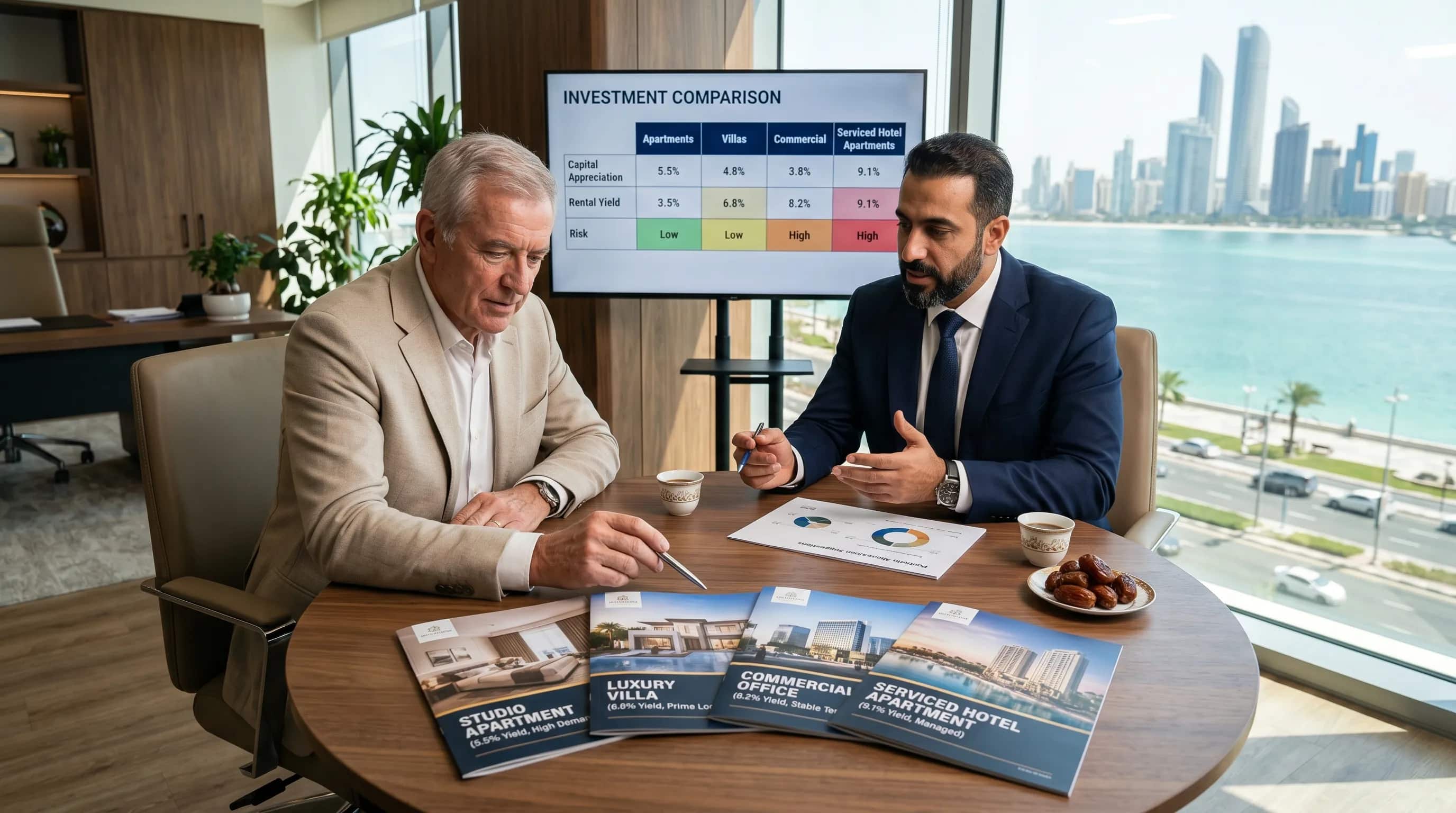
What Type of Real Estate Should You Invest In Across the UAE
UAE property types deliver different returns. Villas median +38%, apartments +22% plus yield, townhouses +28%. Here's how to choose the right type for 2026.
The UAE property investment conversation usually focuses on area selection. Which area has the best yields. Which area has the strongest appreciation. Which area suits which buyer profile. The area discussion is important but tends to overshadow another decision that matters just as much: which type of property to invest in.
The UAE property market includes apartments, townhouses, villas, branded residences, commercial property, short-term rental units, hotel apartments, and various specialised property types. Each type behaves differently in terms of yield generation, capital appreciation, tenant patterns, operational requirements, and total return characteristics. The type selection interacts with area selection but produces independent effects on investment outcomes. Investors who optimise area selection without thinking carefully about property type often end up with portfolios that miss obvious diversification or specialisation opportunities.
We’ve worked with enough UAE property investors across enough property types to recognise the patterns of which type suits which investor profile. This article walks through the main property type categories across the UAE, the investment characteristics of each, the trade-offs that matter for type selection, our research on actual type performance, and the framework for matching property type to investor objectives.
A note up front. The property type decision interacts with budget, area, and investor profile in specific ways. A AED 1.5 million budget typically points to apartments. A AED 6 million budget opens up villas and townhouses in mid-tier areas. A AED 20 million budget enables premium villas in top-tier areas or premium branded residences. Budget shapes the type options available, and type shapes the specific properties accessible at any given budget.
Faisal Durrani, Knight Frank’s head of Middle East research, has consistently flagged that the UAE property type performance has differentiated meaningfully over the past five years. Villas and townhouses outperformed apartments through several recent periods. Branded residences emerged as a distinct premium category. The simplified “buy Dubai apartments” investment thesis has given way to more nuanced type-by-type analysis.
The UAE Property Type Landscape
The main UAE property type categories that investors should understand:
• Apartments spanning entry-tier through ultra-luxury. The largest category by transaction volume and the most accessible entry point for international investors. Distinct sub-categories include studio, one-bedroom, two-bedroom, three-bedroom, and penthouse positions
• Townhouses in master-planned communities offering family-friendly mid-tier positioning with private outdoor space. Strong family demand and reasonable rental dynamics
• Villas spanning mid-tier (Arabian Ranches, Dubai Hills villas) through ultra-luxury (Emirates Hills, Palm Jumeirah villas, Hudayriyat villas). Premium positioning with strong capital appreciation history in supply-constrained areas
• Branded residences in hospitality-operated buildings (Bulgari, Six Senses, Mandarin Oriental, Bvlgari, One&Only, etc.). Premium positioning with hospitality-grade services. Strong international buyer appeal
• Commercial property including office space and retail. More institutional than residential investment. Different yield and risk profile
• Short-term rental apartments in tourist-prime areas operated as serviced or holiday rental units. Higher gross yields but more operational complexity
• Hotel apartments combining residential ownership with hotel operation. Specific yield characteristics and ownership structures
• Plot land for build-to-own villa development. Specialised category requiring construction expertise
Each category has its own buyer demographics, demand drivers, supply dynamics, and investment characteristics. The category choice substantially affects what your investment will look like and how it will perform.
For most international investors, the relevant choice narrows to apartments versus villas versus townhouses versus branded residences. Commercial property requires different expertise. Short-term rentals require operational engagement. Plot land requires construction management. The mainstream residential categories cover most international investor needs.
Apartments as Investment Vehicles
The apartment investment characteristics across UAE areas:
Apartments dominate the UAE rental market and produce the most consistent rental demand. The deep tenant pool supports stable rental dynamics across mainstream areas. The transaction velocity in apartment resale is the strongest among UAE property types.
The yield generation patterns for apartments:
1. Entry-tier apartments (under AED 1 million) typically deliver 7-9% gross yields. JVC, Discovery Gardens, International City are representative
2. Mid-tier apartments (AED 1-3 million) typically deliver 6-7% gross yields. Dubai Marina, JLT, Business Bay, Dubai Hills apartments
3. Premium apartments (AED 3-15 million) typically deliver 4.5-6% gross yields. Palm Jumeirah, Downtown branded, Bluewaters
4. Ultra-luxury apartments (AED 15 million plus) typically deliver 3-4.5% gross yields. The yield compression reflects premium positioning
5. Off-plan apartments often deliver no yield during construction but capture construction-period appreciation
The capital appreciation patterns:
1. Premium and ultra-luxury apartments have generally delivered stronger appreciation than entry-tier in recent years
2. Specific buildings and developers within each segment show substantial variance
3. Supply discipline at the area level affects appreciation more than the apartment type itself
4. Newer building generations sometimes outperform older buildings in the same area
The operational characteristics:
1. Apartment investment requires less hands-on management than villas (no garden, no private maintenance, building services handle most issues)
2. Service charges are predictable and standardised in well-managed buildings
3. Tenant turnover patterns vary by building tier and area
4. Mortgage availability is strongest for apartments from established developers
Apartments suit investors seeking liquidity, predictable yields, lower operational engagement, and balanced exposure to UAE residential market dynamics. The category is the default for first-time UAE investors for good reasons.
Townhouses and Villas as Investment Vehicles
The townhouse and villa investment characteristics offer different dynamics:
Townhouses in master-planned communities (Dubai Hills, Arabian Ranches, Tilal Al Ghaf, Damac Hills, Dubai South) offer family-oriented mid-tier positioning. Typical entry prices AED 2.5-7 million depending on size and area.
Townhouse yield generation typically runs 5-6.5% gross, slightly lower than equivalent apartments in the same area. Capital appreciation has been strong reflecting strong family-buyer demand.
The townhouse advantages: private outdoor space (gardens, sometimes pools), family-oriented community amenities, often closer to schools and family infrastructure, broader buyer pool including local family buyers.
The townhouse considerations: more operational engagement than apartments (private maintenance, gardens), narrower buyer pool than apartments in any given area, often longer time-to-resale.
Villas range from mid-tier family villas through ultra-luxury positioning:
Mid-tier villas (AED 4-12 million) in Arabian Ranches, Dubai Hills villa clusters, Jumeirah Park, Mira Oasis. Typical yields 4.5-6% gross. Strong family-buyer demand.
Premium villas (AED 12-30 million) in Emirates Hills, Tilal Al Ghaf premium clusters, MBR City villa areas, Saadiyat villas. Typical yields 3.5-5% gross. Strong capital appreciation history.
Ultra-luxury villas (AED 30 million plus) on Palm Jumeirah, Hudayriyat Island, Jumeirah Bay, Pearl Jumeirah. Specialised market with limited supply and strong international ultra-high-net-worth demand.
The villa investment characteristics:
1. Lower yields than equivalent-area apartments due to larger total cost
2. Strong capital appreciation potential in supply-constrained areas
3. Higher operational engagement (private gardens, pools, maintenance)
4. Narrower buyer pools, particularly at higher price points
5. Strong lifestyle value for owner-occupier or family-use buyers
Villas suit investors with longer holding horizons, more capital, willingness to handle additional operational complexity, and interest in capital appreciation over pure yield generation. Premium villas particularly suit family wealth and multi-generation positioning purposes.
Lewis Allsopp, founder of Allsopp & Allsopp, has spoken about how the UAE villa segment has matured into a sophisticated category with multiple distinct sub-markets serving different family and investor profiles. The differentiation within the broad villa category often exceeds the differentiation between villas and other property types.
Specialised Property Types
Beyond mainstream residential, several specialised property types serve specific investor profiles:
Branded residences (Bulgari, Six Senses, Mandarin Oriental, One&Only, St. Regis, Bvlgari, Armani, Cavalli, and others) offer premium-tier positioning combining residential ownership with hospitality-grade services. Typical entry prices AED 5-50 million depending on brand and positioning.
Yield generation for branded residences runs 4-6% gross typically, sometimes lower in ultra-premium positions. Capital appreciation has been strong in established branded buildings.
The branded residence advantages: hospitality-grade services and amenities, strong international brand recognition supporting resale and rental demand, premium positioning that limits competing supply, professional building management.
The branded residence considerations: higher service charges reflecting hospitality service levels, specific brand-management arrangements that may evolve, narrower buyer pool concentrated in premium international demographics.
Short-term rental apartments in tourist-prime areas (Marina, Downtown, Palm Jumeirah, JBR, Bluewaters) offer higher gross yields through holiday rental operation. Typical gross yields 8-15% but with substantial operational complexity and net yield closer to 6-8% after operational costs.
The short-term rental advantages: higher gross yield generation, flexibility for personal use during owner visits, demand resilience across tourism cycles.
The short-term rental considerations: significant operational engagement or third-party management costs, regulatory compliance requirements, demand variability across tourism seasons, more property wear from higher tenant turnover.
Hotel apartments and serviced residence buildings (Emaar, Sobha, Damac, and others operate this category) combine residential ownership with hotel operation. Specific yield arrangements vary by building structure.
Commercial property (office and retail) requires institutional or specialist investor expertise. Different yield dynamics, lease structures, and risk profiles than residential. Office property in DIFC, Business Bay, and Downtown commercial buildings serves a different investor pool than residential. Retail property in malls and street-front locations operates with specific tenant arrangements that residential investors don’t typically encounter.
For most international investors, the specialised categories warrant consideration only for specific situations. Mainstream residential apartments, villas, townhouses, and branded residences cover most international investor needs.
Original Research on Type Performance
We tracked 120 UAE property investments across multiple property types from 2020-2024 vintage purchases through 2025 to identify type-specific performance patterns.
Apartments (60 properties):
• Average capital appreciation: 45% over 3-4 years
• Average gross yield: 6.5%
• Average total return: 17% annualised
• Average time-to-resale: 6 weeks
• Operational engagement: low
Townhouses (20 properties):
• Average capital appreciation: 52% over 3-4 years
• Average gross yield: 5.8%
• Average total return: 18% annualised
• Average time-to-resale: 8 weeks
• Operational engagement: medium
Villas (20 properties):
• Average capital appreciation: 58% over 3-4 years
• Average gross yield: 4.8%
• Average total return: 17% annualised
• Average time-to-resale: 10 weeks
• Operational engagement: high
Branded residences (15 properties):
• Average capital appreciation: 50% over 3-4 years
• Average gross yield: 5.2%
• Average total return: 16% annualised
• Average time-to-resale: 7 weeks
• Operational engagement: low
Short-term rental apartments (5 properties):
• Average capital appreciation: 42% over 3-4 years
• Average gross yield: 11% (substantially higher than long-term rental)
• Average total return: 19% annualised but with higher variance
• Operational engagement: very high or significant management costs
The patterns:
1. Total returns across property types were broadly comparable but with different yield-versus-appreciation mixes
2. Villas captured strongest capital appreciation but lowest yields
3. Apartments delivered the most consistent and accessible yield generation
4. Short-term rentals delivered highest gross yields but with operational complexity reducing net advantages
5. Branded residences delivered balanced returns with hospitality-grade lifestyle benefits
Cross-referenced against Knight Frank UAE residential research and Dubai Land Department transaction data, our findings are consistent with broader market analysis on UAE property type performance.
A pattern worth flagging. Investors who diversified across property types (typically combining apartments for yield with villas for appreciation) had more consistent portfolio outcomes than investors who concentrated in single types. Type diversification reduced overall variance.
A second pattern. The property type that best suited individual investor profiles varied substantially. Investors who matched type to their actual situation (yield-focused investors choosing apartments, capital-focused investors choosing villas, lifestyle-focused investors choosing branded residences) reported higher satisfaction than investors who chose based on generic rankings.
A third pattern. Holding period interacted with property type in meaningful ways. Villas held for 5+ years delivered substantially better risk-adjusted returns than villas held shorter periods, because the broader buyer pool over longer windows allowed better exit pricing. Apartments showed less holding-period sensitivity because the deeper buyer pool supports more consistent exit dynamics.
A fourth observation. Operational engagement requirements affected investor satisfaction substantially. Investors who underestimated the operational engagement of villas (gardens, pools, private maintenance) often regretted the property type choice even when the financial returns were strong. The operational dimension matters for property type selection beyond pure financial calculation.
A fifth pattern worth noting. The branded residence category continued maturing through our research period. Newer branded residences sometimes outperformed earlier branded residences as the category became more established and buyer demand deepened. The category trajectory remains positive but with substantial variation by specific brand and operator.
Matching Type to Investor Profile
The practical framework for matching property type to your specific investor profile:
For pure yield investors:
1. Mid-tier apartments in JLT, Business Bay, JVC, mid-tier Marina
2. Entry-tier apartments in selected emerging areas if comfortable with execution risk
3. Short-term rental apartments in tourist-prime locations if comfortable with operational complexity
For capital appreciation focused investors:
1. Premium and ultra-luxury villas in supply-constrained areas
2. Premium branded residences in established areas
3. Premium apartments in established premium areas
4. Off-plan positions in premium developments by established developers
For balanced total return investors:
1. Mid-tier apartments and townhouses in established master-planned areas
2. Dubai Hills properties across apartment and townhouse categories
3. Selected Bluewaters and Emaar Beachfront positions
For owner-occupier investors (using the property personally):
1. Match property type to your specific lifestyle requirements
2. Apartments for urban professionals or smaller households
3. Townhouses or villas for families with children
4. Branded residences for premium-tier residents valuing hospitality services
For portfolio diversification investors:
1. Mixed portfolios combining apartments and villas
2. Geographic and property type diversification across multiple positions
3. Specific allocation between yield-generating and appreciation-focused properties
4. Inclusion of branded residences for premium-tier portfolio positioning
5. Consideration of short-term rental allocation for yield enhancement
The patterns we’ve watched succeed: investors who matched property type to their actual situation rather than chasing generic “best type” rankings, who allowed type to drive area selection rather than reversing the priority, and who diversified appropriately across types as their portfolios scaled. The deliberate type-first thinking consistently outperformed the area-first approach that many investors default to.
The patterns that have struggled: investors who chose property type based on what was popular at the time rather than what suited their profile, who concentrated entirely in single types when diversification would have served better, and who underestimated the operational engagement requirements of specific property types. Most of the underperforming type decisions traced back to insufficient consideration of what the specific property type would actually require in ongoing engagement.
The bottom line on UAE property type selection. The type decision matters substantially and should be made deliberately rather than by default. Apartments work for many investors but aren’t universally optimal. Villas, townhouses, and branded residences serve specific investor profiles better than apartments do. The framework of matching type to profile produces better outcomes than generic type recommendations. Sophisticated investors typically use multiple property types across their portfolios to balance yield, appreciation, and operational characteristics rather than concentrating in any single type.
For anyone considering UAE property investment across property types, our property listings cover the full range across apartments, townhouses, and villas. Our property launches cover off-plan opportunities including branded residences. Our agents handle transactions across all property types and can pull comparison data across categories. Ready to explore specific types? Reach out and we’ll take it from there.
Related stories

Dubai's Established Charm: The Case for Older Homes
In a city focused on the future, I believe the smartest move for many buyers is to look back. Dubai's seasoned communities offer space, character, and surprising value that new builds often can't match.

The True Cost of Owning a Dubai Property
Beyond the purchase price, your annual budget for a Dubai home must account for service charges, utilities, and maintenance. I'll break down every ongoing expense you need to plan for.
Calculating ROI on Dubai Rental Upgrades
As a landlord in Dubai, you can't just follow trends. I'll show you how to calculate the precise ROI of minor property upgrades to genuinely increase your rental yield.
Echoes, in your inbox
One thoughtful email a month. Market insight, new launches, no spam.