

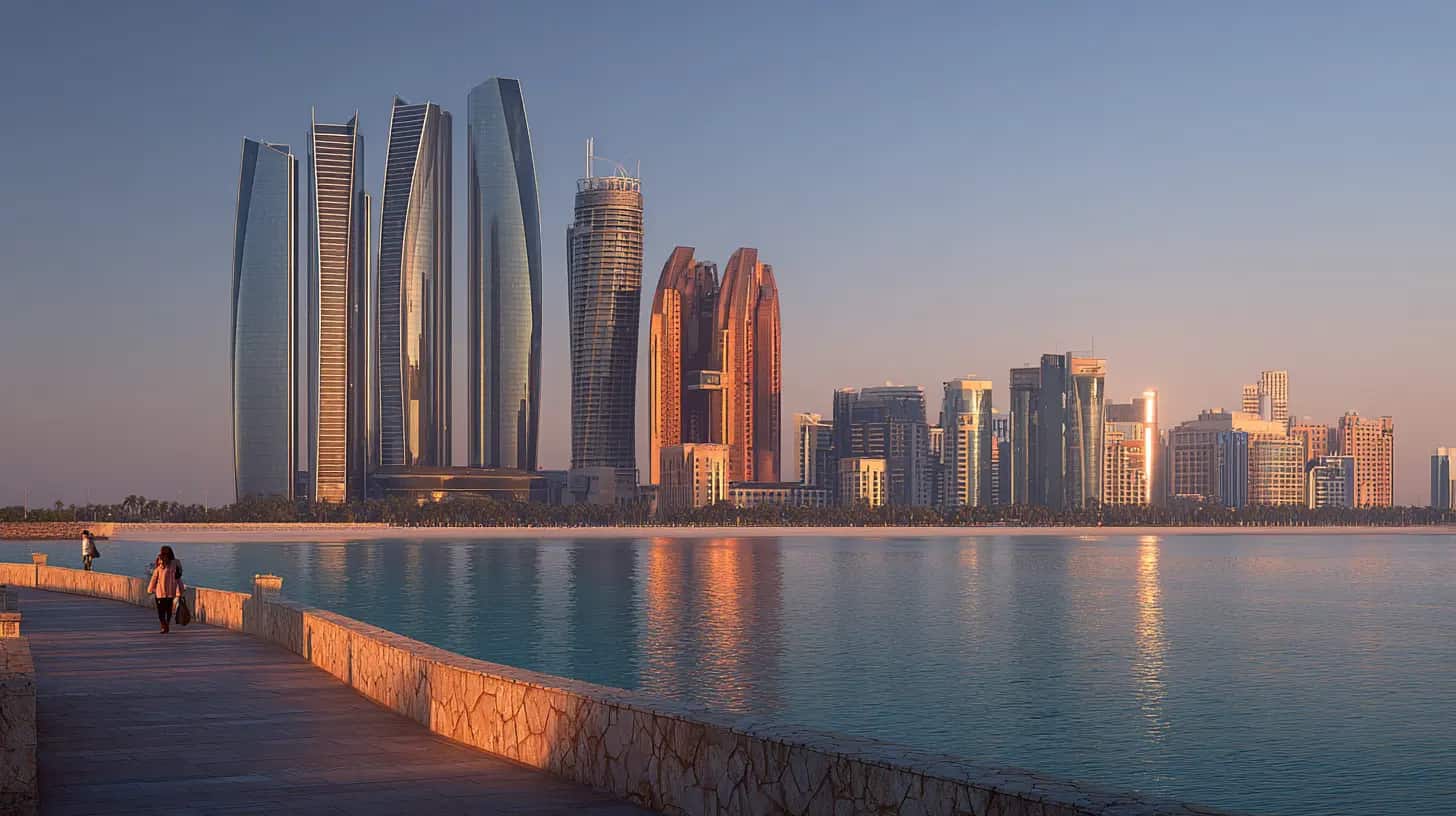
Top Areas to Buy Property in Abu Dhabi in 2025
Saadiyat, Yas, Al Reem, Al Maryah, Jubail. The six Abu Dhabi areas with the strongest investment cases in 2025, with real pricing data and honest trade-offs.
Abu Dhabi's Property Market Has Arrived. The Question Is Which Part of It Is Right for You.
For much of the preceding decade, the position of Abu Dhabi in the conversation about UAE real estate was one of support. Dubai was the market in the headlines, making launches, and securing investment. Abu Dhabi was the market that was serious, but not exactly exciting. A market worth paying attention to, but not worth rushing to. All of that changed in 2022 and is completely false in 2025. The residential market in Abu Dhabi has moved forward decisively. Transaction volume has hit records in 2023 and 2024. International buyers, accustomed to favoring Dubai, are increasingly realizing that Abu Dhabi offers a comparable quality of life, in some cases a superior quality of product, a comparable framework for foreign ownership, and a comparable, if not somewhat higher, price for a comparable or superior value.
However, it is important to note that the underlying factors are real and structural in nature. Abu Dhabi has successfully and visibly diversified its economy, and its non-oil GDP now comprises more than 77%. Moreover, this figure is continually growing, and along with it, a growing population of professionals and their associated demand for housing and spending power. The type of investor that is now being attracted by the Golden Visa is different from that of the typical market history. The cultural landscape of Saadiyat Island, as defined by the Louvre Abu Dhabi and its forthcoming Guggenheim, is now a factor in city appeal. Additionally, the product pipeline for Yas Island, Al Reem Island, Saadiyat Island, and several new and emerging communities is now beginning to deliver product that is of the same quality as Dubai’s finest but retains its pricing advantage, though this is now beginning to diminish.
This article will highlight the six areas that we believe matter most for property buyers in 2025, and they will be the areas in which we believe value, demand drivers, developer quality, and community fundamentals combine in the strongest proposition. We will look at each of these areas in terms of their character, pricing, yield, appreciation history, and ideal buyer type. We will do this in a way that is candid and recognizes trade-offs, and it is important to note that we do not assume that each of these areas will necessarily be right for each type of buyer.
What's Driving Abu Dhabi's Market in 2025
Understanding the specific demand drivers behind Abu Dhabi's current market cycle matters for evaluating individual areas — because different areas are being driven by different forces, and those forces have different durability.
The government employment base remains the most stable demand driver. Abu Dhabi is the UAE's capital and its federal government functions employ a large, well-paid professional population that generates consistent housing demand regardless of market cycles. Government employees don't disappear in downturns, and they generally pay rent reliably. Communities close to the city's government district benefit from this stable base more than outlying communities do.
The ADGM professional community is a second distinct demand driver. The Abu Dhabi Global Market on Al Maryah Island has attracted a growing cohort of international financial services professionals whose housing preferences and budgets differ from the government employee base. This community gravitates toward Al Reem, DIFC-adjacent product, and the higher-end Saadiyat offer.
The international buyer influx is the most talked-about recent driver and the most variable. The buyers who have been particularly active in Abu Dhabi since 2022 include European investors seeking Golden Visa residency, Russian-speaking buyers who have found the UAE's neutrality and tax structure attractive following the Ukraine conflict, and a growing cohort from East and South Asia drawn by Abu Dhabi's infrastructure quality and the specific appeal of Saadiyat's cultural positioning. These buyers add capital and diversify the market's demand base — but they are more sensitive to global geopolitical and economic conditions than the domestic professional base is.
According to the Abu Dhabi Real Estate Centre's 2024 Annual Market Report, non-national buyers accounted for 41% of total residential transactions in 2024, up from 29% in 2021. That directional shift is significant and shows no sign of reversing. The full report provides detailed data by nationality and community: ADREC Annual Market Report 2024.
Saadiyat Island: The Premium Address That Earned Its Premium
Saadiyat has been covered in this publication before, but its position as Abu Dhabi's most internationally recognised residential address means it belongs at the top of any serious 2025 buying analysis.
The island's investment case has evolved. In 2018 or 2019, Saadiyat was partly a bet on cultural infrastructure that was promised but not fully delivered. In 2025, the Louvre Abu Dhabi is seven years old and drawing over a million visitors annually. The Guggenheim Abu Dhabi — designed by Frank Gehry — is under active construction with a projected 2025 to 2026 opening. Saadiyat Grove is open and trading. The beaches are established. The community has formed. This is no longer a bet on what Saadiyat might become — it is a documented performance of what Saadiyat already is.
Pricing reflects that maturation. Beachfront villas now transact at AED 15 million to AED 40 million. One-bedroom apartments in Mamsha Al Saadiyat and Saadiyat Reserve run AED 2.5 million to AED 4 million. Two-bedrooms sit at AED 4 million to AED 7 million. These are not values that suggest distress or mispricing — they are values that reflect a fully operational premium community.
Saadiyat's buyer profile has shifted significantly toward end users over the past three years. Investors who bought in early phases and held through the appreciation cycle have been selling to owner-occupiers — internationally mobile buyers who specifically want to live on Saadiyat rather than just hold it. That end-user demand is qualitatively different from investor demand and more durable through market softness.
Rental yields on Saadiyat sit at 5% to 6.5% for apartments — lower than Abu Dhabi's yield average, reflecting the premium capital values. The yield compression is the price of buying into the emirate's best community address. Investors who are yield-focused will find better numbers on Al Reem. Investors who want quality of asset and quality of tenant should look at Saadiyat seriously.
The Guggenheim opening, when it happens, is the next catalytic event in Saadiyat's appreciation story. Multiple studies of cultural institution effects on surrounding property values suggest a 10% to 20% uplift in the immediately surrounding residential stock following the opening of a major international institution. Saadiyat has already seen some anticipation pricing but the full effect typically follows actual opening.
See what's currently available on Saadiyat Island across the community's different residential zones.
Yas Island: Where Lifestyle Infrastructure Meets Investment Logic
Yas Island's evolution from pure entertainment destination to genuine residential community is one of the more remarkable urban development stories in the Gulf over the past decade. The Yas Marina Circuit, Ferrari World, Yas Waterworld, and Warner Bros. World were there first. The residential population followed — tentatively, then confidently, then in large enough numbers to justify schools, hospitals, and the kind of permanent infrastructure that turns a destination into a home.
Aldar Properties has been the primary force behind Yas's residential transformation. Yas Acres, launched in 2016, was the first serious signal that the island could sustain permanent residents. It sold out. The sequels — Noya, Noya Luma, Water's Edge, and several more phases — have each sold strongly, and the aggregate of those sales has built a residential population large enough to generate genuine community infrastructure rather than just amenity amenities.
The investment case for Yas in 2025 is built on four pillars. First, the proximity to Abu Dhabi International Airport — roughly ten minutes by road — which makes it one of the most logistically convenient residential addresses in the UAE for internationally mobile professionals. Second, the entertainment infrastructure, which reduces the need to leave the island for most of what a family needs on a weekend. Third, the school ecosystem, which has developed with the residential population and now includes multiple established options. Fourth, the yield profile — 6% to 7% gross for apartments in well-located buildings — which is among the strongest for a premium-quality Abu Dhabi community.
Current pricing on Yas runs AED 1.1 million to AED 2 million for one-bedroom apartments, AED 1.7 million to AED 3 million for two-bedrooms, and AED 4.5 million to AED 8 million for four-bedroom villas. These prices represent 70% to 90% appreciation since 2019 on the villa side and 50% to 65% on apartments — strong returns on a product type that was genuinely undervalued relative to its fundamentals in the late 2010s.
Talal Al Dhiyebi, CEO of Aldar Properties, noted in the company's 2024 annual investor presentation that Yas Island communities achieved 96% occupancy across completed residential units — a figure that reflects real demand rather than speculative inventory holding.
Browse Yas Island listings across Aldar's completed and off-plan communities currently available.
Al Reem Island: The Yield Workhorse
Al Reem sits immediately off the northeast coast of Abu Dhabi's main island — so close that crossing the connecting bridges barely registers as leaving the city centre. That proximity, combined with a price point meaningfully below Saadiyat and a yield profile that consistently tops Abu Dhabi's residential yield tables, makes it the area that features most frequently in yield-focused investment analysis.
The residential market on Al Reem is primarily apartments. The Shams Abu Dhabi development zone has delivered millions of square feet of residential space across multiple towers over fifteen years, and the island now houses a significant permanent population with its own schools, hospital — Cleveland Clinic Abu Dhabi sits just across the water on Al Maryah — retail at Reem Mall, and the kind of daily-life infrastructure that makes living here genuinely self-contained.
Entry prices on Al Reem are the most accessible of Abu Dhabi's established island communities. One-bedroom apartments run AED 700,000 to AED 1.3 million. Two-bedrooms sit at AED 1.1 million to AED 2.1 million. These prices, combined with consistent gross yields of 6.5% to 8.5% for well-located units, make Al Reem the community where the investment case is easiest to model and most reliably delivers as modelled.
Tenant demand on Al Reem is driven by a broad and stable base — government employees, ADGM professionals, healthcare workers from Cleveland Clinic and the surrounding medical cluster, families who want city proximity without Saadiyat pricing. Vacancy is low and annual renewal rates are consistently above the Abu Dhabi average.
The northern end of Al Reem is still developing, and several new tower projects are under construction. The new supply adds some ceiling to rental rate growth — the same dynamic that affects JVC in Dubai — but the island's central location and the quality of the existing demand base means that well-located, well-managed stock in established buildings maintains pricing pressure upward.
Capital appreciation on Al Reem since 2020 runs 35% to 55% across most product types — solid rather than spectacular, consistent with a community driven by genuine use rather than speculative momentum.
Explore current Al Reem Island listings for apartments across established and newer buildings.
Al Maryah Island: Abu Dhabi's Financial District Address
Al Maryah Island occupies a specific and important niche in Abu Dhabi's residential market. It is the emirate's financial district — home to ADGM (Abu Dhabi Global Market), a string of international bank offices, professional services firms, and the four-seasons hotel and branded residences that anchor the island's luxury positioning.
The residential market on Al Maryah is relatively small in unit count but high in average value and high in institutional quality. The Cleveland Clinic Abu Dhabi campus on the island is one of the region's premier healthcare facilities and functions as a demand anchor for medical professionals who want proximity to where they work.
Prices on Al Maryah are at the upper end of the Abu Dhabi market. Two-bedroom apartments in the Boutique Collection and other premium buildings start at AED 2.5 million and run to AED 6 million and above. The Four Seasons Private Residences sit above AED 8 million for two-bedrooms. These are not yield investments — gross yields run 4% to 5.5% at current pricing — they are premium lifestyle assets for buyers who specifically want the ADGM address and the island environment.
For investors targeting the ADGM professional tenant — internationally qualified financial services professionals on senior-level packages — Al Maryah offers a tenant profile that is among the highest-quality in Abu Dhabi. These tenants pay reliably, maintain properties well, and generate fewer management issues than the broader mid-market tenant pool. The trade-off is lower yield and higher entry price.
The island's long-term value story is tied to ADGM's continued growth as a financial centre. Abu Dhabi's ambition to position ADGM alongside DIFC as a dual pillar of the UAE's financial services infrastructure is well-documented and supported by both regulatory investment and institutional commitment.
Jubail Island: Long-Term Scarcity Play
Jubail Island is the most distinctive and perhaps the most interesting area in this analysis for investors with a long-term horizon and appetite for a community that is still maturing.
The island's proposition is based on what it preserves rather than what it builds. The natural mangrove ecosystem — one of the most significant remaining in the UAE — shapes everything about the development. Villas are positioned to face the mangroves. Walking trails run through protected areas. The development density is low by Abu Dhabi standards and is constrained by the ecological protection requirements around the island's natural assets.
That constraint is the investment thesis. There is a hard supply ceiling on Jubail Island set not by developer choice but by geography and ecological protection. The number of villas that can be built is fixed. As awareness of nature-inclusive living grows among international buyers — particularly from European markets where such product is scarce and premium-priced — demand for the specific experience Jubail offers is likely to grow faster than supply can.
Villa prices launched at AED 4 million to AED 12 million for initial phases. Secondary market pricing has moved above launch on completed phases, confirming that demand has exceeded initial expectations. Gross yields on the villa product run 4.5% to 6% — not the yield focus community, but the capital preservation and long-term appreciation community.
The risk is community maturity. Jubail's retail, healthcare, and daily-life infrastructure is still developing. Buyers in 2025 are accepting current infrastructure gaps in exchange for lower-than-future pricing and the opportunity to establish a position in a supply-constrained, ecologically distinctive address before it is fully discovered.
For buyers interested in Jubail alongside Abu Dhabi's other investment communities, our broader Abu Dhabi listings cover the full range of available product across the emirate.
Gaia Realty Original Research: Abu Dhabi Area Investment Snapshot, Q1 2026
Based on Abu Dhabi Land Department (DARI) transaction data, ADREC market statistics, rental registration records, and active listing analysis as of Q1 2026.
Capital values and gross yields by area:
- Saadiyat Island 1-bed apartment: AED 2.5M to AED 4M, yield 5% to 6.5%, occupancy avg. 85%
- Saadiyat Island beachfront villa: AED 15M to AED 40M, yield 4% to 5.5%, end-user dominant
- Yas Island 1-bed apartment: AED 1.1M to AED 2M, yield 6% to 7%, occupancy avg. 88%
- Yas Island 4-bed villa: AED 4.5M to AED 8M, yield 5% to 6.5%, occupancy avg. 91%
- Al Reem Island 1-bed apartment: AED 700K to AED 1.3M, yield 6.5% to 8.5%, occupancy avg. 87%
- Al Reem Island 2-bed apartment: AED 1.1M to AED 2.1M, yield 6% to 8%, occupancy avg. 85%
- Al Maryah Island 2-bed apartment: AED 2.5M to AED 6M, yield 4% to 5.5%, ADGM professional dominant
- Jubail Island villa: AED 4M to AED 12M, yield 4.5% to 6%, ecology-focused buyer profile
Capital appreciation since January 2020:
- Saadiyat villas: 70% to 100%
- Yas Island villas: 70% to 90%
- Saadiyat apartments: 45% to 65%
- Yas Island apartments: 50% to 65%
- Al Reem Island: 35% to 55%
- Jubail Island: 25% to 45% on completed phases
- Al Maryah: 30% to 50%
Average days on market for secondary sales in 2025:
- Saadiyat Island: 28 days
- Yas Island: 24 days
- Al Reem Island: 31 days
- Al Maryah Island: 35 days
- Jubail Island: 42 days
Non-national buyer share by area in 2024:
- Saadiyat Island: 63%
- Jubail Island: 58%
- Yas Island: 54%
- Al Maryah Island: 49%
- Al Reem Island: 38%
How to Choose Between These Areas
The six areas covered here represent genuinely different investment and lifestyle profiles. The framework for choosing between them is straightforward if you're honest about what you're optimising for.
Yield is your primary objective — Al Reem. Consistent 6.5% to 8.5% gross, wide tenant pool, accessible entry, lower service charges than premium communities. It is the most reliable income play in Abu Dhabi's residential market.
Capital appreciation over five to ten years — Saadiyat and Yas, with Jubail as a higher-risk, higher-potential option. Saadiyat has a cultural infrastructure catalyst in the Guggenheim that will likely reprice the surrounding residential stock. Yas has Aldar's continued development investment and proven community formation. Jubail has supply scarcity that is structural rather than temporary.
Lifestyle quality for end users — Saadiyat for the cultural and beach proposition, Yas for the family and entertainment infrastructure, Al Maryah for the financial district professional. Each delivers a genuinely different daily life.
Total return balanced between yield and appreciation — Yas is the strongest case here. The combination of 6% to 7% yields and 70% to 90% appreciation since 2019 produces total returns that compare well against any residential asset in the region over the same period.
Budget accessibility — Al Reem offers the lowest entry point among Abu Dhabi's established island communities without compromising on infrastructure maturity. Jubail is accessible on a relative basis but requires a longer infrastructure-maturity waiting period.
Our buy property service covers Abu Dhabi alongside Dubai and can help you model the full cost and return picture for specific properties before you commit.
Questions People Ask About Buying in Abu Dhabi in 2025
Is Abu Dhabi a better investment than Dubai right now?
Different profiles rather than better or worse. Abu Dhabi generally offers better yields at comparable price points and slightly lower entry prices than Dubai equivalents. Dubai offers stronger secondary market liquidity and greater international brand recognition for the top addresses. Both markets are performing well in 2025.
Can foreigners buy freehold property in Abu Dhabi?
Yes. Abu Dhabi expanded its freehold zones significantly from 2019, and all areas covered in this article — Saadiyat, Yas, Al Reem, Al Maryah, Jubail — are designated freehold for non-UAE nationals. Always confirm freehold status for any specific plot before transacting.
What are the transaction costs in Abu Dhabi versus Dubai?
Lower. Abu Dhabi's transfer fee is 2% of the purchase price versus Dubai's 4% DLD fee. Total transaction costs including agency, registration, and mortgage fees typically land at 4% to 5% of purchase price in Abu Dhabi versus 6% to 8% in Dubai.
Which Abu Dhabi area has the best schools?
Yas Island has the most developed in-community school infrastructure. Al Reem is close enough to the mainland for easy access to a wider range of schools. Saadiyat's school offer is growing but not yet as strong as Yas.
Is off-plan safe in Abu Dhabi?
Yes, with the same caveats as anywhere. Abu Dhabi's DARI registration system and escrow requirements for off-plan sales are well-established. Aldar, the dominant developer across most of these communities, has one of the strongest delivery records in the UAE. Newer or smaller developers warrant more due diligence.
What's the Golden Visa threshold for Abu Dhabi property?
AED 2 million, applied federally. Most Saadiyat, Yas, and Al Maryah properties exceed this threshold. Al Reem offers some qualifying product at accessible price points. Jubail villas easily qualify.
How does Al Reem compare to Business Bay in Dubai for investment?
Similar investment profiles. Both offer 6.5% to 8% gross yields on mid-market apartments with broad professional tenant demand. Business Bay has stronger secondary market liquidity and slightly higher capital appreciation history. Al Reem has lower service charges and slightly lower entry prices. Choice often comes down to which city the investor prefers.
Is Saadiyat Island overpriced in 2025?
At current levels it is priced as a fully-matured premium community — which it is. The case for further significant appreciation is tied to the Guggenheim opening and continued international buyer demand rather than basic infrastructure maturation. Whether that justifies current prices depends on your view of those specific catalysts.
What's the rental demand like in Abu Dhabi compared to Dubai?
Abu Dhabi's rental market is slightly less volatile than Dubai's — more driven by the stable government and institutional employment base and less by the speculative investor cycle. Occupancy rates in established communities are consistently high and renewal rates are strong. The trade-off is that the ceiling on rental rate growth is lower than in Dubai's more dynamic market.
Are there good hospitals near these communities?
Yes. Cleveland Clinic Abu Dhabi on Al Maryah Island is one of the region's premier facilities and is accessible from all the island communities. King's College Hospital has a presence in Abu Dhabi. Sheikh Khalifa Medical City serves the broader population. Healthcare quality in Abu Dhabi is genuinely high.
How liquid is the Abu Dhabi secondary market compared to Dubai?
Less liquid overall but improving. Average days on market across the profiled communities run 24 to 42 days — longer than Dubai's most active communities but within a range that allows reasonable exit flexibility. Saadiyat and Yas are the most liquid of the Abu Dhabi areas.
What's the single best area to buy in Abu Dhabi right now?
Yas Island for total return — the combination of yield, appreciation, community maturity, and ongoing developer investment makes the strongest balanced case. Al Reem for yield-focused investors. Saadiyat for end users and capital preservation buyers. There is no single right answer for every buyer profile.
Abu Dhabi in 2025 Is Not the Market It Was in 2019. Buy Accordingly.
The Abu Dhabi residential market has seen a significant re-pricing of assets since 2020 and continues to attract investment from a wider and more international investor pool than ever before. The low-hanging fruit of investing in areas that were clearly undervalued relative to their fundamentals has been largely harvested. What remains is a market in which areas do perform well, but in which analysis of those areas requires a deeper level of sophistication than was necessary in an environment in which pricing was broadly inexpensive.
The areas discussed in the article have clearly achieved their current price levels through the demonstrable delivery of the community quality that was offered. Saadiyat offers beaches, the Louvre, and a burgeoning cultural scene. Yas offers a functioning community with schools, entertainment, and a history of delivery from Aldar. Al Reem offers proximity to the city, a high level of tenant demand, and the strongest yield profile of any of the Abu Dhabi islands. Al Maryah offers ADGM, Cleveland Clinic, and a high-end tenant pool. Jubail offers scarcity of nature and a tenant pool that will only grow in sophistication as the concept of nature-friendly living becomes more recognized.
What these areas need from investors is an understanding of what they are acquiring and the rationale behind acquiring it. A yield investor in Saadiyat will not be satisfied with his investment. A trophy investor in Al Reem will not be satisfied with his investment. However, an investor who chooses the right area based on his objectives and holds that investment for a sufficient period of time for his objectives to be met will find that Abu Dhabi’s property market in 2025 continues to reward the patient and informed investor.
If you want to talk through which area and product type makes the most sense for your situation, our team works across both Abu Dhabi and Dubai and can give you an honest comparison. Reach out and we'll take it from there.
Related stories
Dubai's Established Charm: The Case for Older Homes
In a city focused on the future, I believe the smartest move for many buyers is to look back. Dubai's seasoned communities offer space, character, and surprising value that new builds often can't match.
The True Cost of Owning a Dubai Property
Beyond the purchase price, your annual budget for a Dubai home must account for service charges, utilities, and maintenance. I'll break down every ongoing expense you need to plan for.
Calculating ROI on Dubai Rental Upgrades
As a landlord in Dubai, you can't just follow trends. I'll show you how to calculate the precise ROI of minor property upgrades to genuinely increase your rental yield.
Echoes, in your inbox
One thoughtful email a month. Market insight, new launches, no spam.