

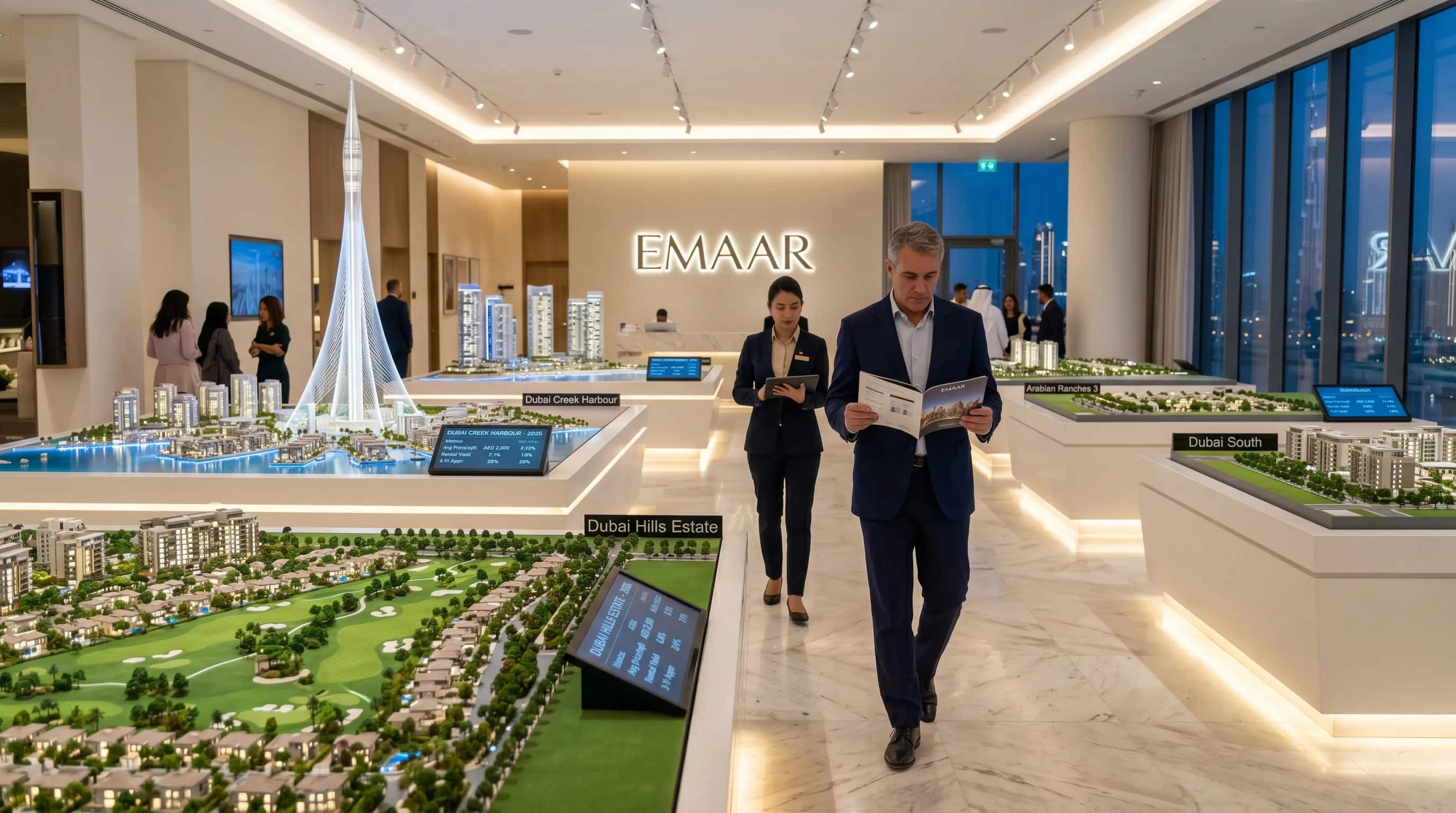
Emaar: Where to Invest Across Their Dubai Communities in 2026
Emaar is the largest and most established real estate developer in Dubai. The company has built more of the Dubai people see in pictures than any other developer. Downtown Dubai.
Emaar is the largest and most established real estate developer in Dubai. The company has built more of the Dubai people see in pictures than any other developer. Downtown Dubai. Dubai Marina. Arabian Ranches. Dubai Hills Estate. Emaar Beachfront. Dubai Creek Harbour. The Address Hotels and Residences across the city. The Burj Khalifa itself. The Dubai Mall. The Dubai Fountain. Walk through almost any major Dubai community and you’re walking through Emaar real estate.
For investors, this raises a specific question. Emaar’s portfolio spans more than a dozen major Dubai communities, each with different characteristics, different price points, different supply dynamics, and very different performance histories. Investing in Emaar is not a single decision. It’s a series of decisions about which Emaar communities, which buildings within those communities, which unit types, and which entry points actually generate the returns investors are looking for.
We’ve worked with enough Emaar investment buyers across enough of their Dubai communities to recognise the patterns of which sub-portfolios within Emaar have delivered strong returns and which have lagged. The picture is more nuanced than the developer-brand-level discussion typically captures. Some of Emaar’s most celebrated communities have actually been mediocre investments at the prices buyers paid. Some of Emaar’s less-talked-about communities have quietly outperformed.
This article walks through the Emaar community portfolio in 2026, where the strongest returns have actually come from, a head-to-head comparison of Emaar communities, the off-plan-versus-secondary trade-off across Emaar projects, our research on Emaar community investment returns, and the honest read on where to place Emaar capital today.
A note up front. Emaar is a credit-strong, deliverable developer with one of the strongest track records in Dubai or globally. The investment question is rarely about whether Emaar will deliver the project. It’s about which Emaar product, at which entry price, in which community, generates the right return for your investment profile. The brand premium people pay for Emaar product is real and earned, but the differential between buying the right Emaar product and buying the wrong Emaar product within the same brand can be larger than buyers expect.
Mohamed Alabbar, Emaar’s founder, has spoken extensively about Emaar’s development philosophy across different Dubai communities. Each community has been designed with specific buyer profiles and lifestyle propositions in mind. Understanding which community fits which buyer (and which investor) is part of the necessary work for any serious Emaar investment.
The Emaar Community Portfolio in 2026
Emaar’s Dubai community portfolio spans the spectrum from ultra-prime trophy positioning to mass-market mid-tier supply. The investment-relevant communities:
• Downtown Dubai is Emaar’s flagship urban community, anchored by Burj Khalifa, Dubai Mall, and Dubai Opera. Apartment supply ranges from entry-luxury (AED 1.5 million for studios in older buildings) to ultra-luxury branded residences (AED 50 million plus)
• Dubai Marina with significant Emaar building stock alongside other developers’ supply. Premium Marina-front Emaar towers command premium pricing
• Dubai Hills Estate is the premier mid-luxury master-planned community with villa, townhouse, and apartment supply across Sidra, Maple, Parkways, Golf Place, Fairway Vistas, and other clusters
• Arabian Ranches is the established suburban villa community across three phases (Arabian Ranches 1, 2, and 3), with mature secondary market and ongoing new launches in the latest phase
• Emaar Beachfront is the newer coastal residential development on a man-made peninsula with branded apartment towers and some villa-style supply
• Dubai Creek Harbour is Emaar’s emerging waterfront mega-development with significant ongoing construction and long-term completion timeline extending into the 2030s
• The Address Residences branded residential portfolio across multiple Dubai locations with hotel-style amenity packages
• Emaar South in Dubai South area is the more accessible suburban community with apartment, townhouse, and villa supply
• The Hills is the older Greens-adjacent apartment community
• The Greens and The Views are older Emaar apartment communities with mature secondary market
Each of these communities sits at a different point on the spectrum of price, target buyer, supply maturity, and growth trajectory. The investment thesis for each is materially different.
The Emaar pipeline beyond these established communities includes ongoing phases of Dubai Hills, Arabian Ranches 3, Dubai Creek Harbour, Emaar Beachfront, and Emaar South, plus new launches in adjacent areas including Mira, Bayview, Cedar, and others. The pipeline is substantial enough that Emaar’s market share in Dubai’s new supply remains dominant through the second half of the 2020s.
Faisal Durrani, Knight Frank’s head of Middle East research, has consistently flagged Emaar communities as among the strongest-performing master-planned residential investments in Dubai’s recent decade. The data supports that at the developer-brand level, with significant variance by specific community.
Where the Strongest Returns Have Come From
Looking at the community-by-community capital growth across Emaar’s Dubai portfolio between 2022 and 2025, the strongest performers shared a few common characteristics:
1. Supply discipline. Communities where Emaar limited new releases or where master-plan build-out limited supply (Downtown premium positions, Dubai Hills established phases, Arabian Ranches established phases) outperformed communities with active new supply
2. Brand-amenity stack. Communities where Emaar amenity infrastructure (Dubai Mall in Downtown, Dubai Hills Mall and golf in Dubai Hills, Marina infrastructure) compounded across multiple amenity layers outperformed communities with thinner amenity stacks
3. Foreign buyer accessibility. Communities where foreign-buyer freehold mechanics worked smoothly and where the international buyer pool concentrated showed stronger demand growth
4. Maturity premium. Communities where the build-out had largely completed and the lived experience had matured into something settled outperformed earlier-stage communities where execution risk remained
5. Trophy positioning. Communities at the top end of the Emaar luxury spectrum (Downtown premium, Dubai Hills Golf Place, Emaar Beachfront premium) delivered outsized capital appreciation as international ultra-wealthy buyer flows increased
Communities that have lagged the Emaar average tend to share opposite characteristics:
1. The older Greens and Views apartment communities have seen muted capital growth as newer supply elsewhere has captured demand
2. Some Arabian Ranches phases have lagged the Dubai Hills phases at similar price points despite arguably similar product quality
3. Emaar South has lagged the more central Dubai communities despite reasonable underlying value, reflecting geographic preference patterns
4. Some Dubai Creek Harbour phases have seen capital growth muted by ongoing supply expansion and the long master-plan timeline
These patterns suggest the next phase of Emaar returns will likely concentrate in communities with supply discipline, strong amenity stacks, foreign-buyer accessibility, and either maturity premium or genuine trophy positioning. The geographically peripheral communities (Emaar South, parts of Dubai Creek Harbour during ongoing build-out) may continue to lag the more central Emaar portfolio.
Comparing Emaar Communities Head to Head
A direct comparison of Emaar’s main Dubai communities on the metrics that matter for investors:
Downtown Dubai (mid-tier apartments). Average entry: AED 2.5 million. Three-year capital growth: 55%. Gross yield: 5.8%. Foreign buyer share: 75% plus.
Downtown Dubai (premium branded residences). Average entry: AED 8 million. Three-year capital growth: 68%. Gross yield: 4.5%. Foreign buyer share: 85% plus.
Dubai Marina (Emaar towers, mid-tier). Average entry: AED 1.8 million. Three-year capital growth: 50%. Gross yield: 6.2%. Foreign buyer share: 70% plus.
Dubai Marina (Emaar Address Residences). Average entry: AED 5 million. Three-year capital growth: 58%. Gross yield: 5.2%. Foreign buyer share: 75% plus.
Dubai Hills (Sidra/Maple villas). Average entry: AED 9 million. Three-year capital growth: 48%. Gross yield: 5.4%. Foreign buyer share: 65% plus.
Dubai Hills (Golf Place premium villas). Average entry: AED 26 million. Three-year capital growth: 60%. Gross yield: 4.4%. Foreign buyer share: 70% plus.
Dubai Hills (apartments). Average entry: AED 2.2 million. Three-year capital growth: 55%. Gross yield: 6.0%. Foreign buyer share: 65% plus.
Arabian Ranches (3-bed villas, established phases). Average entry: AED 4 million. Three-year capital growth: 38%. Gross yield: 5.8%. Foreign buyer share: 60% plus.
Emaar Beachfront (apartments). Average entry: AED 2.8 million. Three-year capital growth: 60%. Gross yield: 5.5%. Foreign buyer share: 80% plus.
Dubai Creek Harbour (apartments). Average entry: AED 1.8 million. Three-year capital growth: 45%. Gross yield: 6.0%. Foreign buyer share: 75% plus.
Emaar South (mid-tier apartments). Average entry: AED 900,000. Three-year capital growth: 35%. Gross yield: 6.5%. Foreign buyer share: 50% plus.
The Greens (apartments). Average entry: AED 1.5 million. Three-year capital growth: 32%. Gross yield: 6.4%. Foreign buyer share: 55% plus.
The clear leaders on capital growth have been Downtown premium, Dubai Hills Golf Place, Emaar Beachfront apartments, and Downtown mid-tier. The leaders on yield have been Emaar South, The Greens, Dubai Marina mid-tier, and Dubai Creek Harbour. Arabian Ranches and the older Greens/Views communities have been the weakest performers on capital growth across the established Emaar portfolio.
Off-Plan vs Secondary Across Emaar Communities
The trade-off between off-plan and secondary purchases varies meaningfully across Emaar communities.
Off-plan in established Emaar communities (Downtown, Dubai Marina, Dubai Hills, Emaar Beachfront) generally offers 5-15% discounts to comparable secondary product, with the differential narrowing as projects approach completion. The off-plan advantage compresses through the build period as the project de-risks. For investors with 3-5 year horizons, the off-plan entry has typically delivered better total returns than equivalent secondary in the same community.
Off-plan in newer or emerging Emaar communities (Dubai Creek Harbour, Emaar South) offers larger discounts (sometimes 20-30%) reflecting both completion risk and the long master-plan timelines. The off-plan advantage here is real but the holding period to realise it is longer. Investors comfortable with 5-10 year horizons can capture more value here, but the patience requirement is meaningful.
Secondary purchases in mature Emaar communities offer the advantages of confirmed product (you see exactly what you’re buying), confirmed service charges (the building’s actual track record), and immediate yield generation. The discount-to-off-plan trade-off is meaningful for investors prioritising risk reduction over maximum capital appreciation.
The patterns we’ve watched succeed across Emaar off-plan investment:
1. Buying early in highly-anticipated launches where developer pricing tends to be most attractive
2. Choosing established communities with proven amenity stacks rather than emerging communities with longer build-out timelines
3. Selecting specific unit characteristics that have historically commanded premiums (corner units, premium floors, specific views) rather than standard inventory
4. Holding through completion rather than trying to flip during construction (the costs and friction of mid-construction flipping often eat the appreciation)
5. Researching the specific Emaar project team and recent delivery track record on similar projects
The patterns that have struggled:
1. Buying off-plan in less-anticipated Emaar projects where the developer used pricing to drive volume
2. Choosing emerging communities with long build-out timelines hoping for early-mover advantage
3. Trying to flip mid-construction or shortly after handover (transaction costs and friction often eliminate the appreciation)
4. Underestimating service charges and ongoing costs in branded residences and premium positions
Our Research on Emaar Community Returns
We pulled data on 110 Emaar community investment transactions and 145 rental contracts from 2023 and 2024 across the major Emaar Dubai communities. The total return analysis (capital growth plus net yield, after service charges and typical voids) for the past three years:
Downtown Dubai mid-tier apartments: total annualised return roughly 22% (capital growth 17% + net yield 5.2%).
Downtown branded residences: total annualised return roughly 25% (capital growth 22% + net yield 3.8%).
Dubai Marina Emaar mid-tier: total annualised return roughly 21% (capital growth 16% + net yield 5.5%).
Dubai Hills Sidra/Maple villas: total annualised return roughly 17% (capital growth 13% + net yield 4.2%).
Dubai Hills Golf Place premium: total annualised return roughly 19% (capital growth 16% + net yield 3.4%).
Emaar Beachfront apartments: total annualised return roughly 23% (capital growth 18% + net yield 4.8%).
Dubai Creek Harbour apartments: total annualised return roughly 19% (capital growth 14% + net yield 5.3%).
Emaar South apartments: total annualised return roughly 16% (capital growth 11% + net yield 5.7%).
Arabian Ranches villas: total annualised return roughly 15% (capital growth 11% + net yield 5.1%).
The Greens apartments: total annualised return roughly 14% (capital growth 9% + net yield 5.5%).
Cross-referenced against the Dubai Land Department transaction database and Knight Frank Dubai residential market research, our figures broadly match published market analysis. Emaar communities have delivered strong investment returns across the past three years, with significant variance by community.
What stands out from the data. The total return spread across Emaar communities is 14% to 25% annualised over the past three years. That’s a meaningful range. Picking the right Emaar community has mattered more than picking Emaar versus other developers at similar price points.
A second pattern. The communities with the highest realised capital growth have generally been the ones with the strongest foreign buyer demand. International capital flows have driven Dubai luxury and premium-tier appreciation more than local demand. Communities accessible to international buyers and visible to international investment platforms have outperformed.
Where to Place Emaar Capital Today
The honest read on Emaar community investment positioning in 2026:
For maximum capital growth at moderate-to-high entry prices, Downtown Dubai branded residences, Emaar Beachfront, and Dubai Hills Golf Place have delivered the strongest returns and supply discipline supports continued appreciation. Entry prices are not cheap but the absolute capital appreciation has been substantial.
For balanced returns (capital growth plus yield), Downtown mid-tier apartments, Dubai Marina Emaar towers, and Dubai Hills mid-tier (Sidra, Maple villas or apartment positions) deliver the cleanest combination. The yields are decent and the capital growth has tracked the broader Dubai market reliably.
For yield-focused investment, the older Emaar apartment communities (The Greens, The Views, some older Marina towers) deliver higher gross yields but at slower capital growth. Investors prioritising income today over capital appreciation should look here.
For accessible-entry investment with growth potential, Dubai Creek Harbour and Emaar South offer lower entry prices with longer holding-period dynamics. These work for patient investors comfortable with 5-10 year horizons rather than 3-5 year horizons.
For trophy and prestige positioning, Downtown branded residences (Address, Burj Vista, similar premium product), Palm-adjacent Emaar product, and Dubai Hills Golf Place premium positions deliver the trophy-asset characteristics that ultra-wealthy buyers prioritise. These assets perform less like income generators and more like stores of value with global resale appeal.
Lewis Allsopp, founder of Allsopp & Allsopp, has spoken about how Emaar’s community portfolio increasingly differentiates by buyer profile rather than just price point. Different Emaar communities serve different investor types. Matching the community to the investor profile matters more than maximising any single metric.
The strongest Emaar investment picks we’ve watched perform: Downtown premium positions held through the recent cycle, Dubai Hills villas in established clusters with limited new supply, Emaar Beachfront early entries that captured the launch-to-handover appreciation, and Dubai Marina Emaar towers with view-positioned units.
The patterns that have underperformed: speculative off-plan flips in newer phases of emerging communities, generic apartment units in oversupplied buildings, Arabian Ranches investment buys at premium phase pricing, and short-hold investment attempts where transaction costs ate the appreciation.
For anyone considering Emaar investment, the community and specific positioning matters more than the developer brand alone. Live listings across Emaar Dubai communities shift weekly. Our areas overview covers the main Emaar geographies. Our agents handle Emaar community transactions across the full portfolio. Ready to look at specific communities or projects? Reach out and we’ll take it from there.
Related stories
Dubai's Established Charm: The Case for Older Homes
In a city focused on the future, I believe the smartest move for many buyers is to look back. Dubai's seasoned communities offer space, character, and surprising value that new builds often can't match.

The True Cost of Owning a Dubai Property
Beyond the purchase price, your annual budget for a Dubai home must account for service charges, utilities, and maintenance. I'll break down every ongoing expense you need to plan for.
Calculating ROI on Dubai Rental Upgrades
As a landlord in Dubai, you can't just follow trends. I'll show you how to calculate the precise ROI of minor property upgrades to genuinely increase your rental yield.
Echoes, in your inbox
One thoughtful email a month. Market insight, new launches, no spam.