

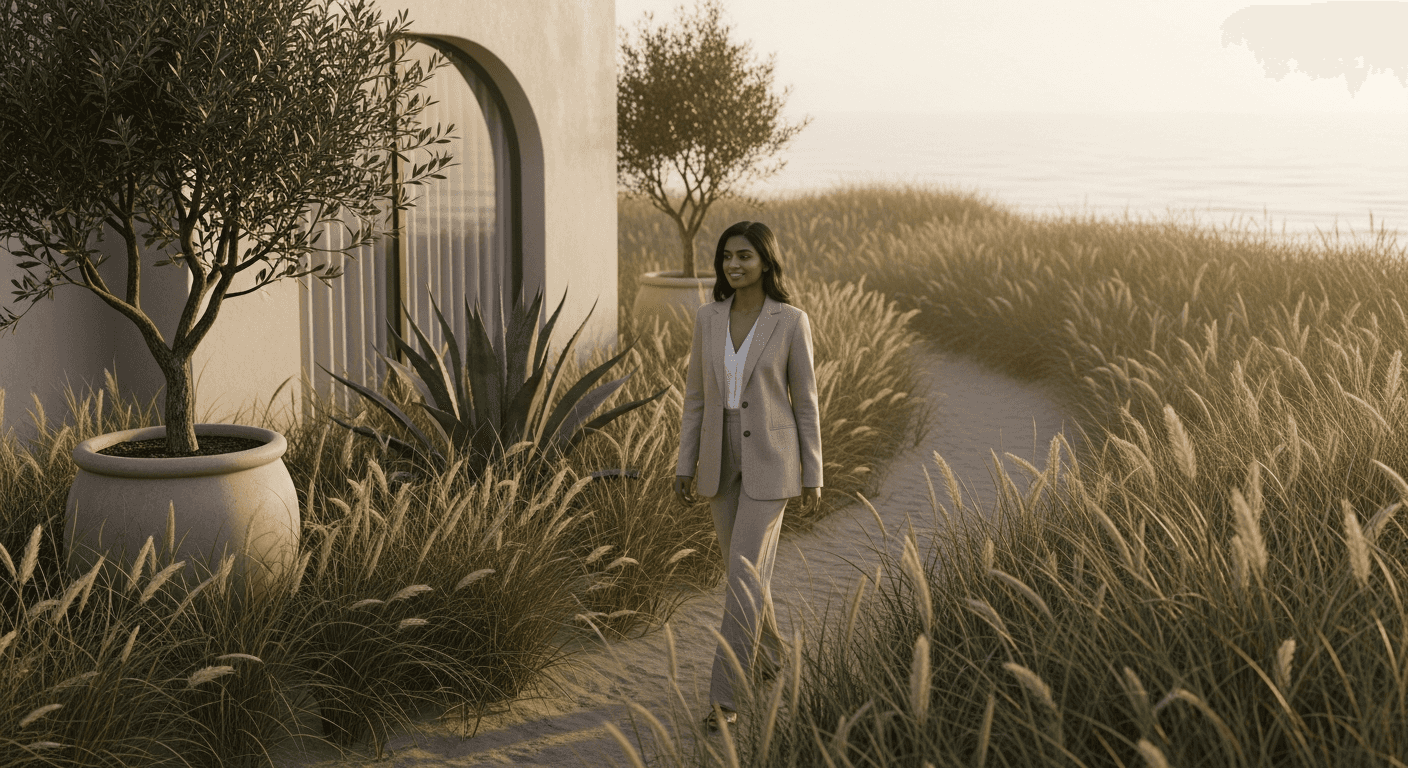
The Wellness Haven: Dubai's Holistic Living Neighbourhoods
A deep dive into the Dubai neighbourhoods built for wellbeing, from the lush gardens of Al Barari to the eco-conscious design of Expo City. Discover where health, nature, and home truly connect.

For years, luxury real estate in Dubai was defined by two things: size and view. A bigger penthouse, a better view of the Burj Khalifa or the sea — that was the formula. But a fundamental shift is underway, one that I've seen accelerate dramatically in my conversations with clients. The new luxury isn't just about what you see from your window; it's about how you feel within your walls and, more importantly, within your community. Welcome to the era of the wellness haven, where a property's greatest amenity is the quality of life it offers.
Here’s what we will explore in this deep dive:
- The Original Blueprint: A close look at Al Barari, the pioneer of green living in Dubai.
- Mainstreaming Wellness: How communities like Dubai Hills brought the concept to a wider audience.
- The 'Blue Health' Effect: Exploring the wellness benefits of waterfront living.
- Branded Sanctuaries: The rise of hotel-branded residences focused on health.
- Urban Oases: Finding wellness in the heart of the city.
- The Eco-Conscious Frontier: What sustainable communities like Expo City tell us about the future.
- A Buyer's Practical Guide: How to assess if a wellness community is right for you, including the real costs.
The Greenprint: Al Barari, Dubai's Original Oasis
I remember the first time I drove into Al Barari over a decade ago. You leave the E311 highway, take a few turns past the royal camel stables at Nad Al Sheba, and suddenly the beige desert landscape gives way to an almost impossibly lush wall of green. It felt less like arriving at a residential project and more like discovering a secret garden. That feeling, I've come to realise, is the entire point. Al Barari wasn't just another villa development; it was a statement. Zaya, the developer, committed to a radical idea for Dubai at the time: dedicating over 60% of the masterplan to landscaped gardens, lakes, and streams. It was the first true example of a health-focused property Dubai had ever seen, long before 'wellness' became a marketing buzzword.
What makes it a benchmark for serene living Dubai is this unwavering commitment to biophilia — the idea that humans have an innate tendency to seek connections with nature. Living in Al Barari is an immersive experience. You don't just have a garden; you live in one. The air feels cleaner, the temperature a degree or two cooler. The soundscape is dominated by birdsong and the rustle of leaves, not traffic. For residents, this isn't a feature; it's the fabric of daily life. Morning walks aren't on a pavement next to a road, but on winding paths through dense foliage. The community's heart is The Farm, an organic restaurant that was a destination in its own right long before the surrounding area was so developed. This integration of nature and amenities creates a powerful sense of place that few other communities have managed to replicate with such authenticity.
Of course, this level of curated nature comes at a price, both in initial outlay and ongoing costs. This is the top tier of Dubai wellness communities. Villas in sub-communities like The Residences or The Nest command a significant premium. But for those who can afford it, the question we at Gaia Living often help clients answer isn't just "what is the price?" but "what is the value of this environment?" The answer lies in the unquantifiable benefits: the reduced stress, the encouragement of an active outdoor lifestyle, the sheer pleasure of being surrounded by beauty. It's also in the numbers. The service charges in Al Barari are among the highest in Dubai, and for good reason. Maintaining this botanical paradise — with its thousands of plant species, waterways, and dedicated horticultural team, is a massive operational expense. For a large villa, this can easily exceed AED 100,000 annually. It's a cost that weeds out casual investors and ensures residents are deeply committed to the community's ethos. This, in my view, is a key part of its success. It has fostered a community of like-minded individuals who value privacy, nature, and quiet luxury over ostentation.
The True Cost of Paradise: A Breakdown
Let's ground this idyllic picture in financial reality. Saying a community is expensive is easy; understanding the exact cost is where our job at Gaia Living begins. Let’s imagine you are purchasing a beautiful, ready-to-move-in villa in Al Barari's Dahlia community on the secondary market. The seller has accepted your offer of AED 15,000,000.
Here’s a line-by-line breakdown of the upfront costs you would need to budget for, based on current regulations from the Dubai Land Department (DLD).
- Purchase Price: AED 15,000,000
- DLD Transfer Fee: 4% of the purchase price, which is AED 600,000. This is typically split 50/50 between buyer and seller, but it's a point of negotiation. For this example, let's assume the buyer pays the full amount as is common.
- DLD Administration Fees: A fixed fee of AED 4,200 (including VAT) payable to the DLD.
- Real Estate Agency Fee: 2% of the purchase price, plus 5% VAT. This amounts to AED 300,000 + AED 15,000 VAT = AED 315,000.
- Property Trustee Registration Fee: This is for the transfer process and is handled by a DLD-approved trustee office. The fee is AED 4,200 (including VAT).
- No Objection Certificate (NOC) Fee: This is a fee paid to the developer (Al Barari in this case) to confirm there are no outstanding service charges or other issues. This can range from AED 500 to AED 5,250 (the maximum allowed, including VAT). Let's budget AED 5,250.
Total Upfront Cost (Cash Purchase):
- Purchase Price: 15,000,000
- DLD Fee: 600,000
- DLD Admin: 4,200
- Agency Fee: 315,000
- Trustee Fee: 4,200
- NOC Fee: 5,250
- Total:AED 15,928,650
This demonstrates that you need nearly AED 1 million in fees on top of the property price. If you were getting a mortgage, you'd also have to factor in a 0.25% mortgage registration fee to the DLD on the loan amount, plus bank arrangement fees. And this doesn't even touch the ongoing costs. With a villa of, say, 8,000 sq.ft. And a service charge of AED 18 per sq.ft., you're looking at an annual bill of AED 144,000 just to maintain the community's pristine environment. It’s a significant financial commitment, but for the right buyer, it's an investment in a lifestyle that's simply unavailable anywhere else in the city.
Mainstreaming Wellness: The Dubai Hills Formula
The genius of Dubai's property market is its ability to take a niche, ultra-luxury concept and democratise it. If Al Barari was the boutique haute couture of wellness living, then Dubai Hills Estate is the prêt-à-porter collection. Developed by Emaar Properties, the master developer behind landmarks like Downtown Dubai, Dubai Hills took the core principles of Al Barari — green space, community, family-centric lifestyle, and scaled them into a sprawling, accessible city-within-a-city. It’s less of a secluded, mystical garden and more of an idyllic, master-planned American suburb, polished and perfected for the Dubai context. The key difference is the approach to green space. Instead of a dense, untamed jungle, Dubai Hills offers vast, manicured lawns, an 18-hole championship golf course, and the enormous Dubai Hills Park at its centre.
This approach makes wellness a part of an integrated lifestyle. It’s not just about retreating into nature; it's about living actively within it. On any given weekend, the park is alive with families, joggers, and kids on bikes. The 54km cycling track is heavily used, and the entire community is designed to encourage movement. Emaar’s masterstroke was integrating every conceivable family need within the community gates. You have the Dubai Hills Mall for shopping and entertainment, the King's College Hospital for world-class healthcare, and GEMS schools for education. This creates a near-frictionless existence where the stressful daily commutes for school runs or grocery trips are eliminated. This, in itself, is a powerful form of wellness. It gives residents back the most precious commodity of all: time.
This integrated model offers a far broader range of entry points compared to Al Barari. You can find one-bedroom apartments in developments like Park Heights or Collective starting from around AED 1.5 million, offering access to the same green lungs and world-class infrastructure as the AED 100 million+ mansions in the exclusive Hills Grove sector. This has made Dubai Hills one of the most sought-after addresses for end-user families in Dubai. It represents a more attainable dream of holistic living homes Dubai, where good schools, safe parks, and a strong sense of community are the primary drivers of value. When clients ask me about Dubai Hills, I tell them to think of it as a lifestyle platform. The property is your access card to an ecosystem designed to make daily life healthier, easier, and more connected. The premium you pay over other, less integrated communities is for this seamlessness, and in my experience, very few residents ever regret it.
The new luxury isn't just about what you see from your window; it's about how you feel within your walls and, more importantly, within your community.
Blue Health: The Waterfront Wellness Paradigm
While green space has long been the poster child for wellness real estate, Dubai's most defining natural asset has always been its coastline. The concept of "Blue Health" — the positive impact of proximity to water on our mental and physical wellbeing, is now a driving force in property development. It’s something I feel viscerally. There’s a calming, expansive quality to a sea view that a garden, however beautiful, can't quite match. For decades, the ultimate expression of this was a villa on the fronds of Palm Jumeirah, a project by Nakheel that remains one of the world's most audacious and desirable addresses. Having your own private beach and an uninterrupted view of the Arabian Gulf is a powerful, restorative experience.
However, the waterfront wellness trend has evolved far beyond the Palm's exclusive fronds. Developers are now creating high-density communities that deliver this blue health experience to a wider audience. A prime example is Emaar Beachfront, a gated island community set between Dubai Marina and the Palm. Here, Emaar has engineered a Miami-style beachfront lifestyle in a high-rise format. Every single apartment building has direct access to a 1.5km stretch of private, pristine beach. The design is intentional: balconies are deep, windows are floor-to-ceiling, and the orientation of the towers is meticulously planned to maximise views of the sea, the Marina skyline, or the Palm. The lifestyle is pure resort. Your morning run is on the sand, your afternoon is spent at a beach club, and your evening involves watching the sunset over the water from your balcony.
This concept is being replicated and refined across the UAE. We're seeing it in masterplans like Dubai Maritime City and with the renewed focus on communities like Jumeirah Beach Residence (JBR). Even in other emirates, the trend is clear. Ambitious projects on Al Marjan Island in Ras Al Khaimah, developed by players like Al Hamra, are built entirely around this principle. They are attracting global hotel brands and buyers who want the benefits of waterfront living — the views, the recreation, the resort atmosphere, often at a more accessible price point than prime Dubai. What we advise our clients at Gaia Living is that the value here is multi-layered. Yes, there's the capital appreciation potential of a finite resource like beachfront land. But the real return is the daily dividend paid to your wellbeing. The sound of the waves, the salty air, the open horizon, these are amenities that can't be listed in a brochure, but they are often the most valuable of all.
The Rise of Branded Wellness Residences
Perhaps the most explicit manifestation of the health-focused property trend is the explosion of branded wellness residences. This is where the worlds of ultra-luxury hospitality and real estate converge. Developers partner with world-renowned hotel and wellness brands — think Six Senses, Aman, Banyan Tree, to create residential offerings that come with a built-in, five-star wellness ecosystem. These are more than just apartments with a nice gym; they are fully integrated living experiences curated by experts in wellbeing.
On Palm Jumeirah, the Six Senses Residences is a perfect case study. It’s not just located next to the Six Senses hotel; it’s an extension of its philosophy. Residents have access to a 60,000 sq.ft. Wellness and lifestyle facility, including a signature spa, longevity clinic, and a vast array of fitness and therapeutic options. The design itself is infused with wellness principles, from biophilic elements and natural materials to advanced air and water filtration systems built into the infrastructure. The promise is simple: your home will not only be luxurious but will actively contribute to your health. This is a powerful proposition, and it comes with a price tag to match. The premium for a branded residence over a comparable non-branded property can be 30% or more.
Is it worth it? My verdict is that you have to look past the logo. The value isn't in the brand name itself, but in the operational excellence and the unique amenities that brand delivers. A checklist for buyers we've developed at Gaia Living includes:
- Amenity Access: Is access to the wellness facilities guaranteed and included in service charges, or is it a pay-per-use model?
- Service Integration: How deep is the integration? Can you get in-residence spa treatments, wellness meal delivery, or a personal wellness concierge?
- Quality of Build: Does the 'wellness' promise extend to the construction itself? Ask about air quality, water filtration, acoustic insulation, and the use of non-toxic materials.
- Community and Programming: Do they offer curated wellness programming like visiting practitioners, yoga retreats, or community health workshops?
When these elements are executed flawlessly, a branded residence can offer an unparalleled lifestyle. However, buyers should be wary of projects that simply slap a brand on a standard luxury building. The true value lies in the authentic, day-to-day integration of a genuine wellness philosophy into the very fabric of the home and community.
Finding Serenity in the City: The Urban Sanctuaries
For all the appeal of a secluded villa or a beachfront apartment, the reality for many is that life and work are centred in the urban core. The challenge and the opportunity for developers is to infuse wellness into high-density environments. This is where walkability, convenience, and curated public spaces become the key pillars of a healthy lifestyle. You don't need a sprawling park if your neighbourhood itself functions as one. The master of this in Dubai is Meraas, and their flagship project, City Walk, is a masterclass in creating a vibrant, pedestrian-first community in the heart of the city, right between Downtown Dubai and Jumeirah.
City Walk's design consciously turns its back on the car-centric model of old Dubai. It features low-rise residential blocks set along a network of beautifully landscaped, air-conditioned (in summer) streets lined with cafes, boutiques, and public art. The entire neighbourhood is designed to be explored on foot. This simple act of promoting walking has profound wellness benefits, both physically and mentally. It fosters spontaneous social interaction and a sense of connection to your surroundings that is impossible to achieve when moving from one air-conditioned box (home) to another (car) to a third (office). The presence of the Green Planet, a self-contained tropical biodome, and the central plaza with its fountains and event space, further reinforces the idea of the neighbourhood as a living, breathing entity.
This model is being adapted elsewhere. Within the dense towers of Business Bay, we're seeing developers use podium levels to create elevated 'parks' for residents, with running tracks, pools, and extensive landscaping high above the city bustle. Projects by developers like Binghatti and Select Group are increasingly focused on creating a resort-style amenity floor that acts as a social and recreational hub for the building. Even older, more established areas are being retrofitted for wellness. The 7km pedestrian and cycling path along the Dubai Water Canal has transformed the areas around it, offering a new recreational spine for residents. For my clients who value the energy and convenience of urban living, my advice is to look for these pockets of intentional design. Look for the wide pavements, the proximity to a canal or park, and buildings that invest heavily in their communal amenities. In a dense city, these are the features that create a true urban sanctuary.
The Eco-Conscious Frontier
Looking ahead, the conversation around wellness is deepening to include not just personal health, but planetary health. The most forward-thinking eco-conscious neighbourhoods Dubai are those that equate sustainability with a higher quality of life. The legacy of Expo 2020, now repurposed as Expo City Dubai, is perhaps the most significant large-scale example. It was designed from the ground up with sustainability and human-centric principles at its core. It's a 15-minute city, where residents can access all their daily needs by foot or on a bike, a radical departure for Dubai. The buildings incorporate cutting-edge sustainable technology, and the entire city is a living lab for new ideas in urban design.
Another pioneering project is The Sustainable City in Dubailand. It's been operational for years and has proven its model works. Here, sustainability isn't an add-on; it's the entire operating system. Homes are designed to be net-zero energy, with solar panels on every roof. Water is recycled for irrigation, and residents have access to biodome greenhouses for urban farming. This creates a powerful closed-loop system that reduces residents' environmental footprint and their utility bills. The community is car-free at its core, with parking on the perimeter, forcing a lifestyle built around walking, cycling, and electric buggies. This might sound extreme, but the result is a quiet, safe, and socially cohesive environment where children can play freely on the streets.
These Dubai wellness communities represent the future, but they also present a choice. Living this way requires a conscious buy-in to a different lifestyle. It’s a commitment to a set of values. For our clients at Gaia Living who are drawn to these projects, the motivation is often as much ethical as it is financial or health-related. They want to live in a way that aligns with their beliefs about the future. While still a niche segment, I see this as the most significant long-term trend in the market. As concerns about climate and resources grow, communities that offer a tangible, sustainable, and healthy way of life will not just be desirable; they will be essential.
Key takeaway: Ultimately, the best 'wellness community' is the one that aligns with your personal definition of a good life. Whether that’s the untamed nature of Al Barari, the family-centric convenience of Dubai Hills, or the sustainable ethos of Expo City, the Dubai market now offers a sophisticated menu of options for a healthier, more holistic existence. The key is to look beyond the marketing and assess the tangible reality of the lifestyle on offer.
Sources
- Dubai Land Department (DLD): https://dubailand.gov.ae/en/
- UAE Government Portal (u.ae): https://u.ae/en
- Dubai Statistics Center: https://www.dsc.gov.ae/en-us
- Central Bank of the UAE: https://www.centralbank.ae/en/
Questions, answered
- What is considered a 'wellness community' in Dubai?
- A wellness community in Dubai is a residential development where the master plan and amenities are intentionally designed to support residents' physical, mental, and social health. This includes features like extensive green spaces, walking and cycling tracks, high-quality fitness centres, healthy dining options, and sometimes advanced in-home tech like air and water purification systems.
- Are wellness communities in Dubai more expensive?
- Yes, properties in dedicated wellness communities often carry a price premium due to their unique amenities, higher-quality build, and extensive landscaping. Buyers should also budget for higher annual service charges to maintain these premium facilities.
- Which is the original wellness community in Dubai?
- Al Barari is widely regarded as Dubai's original and most immersive wellness community. It was a pioneer in creating a lush, nature-focused environment with an exceptionally high ratio of landscaping to built-up area, setting the standard for holistic living in the region.
- Can I find wellness-focused apartments, or is it only villas?
- While many of the pioneering wellness communities focused on villas, there is now a wide range of wellness-focused apartments. Areas like Dubai Hills Estate, City Walk, and branded residences on Palm Jumeirah offer apartments with access to parks, high-end gyms, and a walkable, health-centric lifestyle.
- What are the hidden costs of living in a wellness community?
- The most significant 'hidden' cost is the annual service charge, which can be substantial to cover the maintenance of extensive parks, water features, and exclusive amenities. These fees are regulated by RERA and are based on the usable area (in sqft) of your property.
- Do eco-conscious neighbourhoods in Dubai actually save you money?
- While the initial purchase price might be higher, homes in eco-conscious communities like Expo City or The Sustainable City can lead to long-term savings. Features like solar panels and energy-efficient cooling can significantly reduce your monthly DEWA bills, offering a financial benefit to sustainable living.

Yusuf writes about how Dubai actually lives — waterfront mornings, community dining, walkability, and the lifestyle premium built into an address.
Related stories
Dubai's Established Charm: The Case for Older Homes
In a city focused on the future, I believe the smartest move for many buyers is to look back. Dubai's seasoned communities offer space, character, and surprising value that new builds often can't match.
The True Cost of Owning a Dubai Property
Beyond the purchase price, your annual budget for a Dubai home must account for service charges, utilities, and maintenance. I'll break down every ongoing expense you need to plan for.
Calculating ROI on Dubai Rental Upgrades
As a landlord in Dubai, you can't just follow trends. I'll show you how to calculate the precise ROI of minor property upgrades to genuinely increase your rental yield.
Echoes, in your inbox
One thoughtful email a month. Market insight, new launches, no spam.