

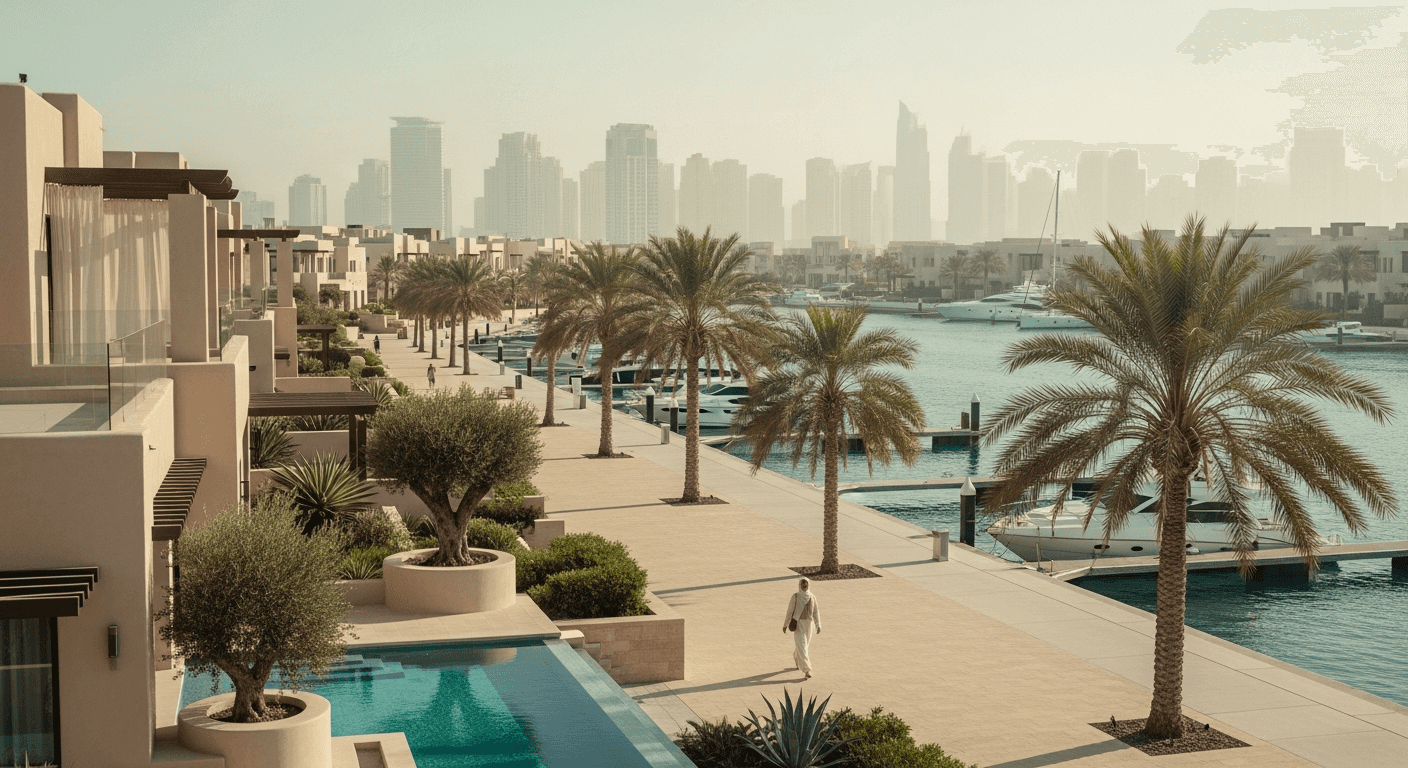
The Walkable Villa: Dubai's New Lifestyle Must-Have
A deep dive into Dubai's best villa communities with integrated retail and dining, exploring how this convenience factor is reshaping family life and property values.

The way we think about the ideal family home in Dubai has fundamentally changed. It's no longer just about the size of the garden or the number of bedrooms; it's about the life you can live just beyond your front door. The ultimate luxury today is time, and the ultimate convenience is proximity.
Here's what we'll explore:
- The critical shift from isolated villas to truly integrated communities.
- A look at the pioneers who created the blueprint, like Arabian Ranches.
- The new gold standard for integrated living: Dubai Hills Estate.
- Other notable contenders and their unique approaches to community retail.
- The tangible, day-to-day benefits for family life and community connection.
- The financial breakdown: understanding the premium and running costs.
- A detailed, line-by-line cost calculation for buying in an integrated community.
- My final verdict on whether this model is the right choice for you.
The Evolution of the Dubai Villa Community
When I first started in Dubai real estate, the dream for many families was a standalone villa in Jumeirah or Umm Suqeim. These homes offered space, privacy, and a certain classic Dubai charm. But they also guaranteed a life spent in the car. Every grocery run, school drop-off, or trip for a coffee was a journey that required planning and navigating traffic. The home was a sanctuary, but it was an isolated one. The community existed on the roads between destinations, not within the neighbourhood itself.
The first wave of master-planned villa projects in the early 2000s began to change this. Developers started thinking on a larger scale, creating gated enclaves with shared pools, parks, and basic security. This was a significant step forward, providing a safer and greener environment for families. Yet, for the most part, they were still residential dormitories. You lived there, you played in the park, but for almost everything else — shopping, dining, socialising, you got in your car and drove somewhere else. The focus was on the hardware of the community (the houses and paths) rather than the software (the lifestyle).
Over the past decade, I've watched a second, more profound evolution take place. The most successful developers realised that true community isn't just about shared green space. It’s about shared experiences. It’s about creating a centre of gravity, a heart for the neighbourhood where people can connect. This led to the rise of `integrated community amenities`, with retail and dining at their core. The new vision was for a lifestyle where daily needs could be met on foot or with a short golf cart ride. This shift addresses a deep-seated desire for a more traditional, village-like atmosphere within the context of a bustling, modern metropolis. It’s about reclaiming the time once lost to traffic and using it to build connections with family and neighbours. This is the essence of `convenient family living Dubai` and it has become the defining feature of the city's most desirable addresses.
The Blueprint: Arabian Ranches and Emaar's Vision
 Featured project
To understand the DNA of Dubai's integrated communities, you have to start with Arabian Ranches. When it launched, it was a radical concept for the city. Emaar Properties didn't just build clusters of villas in the desert; they built a fully-formed neighbourhood with a soul. At the centre of this vision were its community retail hubs: the Arabian Ranches Village and, later, The Ranches Souk. These weren't afterthoughts; they were foundational pillars of the master plan, and in my view, they are the primary reason for the community's enduring appeal.
What Emaar understood so early on was that convenience fosters community. The ability to `walk to shops villas Dubai` residents now take for granted was revolutionary. It meant you could let your teenager pop down to the supermarket for milk, meet a friend for a coffee without a formal plan, or pick up a prescription without it becoming a half-hour errand. The Ranches Souk isn't a megamall; it's a carefully curated collection of essential services. You have a Carrefour for groceries, a pharmacy, salons, a pet store, and a handful of charming cafes and casual restaurants. It’s everything a family needs for day-to-day life, all wrapped in an attractive, accessible package.
This integration of lifestyle amenities has a powerful, tangible impact. It transforms the rhythm of daily life. Instead of weekends being dominated by logistical trips to malls further afield, they become more relaxed and spontaneous. The community centre acts as a natural meeting point, fostering the kind of organic social interactions that are often missing in a transient city. I've had countless clients tell me that the reason they chose Arabian Ranches over other options was the simple, priceless ability to leave the car keys at home. This model, which also includes the Jumeirah English Speaking School (JESS) and the Arabian Ranches Golf Club within its gates, set the blueprint for every successful family-oriented community that followed. It proved that in Dubai, lifestyle sells just as much as square footage.
The New Gold Standard: Dubai Hills Estate
If Arabian Ranches wrote the book on integrated community living, then Dubai Hills Estate is the expanded and updated second edition. It takes the core principles of its Emaar predecessor and amplifies them on a scale that is simply breathtaking. In my opinion, it currently represents the pinnacle of this development philosophy in Dubai, creating a genuine 'city-within-a-city' that caters to nearly every conceivable need of its residents.
The most obvious example of this is the Dubai Hills Mall. Unlike the community souks of older neighbourhoods, this is a full-fledged destination mall located right at the heart of the development. This means residents don't just have access to a supermarket and a cafe; they have hundreds of high-street and luxury brands, a multiplex cinema, and a vast array of `on-site dining options villas` are just a short drive or even a walk away from. But the integration goes deeper. Sprinkled throughout the various sub-communities are smaller, more intimate retail strips and community centres, ensuring that even if you live further from the mall, a quick coffee or grocery top-up is never far away. This multi-layered approach to retail is what sets it apart.
But the vision extends far beyond shopping. The master plan smoothly incorporates a championship golf course, the King's College Hospital, several world-class schools like GEMS International School, and the Dubai Hills Business Park. This creates a powerful, self-sustaining ecosystem. It's theoretically possible for a resident to live, work, shop, educate their children, and receive medical care without ever needing to leave the community's borders. This level of comprehensive integration has a profound effect on property values and desirability. It has become the benchmark against which all new large-scale family communities are measured. For families seeking the absolute peak of `convenient family living Dubai`, Dubai Hills Estate is, for now, the undisputed champion.
Beyond the Big Two: Other Contenders and Models
While Emaar may have perfected the large-scale integrated model, they are far from the only developer to recognise the power of on-site amenities. Across Dubai, other communities have adopted similar principles, often with their own unique flavour and focus. This diversity provides excellent options for buyers at different price points and with different lifestyle priorities.
A prime example is Jumeirah Golf Estates. Its approach is less about a public-facing mall and more about a high-end, resident-focused Clubhouse. The JGE Clubhouse is the social and recreational heart of the community. It offers multiple premium dining options, from casual sports bars to fine dining restaurants, alongside state-of-the-art fitness facilities and, of course, access to its two world-class golf courses. It also features a small supermarket for essentials. This model caters to a discerning clientele that values exclusivity and a sophisticated, resort-like atmosphere over sprawling retail. It's a different kind of convenience — one that is curated, luxurious, and centred around a specific lifestyle.
Elsewhere, Nakheel has successfully implemented its 'Pavilion' concept in several of its villa communities, most notably in Al Furjan and Jumeirah Islands. These are not destinations in the way Dubai Hills Mall is, but highly functional, practical neighbourhood hubs. An Al Furjan Pavilion typically contains a Spinneys or Carrefour, a gym, a medical clinic, a few restaurants, and essential services like a pharmacy and a salon. They are designed for pure utility and have been incredibly effective in enhancing the livability of these areas. Similarly, developers like Damac have invested heavily in creating lifestyle hubs within their communities like Damac Hills and Damac Hills II, with retail promenades, unique attractions like Malibu Bay, and planned community centres. These different approaches demonstrate that the core principle — placing daily needs within easy reach, can be adapted to suit various community scales and target demographics.
The Human Element: Daily Life and Community Building
Beyond the property specs and master plans, the true value of these integrated communities lies in their impact on the human experience. As a communities correspondent, this is what I find most compelling. The simple addition of a walkable retail hub fundamentally alters the social fabric of a neighbourhood for the better. It transforms streets from mere transit corridors into places for community life to unfold.
Picture a typical Friday morning. In a community like Dubai Hills or Arabian Ranches, you'll see a constant, gentle flow of activity. Parents with strollers heading to a cafe after the school run, kids on bikes making their way to the park, residents taking a leisurely walk to the supermarket. These casual, unplanned interactions are the building blocks of a true community. You start to recognise faces, exchange greetings, and turn anonymous neighbours into familiar acquaintances and, eventually, friends. In a city as fast-paced and diverse as Dubai, where many people are far from their original support networks, these neighbourhood hubs serve as vital social anchors. They provide a space for connection that is organic and unforced.
“The most valuable amenity a developer can build isn't a pool or a gym; it's a place where neighbours can accidentally meet.”
This has a profound effect on families. The convenience factor frees up hours every week that would otherwise be spent in a car. That is time that can be reinvested into family dinners, helping with homework, or simply relaxing. It lowers the logistical stress of running a household. For children, it fosters a sense of independence and freedom that is rare in a modern city. The ability to safely walk or cycle to a friend's house or to grab an ice cream is a formative experience that builds confidence and a sense of belonging. Ultimately, these `villa communities with retail Dubai` offers are not just selling houses; they are selling a higher quality of life, and in my experience, that is something families are increasingly willing to invest in.
The Financial Equation: Is Convenience Priced In?
This enhanced lifestyle inevitably leads to a crucial question for any prospective buyer: does convenience come at a cost? The short answer is yes. Properties within well-established, highly integrated communities almost always command a price premium compared to similar-sized homes in less-developed areas. This premium is a direct reflection of market demand. Buyers are voting with their wallets, confirming that the value of `integrated community amenities` is real and quantifiable.
At Gaia Living, when we analyse property values, the pattern is clear. A four-bedroom villa in a community with a walkable souk and established schools will consistently be valued higher than a comparable villa that requires a 15-minute drive to the nearest supermarket. This premium is not just about sentiment; it's rooted in solid investment fundamentals. These properties attract a larger and more stable pool of potential tenants, particularly high-quality, long-term family tenants. This translates into lower vacancy rates and more resilient rental yields, even during market fluctuations. For an investor, this makes them a more secure asset. For an end-user, it provides confidence in the home's ability to retain and grow its value over time.
Of course, the other side of the financial coin is the running cost, specifically service charges. It's logical to assume that maintaining extensive landscaping, multiple pools, security patrols, and pristine retail areas would lead to higher fees. This is often true. Service charges in premier villa communities in Dubai generally range from AED 3 to AED 6 per square foot per year, calculated on the property's built-up area (BUA). A community with a vast mall and multiple clubhouses will likely be at the upper end of that scale. However, it's crucial for buyers to see this not just as a cost, but as an investment in their lifestyle and the upkeep of the entire community ecosystem, which in turn protects their property's long-term value. A well-managed community with properly funded maintenance is a far better investment than one that cuts corners.
A Worked Example: The All-In Cost of Buying
To make this tangible, let's walk through the real costs of purchasing a villa in one of these sought-after communities. Theoretical discussions are useful, but seeing the numbers in black and white provides true clarity. Let's imagine we are helping a client buy a 4-bedroom villa in a community like Dubai Hills Estate or a newer phase of Arabian Ranches.
First, the upfront, one-time costs associated with the transfer of the property. These fees are largely non-negotiable and must be factored into your budget on top of the property price.
Hypothetical Purchase Scenario: - Property Purchase Price: AED 6,500,000
Upfront Costs Breakdown: - Dubai Land Department (DLD) Transfer Fee: 4% of Purchase Price - AED 6,500,000 x 4% = AED 260,000 - DLD Administrative Fees: A fixed fee for processing the transfer. - Approximately AED 4,200 (including VAT) - Property Registration Trustee Fee: Paid to a DLD-approved registration trustee to handle the transfer. - Approximately AED 4,200 (including VAT) - Real Estate Agency Fee: The standard fee for brokerage services. - 2% of Purchase Price + 5% VAT = (AED 130,000) + (AED 6,500) = AED 136,500 - Developer No Objection Certificate (NOC) Fee: The developer must issue an NOC to confirm there are no outstanding liabilities on the property. This fee varies. - Range: AED 500 - AED 5,000. Let's assume AED 5,250 (incl. VAT).
Total Upfront Costs (excluding mortgage fees): - AED 260,000 + AED 4,200 + AED 4,200 + AED 136,500 + AED 5,250 = AED 410,150
This means that to acquire the AED 6.5M villa, you need almost AED 6.9M in available funds if you are a cash buyer. If you are taking a mortgage, you will also have a mortgage registration fee of 0.25% of the loan amount payable to the DLD. It's crucial to be aware of these government and administrative fees, which are clearly outlined on the Dubai Land Department (DLD) website.
Ongoing Annual Costs: Next, consider the recurring costs of ownership. - Annual Service Charges: This is where the community's amenities are funded. Let's assume our 4-bed villa has a Built-Up Area (BUA) of 4,000 sq. Ft. and the service charge is at the higher end, say AED 4.50 per sq. Ft. - 4,000 sq. Ft. x AED 4.50/sq. Ft. = AED 18,000 per year. This fee covers the maintenance of all common areas: parks, pools, security, landscaping, and the external upkeep of community retail centres. It's the engine that keeps the community running smoothly and looking pristine, directly protecting the value of your home.
My Verdict: Choosing the Right Integrated Community
After years of walking these communities, speaking with residents, and analysing market data, my conviction is stronger than ever: for most families, the premium paid for a home in a well-integrated community is not just worth it; it’s one of the wisest lifestyle investments you can make in Dubai. The benefits — in saved time, reduced stress, enhanced safety, and a genuine sense of belonging, are immense and difficult to quantify on a spreadsheet alone.
The key is to find the community that matches your family's specific 'flavour' of life. Not every integrated community is the same. For those who want the classic, mature, and established suburban feel with a strong school-centric vibe, Arabian Ranches remains a formidable choice. It has a warmth and an established rhythm that is very comforting. For families who want the absolute pinnacle of convenience, a vast array of choices, and a modern, ambitious energy, Dubai Hills Estate is the clear front-runner. It offers a truly all-encompassing lifestyle.
For others, the best fit might be different. The luxury, exclusivity, and resort-style living of Jumeirah Golf Estates will appeal to those who prioritise high-end leisure and a quieter, more sophisticated environment. Meanwhile, communities like Al Furjan or the DAMAC Hills projects offer this convenient lifestyle at a more accessible price point, with a focus on practical, everyday needs. Each offers a distinct personality. The best approach we advise our clients at Gaia Living is to spend time in each. Have a coffee in the souk, walk through the park, visit on a weekend. Get a feel for the energy of the place before you commit. The home is important, but the community is where you'll live your life.
The trend towards integrated, walkable communities is the most significant force shaping Dubai's suburban landscape. While these homes command a premium, this cost is justified by a demonstrably higher quality of life, stronger rental demand, and more resilient long-term property values. This is not a passing fad; it is the new standard for family living in the emirate.
## Sources - Dubai Land Department (DLD): https://dubailand.gov.ae - UAE Government Portal (Fees and Regulations): https://u.ae
Questions, answered
- Which Dubai villa communities are the most walkable?
- Communities like Arabian Ranches, Dubai Hills Estate, Jumeirah Golf Estates, and Al Furjan are highly walkable. They feature integrated retail souks, community centres, or large malls, allowing residents to walk to shops, cafes, and restaurants.
- Is it more expensive to buy a villa in a community with integrated retail?
- Yes, there is often a price premium for villas in communities with extensive integrated amenities. This reflects the high demand for convenience, but these properties also tend to have stronger rental demand and better long-term capital appreciation potential.
- What are typical service charges for a villa in an integrated community?
- Service charges for villas in Dubai typically range from AED 3 to AED 6 per square foot of the built-up area annually. Communities with more extensive amenities like large retail centres, clubhouses, and landscaping may fall at the higher end of this range.
- What does 'integrated community' mean in Dubai real estate?
- An integrated community is a master-planned development designed to be self-sufficient. It goes beyond just housing to include on-site amenities like retail centres, schools, parks, healthcare facilities, and dining options, all within the community's boundaries.
- Are there any new villa communities with good retail options?
- Yes, many new developments are adopting this model. Newer phases of established communities, like Arabian Ranches III, and large-scale projects like those in Meydan or Dubai South, are being designed with integrated retail and lifestyle hubs from the ground up.
- Can I get a mortgage for a villa in these communities?
- Absolutely. All major banks in the UAE offer mortgages for villas in established freehold communities. For UAE residents, the maximum loan-to-value is typically 80% for a first property, requiring a 20% down payment plus associated fees.

Sophia profiles Dubai's villa communities — schools, commute times, green space, and the intangible feel of a neighbourhood. She writes for families putting down roots.
Related stories
Dubai's Established Charm: The Case for Older Homes
In a city focused on the future, I believe the smartest move for many buyers is to look back. Dubai's seasoned communities offer space, character, and surprising value that new builds often can't match.
The True Cost of Owning a Dubai Property
Beyond the purchase price, your annual budget for a Dubai home must account for service charges, utilities, and maintenance. I'll break down every ongoing expense you need to plan for.
Calculating ROI on Dubai Rental Upgrades
As a landlord in Dubai, you can't just follow trends. I'll show you how to calculate the precise ROI of minor property upgrades to genuinely increase your rental yield.
Echoes, in your inbox
One thoughtful email a month. Market insight, new launches, no spam.