

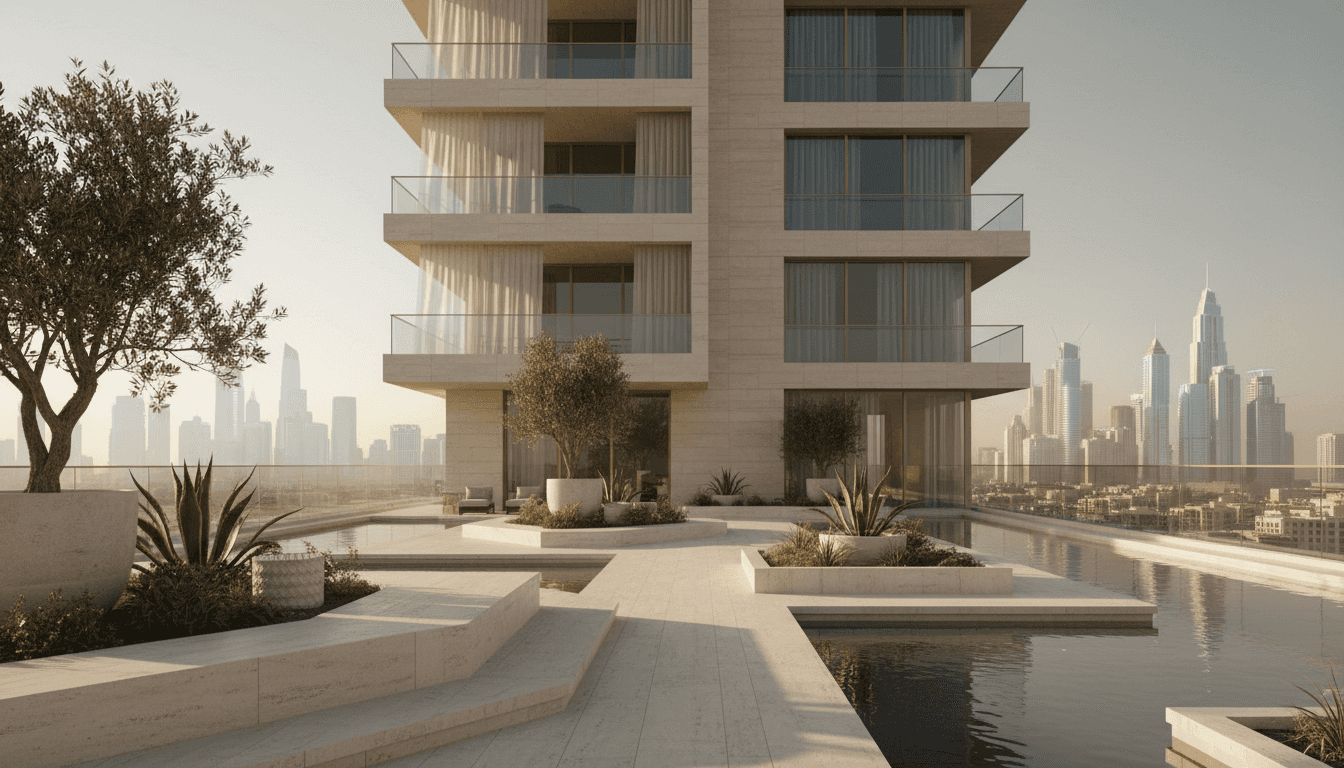
The True Value of Green Homes in Dubai
A deep dive into the quantifiable price premium and resale value uplift for energy and water-efficient properties in the Dubai market. Discover how 'green' is becoming a tangible financial asset.

For years, 'sustainability' in Dubai real estate was seen as a marketing term, a noble aspiration rather than a hard-nosed financial metric. My analysis suggests this is changing, and fast. The measurable premium for energy and water-efficient properties is becoming a concrete factor in asset valuation, moving beyond utility savings to directly influence capital appreciation and resale velocity.
In this report, I will quantify this emerging 'green premium'. We'll explore:
- The official green building codes that define efficiency in Dubai.
- The evidence for a direct, upfront sales price premium.
- The powerful, and often underestimated, impact on running costs.
- How efficiency translates into superior rentability and yields.
- The critical role of green features in future-proofing an asset's resale value.
Defining Efficiency: The Al Sa'fat and LEED Frameworks
Before we can measure a premium, we must define what the market considers 'green'. In Dubai, this isn't a vague concept; it's codified. The primary framework is the Al Sa'fat Green Building Rating System, mandated by Dubai Municipality. Since its introduction, it has become the baseline for all new construction. It operates on a tiered system — Bronze, Silver, Gold, and Platinum, with Bronze being the minimum requirement for any new building to secure a permit. This regulation alone has fundamentally lifted the base quality of Dubai's new property stock.
Al Sa'fat isn't just about solar panels. It's a holistic set of criteria covering energy efficiency, water conservation, responsible material sourcing, and indoor environmental quality. A 'Silver' rated villa, for example, must demonstrate at least a 20% improvement in energy and water efficiency over a baseline model. For investors and homeowners, this rating is not just a plaque on the wall; it’s a verifiable signal of lower future operational costs. We see developers like Emaar Properties and Aldar increasingly highlighting the Al Sa'fat ratings of their new projects in their marketing materials, a clear sign they believe it influences buyer decisions.
Alongside the mandatory local standard, the international LEED (Leadership in Energy and Environmental Design) certification remains a powerful differentiator, especially in the premium and commercial sectors. A LEED Gold or Platinum certification is a globally recognised benchmark of excellence. Projects like Creek Harbour and parts of DIFC have championed LEED standards, attracting a sophisticated international clientele who understand and value the certification. From an analytical standpoint, LEED-certified buildings provide some of the cleanest data for measuring a price premium because the certification is a distinct, marketable feature that can be isolated and compared against non-certified stock in the same area.
My view is that while Al Sa'fat sets the floor, LEED certification creates the ceiling for perceived value in the green building space. A buyer might not know the technical specifics of either, but they understand that a Gold or Platinum rating from either system implies superior construction quality, better insulation, more advanced MEP (mechanical, electrical, plumbing) systems, and critically, a healthier living environment. This perception is the bedrock upon which the financial premium is built. It moves the conversation from cost per square foot to total cost of ownership.
The Upfront Sales Premium: Is It Real?
 Featured project
This is the central question for any investor. Is there a measurable 'green premium' at the point of sale? The data is becoming clearer, and my answer is a qualified yes. While the market is not yet mature enough to have a universal, index-linked premium, my analysis of transaction data, paired with observations from our brokerage teams at Gaia Living, points towards a bifurcated market. In the affordable to mid-market segments, the premium is subtle and often absorbed into other factors like location or amenities. However, in the prime and super-prime segments, a clear price divergence is emerging.
In my experience, properties with a demonstrable, high-level green certification (like LEED Gold/Platinum or Al Sa'fat Gold/Platinum) can command a sales premium of between 5% and 15% compared to similar-sized, non-certified properties in the same location. Consider a community like Al Barari, which has long integrated nature and sustainable design into its DNA. While not all of its villas have formal certification, its entire ethos is 'green'. The enduring demand and strong price performance in Al Barari, even during market lulls, is a sign of the value buyers place on this environment. A more direct example is The Sustainable City in Dubai Science Park, which was built from the ground up on efficiency principles. Resale properties there have consistently commanded strong prices precisely because of their proven low running costs and unique living environment.
Why does this premium exist? It's not altruism. Sophisticated buyers are doing the maths. They understand that a higher initial outlay for an energy-efficient home will be amortised over time through lower utility bills and service charges. A developer I spoke with recently framed it perfectly: they are not selling a 'green' villa; they are selling a villa with a lower 'total cost of ownership'. This shift in language is crucial. It reframes sustainability from an expense into an investment. Beyond that, the mortgage market is beginning to play a role. While not yet widespread in the UAE, 'green mortgages' offering slightly better interest rates for certified energy-efficient homes are a growing trend globally. As the Central Bank of the UAE and local lenders continue to embrace ESG principles, it's a mechanism I expect to see gain traction here, further supporting the upfront premium.
It is important, however, to be specific about what drives the premium. It is not a generic 'eco-friendly' label. The premium is most pronounced when linked to concrete, verifiable features and certifications. These include:
- Official Certification: A LEED or high-tier Al Sa'fat rating.
- Advanced MEP Systems: High-efficiency VRF/VRV air conditioning systems, which are significantly more economical to run than standard split units.
- On-site Renewables: Integrated solar water heating or photovoltaic panels for electricity generation.
- Superior Building Envelope: Use of insulated blockwork, high-performance glazing, and thermal breaks that dramatically reduce cooling loads.
- Smart Water Systems: Greywater recycling for irrigation, and low-flow fixtures throughout the home.
When a seller can present a DEWA bill that is 40% lower than the neighbour's, that is not a story; it is a data point that directly justifies a higher asking price.
The Power of Lower Running Costs: Service Charges & DEWA
The most immediate and quantifiable benefit of an efficient home is the reduction in monthly running costs. For many buyers, this is a more compelling argument than a potential future resale premium. In Dubai, these costs fall into two main categories: DEWA (electricity and water) bills and community service charges. Efficient design attacks both simultaneously, creating a powerful compounding effect on savings.
Let's start with DEWA. Electricity consumption, primarily for air conditioning, is the single largest component of a Dubai household's utility bill. A poorly insulated villa with old, inefficient AC units can easily run up bills of many thousands of dirhams per month during the summer. A modern, well-designed building with a high-performance façade and an efficient cooling system can slash this by 20-50%. This is not a theoretical number. Residents of communities like The Sustainable City often share their DEWA bills publicly, showing near-net-zero electricity consumption. This is a powerful marketing tool. A saving of AED 2,000 per month is an extra AED 24,000 per year in the owner's pocket. Over a five-year period, that's AED 120,000 — a significant sum that directly impacts the property's overall financial attractiveness.
Now, let's consider service charges. These fees, levied by the owner's association and regulated by the Dubai Land Department (DLD), cover the maintenance and operation of a building's common areas. A huge portion of this budget goes towards electricity for cooling lobbies, corridors, and gyms, as well as water for landscaping and swimming pools. A building designed with efficiency in mind — using LED lighting, motion sensors, solar power for common areas, and water-wise irrigation, will have a structurally lower cost base. This translates directly to lower service charges for every owner. While charges vary greatly, a typical range might be AED 15-25 per square foot per year. A 10% reduction on a 2,000 sq ft apartment could save AED 3,000-5,000 annually. It's another tangible saving that adds up.
To illustrate, let's compare two hypothetical 4-bedroom villas of 5,000 sq ft:
Villa A: Standard Construction (circa 2010) * AC System: Standard central AC units. * Glazing: Standard double glazing. * Insulation: Basic blockwork. * Water: Standard fixtures, mains water for irrigation. * Estimated Monthly DEWA (Peak Summer): AED 7,000 * Estimated Annual Service Charge (at AED 4/sqft): AED 20,000 * Total Annual Running Cost: (7,000 * 4 peak months) + (3,500 * 8 off-peak months) + 20,000 = AED 76,000
Villa B: Certified Green Construction (e.g., Al Sa'fat Gold) * AC System: High-efficiency VRF system. * Glazing: High-performance, low-E coated. * Insulation: Insulated blocks + exterior insulation. * Water: Solar water heater, low-flow fixtures, greywater recycling for garden. * Estimated Monthly DEWA (Peak Summer): AED 4,200 (40% saving) * Estimated Annual Service Charge (at AED 3.5/sqft): AED 17,500 * Total Annual Running Cost: (4,200 * 4 peak months) + (2,100 * 8 off-peak months) + 17,500 = AED 51,100
In this realistic scenario, the owner of Villa B saves nearly AED 25,000 per year. An educated buyer or tenant will factor this saving into their calculation of the property's true cost, making them willing to pay a higher price or rent for Villa B. This is the core mechanism of the eco-friendly property investment thesis.
Rentability, Yield, and Tenant Appeal
For an investor, the ultimate test of a property is its ability to generate consistent rental income. Here, the benefits of energy and water efficiency are becoming a significant competitive advantage. The rental market in Dubai is sophisticated. A growing cohort of tenants, particularly corporate executives and expatriate families, are not just looking at the headline rent; they are evaluating the all-in cost of living. They ask about average DEWA bills. They are aware of 'chiller-free' versus chiller-inclusive buildings. An apartment or villa that can be marketed with 'proven low utility bills' stands out from the crowd.
In my experience leading the research team at Gaia Living, when we list a property for rent that has a strong green credential, like those in Sobha Hartland which often feature high-quality construction, the enquiry level is consistently stronger. These properties tend to rent faster and often to a higher-quality tenant who appreciates the long-term value. This reduces void periods — the time a property sits empty between tenants, which is a silent killer of rental yield. A property that rents in two weeks instead of six has already improved its annual return significantly.
“The conversation with discerning tenants is shifting from 'What's the rent?' to 'What's the total monthly cost?'. A lower DEWA bill is as good as a rent reduction, but one that the landlord doesn't pay for.”
This also allows landlords to be firmer on their asking rent. If two identical villas are available in Arabian Ranches, and one can demonstrate 30% lower running costs, the owner of the efficient villa is in a much stronger negotiating position. They can justify a rental price that is, say, 5% higher, because the tenant's total out-of-pocket expense will still be lower. This directly enhances the gross rental yield. A 5% increase in annual rent on an AED 5 million villa is an extra AED 12,500 per year, flowing directly to the bottom line.
Beyond that, the 'wellness' aspect of green buildings is a powerful, if less quantifiable, driver of tenant appeal. Features like enhanced air filtration, use of non-toxic materials, and better natural light are increasingly sought after by health-conscious residents. Communities designed with extensive green spaces, walking trails, and natural environments — think of master plans like those by Nshama or the mature greenery of Meadows, inherently attract families and long-term residents. This leads to stickier tenants, lower turnover, and a more stable rental income stream, which is the holy grail for any buy-to-let investor.
Future-Proofing: Resale Value in a Greening Market
While the immediate benefits of lower costs and higher rent are compelling, the most significant financial impact of green features, in my professional opinion, will be on long-term resale value. The Dubai real estate market is maturing. Regulatory oversight from RERA is robust, and buyers are more educated than ever. The 'buy anything and it will go up' mentality of previous cycles has been replaced by a focus on quality and long-term fundamentals. In this environment, asset quality is paramount, and energy efficiency is becoming a key component of that quality.
Think ahead five or ten years. The Al Sa'fat code means that every new building entering the market will meet at least a minimum standard of energy efficiency. This will make older, inefficient buildings look increasingly obsolete. A property built in 2008 with poor insulation and an inefficient AC system will be competing for buyers against newer stock that is demonstrably cheaper to run and more comfortable to live in. This creates a clear risk of a 'brown discount' — a markdown in value for inefficient properties. Investing in a green-certified property today is, therefore, a defensive strategy. It's about future-proofing your asset against obsolescence.
We are already seeing the first signs of this. When valuing older properties, one of the first things our agents look at is the condition of the MEP systems. An owner who has recently upgraded their AC to a high-efficiency system, for example, can command a higher price than a neighbour with a 15-year-old unit, and will almost certainly sell faster. The cost of retrofitting an entire villa with new AC, windows, and insulation can be substantial, running into hundreds ofthousands of dirhams. A buyer will factor this future capital expenditure into their offer price for an older property, effectively discounting it. The green-certified home, by contrast, has this value already built in.
This dynamic will only accelerate. As Dubai pushes towards its ambitious Net Zero 2050 strategy, we can anticipate further tightening of building codes and potentially the introduction of mandatory energy ratings for all properties at the point of sale or lease, similar to the Energy Performance Certificates (EPCs) common in Europe. When that day comes, a property with a high energy-efficiency rating will have a clear, quantifiable advantage on the open market. Early adopters of green technology and design will be in a prime position to capitalize on this regulatory and cultural shift. It's a classic case of skating to where the puck is going, not where it has been. For any long-term investor, this should be a primary consideration.
The Developer Perspective: Cost vs. Value
It's also instructive to look at this from the developer's side. For a long time, the perception was that building 'green' was prohibitively expensive. While there is an upfront cost to higher-spec materials and systems, this delta is narrowing rapidly as technologies mature and supply chains for green materials become more robust. Major developers like Binghatti and Omniyat, known for their distinctive designs, are also increasingly incorporating advanced, efficient systems because they recognise it as a hallmark of quality that their buyers expect.
From my conversations with developers, the additional cost for achieving a mid-tier certification like Al Sa'fat Silver might be in the range of 1-3% of total construction costs. For a high-tier LEED Gold certification, this might rise to 2-5%. However, they are increasingly seeing this not as a cost, but as an investment in marketability. A project that can advertise LEED certification or significantly lower running costs has a unique selling proposition that helps it stand out in a competitive market for off-plan launches. It allows their sales teams to tell a more compelling story that resonates with today's more discerning buyers.
Beyond that, developers who build green are building a more resilient brand. They are seen as forward-thinking and committed to quality. This reputation has a halo effect on their entire portfolio. In a market where trust and track record are everything, a commitment to sustainable building practices is a powerful signal. Look at the new wave of wellness-focused or eco-conscious projects launching, such as those in master communities like AlJurf Gardens by IMKAN, which are predicated on a harmonious relationship with the environment. These are not niche concepts anymore; they are becoming mainstream luxury offerings. This shows that the market leaders believe the demand for sustainable property value in Dubai is deep and lasting.
The financial case for energy and water efficiency in Dubai property is no longer theoretical. While the upfront 'green premium' is most evident in the prime market, the true value lies in a powerful combination of lower operational costs, enhanced rentability, and, most critically, superior long-term asset resilience. An efficient home is not just a building; it is a higher-performing financial asset that is better positioned for the future of the Dubai market.
Sources
- Dubai Land Department (DLD): https://dubailand.gov.ae/
- Dubai Municipality (Al Sa'fat Regulations): https://www.dm.gov.ae/
- Central Bank of the UAE (Financial Stability Reports): https://www.centralbank.ae/
- UAE Government Portal (UAE Net Zero 2050): https://u.ae/
Questions, answered
- Do green buildings in Dubai really sell for a higher price?
- Yes, evidence suggests an emerging price premium of 5-15% for properties with recognised green certifications like LEED, particularly in the premium and luxury segments. This is driven by lower running costs and higher perceived quality.
- How much can I save on bills with an energy-efficient home in Dubai?
- You can expect significant savings on your DEWA (Dubai Electricity and Water Authority) bills, potentially 20-40% lower than a comparable non-efficient unit. This is due to better insulation, efficient AC systems, solar water heaters, and low-flow fixtures.
- Does a green certification improve a property's resale value?
- Absolutely. A key benefit is enhanced resale value. As the market becomes more sophisticated, properties with documented efficiency and lower running costs are more attractive to buyers, commanding higher prices and selling faster than older, less efficient stock.
- What are the main green building standards in Dubai?
- The two primary standards are the globally recognised LEED (Leadership in Energy and Environmental Design) system and Dubai's own mandatory Al Sa'fat Green Building Rating System. Al Sa'fat has several tiers (Bronze, Silver, Gold, Platinum) and applies to all new construction.
- Are service charges lower in sustainable buildings?
- Yes, they are often measurably lower. Efficient buildings consume less power for common area cooling and lighting, and may use recycled water for landscaping, reducing shared operational costs that are passed on to owners via service charges.
- Is it worth investing in an eco-friendly property in Dubai?
- From a financial perspective, the indicators are increasingly positive. An eco-friendly property investment offers a combination of potential upfront premiums, lower running costs, stronger rental demand, and better long-term asset value, making it a compelling strategy.

Amara translates DLD transaction data, supply pipelines, and macro signals into clear calls on where Dubai's market is heading. She writes the numbers most brokers only feel.
Related stories
Selling Your Off-Plan Dubai Property: A Strategic Guide
A strategic guide for investors on how and when to sell an off-plan property in Dubai before completion. I'll cover the right timing, true costs, developer permissions, and marketing strategies to maximise your return on a pre-completion sale.
Dubai Mortgage Refinance: The Complete Guide
Refinancing your Dubai mortgage can unlock significant savings, but the process involves costs and complexities. Here is my complete breakdown of the process, costs, and timing to help you decide if it's the right move for you.
Dubai's New Frontier: Investing in the Next Mega-Projects
A deep dive into Dubai's ambitious new master plans, analysing the investment potential and risks in the city's next wave of urban expansion from Palm Jebel Ali to The Oasis.
Echoes, in your inbox
One thoughtful email a month. Market insight, new launches, no spam.