

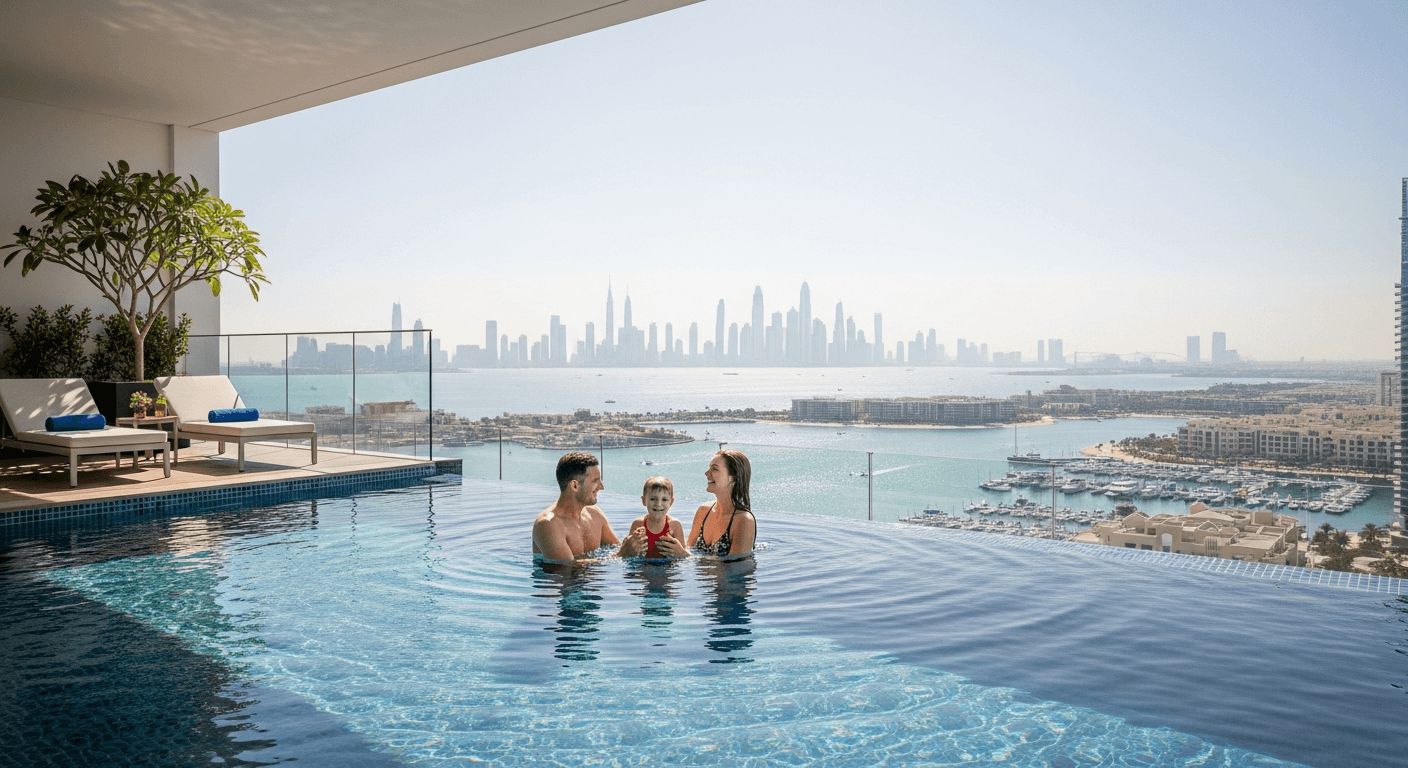
The True Cost of a Dubai Penthouse
Beyond the nine-figure price tags, what does it really cost to own and maintain a prime Dubai penthouse? I'll break down every fee, from transaction costs to service charges in Dubai's most exclusive sky-homes.

As the Apartments Editor at Gaia Living, I spend my days analyzing floor plans and comparing building amenities. But the question I get most often from clients considering the pinnacle of the market is surprisingly simple: What is the *real* Dubai penthouse cost? It's a question that goes far beyond the headline-grabbing sale price. The answer involves a detailed look at transaction fees, recurring operational costs, and the intangible value of holding a true trophy asset.
Here's what we'll explore in this deep dive:
- Defining the modern 'penthouse' in Dubai's unique market.
- A tour of purchase prices in prime locations like Palm Jumeirah and Downtown.
- The significant upfront costs beyond the sale price.
- A detailed analysis of recurring penthouse service charges.
- The anatomy of a trophy asset and its value-driving features.
- A worked example calculating the total cost of ownership for an AED 50 million penthouse.
- My final verdict on a penthouse value analysis: home, investment, or both?
What Exactly is a 'Penthouse' in Dubai?
The term 'penthouse' has become one of the most liberally used in real estate marketing. In many developments, it simply refers to any apartment on the highest floor, regardless of its size or features. However, in the ultra-luxury segment where properties trade for tens or hundreds of millions of dirhams, the definition is far more specific and demanding. Here, a penthouse is not just an apartment; it's a category of home unto itself, akin to a mansion in the sky.
In my experience, a true 'trophy' penthouse in Dubai today must have several non-negotiable characteristics. Firstly, scale. We are talking about vast living spaces, typically starting from 6,000 sq ft and often exceeding 20,000 sq ft. These are frequently spread across multiple levels — duplex, triplex, or even quadplex layouts. The most exclusive are 'simplex' penthouses that occupy an entire floor, offering true 360-degree privacy and panoramic views. This sense of horizontal, villa-like space within a tower is a key differentiator.
Secondly, the private amenities are what separate these homes from standard apartments. A private swimming pool on a terrace is now the baseline expectation. Top-tier penthouses feature multiple pools, private gyms, spa rooms with saunas and steam rooms, cinemas, and dedicated office suites. Developers like AHS Properties and Omniyat have made these features central to their offerings, understanding that the buyer at this level seeks a self-contained private resort, not just a residence. These spaces must be genuinely private and for the exclusive use of the penthouse owner, not just a 'private access' section of a shared facility.
Finally, the architectural volume is critical. Soaring double-height ceilings, often reaching 6 to 8 metres in the main living areas, create a sense of grandeur that a standard apartment cannot replicate. This is complemented by expansive outdoor terraces that are more like sky gardens, often featuring full-scale landscaping, outdoor kitchens, and multiple seating areas. When I review a floor plan for a potential penthouse listing, I'm looking for a smooth flow between indoor and outdoor living, a feature that developers like Meraas have perfected in projects across City Walk and Bluewaters Island.
The Purchase Price: A Tour of Prime Locations
 Featured project
The sticker price for prime Dubai penthouses is where the headlines are made, and for good reason. These assets represent the apex of the market, with values that reflect their extreme scarcity and unparalleled luxury. The location is the primary determinant of this value, with a clear hierarchy of 'triple-prime' addresses.
Palm Jumeirah remains the undisputed king for waterfront penthouses. Here, the view is everything. A penthouse with a direct, unobstructed vista of the sea, the Marina skyline, and the Ain Dubai will always command a significant premium over one with a partial or obstructed view. In buildings like Atlantis The Royal Residences, penthouses have set records, with prices reportedly ranging from AED 60 million to well over AED 180 million. Other notable addresses like One at Palm Jumeirah by Omniyat and the W Residences offer sprawling units with superyacht-level finishes, where prices consistently sit in the AED 70 million to AED 200 million+ bracket. The key driver here is the fusion of beach resort living with the security and convenience of a vertical community.
Downtown Dubai offers a different, but equally compelling, proposition: iconic urban living. The ultimate trophy here is, of course, a penthouse in the Burj Khalifa. These are incredibly rare on the secondary market and their value is almost mythical. For a more contemporary take on Downtown luxury, towers like IL Primo by Emaar Properties offer colossal full-floor penthouses directly overlooking the Dubai Opera and The Dubai Fountain. These units, often exceeding 11,000 sq ft, have commanded prices north of AED 100 million. The appeal is the walkability, the direct access to the world's largest mall and cultural hub, and the breathtaking views of the world's tallest building. The price per square foot in these prime Downtown assets can easily breach AED 7,000 to AED 10,000.
Beyond these two titans, other areas have emerged as hotspots for ultra-luxury penthouses. DIFC is home to branded residences like the Four Seasons and Waldorf Astoria, where penthouses appeal to high-net-worth financiers who value proximity to their offices. Bluewaters Island offers a unique, low-rise intimate community feel with spectacular sea and Marina views, and its limited penthouse stock is fiercely sought after. Similarly, along the Dubai Water Canal in Business Bay, branded residences from the likes of Dorchester Collection (The Lana) have introduced a new level of service and quality, with penthouse prices reflecting this pedigree, often starting from AED 75 million.
Beyond the Sticker Price: Upfront Transaction Costs
When we at Gaia Living advise a client on acquiring a high-value property, our first step is to create a comprehensive cost projection. The purchase price is just one line item. The mandatory government fees and associated transaction costs are substantial and must be factored into your budget from day one. For a multi-million dirham penthouse, these costs can amount to a significant sum.
Let’s be precise. The single largest cost is the Dubai Land Department (DLD) transfer fee, which is set at 4% of the registered purchase price. On a penthouse valued at AED 50 million, this fee alone is AED 2 million. This is a non-negotiable government charge and is the cornerstone of any property transaction in Dubai. In addition to this percentage-based fee, there are smaller administrative fees payable to the DLD, which currently stand at AED 4,200 for properties valued above AED 500,000. These fees are detailed on the official DLD website.
Next, you must account for the fees paid to the various parties facilitating the transaction. Here is a typical breakdown:
- Real Estate Agency Fee: The standard commission in Dubai is 2% of the purchase price. For a professional brokerage guiding a complex, high-value transaction, this fee is well-earned. On our AED 50 million example, this amounts to AED 1 million. Crucially, you must also add 5% Value Added Tax (VAT) on top of this fee, bringing the total to AED 1,050,000.
- Trustee Office Fee: The transfer of ownership is completed at a DLD-approved Trustee Office. These offices charge a fixed fee for their services, which is typically AED 4,000 + 5% VAT (AED 4,200) for properties above AED 500,000.
- Developer's No Objection Certificate (NOC): Before a property can be transferred in the secondary market, the original developer must issue an NOC. This confirms that all service charges and other dues have been settled by the seller. The fee for this certificate varies by developer but typically ranges from AED 500 to AED 5,000. For a penthouse, expect it to be at the higher end of this range.
If you are financing a portion of the purchase with a mortgage, additional costs apply. Remember that under regulations from the Central Bank of the UAE, for a property over AED 5 million, the maximum loan-to-value for an expatriate's first property is 80%, meaning a minimum 20% down payment is required. You will also pay a bank arrangement fee, typically up to 1% of the loan amount, plus a property valuation fee of around AED 3,000-5,000. For a penthouse, the valuation is a specialized process and may cost more. All told, a buyer should prudently budget for approximately 6-7% of the purchase price in total upfront costs.
The Silent Partner: Deconstructing Penthouse Service Charges
If the upfront costs are a one-time hurdle, the annual service charges are a significant, recurring financial commitment that every owner must understand. In my view, this is one of the most critical elements in a proper penthouse value analysis. For a large property, these fees can easily equal the cost of renting a luxury apartment elsewhere in the city. The funds are used to maintain the building's common areas, amenities, and overall standard of living, and are regulated by Dubai's Real Estate Regulatory Agency (RERA).
Service charges are calculated on a per-square-foot basis, based on the total area of your unit as registered on your Title Deed. The rate is set annually by the approved Owners Association Management company and must be audited and approved by RERA. You can view approved charges for any building through the official Dubai REST app. For a standard apartment tower in a community like Dubai Marina, service charges might range from AED 16 to AED 25 per sq ft. However, for the caliber of building that houses a prime penthouse, the costs are substantially higher.
In a luxury, non-branded tower with extensive amenities — think large pools, a state-of-the-art gym, cinema, and 24-hour concierge, the charges will likely fall in the AED 30 to AED 50 per sq ft range. For a 10,000 sq ft penthouse, this translates to an annual bill of AED 300,000 to AED 500,000. For ultra-luxury branded residences, where the service levels are on par with a five-star hotel, the charges are even higher. It is not uncommon to see service charges in the range of AED 60 to AED 80+ per sq ft for properties associated with brands like The Dorchester Collection, Four Seasons, or St. Regis. For that same 10,000 sq ft penthouse, the annual charge could approach AED 800,000.
So what do these elevated penthouse service charges actually cover? The list is extensive:
- Staffing: 24/7 security, a dedicated multi-lingual concierge team, valet parking staff, bellhops, and a large team of cleaners and maintenance technicians.
- Amenities: Maintenance and operational costs for pools (often including chilling/heating), high-end gym equipment (including service contracts), spa facilities, residents' lounges, and landscaping.
- Utilities: Common area electricity (DEWA) and cooling (chiller) costs, which can be substantial for large lobbies and amenity floors.
- Maintenance & Insurance: The master community fee, building insurance, elevator maintenance contracts, and a 'sinking fund' for future capital expenditures like facade cleaning or system replacements.
When we review these costs with clients, we emphasize that high service charges are not inherently negative. They are an investment in protecting the value of your asset and ensuring the lifestyle you paid for. A building with low service charges might be cutting corners on maintenance, which will inevitably lead to a decline in quality and, ultimately, property value. The key is to ensure the cost is justified by the level of service, management transparency, and quality of the amenities provided.
Anatomy of a Trophy Asset: Features That Command a Premium
What makes a penthouse worth AED 100 million? The answer lies in a collection of specific, high-value features that create an experience no other property type can offer. As an analyst of apartment layouts, I've seen how certain elements consistently add tangible value and command a significant premium. These are the details that separate a genuine trophy asset from a simple large apartment.
First and foremost is the private elevator and lobby. The ultimate luxury is privacy. Top-tier penthouses offer a dedicated elevator that opens directly into the residence. There are no shared hallways. Often, this is paired with a private, air-conditioned garage space for multiple vehicles, with a secure entrance leading directly to the private lift lobby. This creates a smooth, paparazzi-proof journey from your car to your home. This feature alone can add millions to the value, as it completely changes the dynamic of high-rise living.
Second, as mentioned earlier, is the private pool. But the specifics matter immensely. A small plunge pool is a nice feature; a 15-meter rooftop infinity pool that allows for actual swimming is a game-changer. The engineering and structural work required to support such a feature at height are immense, and its cost is reflected in the price. The best penthouses position these pools to take full advantage of iconic views, creating a 'wow' factor that is central to the property's appeal. The terrace space surrounding the pool is just as important, needing enough room for sun loungers, dining areas, and landscaping to feel like a true resort deck.
Third are the 'back-of-house' facilities. A penthouse that will be a primary residence for a high-net-worth family needs functional, well-designed service areas. This includes a large, industrial-grade 'wet' or 'greasy' kitchen, entirely separate from the open-plan 'show' kitchen. It also requires dedicated staff quarters with their own entrance, kitchenette, and living space. This operational efficiency is a hallmark of a thoughtfully designed penthouse. It acknowledges that a home of this scale requires staff to run smoothly, and it provides for them appropriately.
Other high-end apartment features that add significant value include: - Smart Home Automation: Not just app-controlled lighting, but fully integrated Crestron or similar systems that manage security, climate, audio-visual systems, and curtains from a central interface. - Showcase Storage: Walk-in wardrobes that resemble high-end fashion boutiques, climate-controlled cellars for wine or cigars, and even private art galleries with museum-grade lighting. - Wellness Suites: Dedicated rooms for a private gym with Technogym equipment, a yoga studio, and a spa with a massage table, sauna, and steam room. This brings the five-star hotel experience into the home. - Branded Finishes & Fittings: The use of globally recognized luxury brands for everything from the kitchen appliances (Gaggenau, Miele) and sanitary ware (Fantini, Dornbracht) to the marble (Calacatta, Statuario) and wood flooring signifies a no-compromise approach to quality.
“The question isn't whether a penthouse can generate a 6% yield; it's whether you can put a price on a private lobby, 360-degree skyline views, and the world's best services at your beck and call. For the true buyer, the answer is no.”
Worked Example: The Full Cost of an AED 50 Million Penthouse
To synthesize all these elements, let’s walk through a concrete example. Imagine you have found your ideal penthouse in the secondary market. It's a 12,000 sq ft duplex in a prime, non-branded but high-quality building in Dubai Hills, and you have agreed on a purchase price of AED 50,000,000. Let's calculate the true cost of acquisition and the first year of ownership.
First, the one-time upfront costs. This is the capital you need available in cash, on top of any mortgage down payment.
Upfront Acquisition Costs (Cash Purchase): - Purchase Price: AED 50,000,000 - DLD Transfer Fee (4%): AED 2,000,000 - DLD Admin Fee: AED 4,200 - Trustee Registration Fee (incl. VAT): AED 4,200 - Agency Fee (2%): AED 1,000,000 - VAT on Agency Fee (5%): AED 50,000 - Developer NOC Fee (estimate): AED 5,000 - Subtotal Upfront Costs: AED 3,059,400
Total Capital Outlay at Purchase: AED 53,059,400
This demonstrates that to acquire a fifty-million dirham property, you need over three million dirhams in additional liquid funds just to cover the transaction. This is a crucial budgeting point that is often underestimated by first-time buyers in Dubai.
Now, let's look at the recurring annual costs. We'll assume a service charge of AED 45 per sq ft, which is a realistic figure for a high-end building with excellent amenities in this location.
Estimated Annual Running Costs: - Service Charges: 12,000 sq ft x AED 45/sqft = AED 540,000 - Home Insurance: A comprehensive policy for a property of this value could be approximately AED 25,000 - AED 40,000 - Utilities (DEWA & Chiller): Given the size and features like a private pool, a realistic budget would be at least AED 10,000 - AED 15,000 per month, totaling AED 120,000 - AED 180,000 annually. - Basic Maintenance: For things not covered by service charges (internal systems, appliance servicing): AED 20,000+ - Total Estimated Annual Cost: AED 705,000 - AED 780,000
This annual budget of over AED 700,000 is the true cost of *living* in and maintaining your asset. It's a number that must be comfortable for you, independent of any potential rental income or capital appreciation. It underscores that owning a penthouse is not a passive act; it is an active, ongoing financial commitment.
Penthouse Value Analysis: Home, Investment, or Status Symbol?
After analyzing the immense costs, the final question is one of value. Is a luxury penthouse Dubai a sound financial investment, a pure lifestyle purchase, or something else entirely? In my experience working with clients at this level, it's almost always a combination of all three, but the weighting is deeply personal.
From a pure investment standpoint, penthouses are an interesting case. Their rental yields, as a percentage of their purchase price, are typically lower than smaller, mainstream apartments. You are unlikely to achieve a 6-8% gross yield on an AED 50 million property; a yield of 2-4% is more realistic. However, the absolute rental income can still be substantial, potentially reaching AED 1.5 - 2.5 million per year. For an investor focused on cash flow, this can be attractive. The more compelling investment case is capital appreciation. True trophy assets are, by definition, scarce. There is only one penthouse at the top of a given iconic building. This scarcity can insulate them from wider market downturns and lead to outsized price growth during upswings. They are part of a global market for trophy real estate, attracting buyers from all over the world, which further stabilizes their value.
For the majority of buyers I meet, however, the primary motivation is lifestyle. The penthouse is not an asset on a spreadsheet; it is their home. They are buying the space, the privacy, the security, and the unmatched experience. They are buying the convenience of having world-class dining, wellness, and entertainment within their own building or a short walk away. For this type of buyer, the Dubai penthouse costs are the price of admission to a life of unparalleled comfort and luxury. The financial return is a secondary consideration. The real 'return on investment' is measured in quality of life, time saved, and memories created with family and friends in an extraordinary setting.
Finally, we cannot ignore the element of status. Owning a landmark penthouse in a global city like Dubai is a powerful statement. It signifies a certain level of achievement and success. While few clients would state this as their primary reason for buying, it is an undeniable part of the asset's appeal. It's a tangible legacy and a source of pride. The value here is intangible but very real. My ultimate verdict is that a prime penthouse should be approached as a lifestyle acquisition first. It's a purchase made from the heart, but it must be underwritten by a very clear-headed analysis of the costs. If the substantial annual running costs are comfortable for you, then the potential for capital appreciation and the immense pride of ownership make it one of the most rewarding assets one can own.
The true cost of a prime Dubai penthouse involves adding approximately 6-7% of the purchase price for upfront transaction costs and budgeting for annual service charges that can easily exceed AED 500,000. This is a lifestyle acquisition first and an investment second.
Sources
- Dubai Land Department (DLD): https://dubailand.gov.ae/
- Real Estate Regulatory Agency (RERA): Rules and service charge information are accessible via the DLD portal and Dubai REST app.
- Central Bank of the UAE (CBUAE): https://www.centralbank.ae/
Questions, answered
- What are the typical service charges for a luxury penthouse in Dubai?
- For a prime Dubai penthouse, expect annual service charges to range from AED 30 to over AED 80 per square foot. For a 10,000 sq ft unit, this translates to AED 300,000 to AED 800,000+ per year, covering high-end amenities, security, and maintenance.
- What are the main upfront fees when buying a penthouse in Dubai?
- The main upfront costs, aside from the purchase price, include a 4% Dubai Land Department (DLD) transfer fee, a 2% (+VAT) real estate agency fee, and trustee fees. In total, you should budget for an additional 6-7% of the property's value.
- Is a Dubai penthouse a good investment?
- A Dubai penthouse should be seen primarily as a lifestyle asset. While they can offer significant capital appreciation, their rental yields are typically lower (2-4%) than smaller units. Their value lies in scarcity, prestige, and an unparalleled living experience.
- How much deposit is needed for a penthouse mortgage in Dubai?
- For a property valued over AED 5 million, the Central Bank of the UAE mandates a minimum down payment of 20% for expatriates and 15% for UAE nationals on their first property. For a second or subsequent property, this requirement increases significantly.
- What defines a 'prime' penthouse location in Dubai?
- Prime locations are defined by their prestige, views, and exclusivity. Key areas for top-tier penthouses include Palm Jumeirah for its beachfront living, Downtown Dubai for its iconic skyline views, and exclusive enclaves like Bluewaters Island and DIFC.
- Do all top-floor apartments qualify as penthouses?
- Not in the ultra-luxury segment. While developers may label any top-floor unit a 'penthouse', a true trophy asset is typically a duplex, triplex, or full-floor residence with unique features like a private pool, double-height ceilings, and extensive outdoor terraces.

Ravi lives and breathes apartment living — from studio yields in JVC to branded residences on the Palm. Floor plans, service charges, and view lines are his love language.
Related stories
Right-Sizing Your Dubai Villa for a New Chapter
As an empty nester or active retiree, your idea of the perfect Dubai home shifts. I explore the best villa communities that prioritise lifestyle and low-maintenance living over sheer size.
Dubai's AC Dilemma: The Real Cost of Cooling
Your apartment's air conditioning is more than just a utility—it's a major factor in your monthly budget and comfort. I'll break down the real costs and benefits of Dubai's two main cooling systems, helping you choose your next home wisely.
Managing Multiple Offers: A Dubai Seller's Playbook
Receiving multiple offers on your Dubai property is an excellent problem to have, but handling it incorrectly can cost you time and money. Here’s my strategic playbook for managing competitive bids to secure the best possible outcome.
Echoes, in your inbox
One thoughtful email a month. Market insight, new launches, no spam.