

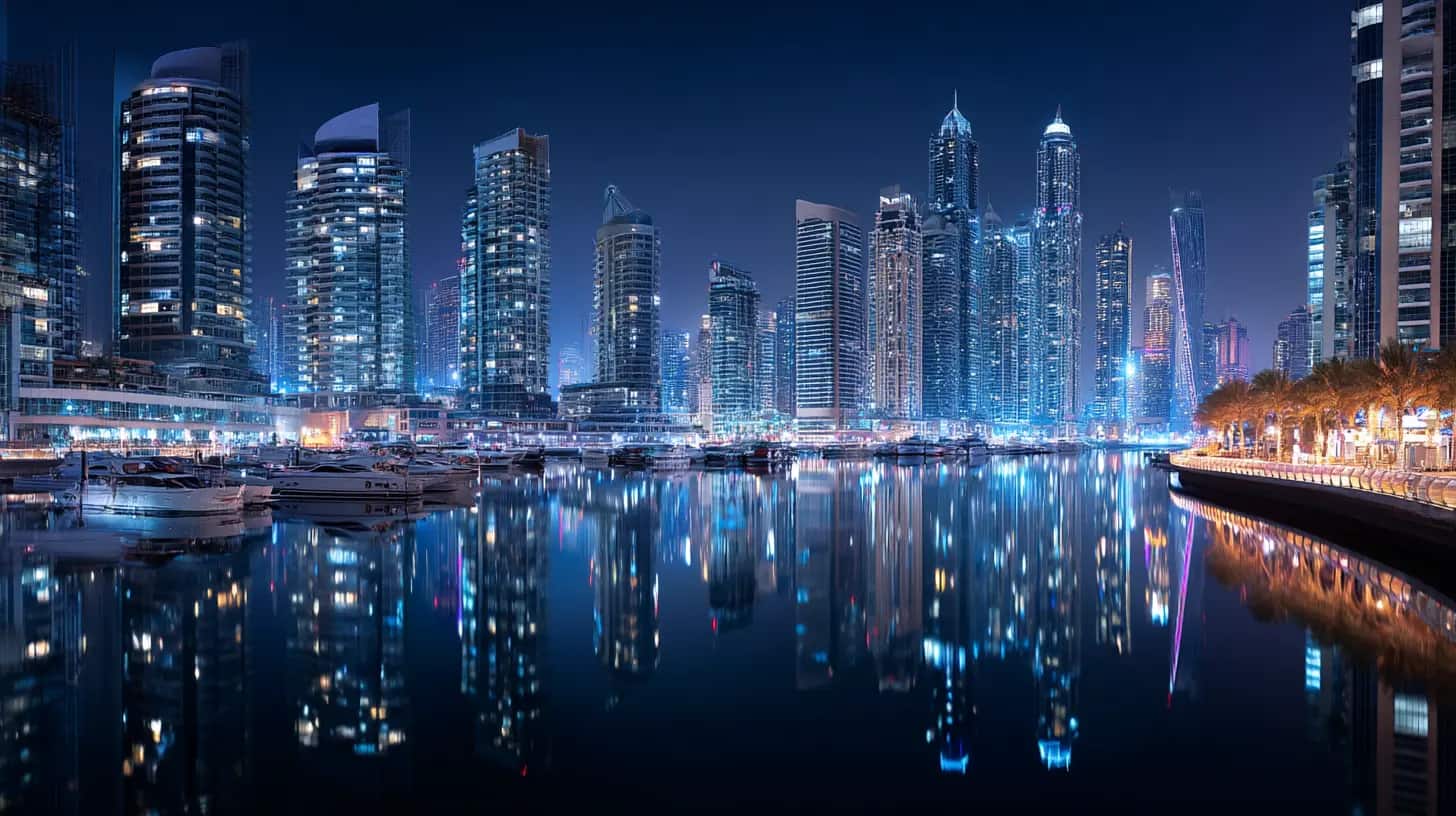
The Top Developers Shaping Dubai's Skyline
Emaar, DAMAC, Nakheel, Sobha, Binghatti, Meraas. Here's what each developer delivers, what their track records say, and what it means for buyers in 2026.
Dubai's Skyline Didn't Happen. It Was Built — by a Handful of Developers Who Bet Everything on a Vision.
Take a spot anywhere along Sheikh Zayed Road one evening, when the weather is clear, and look out over the view. The Burj Khalifa. The Address buildings. The helix of the Cayan Tower. The Opus designed by Zaha Hadid. The list of glass and steel stretching from Downtown Dubai to Dubai Marina. Every building in the view represents a decision by a particular developer, at a particular time, on a particular plot of land. Some of those decisions have created billions of dollars of value. Others have failed. Most have reshaped the cityscape.
Dubai real estate is often talked about in terms of communities and price points. But underlying those topics is a basic question set of enormous importance to the investor or buyer: who built it? Do they deliver? What does the name of the developer imply in terms of quality and resale value? In Dubai, the name of the developer is perhaps the single best indicator of quality, delivery risk, and investment performance.
This is because the market has learned this through hard experience. The 2008 crisis created a landscape of developers who had sold off-plan, collected deposits, and were unable to deliver as market conditions changed. The developers that have survived this period and retained a reputation for quality and integrity, such as Emaar, have a credibility factor that new market entrants have attempted to achieve over the past several years. The developers that failed have left consumers waiting for completions that, in some cases, never materialized.
However, as of 2026, the market is a significantly different landscape. Regulation is now in place for escrow on off-plan sales. RERA is now more powerful than it has ever been in the past. Yet, as is evident from this article, developer reputation still plays a large role in completion guarantees, quality of construction, after-sales support, and resale value when a developer's name is associated with a project.
This article will highlight developers that are currently making a significant impact on Dubai's skyline. It does not pretend to be an exhaustive list of developers; indeed, there are hundreds of developers currently active in Dubai. However, it will highlight developers that have projects that shape neighborhoods and whose launches impact markets, and whose reputations convey meaningful information to consumers as to what they are actually purchasing.
Emaar Properties: The Standard Everything Else Is Measured Against
There is no honest discussion of Dubai real estate development that doesn't start with Emaar. The company, founded in 1997 and chaired by Mohamed Alabbar, has delivered more of Dubai's defining infrastructure than any other single entity. Downtown Dubai — the Burj Khalifa, Dubai Mall, The Dubai Fountain, The Address hotels — is an Emaar project. Dubai Marina was co-developed with Emaar as the lead. Dubai Hills Estate, Arabian Ranches, Emaar Beachfront, Creek Harbour. The list is long and the scale is hard to overstate.
What Emaar has done that matters most for investors is not just deliver buildings — it's delivered communities. The distinction is important. A building is a structure. A community is a structure plus retail, plus schools, plus parks, plus roads, plus a social environment that makes people want to live there. Emaar has built communities at a scale that creates self-reinforcing demand: people want to live in Emaar developments because other people want to live in Emaar developments.
Emaar's brand premium is documented and durable. Multiple studies of Dubai transaction data have found that Emaar-branded units in comparable locations command 10% to 20% resale premiums over equivalent product from lesser-known developers. The premium is strongest among international buyers from South Asia and East Africa, where the Emaar name carries decades of marketing and track record. It is also strong among institutional buyers who use brand quality as a proxy for liquidity risk.
The company's current pipeline is as active as it has ever been. Creek Harbour — the massive masterplan on the eastern Creek including the forthcoming Creek Tower, designed by Santiago Calatrava — is Emaar's most ambitious current project. New phases in Dubai Hills, Emaar Beachfront, and a string of new community launches have kept the pipeline full through 2025 and into 2026.
Explore current Emaar developments across their active communities if you want a live picture of what's available.
DAMAC Properties: Luxury Positioning and Global Ambition
DAMAC was founded in 2002 by Dr. Hussain Sajwani and has grown into one of the most recognisable luxury real estate brands in the Middle East and beyond. Where Emaar built community infrastructure, DAMAC built lifestyle aspiration — branded residences with Trump, Versace, Fendi, de Grisogono, and Cavalli; towers with interiors by internationally recognised designers; a marketing machine that has made the DAMAC name known in markets from London to Lagos.
The business model is different from Emaar's in important ways. DAMAC is primarily a unit seller rather than a community builder — it launches projects, sells them off-plan, and delivers them. The masterplanned community experience that Emaar provides across multiple square kilometres is not typically what a DAMAC buyer is purchasing. The DAMAC buyer is purchasing a specific unit with specific design credentials in a specific location.
DAMAC Hills and DAMAC Hills 2 represent the company's most significant community-scale development — both are golf course-anchored masterplanned communities that have delivered tens of thousands of units and genuine residential populations. The Trump International Golf Club Dubai anchors DAMAC Hills in a way that has kept the community in the international conversation regardless of the political opinions about the brand.
Yield performance on DAMAC product has generally been solid — the company targets the rental investor market explicitly, and its product in communities like Business Bay and Dubai Marina has generated consistent returns. Resale liquidity depends heavily on location and project quality, which varies more across the DAMAC portfolio than across Emaar's.
Dr. Hussain Sajwani remains one of Dubai's most prominent business figures and the company's ability to attract global brand partnerships is unmatched in the regional market. DAMAC's recent expansion into international markets — the UK, Canada, and elsewhere — has added a layer of complexity to the business that pure Dubai investors don't need to track closely, but it signals the scale of the company's ambitions.
See what's currently available across DAMAC communities and current project pricing.
Nakheel: The Builder of Islands
Nakheel's story is one of the most dramatic in Dubai real estate. The company, wholly owned by the Dubai government, built the Palm Jumeirah — the most recognisable piece of real estate anywhere in the Middle East. It also nearly collapsed in 2009 when its debt load became unsustainable and required a government bailout that was one of the defining moments of Dubai's financial crisis.
What came out the other side is a more conservative, more focused developer — one that has delivered consistently through the 2010s and 2020s after restructuring. The Palm Jumeirah is not just delivered; it's a fully functioning community that has appreciated dramatically in value. The International City, Discovery Gardens, Jumeirah Village Circle — all Nakheel masterplans — house hundreds of thousands of Dubai residents.
Palm Jebel Ali is Nakheel's current flagship project and the one that has returned the company to the top tier of market conversation. Relaunched in 2023 after nearly fifteen years of dormancy, the project generated extraordinary interest and sales velocity on its first villa releases. The fronds are larger than Palm Jumeirah's, the villas more spacious, and the infrastructure commitment more explicitly detailed than the original Palm launch was.
The question that investors ask about Palm Jebel Ali is the same question that was asked about Palm Jumeirah in 2001: will it deliver what it promises on the timeline it promises? Nakheel's track record since its restructuring suggests yes — but the scale of the project means execution risk is real. Buyers going in are making a calculated bet on that delivery.
Nakheel also has significant retail and hospitality infrastructure across its communities — Nakheel Mall, Ibn Battuta Mall, Dragon Mart — that reinforces the livability of its residential developments in ways that purely residential developers can't.
Browse Nakheel's current projects to see what's available across Palm Jebel Ali and other active communities.
Sobha Realty: The Vertically Integrated Outlier
Sobha occupies a distinctive position in Dubai's developer landscape because its business model is genuinely different from the others. Most Dubai developers are essentially marketing and project management operations — they sell off-plan, outsource construction to contractors, and manage the delivery process. Sobha builds almost everything in-house. Design, construction, interiors, landscaping — all done by Sobha Group entities.
PNC Menon, the Indian entrepreneur who founded Sobha Group in the UAE in 1976 before expanding into residential development, built the company around a quality-first philosophy that the in-house construction model was designed to deliver. Whether you agree with the philosophy or not, the product speaks for itself. Sobha Hartland — the company's flagship Dubai community on the Meydan waterfront — has consistently delivered above-average build quality relative to price point, and buyers have noticed.
Sobha Hartland launched in phases from around 2018 and has delivered a combination of apartments, townhouses, and mansions around a waterfront and green corridor setting. Sobha Hartland II, the second phase of the masterplan, is currently active with multiple towers under construction and selling. The community's proximity to Downtown — roughly ten minutes by road — combined with waterfront access at a price point below Emaar Beachfront has made it a genuine value proposition for buyers who want quality at a mid-market price.
Rental yields in Sobha Hartland have been consistently strong — 6% to 7.5% gross for well-located apartments — and the build quality has supported above-average tenant retention. Investors who bought in early phases have seen capital appreciation in the 50% to 70% range since 2020, which is not the Palm or Emaar Beachfront number but is solid for a community that was mid-construction during that period.
The company's expansion into other UAE markets and internationally has been aggressive. Sobha One, Sobha Reserve, and several new project names have added to the pipeline significantly. The risk for investors is whether the quality consistency that defines the Sobha brand can be maintained at greater scale and complexity.
Take a look at Sobha's active projects for current availability and pricing across the Hartland communities.
Binghatti: The Developer That Rewrote the Mid-Market
If you want to understand how quickly a developer can go from obscurity to genuine market force in Dubai, look at Binghatti. Five years ago the company was known primarily for its distinctive geometric facade designs and a reputation for quick delivery in communities like JVC and Business Bay. Today it is the developer behind some of the most talked-about branded residence launches in the city — Bugatti Residences, Jacob & Co Residences, Mercedes-Benz Places — and is competing for buyers at price points that would have been unthinkable for a Binghatti project in 2019.
Muhammad BinGhatti, the company's CEO and the designer behind the signature facades, has become one of Dubai's most visible developer personalities. His combination of architectural ambition, delivery speed — Binghatti consistently delivers projects faster than the market expects — and aggressive brand partnership strategy has repositioned the company in a way that no conventional developer marketing could have achieved.
Binghatti's delivery track record is the most frequently cited competitive advantage by agents and investors who follow the company closely. In a market where off-plan delays are a genuine and recurring risk, a developer with a consistent record of early or on-time delivery is worth a premium for buyers who are price-sensitive about timing. Binghatti's construction model — the company controls more of its supply chain than most Dubai developers — is the structural reason behind that track record.
The mid-market product in JVC and Business Bay generates consistent yields — 6% to 8% gross for well-located units — and the tenant pool for Binghatti's product is wide and active. The newer ultra-luxury branded residences are a different investment case entirely: higher capital values, lower yields, more concentrated buyer profiles, and significant execution risk given the novelty of the brand partnerships.
View Binghatti's current projects to see the range from accessible mid-market apartments to flagship branded developments.
Meraas: Where Lifestyle Infrastructure Meets Residential
Meraas is a different type of developer from the others in this list. It was established by the Dubai government specifically to develop lifestyle destinations — retail, hospitality, entertainment, and the residential product that sits alongside those destinations. City Walk, Bluewaters Island, La Mer, Bvlgari Resort Dubai, the Coca-Cola Arena — all Meraas projects.
The residential product Meraas develops is almost always positioned adjacent to a lifestyle anchor that the company itself has built and operates. This is the key distinction. A Meraas apartment in City Walk or on Bluewaters isn't just in a nice location — it's in a location where the developer has a long-term interest in maintaining the quality and vibrancy of the surrounding environment. That alignment of interests between the developer and the residential buyer is unusual and genuinely valuable.
City Walk has become one of Dubai's most successful urban lifestyle districts — walkable, well-maintained, with a quality of public realm that most Dubai communities don't achieve. The residential product within it has appreciated strongly and commands rental premiums that reflect the lifestyle infrastructure. Bluewaters Island, discussed in the waterfront article, represents the same model at a smaller scale with an even more controlled environment.
Hussain Sajwani of DAMAC and Mohamed Alabbar of Emaar are the most prominent developer personalities in the market. But Abdullah Al Habbai, Group Chairman of Meraas, has overseen a portfolio of destination developments that have shaped how Dubai residents experience their city as much as any residential developer has. The Meraas approach to development — experience first, residential second — produces assets that are harder to analyse on conventional yield metrics but have demonstrated strong long-term value retention.
Meraas product tends to attract end users and premium buy-to-let investors rather than yield-maximising investors. The numbers on yield are lower than Emaar or Sobha in comparable price brackets. The numbers on capital retention and lifestyle quality are higher.
Gaia Realty Original Research: Developer Performance Snapshot, Q1 2026
Based on DLD transaction data, secondary market analysis, and yield data from active property management engagements across developer portfolios as of Q1 2026.
Emaar Properties:
- Average resale premium over non-branded equivalents: 12% to 18%
- Average gross yield across portfolio: 5.5% to 7%
- Average days on market (secondary): 21 days
- Off-plan delivery record: 94% within 6 months of target date
DAMAC Properties:
- Average gross yield across portfolio: 6% to 8%
- Average days on market (secondary): 27 days
- Off-plan delivery record: 86% within 6 months of target date
- Strongest yield communities: Business Bay, DAMAC Hills 2
Nakheel:
- Palm Jumeirah average capital appreciation since 2020: 90% to 130% by product type
- Palm Jebel Ali Phase 1 current secondary premium over launch: 35% to 50%
- Average days on market (Palm Jumeirah secondary): 26 days
Sobha Realty:
- Sobha Hartland average gross yield: 6% to 7.5%
- Average capital appreciation since 2020: 50% to 70%
- Average days on market (secondary): 24 days
- Tenant retention rate: 71% annual renewal
Binghatti:
- Average gross yield (JVC and Business Bay product): 6.5% to 8.5%
- Average days on market (secondary): 19 days — fastest of all profiled developers
- Off-plan delivery record: 91% on or ahead of target date
Meraas:
- City Walk average gross yield: 5% to 6.5%
- Bluewaters Island average gross yield: 4.5% to 5.5%
- Average capital appreciation across portfolio since 2020: 45% to 65%
- End-user buyer share: 72% — highest of all profiled developers
What Developer Choice Actually Means for Investors
The developer profiles above are useful context. What they need to translate into is a framework for how developer identity should affect investment decisions.
For off-plan buyers, developer delivery track record is the most critical variable. An off-plan purchase is a promise — you're buying an asset that doesn't exist yet, based on the developer's commitment to deliver it at a specified quality by a specified date. Developers with strong delivery records — Emaar, Binghatti, and Sobha consistently — reduce the execution risk that is the dominant risk in off-plan investment. Developers with weaker records introduce uncertainty that should be priced into the decision.
For resale investors, brand premium and liquidity matter most. Emaar's brand premium is the most durable in the market. Sobha's quality premium supports above-average tenant retention. Binghatti's delivery speed supports confidence in secondary buyers. Meraas's lifestyle integration supports premium pricing in constrained locations. None of these premiums is guaranteed to persist indefinitely, but they have been consistent for long enough to be built into investment cases.
For yield-focused investors, developer brand matters less than location and product type. A well-located Binghatti apartment in Business Bay will outperform a poorly located Emaar apartment in a less-demanded community on pure yield metrics. Brand matters more for capital preservation and resale liquidity than for initial yield generation.
Our property listings span all of the developers profiled here. If you want to compare current pricing and availability across developer portfolios in specific communities, our agents can run that analysis for you directly.
Questions People Ask About Dubai's Top Developers
Is Emaar always the safest bet for off-plan investment?
Emaar has the strongest delivery track record and the most durable brand premium. But "safest" depends on your objectives. If yield is the priority, other developers in better-yielding locations may outperform Emaar. If capital preservation and liquidity matter most, Emaar is hard to argue against.
How do I check a developer's delivery record before buying off-plan?
Ask your agent for data on the developer's last five completed projects — target completion dates versus actual completion dates. RERA's developer performance data is publicly accessible. Off-plan forums and buyer communities are also useful for ground-level feedback.
Is DAMAC's branded residence strategy a good investment?
Branded residences command launch premiums that can be 20% to 40% above unbranded equivalents. Whether that premium is sustained on resale depends on the brand's longevity and the community's fundamentals. Versace and Fendi have proven durable. Newer brand partnerships carry more uncertainty.
What happened to developers who failed in 2008 and why does it matter now?
Dozens of developers defaulted on off-plan projects during the 2008 crisis, leaving buyers without completed units or deposits. RERA's escrow requirements — introduced post-crisis — now ring-fence buyer payments. The systemic risk is lower, but individual developer financial health still matters. Check that escrow accounts are properly funded before buying off-plan.
Does the developer matter for a ready property purchase?
Less than for off-plan. With a ready property the asset exists — you can inspect it. Developer brand still affects resale liquidity and rental demand, but you're not taking delivery risk. Focus on the physical property, service charge quality, and building management.
Which developer builds fastest?
Binghatti. Consistently. Their construction model gives them more control over timelines than developers who outsource construction. Multiple completed projects have delivered ahead of schedule.
Is Sobha really better quality than other developers?
Consistently above average for the price point, yes. The in-house construction model reduces the quality variability that comes with outsourced builds. It's not the highest-specification product in the market at the top end — that's Meraas and some boutique developers — but it's the most reliable quality-to-price ratio in the mid-market.
Can I buy from any of these developers directly without an agent?
Yes. All major developers sell directly. The practical question is whether buying directly gives you any advantage — it generally doesn't on price, since developer pricing is fixed at launch. An agent with developer relationships can sometimes access better allocations, earlier launch access, or payment plan flexibility that direct buyers don't get.
What's the difference between a developer's primary market price and the secondary market price?
Primary is the developer's launch price for off-plan or new stock. Secondary is what existing owners are asking for completed or near-complete units. In active markets, secondary prices often exceed primary — which is why early off-plan access matters. In slower markets, secondary can trade below primary if sentiment has shifted.
Are there good smaller developers worth considering?
Yes. Ellington Properties is consistently cited for design quality in the mid-market. Omniyat develops ultra-luxury product — the Opus by Zaha Hadid is an Omniyat project — at a standard that competes with Meraas at the top end. Danube offers some of the most accessible price points in the market with a reasonable delivery record.
Does developer reputation affect how quickly I can sell?
Significantly for villas and larger apartments. Emaar and Sobha branded units attract wider buyer pools and sell faster on the secondary market. For studios and one-bedrooms in high-demand communities, location matters more than developer brand on liquidity.
What should I ask a developer before buying off-plan?
Five questions matter most: what is the escrow account structure and who is the escrow agent? What is the payment plan and what triggers each instalment? What is the target handover date and what are the contractual remedies if it's missed? What is the service charge estimate and how is it calculated? And what does the developer's track record look like on their last three completed projects?
The Developers Who Build the Skyline Also Build the Investment Case.
Dubai's skyline is the most obvious expression of developer ambitions around the globe. It is also an investment portfolio owned by hundreds of thousands of people who, at some point in time, chose to invest in specific developers. Some of these bets have been highly profitable, others less so. Between these extremes, however, there exists little random variation.
Developers such as Emaar, Nakheel, DAMAC, Sobha, Binghatti, and Meraas, which dominated the development of Dubai's skyline, share a singular attribute: they delivered. Not always completely, not always on time, not always as promised. But they delivered buildings, buildings that created communities, communities that created residents, and residents whose presence sustained and increased asset values over time. This ability to deliver is at the heart of every investment case.
For those looking at investing in 2026, things are clearer than they were in 2006 or 2016. The developers who have delivered are identifiable by name. The factors by which they differ—the speed of delivery, the performance of their yields, their liquidity, and their premium pricing—are increasingly transparent. The system has made off-plan investment more secure than at any time during the crisis years. None of this removes risk, of course, but it at least allows buyers to make decisions based on facts rather than gamblers' odds.
The skyline will continue to change. The Creek Tower will rise above all else. Palm Jebel Ali will add a further dimension to the Creek's story. New developers will enter and establish their credentials in the same manner as those who came before. But nothing has changed: invest with developers who deliver, in communities created by genuine demand, at prices that allow the system to reward long-term investors.
If you want to explore what's currently available across any of these developers' portfolios and talk through what makes sense for your situation, reach out and we'll take it from there.
Related stories
Dubai's Established Charm: The Case for Older Homes
In a city focused on the future, I believe the smartest move for many buyers is to look back. Dubai's seasoned communities offer space, character, and surprising value that new builds often can't match.
The True Cost of Owning a Dubai Property
Beyond the purchase price, your annual budget for a Dubai home must account for service charges, utilities, and maintenance. I'll break down every ongoing expense you need to plan for.
Calculating ROI on Dubai Rental Upgrades
As a landlord in Dubai, you can't just follow trends. I'll show you how to calculate the precise ROI of minor property upgrades to genuinely increase your rental yield.
Echoes, in your inbox
One thoughtful email a month. Market insight, new launches, no spam.