

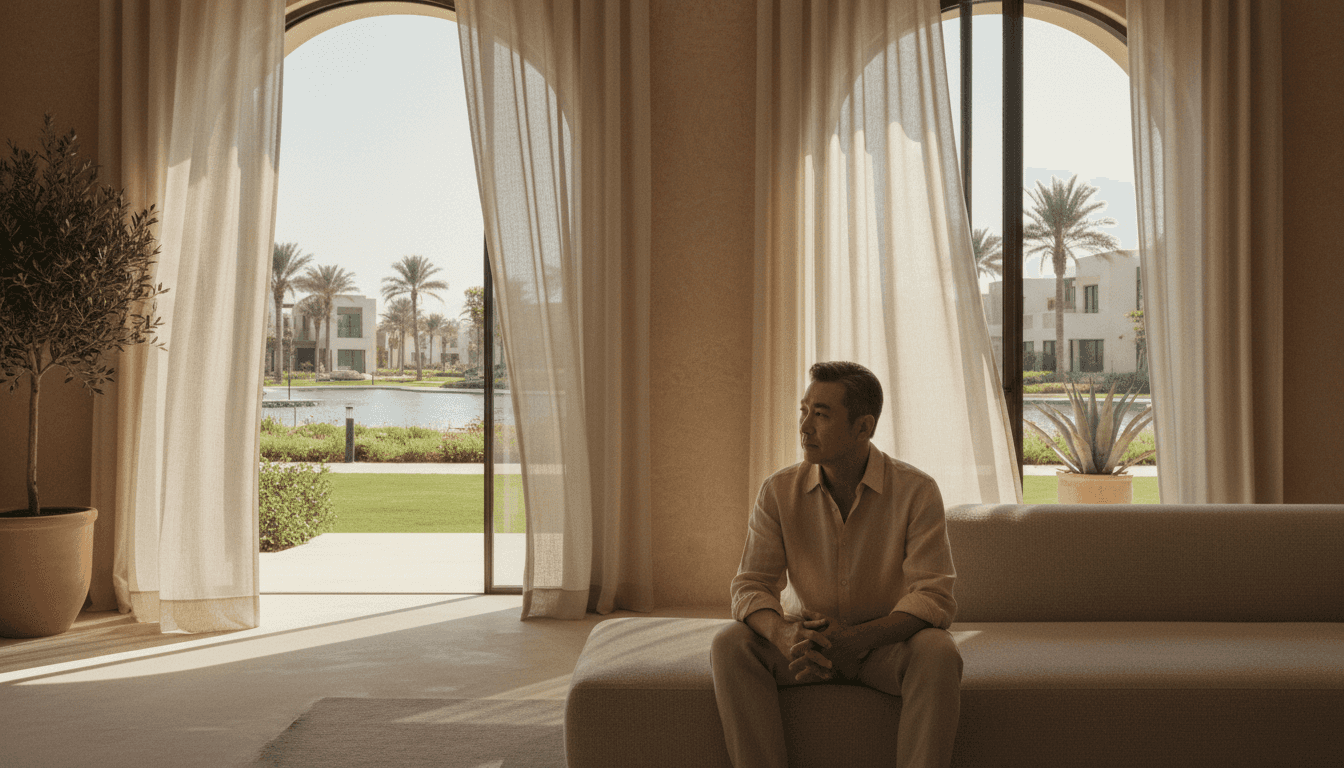
The Social Fabric of Dubai's Villa Communities
A deep dive into how community events and shared spaces are the true foundation of family life in Dubai's most sought-after villa neighbourhoods.

When clients ask me what truly makes a villa community feel like 'home', my answer rarely starts with square footage or architectural style. It begins with the vibrant, and sometimes invisible, social fabric that holds a neighbourhood together.
Here’s what we’ll explore in this guide:
- The shift from transient expat life to deep-rooted community living in Dubai.
- How master developers like Emaar and Damac act as social architects.
- The role of service charges in funding a vibrant community life.
- A look at the different event calendars in established versus new communities.
- How to assess a community's social health before you decide to buy or rent.
- The crucial role of digital groups and informal gatherings.
- My personal verdict on which communities get the social balance right.
From Transient Hub to Rooted Hometown
For years, the story of Dubai was one of transience. It was a place people came for a few years to advance a career before moving on. That narrative has fundamentally changed. Today, I see more families putting down deep, permanent roots, and a key reason for this is the evolution of the city's residential communities. The shift is most pronounced in the sprawling villa neighbourhoods that ring the city's core. These aren't just collections of houses anymore; they are engineered ecosystems designed to foster connection, belonging, and a genuine sense of neighbourhood life that rivals what you might find in any established global suburb. This is where the true value lies for families looking for more than just a property.
I remember the early days of communities like the original Arabian Ranches. The promise was clear: a spacious family home with a garden, away from the bustle of the city. But what really cemented its success wasn't just the villas themselves. It was the shared pools, the village-like retail centre, the golf club, and the school within walking distance. These were the physical anchors. The social anchors came next: the first Halloween 'trick or treat' street parties, the impromptu weekend barbecues in the park, the coffee mornings that turned into lifelong friendships. This became the blueprint. Developers realised that building Dubai community events into the master plan was as crucial as planning the road network. They weren't just selling real estate; they were selling a lifestyle and, more importantly, a support system.
The Golden Visa programme has accelerated this trend dramatically. By offering long-term residency, it has given thousands of families the confidence to view Dubai as their forever home. This long-term mindset changes everything. People are no longer just temporary residents; they are stakeholders. They care about their neighbours, the quality of the local school, and the upkeep of the park where their children play. They invest emotionally, not just financially. This is the fertile ground in which a strong community spirit Dubai can grow. When we at Gaia Living advise families, we now spend as much time discussing the 'feel' of a community and its social calendar as we do the property's specifications.
The Developer as Social Architect
 Featured project
In Dubai, the master developer's role extends far beyond construction. In the most successful communities, they are active social architects, and their instrument is the community management company. These aren't sleepy building managers who just fix leaks and collect fees. They are event planners, activity coordinators, and communication hubs rolled into one. Developers like Emaar Properties, Damac Properties, Nakheel, and Sobha Realty have dedicated teams whose entire job is to curate a calendar of family activities Dubai villas residents can enjoy. This is a powerful differentiator in a competitive market. It creates loyalty and sustains property values over the long term.
Take Emaar Community Management, for instance. They are the gold standard, in my opinion. In communities like Arabian Ranches or the Meadows, their calendar is relentless in the best way possible. You'll see large-scale events for major holidays — Eid celebrations with traditional food and entertainment, vibrant Festival of Lights for Diwali, Christmas markets with fake snow and Santa's grotto. But it's the smaller, regular events that do the heavy lifting of community building. Think outdoor movie nights on a giant inflatable screen in the park, farmers' markets on a Saturday morning selling organic produce, or fitness challenges that get neighbours training together. These neighbourhood gatherings are the moments where casual acquaintances become genuine friends.
Damac has adopted a similar model for their vast Damac Hills and Damac Hills II communities. Given the scale, they've created event hubs like the Malibu Bay wave pool or the central park areas, which become focal points for everything from food truck festivals to national day fireworks. They understand that amenities without programming are just concrete. It's the activation of these spaces that creates a soul. For families, this is a huge draw. It means weekends aren't a constant scramble to find entertainment for the kids; the entertainment is brought to their doorstep, creating easy opportunities for social connections in communities.
The Price of Belonging: Understanding Service Charges
This vibrant community life doesn't just appear out of thin air. It's paid for by the residents through annual service charges. This is often a point of contention for buyers, but I always encourage them to look past the headline number and understand what it actually delivers. In Dubai, service charges are regulated by the Real Estate Regulatory Agency (RERA), and owners have visibility on how their money is spent through the Mollak system, which you can access via the Dubai REST app. A significant portion of this budget is allocated to 'Community Management & Events'.
When you're comparing properties, looking at the service charge per square foot is essential. A typical villa community might have charges ranging from AED 3 to AED 6 per square foot on the built-up area annually. For a standard 4,000 sq. Ft. villa, this translates to AED 12,000 to AED 24,000 per year. While the lower end might seem more attractive, it's crucial to ask what's being cut. Often, the first thing to go in a cost-saving exercise is the 'soft' stuff: the events, the holiday decorations, the extra security patrols that make kids feel safe. The communities with the most robust social calendars tend to be those where residents accept a slightly higher service charge in return for a superior living experience. It's a direct investment in your family's quality of life.
Here’s a simplified breakdown of what a typical service charge budget for a villa community might include:
- Common Area Maintenance: Landscaping, street cleaning, pool maintenance, pest control.
- Utilities: Electricity and water for streetlights, pools, and community buildings.
- Security: 24/7 security staff, gatehouse operations, and CCTV monitoring.
- Management Fees: The cost of the community management company.
- Insurance: Public liability insurance for all common areas.
- Capital Reserve Fund: A sinking fund for major future repairs (e.g., re-paving roads, replacing pool pumps).
- Community Enhancement: This is the budget for events, holiday decorations, newsletters, and social initiatives.
When a community's service charges are too low, it's the last two items on this list that suffer. The reserve fund gets depleted, leading to surprise 'special levies' down the line, and the community enhancement budget disappears, leaving the parks empty and the noticeboards bare. A well-run community with a healthy budget for Dubai community events is often a sign of a well-managed and financially stable owners' association.
Established vs. New: Two Types of Social Scene
There's a fascinating difference between the social dynamics of an established community and one that's brand new and still in the handover phase. Neither is inherently better, but they offer very different experiences for families moving in. Established communities, like The Meadows or Jumeirah Islands, have a social scene that is mature and deeply entrenched. The annual traditions are set, the neighbourhood WhatsApp groups have been running for years, and the social hierarchies, for better or worse, are often established. For a new family, this can be incredibly welcoming. You are stepping into a well-oiled machine with a ready-made calendar of events and a clear structure for getting involved.
However, it can also feel a little like arriving at a party that's already in full swing. The pioneering spirit is gone. In contrast, new communities like Sobha Hartland II or some of the newer phases in Arabian Ranches III offer something else: the chance to be a founder. In these neighbourhoods, every resident is new. Everyone is in the same boat, figuring out the nearest supermarket, complaining about snagging issues, and looking to make friends. This shared experience is a powerful social glue. The first-ever street party, the creation of the first neighbourhood Facebook group, the first resident-organised playdate — these are formative moments that bond people together with incredible speed.
I've seen this happen time and again. In new communities, residents are often more proactive in creating their own social life. They don't wait for the developer to organise everything. They'll start a running club, a book group, or a weekly mothers' coffee morning themselves. The initial lack of formal local community centres can actually spur more creativity and self-reliance. For families who are outgoing and enjoy taking initiative, moving into a brand-new community can be an exhilarating experience. You're not just moving into a house; you're actively building a neighbourhood from the ground up.
How to Read the Social Signs
When you're touring a villa and deciding if the community is right for your family, how can you gauge its social health? It's something I focus on heavily with my clients. The property itself is only half the equation. You need to look for the clues that tell you whether a community is thriving or just existing. It's about being observant and asking the right questions.
First, visit on a weekend afternoon or a weekday around 4 PM. Don't just go for a scheduled viewing. Drive around. Are the parks being used? Do you see kids on bikes, families walking dogs, neighbours chatting over their garden walls? An empty park on a beautiful day is a red flag. Look at the community noticeboards — are they covered in faded, out-of-date announcements, or are they fresh with upcoming events, resident notices, and local class schedules? These are the small but telling signs of an engaged community.
Here are some questions I always encourage my clients to ask us, or even to politely ask a resident if they see one out walking:
- "What are the big annual events here?" A resident's enthusiasm (or lack thereof) for the Halloween, National Day, or festive celebrations is very revealing.
- "Is there an active residents' WhatsApp or Facebook group?" These digital town squares are the modern backbone of neighbourhood life.
- "How is the community management? Are they responsive?" This tells you about the operational health that underpins the social activities.
- "What do kids do here after school and on weekends?" The answer reveals the density of informal family activities Dubai villas in the area.
- "Are the pools and parks usually busy?" This is a simple barometer for how much residents use and value their shared spaces.
“A community's true value isn't just in its land registry entry; it's in the laughter you hear in its parks and the 'hellos' exchanged between neighbours.”
Ultimately, you're trying to get a feel for the human element. A pristine, silent community might look beautiful in a brochure, but a neighbourhood with a bit of life, a few toys left in a front garden, and the sound of kids playing is often the one that will feel most like home. It’s the difference between a house and a home, a district and a neighbourhood.
The Digital Campfire: WhatsApp and Facebook Groups
The role of digital platforms in fostering community spirit Dubai cannot be overstated. While developer-led events create the big-picture framework, the day-to-day texture of neighbourhood life is woven on WhatsApp and Facebook. Almost every sub-community, and often every street, has its own WhatsApp group. These chats are the nervous system of the modern neighbourhood.
On the surface, they are purely functional. "Does anyone have a reliable plumber?" "There's a white cat roaming around Street 5, is it anyone's?" "The ENOC petrol station has a long queue, try the one on Hessa Street." But beneath this practical layer, they are powerful tools for building social connections in communities. They create a sense of shared space and mutual support. A new resident can ask a question and receive ten helpful answers in minutes, instantly feeling welcomed and supported. These groups are where carpools are arranged, where recommendations for nannies are shared, and where someone will offer to lend you a ladder or a cup of sugar.
Facebook groups often serve a broader, community-wide purpose. They are where residents debate issues with the community management, organise larger resident-led initiatives (like a charity drive or a community-wide garage sale), and share photos from neighbourhood gatherings. For a prospective buyer or tenant, getting invited to view the community's main Facebook group can be an incredibly insightful form of due diligence. You get an unfiltered view of the issues, the tone of the conversation, and the general level of resident engagement. It's a far more honest picture than any marketing brochure.
Of course, these groups can also have their downsides. Neighbourhood disputes can play out in public, and the constant notifications can be overwhelming. But in my experience, the positives far outweigh the negatives. They are the modern equivalent of the village green or the town square — a digital campfire around which the community gathers. They break down the isolation that can easily set in, even when you live metres away from your neighbours. They turn a street of strangers into a collective of people who, at the very least, are looking out for each other.
My Verdict: Where Community Thrives
Having walked the streets and parks of nearly every villa community in Dubai, I have my clear favourites for social fabric. These are the places I consistently see delivering on the promise of a connected, family-oriented lifestyle. My top choice remains Arabian Ranches. It's the original and, in many ways, still the benchmark. Emaar's experience shows. The community centres are true hubs, the landscaping is mature and inviting, and the calendar of events is second to none. The sense of established community is palpable.
For those looking for something a bit newer but with that same energy, I'm very impressed with what Nshama has created in Town Square. While it has more townhouses and apartments, the central square concept works brilliantly to create a focal point for community life. Their event programming is energetic and clearly aimed at young families. Similarly, Damac Hills has overcome its sheer scale by creating distinct clusters and amenity hubs that foster smaller, more intimate neighbourhood feels within the larger master plan. The sheer volume of facilities — from the fishing lake to the stables and the sports fields, means there's a tribe for everyone.
Looking forward, I have high hopes for communities like Al Barari and Sobha Hartland. Al Barari, with its incredible landscaping and focus on wellness, naturally attracts a community that values a quieter, nature-oriented social life. Sobha Hartland's advantage is its prime location close to the city's heart, combined with a family-first master plan that includes two international schools right inside the community. As these communities mature, I expect their social fabric to become as strong as their physical infrastructure. They are being populated by families who are actively choosing them for the lifestyle, not just the location.
When choosing a family home in Dubai, look beyond the four walls of the villa. The real, lasting value is found in the shared spaces, the organised events, and the informal social networks. A strong community fabric provides a support system, entertainment for your children, and a sense of belonging that turns a transient stay into a lifelong home. This 'social infrastructure' is as vital as any road or utility, and it's what we at Gaia Living believe truly defines a premier family neighbourhood.
## Sources - Dubai Land Department (DLD): dubailand.gov.ae - Real Estate Regulatory Agency (RERA): dubailand.gov.ae - Dubai REST Official App Information: dubairest.gov.ae - UAE Government Portal - Visas: u.ae
Questions, answered
- Which Dubai villa communities are best for family events?
- Communities like Arabian Ranches, Damac Hills, and Sobha Hartland are known for their strong focus on family activities. Their master developers, Emaar, Damac, and Sobha, consistently invest in organised events, farmers' markets, and holiday celebrations.
- What kind of family activities are common in Dubai villa communities?
- You can expect a wide range of events, including seasonal festivals for Eid, Diwali, and Christmas, outdoor movie nights, farmers' markets, sports tournaments, and kids' summer camps. Many also have dedicated local community centres with pools, gyms, and multi-purpose halls.
- How are community events in Dubai funded?
- These events are primarily funded through the annual service charges that homeowners pay. These fees, which are regulated by the Dubai Land Department (DLD) and RERA, cover the maintenance of all common areas and amenities, including the budget for community management to organise social gatherings.
- Do I have to pay extra to attend community events?
- Most developer-organised events like holiday festivals or outdoor cinemas are free for residents, as they are covered by service charges. However, some specific activities, such as fitness classes, kids' workshops, or food truck purchases, may have separate fees.
- How do residents build social connections in these communities?
- Social connections are built through a mix of official and unofficial channels. Developer-run events provide the main platform, but residents also form their own connections through neighbourhood WhatsApp groups, kids' playdates at the park, and shared use of amenities like pools and sports courts.
- Are new communities as socially active as established ones?
- Established communities often have a more mature social scene with long-standing traditions. However, new communities frequently see residents who are very proactive in creating social connections from scratch, often bonding over the shared experience of moving into a new neighbourhood.

Sophia profiles Dubai's villa communities — schools, commute times, green space, and the intangible feel of a neighbourhood. She writes for families putting down roots.
Related stories
Smart Homes or Smart Marketing? Dubai's AI Real Estate Boom
Developers are touting AI and smart features as the next big thing, but what do they really add to a Dubai property's value? I separate the genuine innovations from the marketing gimmicks.
Dubai's Future Value: Infrastructure and Apartment Growth
As an apartment specialist, I've seen firsthand how major infrastructure projects like new Metro lines and highways are the primary drivers of capital appreciation in Dubai's growth corridors. Understanding these catalysts is key to smart property investment.
A Seller’s Guide to Bank Valuations in Dubai
When selling to a mortgage buyer, the bank's appraisal is the final hurdle. As a seller, you have more influence over this property valuation in Dubai than you might think; this guide shows you how to secure the best possible outcome.
Echoes, in your inbox
One thoughtful email a month. Market insight, new launches, no spam.