

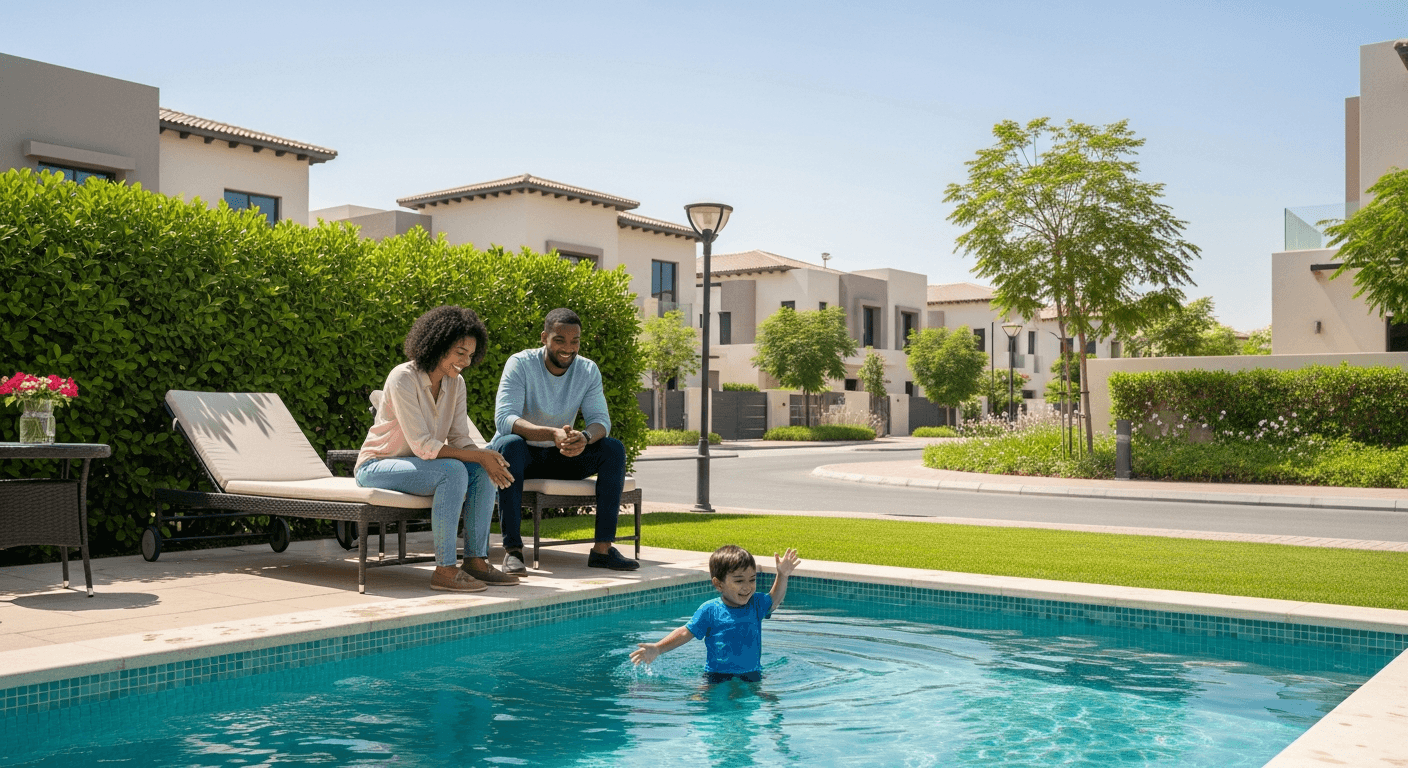
The Professional Parent's Dubai Villa Guide
For discerning professionals, finding a family villa that balances a short commute with a rich lifestyle is the ultimate Dubai prize. I explore the communities that get this delicate equation just right.

The question I hear most often from new clients — especially director-level professionals relocating with their families, isn't about yields or capital appreciation. It's simpler, and far more human than that. They pull up a map in our office, point a finger at the gleaming towers of DIFC or the bustling campus of Dubai Media City, and ask, "Where can I live that gives me a garden for my children, but doesn't steal two hours of my day in traffic?" It’s the essential Dubai paradox for the successful parent: the career demands proximity to the city's economic heart, while the soul craves space, greenery, and a community for the family to thrive in. This is the search for the true luxury item in a global city: time.
Here's what we'll explore in this guide:
- Defining the "Golden Triangle": Pinpointing Dubai's key business districts and what a "short commute" really means.
- The Top Contender: Why Dubai Hills Estate is often the first answer for balanced family living.
- The Established Classic: The enduring appeal of Arabian Ranches and its community-first approach.
- The Urbanist's Choice: Exploring the unique proposition of villas in Jumeirah and Umm Suqeim.
- The Real Cost of Convenience: A line-by-line breakdown of all the upfront and hidden costs.
- A Look Ahead: How future developments might redraw the commuter map.
The Commuter's Map: Dubai's Business Hubs
Before we can find the solution, we must first define the problem. A "short commute" in Dubai is entirely relative to your destination. The city's commercial activity is largely concentrated in a few key zones, and your choice of family home will be heavily influenced by which of these hubs you call your office. In my experience, professional clients are typically commuting to one of three major gravitational centres. Understanding these defines the search for the perfect location among the many business hub communities Dubai has to offer.
The first, and most prominent, is what I call the Financial Corridor. This is the long spine of Sheikh Zayed Road that encompasses Downtown Dubai, Business Bay, and the Dubai International Financial Centre (DIFC). This zone is the epicentre of finance, law, consulting, and corporate headquarters. For professionals working here, the ideal home needs excellent access to Sheikh Zayed Road or Al Khail Road. Traffic is notoriously dense heading into this corridor between 7:30 am and 9:30 am, so proximity is not just a luxury, it's a strategic advantage that can reclaim five to ten hours of your week.
The second major hub is the Tech and Media cluster further down the coast. This area includes Dubai Media City, Dubai Internet City, and Dubai Knowledge Park. It's a sprawling, campus-like environment that is home to global tech giants, advertising agencies, and educational institutions. Commuting to this area from the "wrong" side of town can be particularly challenging due to the layout of the road network and the limited entry and exit points during peak hours. Professionals here are looking for Media City villas or homes with straightforward access to Hessa Street or Sheikh Zayed Road South, which makes this a very different logistical puzzle compared to a DIFC commute.
Finally, there is the emerging "New South" corridor, which includes Dubai South and the legacy district of Expo City. While still developing, this area is rapidly becoming a major logistics, aviation, and exhibition hub. The commute to this area is generally less congested from most parts of the city for now, but its distance means that living somewhere like Mirdif or even the traditional heart of Jumeirah would result in a very long day. Families with one parent working in Dubai South and another in DIFC face the most complex geographical challenge of all. For them, a community that sits at the nexus of the city's main arteries — Al Khail Road and Sheikh Mohammed Bin Zayed Road, becomes not just convenient, but essential.
The Modern Champion: Dubai Hills Estate
 Featured project
For the past few years, if a client has asked me for the single best answer to the commute-versus-lifestyle problem, my first response is almost always Dubai Hills Estate. Developed by Emaar Properties, it has been conceived from the ground up to solve this exact dilemma. In my view, its master plan is a case study in understanding the needs of the modern professional family. The location is its masterstroke. Sitting directly on Al Khail Road, it offers a near-unbelievable straight-shot commute to the Financial Corridor. From most parts of the community, you can be parking your car in Downtown or Business Bay within 20-25 minutes, even in moderate traffic. It sits in a sweet spot that also allows for a manageable 25-minute drive to the Media/Internet City hub, making it one of the very few villas near Dubai business districts that serves both primary commercial zones effectively.
But location is only half the story. The lifestyle infrastructure within Dubai Hills is what truly elevates it. The community is anchored by the magnificent Dubai Hills Park, a vast green space with splash pads, a skate park, and sports courts that acts as a communal backyard for thousands of families. Then there is the Dubai Hills Golf Club, which provides a stunning green backdrop, and the Dubai Hills Mall, a large, well-designed retail centre that means residents rarely need to leave the community for shopping or entertainment. Add to this the King's College Hospital and excellent schools like GEMS International School and King's School Al Barsha located right on the periphery, and you have a self-contained ecosystem. It’s this completeness that fosters a genuine sense of work-life balance villas are supposed to provide.
The properties themselves are modern and cater to contemporary tastes. The smaller townhouses and villas in sub-communities like Maple and Sidra are perfect for young families starting out, typically offering three to five bedrooms. As you move up the scale, you find larger, more luxurious independent villas in areas like Parkway and the ultra-exclusive Hills Grove Villas, which are effectively mansions on the golf course. A four-bedroom villa in a popular sub-community might sell for anywhere between AED 8 million and AED 12 million, with rentals in the AED 400,000 to AED 600,000 per year range. The finishes are consistently high, as you would expect from Emaar, but I do find the plot sizes can be more compact compared to older, more established communities. This is the primary trade-off: you are exchanging sprawling, mature gardens for modern architecture and unparalleled convenience.
The Established Classic: Arabian Ranches
Long before Dubai Hills was even a blueprint, Arabian Ranches was the original gold standard for family villa living in Dubai. For many long-term residents, it still is. Walking through the older parts of Ranches 1, with its terracotta roofs, desert-hued walls, and, most importantly, its incredibly lush, mature landscaping, you feel a sense of establishment and permanence that newer communities are still working to cultivate. It feels less like a development and more like a true suburb, a place where roots have been firmly planted. This is another masterpiece from Emaar, and its success laid the groundwork for everything that followed.
The community's draw is built on a foundation of exceptional amenities and a powerful social fabric. The Arabian Ranches Golf Club, the Dubai Polo & Equestrian Club next door, and the well-stocked community centres in both Ranches 1 and 2 create multiple focal points for residents. However, the crown jewel for many families is Jumeirah English Speaking School (JESS), an outstanding non-profit school located right inside the community. The ability for children to walk or cycle to one of Dubai's best schools is a lifestyle benefit that is difficult to quantify but immensely valuable. This creates a tight-knit community where school-gate friendships easily transition into weekend barbecues. It is, in my opinion, one of the most socially cohesive communities in all of Dubai.
Where the Ranches compromises, however, is on the commute. It is undeniably further out. A drive to DIFC during peak morning rush hour can easily stretch to 35-45 minutes, sometimes longer if there are issues on Umm Suqeim Street or Hessa Street, its main access arteries. The commute to Media City is more manageable, typically around 25-30 minutes. This is the price paid for the space and serenity. This is a community for those who prioritise the neighbourhood feel over shaving ten minutes off their drive. The properties reflect this ethos. Villas in Ranches 1, though older, often sit on more generous plots than their newer counterparts in other communities. You'll find a wide variety of layouts and styles, many of which have been beautifully upgraded over the years. A standard four-bedroom villa here might rent for AED 350,000 to AED 500,000 and sell in the AED 6 million to AED 9 million range, representing a slight value proposition compared to the more central locations. For many of our clients at Gaia Living, the established greenery and world-class schooling make the extra commute a worthwhile trade.
The Urbanist's Choice: Jumeirah & Umm Suqeim
For a certain type of professional, the master-planned, gated community model, however convenient, can feel a bit sterile. They crave character, authenticity, and the vibrant, unpredictable energy of the city itself. For these clients, I often suggest looking away from the new master developments and turning towards the old heart of 'New Dubai': the sprawling, low-rise neighbourhoods of Jumeirah and Umm Suqeim. These areas offer some of the most sought-after family homes near DIFC and the coast, presenting a completely different lifestyle proposition.
Here, the concept of a 'community' is not defined by a developer's gatehouse and shared pool, but by the street, the local corner store, and the public beach. The primary benefit is, without question, location. Living in a villa in Umm Suqeim, you can be at the beach in five minutes, at the Mall of the Emirates in ten, and stepping into your office in Business Bay in fifteen. The commute is, for all intents and purposes, solved. This proximity to everything — from the design boutiques of Jumeirah Beach Road to the foodie hotspots of Al Wasl Road, is what defines the lifestyle. You don't drive to a community centre; you are already in it. The area is also home to a concentration of Dubai's most established and highly-regarded schools, such as Kings' School Dubai, Jumeirah College, and Jumeirah Primary School, making it a top choice for education-focused families.
However, this choice comes with significant trade-offs that are crucial to understand. The vast majority of villas in Jumeirah and Umm Suqeim are not available for foreign ownership, as the land is not designated as freehold. This makes it primarily a rental market for expatriate professionals, though there are a few very exclusive freehold plots and developments like Jumeirah Bay Island by Meraas for UHNW individuals. The housing stock is also much older. You'll find a mix of sprawling, single-story 1980s bungalows on huge plots next to more modern, multi-story G+1 or G+2 villas. Finding a beautifully renovated, modern villa is possible, but it comes at a significant rental premium. Many properties are older and may require a more hands-on approach to maintenance. You also forgo the curated security and pristine landscaping of a gated community. Instead, you get the authentic, sometimes messy, but always interesting experience of city life.
“For many, the ultimate luxury isn't a new build with a shared pool; it's a 15-minute commute and the sand of Kite Beach between your toes after work.”
The Real Cost of Convenience
Finding the right community is about more than just location and lifestyle; it requires a clear-eyed understanding of the total financial commitment. The advertised price of a villa is just the beginning of the story. Both buyers and renters need to factor in a range of other significant costs to budget effectively. As we guide clients through this process at Gaia Living, we make it a point to map out every single expense to avoid any surprises down the line. The dream of a short commute villas Dubai provides can sour quickly if the ongoing costs are higher than anticipated.
Let's take a practical example for a buyer. Imagine you have found the perfect four-bedroom villa in Dubai Hills Estate with a purchase price of AED 8,000,000. If you are an expatriate resident taking out a mortgage, you need to be prepared for substantial upfront costs that go far beyond your down payment. Here is a realistic, line-by-line breakdown of what you should expect to pay on or before the day of transfer:
- Purchase Price: AED 8,000,000
- Down Payment (20% for residents): AED 1,600,000
- Dubai Land Department (DLD) Fee (4% of price): AED 320,000
- DLD Admin Fee: approx. AED 4,200
- Real Estate Agency Fee (2% of price + 5% VAT): AED 168,000
- Mortgage Registration Fee (0.25% of loan amount): AED 16,000 (on a loan of AED 6.4M)
- Bank Mortgage Arrangement Fee (up to 1% of loan): up to AED 64,000
- Trustee Office Fee for transfer: approx. AED 4,200
- Property Valuation Fee for mortgage: approx. AED 3,150
- Total Upfront Cash Required: Approximately AED 2,179,550
As you can see, the total cash needed to complete the transaction is nearly AED 2.2 million, significantly more than just the 20% down payment. It's a figure that often surprises first-time buyers. These fees are regulated and non-negotiable, and they are a critical part of calculating your real budget. Understanding these figures, which are based on regulations from entities like the Dubai Land Department (DLD) and the Central Bank of the UAE, is fundamental.
Beyond the initial purchase, the ongoing costs are just as important. The most significant of these is the annual service charge. This fee is paid to the master developer or owners' association management company and covers the maintenance of all common areas: security, landscaping, swimming pools, parks, and road maintenance. In premium villa communities like Dubai Hills or Arabian Ranches, you can expect these charges to be in the range of AED 4 to AED 7 per square foot of your plot area, per year. For a villa on a 6,000 sq. Ft. plot, this translates to an annual bill of AED 24,000 to AED 42,000. Renters also need to budget for the 5% Dubai Municipality Housing Fee, which is added to their DEWA bill and calculated based on their annual rent. These recurring costs, along with school fees that can easily exceed AED 80,000 per child in a top-tier school, form the true annual cost of your family's lifestyle.
A Look to the Future
Dubai's urban landscape is in a constant state of evolution, and the map of convenient family living is continuously being redrawn. What seems like a long commute today might become a prime location tomorrow with the announcement of a new metro line or highway interchange. When advising clients, we don't just look at the present; we look at the government's strategic plans and the development pipeline to anticipate the shifts that will create future opportunities. The city's southward expansion is perhaps the most significant trend to watch.
The development corridors around Al Maktoum International Airport and the Expo City site are transforming what was once empty desert into a new economic hub. As more businesses and government entities relocate to Dubai South, the gravitational centre of the city will subtly shift. Communities that are currently considered 'far out', such as some phases of Damac Hills and Damac Hills II or the newer parts of Dubailand, will suddenly find themselves in a much more strategic position. For families willing to take a longer-term view, buying in these developing areas can offer a much more attractive entry price compared to the established prime communities, with the potential for both a shorter commute in the future and significant capital appreciation.
Infrastructure is the other key factor. The RTA's 2040 Urban Master Plan, for instance, is a blueprint for a more connected, sustainable city. The planned extension of the Dubai Metro, including the Blue Line, will be a game-changer for several communities that are currently car-dependent. A villa community with a future metro station within walking or cycling distance will see its value proposition change dramatically. As a family advisor, I always encourage clients to look at the official master plans on government portals like the Dubai Government website. This helps in future-proofing an investment. A community that may seem like a compromise on commute time today might be perfectly positioned in five to seven years, offering the best of both worlds for those with the patience to see the vision through.
For professional parents in Dubai, the choice of a family villa is a strategic decision balancing career and quality of life. While newer communities like Dubai Hills Estate offer an exceptional blend of modern living and short commutes, established areas like Arabian Ranches provide a deep sense of community and top-tier schooling. The final choice hinges on a family's unique priorities, but a clear understanding of total costs and future infrastructure plans is essential for making a wise, long-term decision.
My Verdict for the Professional Parent
After years of walking families through this exact decision, I've come to see that there is no single 'best' community. There is only the 'best fit' for a specific family's priorities, budget, and lifestyle. The family who wants their children to grow up in a sprawling garden, surrounded by a tight-knit school community, will find their perfect home in Arabian Ranches, and they will gladly accept the 40-minute commute as a fair price for that idyllic life. The urbanite family who thrives on the energy of the city, wants to be minutes from the beach, and values character over conformity will find their happiness in a renovated villa in Jumeirah, and will happily manage the quirks of an older property for the unbeatable location.
However, if I am pressed to name one community that, in today's market, provides the most comprehensive and balanced solution for the majority of professional families, my vote consistently goes to Dubai Hills Estate. It was purpose-built to solve this very problem, and in my professional opinion, it has succeeded spectacularly. The combination of its strategic central location, which genuinely cuts down commute times to both major business districts, with its world-class, brand-new family amenities — the park, the mall, the hospital, the schools, is a formula that is currently unmatched.
It captures the modern essence of Dubai: ambitious, convenient, and designed for a high quality of life. It offers a solution that doesn't force a hard compromise between your career and your family. You can be present for breakfast with your kids and still make a 9 am meeting in DIFC without stress. You can leave the office at 5 pm and be at the park with your family by 5:30 pm. In a city where time is the greatest luxury, Dubai Hills delivers more of it back to you than almost any other villa community. It represents the next generation of Dubai living, and for the discerning professional parent, it is an incredibly compelling choice.
Ultimately, the best decision is an informed one. The goal is to find a place that feels like home, a community that supports your family's growth, and a location that respects your time. If you are starting this journey, my advice is to spend time in each of these areas, drive the commute during rush hour, and walk through the parks on a weekend. We at Gaia Living are here to help you navigate these choices, providing the data, insights, and on-the-ground experience to help you find your perfect balance.
Sources
- Dubai Land Department (DLD): dubailand.gov.ae
- Central Bank of the UAE: centralbank.ae
- Government of Dubai: dubai.ae
Questions, answered
- Which villa community has the shortest commute to both DIFC and Dubai Media City?
- Dubai Hills Estate generally offers the best balance, with typical drive times of 20-25 minutes to both DIFC/Business Bay and the Media City/Internet City hub, avoiding the most severe traffic bottlenecks of other routes.
- Are there freehold villas close to Downtown Dubai?
- Yes, but they are limited and command a premium. The villas in District One (part of MBR City) and the bespoke mansions in Jumeirah Bay are freehold and very close, while communities like Dubai Hills Estate are a short 20-minute drive away.
- What are typical service charges for a family villa in Dubai?
- For premium master-planned villa communities, expect annual service charges to range from AED 4 to AED 7 per square foot based on the plot area. For a villa on a 6,000 sq ft plot, this would be roughly AED 24,000 to AED 42,000 per year.
- Which community is best for families focused on top-tier schools?
- Arabian Ranches is famously home to Jumeirah English Speaking School (JESS), and Dubai Hills has King's School and GEMS affiliates. The Jumeirah/Umm Suqeim area is also surrounded by many of Dubai's oldest and most respected schools like Kings' Dubai and Jumeirah College.
- Can I get a mortgage for a villa as an expatriate in Dubai?
- Yes, expatriate residents can typically secure a mortgage for up to 80% of the property's value for their first property purchase, as per Central Bank of the UAE regulations. This means a minimum down payment of 20% plus associated fees is required.
- What's the main difference between living in Arabian Ranches and Dubai Hills?
- Arabian Ranches offers a more established, suburban feel with mature landscaping and a very strong community identity, but can face traffic on key access roads. Dubai Hills is more modern, centrally located with a shorter commute, and features newer amenities like the large central park and mall, often on slightly more compact plots.

Sophia profiles Dubai's villa communities — schools, commute times, green space, and the intangible feel of a neighbourhood. She writes for families putting down roots.
Related stories
Dubai's Established Charm: The Case for Older Homes
In a city focused on the future, I believe the smartest move for many buyers is to look back. Dubai's seasoned communities offer space, character, and surprising value that new builds often can't match.
The True Cost of Owning a Dubai Property
Beyond the purchase price, your annual budget for a Dubai home must account for service charges, utilities, and maintenance. I'll break down every ongoing expense you need to plan for.
Calculating ROI on Dubai Rental Upgrades
As a landlord in Dubai, you can't just follow trends. I'll show you how to calculate the precise ROI of minor property upgrades to genuinely increase your rental yield.
Echoes, in your inbox
One thoughtful email a month. Market insight, new launches, no spam.