

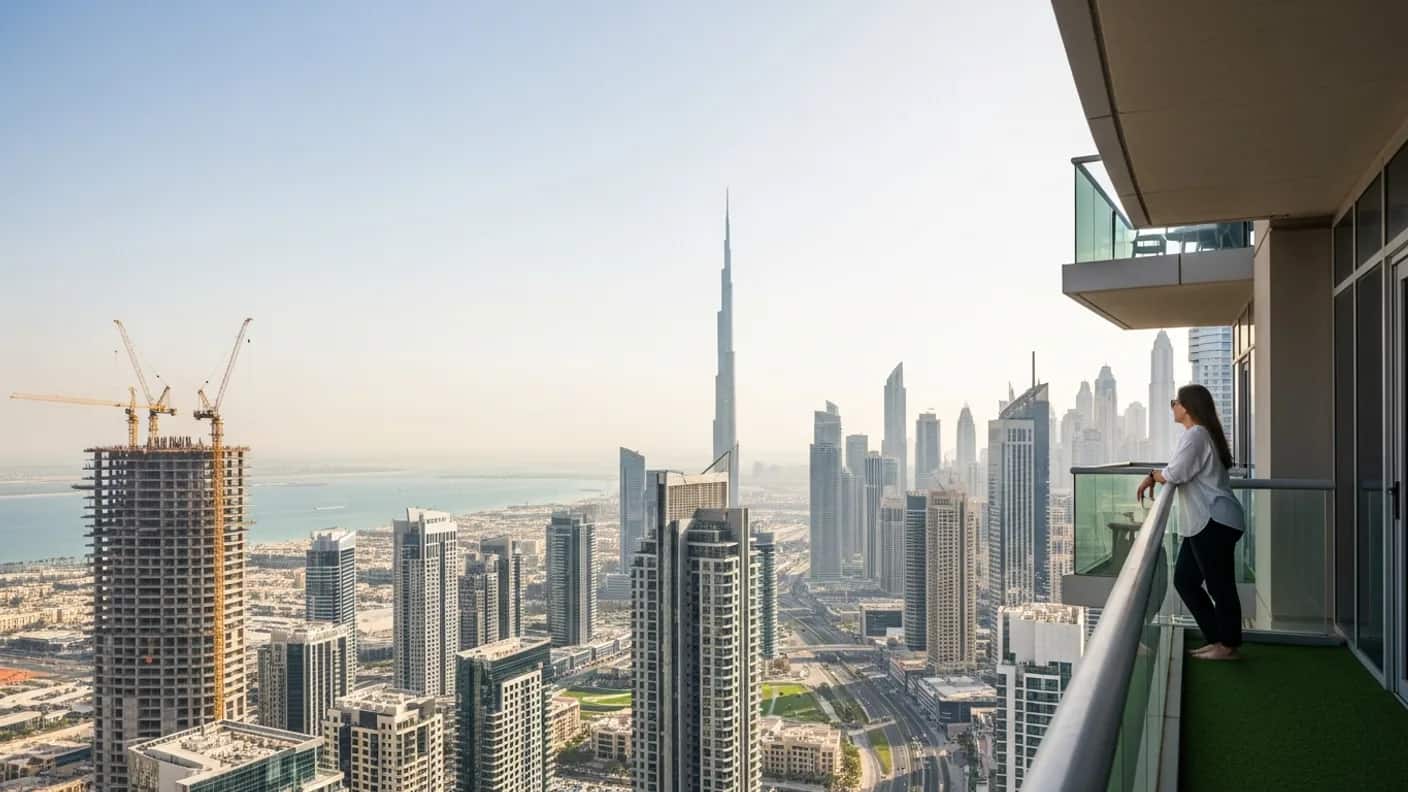
The New Bedrock: How Visas Reshaped Dubai Property Demand
Recent UAE visa reforms, especially the expanded Golden Visa, are fundamentally shifting Dubai's property market from a transient hub to a long-term home for global talent and investors. This analysis unpacks the direct impact on demand, prices, and what it means for your next move.

The conversation around Dubai real estate has fundamentally changed. For years, the market was defined by two-year employment contracts and the transient nature of its expatriate workforce. Today, that narrative feels outdated. It's no longer just about short-term gains or a temporary base; it's about putting down roots, a profound shift directly fueled by the UAE's visionary long-term residency reforms.
Here's what we'll explore in this analysis:
- The old vs. New visa landscape: what actually changed?
- The AED 2 Million Golden Visa: a deep dive into the property pathway.
- How these visas are reshaping buyer psychology and demand patterns.
- The impact on specific communities and property types.
- Financing and affordability in the new long-term residency era.
- Beyond the Golden Visa: other impactful residency options.
- The developer response: aligning projects with long-term living.
- My verdict on the long-term outlook for the Dubai market.
From Transient Hub to Permanent Home: The Visa Revolution
To understand the magnitude of the current shift, you have to remember the old model. For decades, the vast majority of Dubai's expatriate population lived and worked on the basis of a standard two- or three-year employment visa, directly sponsored by and tied to their employer. This created a persistent sense of impermanence. The unspoken rule was that if you lost your job, you had a brief window to find another before your right to reside in the country expired. This reality shaped every major life decision, especially the one to buy property. For many, taking on a 25-year mortgage for a family home felt like an untenable risk against the backdrop of a two-year visa. The market, as a result, was heavily skewed towards renters and investors focused on yield from that rental pool, rather than a broad base of end-user owner-occupiers.
This dynamic fostered a specific type of market behaviour. Investors, both local and international, were chasing rental yields and capital appreciation over a relatively short horizon. Many expatriate residents, even high-earning professionals, preferred the flexibility of renting, avoiding the large capital outlay and long-term commitment of ownership. It wasn't a lack of desire, but a rational response to a system that prioritized workforce flexibility over residential stability. While many people built successful lives and careers here, the underlying framework always contained an element of precariousness that tempered the ambition of truly setting down permanent roots. This had a clear effect on expat property ownership Dubai, keeping it a choice for a smaller, more risk-tolerant segment of the population.
Then came the change. Beginning with initial reforms and culminating in the expanded programme launched in 2022, the UAE government introduced a comprehensive suite of new residency pathways. These were strategically designed to attract and, more importantly, retain global talent, entrepreneurs, and investors. The headline act was the 10-year renewable Golden Visa, but it was accompanied by other significant options like the 5-year Green Visa for skilled workers and freelancers, and dedicated visas for retirees and remote workers. The common thread running through all these reforms was a strategic decoupling of residency from a single employer. For the first time, a significant and growing portion of the population could secure their right to live in the UAE based on their skills, their investment, or their contribution to the economy, independent of a specific job contract. This wasn't just a policy tweak; it was a fundamental rewiring of the social contract between the UAE and its expatriate population, sending an unambiguous signal: we want you to stay, to invest, to build your future here.
This psychological impact cannot be overstated. It replaces uncertainty with stability. It allows a family to look at a school for their child and think in terms of a full K-12 education, not just the next two years. It gives an entrepreneur the confidence to invest capital knowing they won't be forced to uproot their life and business due to an arbitrary contract change. And, most critically for our market, it transforms the rent-versus-buy calculation. When you can plan your life in five or ten-year increments, the financial and emotional logic of owning your home becomes overwhelmingly compelling. The UAE long-term visa real estate connection isn't just a marketing angle; it's the new bedrock of market demand.
The Golden Visa: Deconstructing the AED 2 Million Property Rule
 Featured project
The most direct and powerful link between the new residency landscape and the property market is the 10-year Golden Visa for real estate investors. Its influence is so significant that it merits a detailed breakdown. The core requirement, as set out by the authorities, is the purchase of property in the UAE with a value of AED 2 million or more. While the previous iteration of this visa had a higher threshold and stricter rules, the updated regulations significantly broadened its accessibility and appeal, catalysing a new wave of investment.
Several key refinements made the visa a game-changer. Firstly, the threshold was lowered to a more attainable AED 2 million. Secondly, and perhaps most importantly, the rules were clarified to explicitly include both mortgaged and off-plan properties. An investor can now secure the visa with a mortgaged property, as long as their paid-in equity (the amount paid to the bank, not the loan amount) is at least AED 2 million. Similarly, an investment in an off-plan launches project from an approved developer qualifies once at least AED 2 million of the purchase price has been paid. This was a masterstroke, allowing investors to secure long-term residency without needing the full property value in cash upfront. It aligns the visa pathway with the common financial reality of property acquisition, where use and installment payments are the norm.
To understand the real cost, it’s crucial to look beyond the AED 2 million property value. The upfront costs associated with a transaction are significant and must be factored into any budget. At Gaia Living, we always advise clients to prepare for these additional expenses to ensure a smooth process. Here is a typical line-by-line breakdown for a property purchased at AED 2.2 million, comfortably meeting the visa threshold:
- Property Purchase Price: AED 2,200,000
- Dubai Land Department (DLD) Transfer Fee (4%): AED 88,000
- DLD Registration Trustee Fee: Approximately AED 4,200 (for properties over AED 500k)
- Real Estate Agency Fee (2% + 5% VAT): AED 46,200
- No Objection Certificate (NOC) Fee: Typically between AED 1,000 - AED 5,250 (paid to the developer)
- Initial Total Outlay (excluding mortgage down payment): Approximately AED 2,338,450
This illustrates that the true entry point is closer to AED 2.4 million once all mandatory fees are paid. Buyers must also consider ongoing costs such as service charges, which can range from AED 15 to AED 30 per square foot annually depending on the community and its amenities. The process itself has been streamlined. Once the property transaction is complete and registered with the Dubai Land Department (DLD), the DLD issues a letter confirming the investment. This letter is the key document used to apply for the Golden Visa through the official government channels. This direct, property-linked path to long-term residency is the single biggest driver of the investor visa Dubai property market today.
Reshaping Demand: The Shift from Speculator to End-User
The most profound Dubai golden visa property impact is the change it has fostered in buyer identity. For years, a significant portion of market activity was driven by speculators and short-term investors aiming for quick capital gains or high rental yields. The new visa framework has tilted the scales decisively in favour of the end-user and the long-term, committed investor. People are increasingly buying homes to live in for the foreseeable future, not just as a tradable asset on a balance sheet. This qualitative shift in buyer psychology is creating a more mature, stable, and predictable market.
This change is evident in the questions we now hear from clients at Gaia Living. The conversation has evolved. Five years ago, the primary questions were often, "What is the expected rental yield?" and "How quickly can I flip this for a profit?". Today, while ROI is still important, the dominant queries are, "What are the schools like in this area?", "Is there a park for my children?", and "Can I see myself living in this community for the next ten years?". This reflects a move away from a purely financial calculation towards a lifestyle and stability-based decision. The 10-year security offered by the Golden Visa gives families the confidence to engage in this kind of long-term planning, a luxury that was simply unavailable under the old employer-tied visa system.
This shift in mindset has a direct and measurable impact on the types of properties in demand. We are seeing a sustained surge in interest for larger units capable of accommodating a family over a long period. The demand for three- and four-bedroom apartments, townhouses, and villas has been exceptionally strong. Communities that offer a complete lifestyle ecosystem are the primary beneficiaries. Areas like Dubai Hills, with its integrated schools, hospital, mall, and championship golf course, have become prime destinations for Golden Visa buyers. Similarly, established family-centric communities such as Arabian Ranches and Jumeirah Golf Estates are experiencing renewed interest from residents looking to upgrade from renting to owning, or from smaller apartments to larger homes, now that they have a clear path to long-term stability.
Conversely, while prime areas like Dubai Marina and Downtown Dubai remain perpetually popular, the demand profile is also changing. These areas are no longer just for the young professional on a two-year contract. We are seeing more families and long-term residents choosing larger apartments in these vibrant hubs, seeking to combine urban energy with newfound residential security. Developers have been quick to notice. The design of new projects increasingly incorporates family-friendly features, such as larger balconies, dedicated play areas, and community spaces, even in high-density urban towers. This is a direct response to the market's clear pivot towards end-user demand, a trend that is making the entire real estate ecosystem healthier and more sustainable.
Community Focus: Where Are Golden Visa Buyers Investing?
While the entire market is feeling the positive effects of the visa reforms, the impact is not uniform. Certain communities and property types have become distinct hotspots for Golden Visa-driven investment, particularly those that align with the AED 2 million threshold and the lifestyle aspirations of long-term residents. The Dubai residency property demand is creating clear winners and losers across the city's real estate map.
In the established luxury segment, areas like Palm Jumeirah and Emirates Hills have always been magnets for high-net-worth individuals. The Golden Visa adds an extra layer of 'stickiness' to these investments. It encourages buyers who might have previously viewed a villa on the Palm as a holiday home to now consider making it their primary residence. The ability to sponsor family and household staff, combined with the 10-year residency, provides the practical framework for a full relocation. For these buyers, the AED 2 million threshold is easily met, and the visa is an added benefit that cements their commitment to Dubai as a long-term base of operations and family life. The demand here is less about meeting the minimum requirement and more about using the visa to formalize a lifestyle choice.
“For the first time in Dubai's history, a significant portion of the expatriate population can plan their lives in decades, not just two-year contract cycles. That single change is the most powerful force shaping the property market today.”
The real engine of the visa-driven market, however, is the AED 2 million to AED 5 million 'sweet spot'. This is the price bracket where a large number of high-quality two- and three-bedroom apartments, as well as modern townhouses, are available. It represents the intersection of affordability for upper-middle-class professionals and the visa eligibility requirement. Communities where buyers can find excellent value in this range are thriving. For example, a premium two-bedroom apartment in Business Bay or a larger three-bedroom unit in a community like JVC can fall squarely within this bracket. For those seeking more space, townhouses in family-focused master communities like Town Square or those developed by Damac in their Damac Hills masterplans offer a compelling proposition: a family home with a garden, community amenities, and a 10-year visa.
Perhaps the most significant development has been the surge in visa-linked off-plan sales. The inclusion of off-plan properties in the Golden Visa criteria was a masterstroke by policymakers. It allows a buyer to secure their long-term residency by paying a fraction of the total property value upfront, with the rest spread over a construction-linked payment plan. This has dramatically expanded the pool of eligible buyers. Major developers like Emaar Properties and Nakheel have fully integrated this into their sales and marketing strategies, prominently advertising projects in areas like Emaar Beachfront or the new villas on Palm Jebel Ali as 'Golden Visa eligible'. This synergy between developers and government policy creates a powerful sales driver, allowing buyers to lock in both a future home and their future in Dubai simultaneously. The key here is the Oqood registration — the initial contract registered with the DLD, which serves as proof of investment for the visa application.
The Ripple Effect: Mortgages, Financing, and Market Maturity
The shift towards long-term residency has sent positive ripples through the entire financial ecosystem that supports the property market, most notably the mortgage sector. A resident with a 10-year visa is a fundamentally different proposition for a lender than one on a 2-year contract. The extended residency horizon provides a clear demonstration of commitment and stability, reducing the perceived risk for banks and financial institutions. This newfound confidence makes residents more willing to take on long-term financial obligations, and lenders more willing to grant them.
According to regulations from the Central Bank of the UAE, expatriate first-time homebuyers are typically required to provide a minimum down payment of 20% for properties valued under AED 5 million, and 25% for subsequent properties or those above that price point. For a property valued at AED 2.5 million, a 20% down payment amounts to AED 500,000 in cash, plus the associated transaction fees we detailed earlier. This is a substantial capital commitment. In the past, the precarious nature of short-term visas made many hesitant to lock up such significant capital. Today, with the security of a Golden or Green Visa, that calculation has changed. Buyers are more confident taking out a 20 or 25-year mortgage because their right to reside in the country extends for a significant portion of that loan's term.
Beyond that, the rule allowing mortgaged properties to qualify for the Golden Visa is a crucial enabler. It means a buyer doesn't need to be debt-free to secure their residency. For instance, an investor could purchase a AED 4 million villa in Al Barari, make a 50% down payment of AED 2 million, and immediately become eligible to apply for the Golden Visa while financing the remaining AED 2 million. This brings larger, more desirable family homes within reach for many. To navigate this process, prospective buyers should be prepared with the necessary documentation. A typical mortgage pre-approval checklist for a Golden Visa applicant would include:
- Valid Identification: Passport copy and current visa or entry permit.
- Proof of Income: A recent salary certificate and 6 months of personal bank statements showing salary credits.
- Property Documents: The Memorandum of Understanding (MoU) or Sales and Purchase Agreement (SPA), and a copy of the property's Title Deed or Oqood.
- Down Payment Proof: Bank statements or other evidence showing sufficient funds for the down payment and associated fees.
- Credit Report: A copy of the report from the Al Etihad Credit Bureau (AECB).
This convergence of long-term visas and accessible financing is a hallmark of a maturing market. It moves the focus away from all-cash transactions, which can be volatile and cyclical, towards a more stable, end-user-driven market underpinned by long-term, amortizing debt. This creates a healthier balance sheet for both individual households and the market as a whole, reducing systemic risk and promoting sustainable growth.
Beyond the Golden Goose: Other Visas Sustaining the Market
While the AED 2 million property visa grabs the headlines, it is a mistake to view its impact in isolation. The true strength of the new residency framework lies in its diversity. A whole ecosystem of visas is working in concert to deepen the pool of potential property buyers and create demand across all segments of the market, not just the premium tier.
The Green Visa, for example, is a powerful, if indirect, catalyst for property demand. This 5-year, self-sponsored visa is available to skilled professionals, freelancers, and small-scale investors who meet certain educational or income criteria. Critically, it does not require property ownership. However, by granting individuals and their families five years of stability without being tied to an employer, it empowers them to make long-term plans. A freelance software developer or a skilled marketing manager on a Green Visa is far more likely to transition from renting to buying than they were under the old system. This visa class is a major driver of demand in the sub-AED 2 million market, supporting sales of studios, one-bedroom, and two-bedroom apartments in vibrant, affordable communities like Dubai South and Arjan.
Similarly, the Retirement Visa has carved out a new and important niche in the market. To be eligible, retirees over the age of 55 must meet one of several criteria, one of which is owning a debt-free property worth at least AED 1 million. This lower threshold opens up a different segment of the market. It creates demand for smaller, more manageable properties in quieter communities with good access to healthcare facilities and leisure amenities. We see this demand translating into interest in specific sub-communities in Dubailand or established low-rise neighbourhoods. These buyers are not typically looking for large family villas, but rather comfortable, high-quality homes for their post-working years.
Even the one-year Digital Nomad Visa plays a role in this ecosystem. It acts as an introductory funnel. It allows global talent to experience the Dubai lifestyle firsthand without a major commitment. In my experience, a significant percentage of those who come for a year fall in love with the city's safety, dynamism, and quality of life. They then begin actively looking for pathways to stay longer, which inevitably leads them to explore the Green Visa or the Golden Visa through property investment. The cumulative effect of these various pathways is a market that is constantly being fed by a diverse, multi-layered stream of potential buyers, creating a resilience and depth that simply did not exist a decade ago.
The Developer Response: Building for a New Kind of Buyer
Dubai's real estate developers are nothing if not attuned to market demand. They have been quick to recognise and adapt to this fundamental shift towards long-term residency. The DNA of new projects is changing, moving beyond pure architectural spectacle to a more holistic focus on livability and community. This is a direct response to a buyer base that is no longer just investing in a concrete shell, but in a place to build a life.
The most obvious change is the heavy emphasis on community amenities. It’s no longer enough to just have a pool and a gym. Leading developers like Meraas in their City Walk project or Emaar in Dubai Hills are creating fully integrated ecosystems. New projects are being designed and marketed around the quality of their schools, the proximity of their clinics, the expanse of their public parks, and the convenience of their retail offerings. We are seeing co-working spaces become a standard feature in residential towers, catering to the growing number of freelancers and remote workers on Green Visas. The master plan is now as important as the floor plan. This focus on building genuine communities, rather than just collections of buildings, is a direct result of developers catering to a resident who plans to stay for a decade, not just a couple of years.
Payment plans have also been strategically re-engineered to align with the new buyer profile. The proliferation of post-handover payment plans is a key indicator. These plans allow a buyer to pay a portion of the property's price during construction, take possession upon completion, and then pay the remaining balance in installments over several years while living in the home. This model is incredibly attractive to end-users, as it effectively allows their rent savings to contribute towards their mortgage-free ownership. For a family transitioning to a long-term visa, this can significantly ease the financial burden of purchasing a home. It's a financial product perfectly tailored for the new era of residency.
Finally, the marketing language itself has transformed. Walk into any major property launch event today, and you will see "Golden Visa Eligibility" displayed as a primary feature, right alongside the square footage and the completion date. This is not just a footnote; it's a core part of the value proposition. Developers are proactively providing buyers with the information and support needed to navigate the visa application process. This alignment between private sector development and public policy creates a powerful, self-reinforcing cycle. The visas drive demand for property, and the developers build and market products that make it easier for buyers to access those visas. This strategic synergy is accelerating the market's evolution towards stability and long-term, sustainable growth.
My Verdict: A Permanent Shift, Not a Temporary Boost
So, what is the final analysis? Are these visa reforms creating a temporary, policy-driven bubble, or have they fundamentally and permanently altered the structure of the Dubai property market? In my view, the evidence overwhelmingly points to the latter. This is not a cyclical upswing; it is a structural re-rating of Dubai as a place to live and invest. The introduction of long-term, self-sponsored residency has provided the one crucial element the market was missing: a foundation of stability.
Of course, the market will still have its cycles. It will remain sensitive to global economic headwinds, interest rate fluctuations, and regional geopolitics. No market is immune to risk. However, the underlying demand drivers are now fundamentally different and far more robust. The Dubai residency property demand is no longer solely dependent on the recruitment cycles of major corporations or the speculative whims of international capital. It is now anchored by a growing class of residents who are committed to the UAE for the long haul — entrepreneurs building businesses, professionals building careers, and families building lives.
This maturing process is creating a healthier market. The extreme volatility of the past is being replaced by more fundamentals-driven growth. We are seeing a market where price appreciation is increasingly linked to genuine improvements in infrastructure, community quality, and the overall economic landscape, rather than short-term sentiment. The demand for family homes in well-serviced communities is a sign of this. It shows a market that is responding to the real-life needs of its population, not just the abstract models of financial investors. For anyone considering buying property in Dubai, this is an incredibly positive development. It means you are investing in a market that is increasingly aligned with your own long-term goals.
The UAE's long-term visa reforms, led by the Golden Visa, have fundamentally altered buyer behaviour, shifting demand towards larger, family-oriented homes and creating a more stable, end-user-driven property market. This is not a fleeting trend but a structural evolution that provides a strong foundation for sustainable growth in the years to come.
Sources
- Dubai Land Department (DLD): https://dubailand.gov.ae/
- The Official Portal of the UAE Government: https://u.ae/
- Central Bank of the UAE: https://www.centralbank.ae/
Questions, answered
- Can I get a Dubai Golden Visa with a mortgaged property?
- Yes. You can qualify for the 10-year Golden Visa with a mortgaged property, provided the cash amount you have paid to the bank (your equity) is at least AED 2 million. You'll need a letter from your bank confirming the paid-up amount.
- What is the minimum property investment for a Dubai Golden Visa?
- The minimum investment is AED 2 million. This can be for a single property or spread across multiple properties, and includes both ready and approved off-plan properties.
- What happens to my Golden Visa if I sell my property?
- The Golden Visa is tied to owning a qualifying property. If you sell the property and your investment drops below the AED 2 million threshold, your visa may not be renewable upon its expiry unless you purchase another qualifying property.
- Do off-plan properties qualify for the Golden Visa?
- Yes, off-plan properties from government-approved developers and projects qualify for the Golden Visa. You must have paid at least AED 2 million of the property's value to the developer to be eligible to apply.
- Are there other long-term visa options in the UAE besides the property visa?
- Yes. The UAE offers several other long-term residency options, including the Green Visa for skilled professionals and freelancers, and special visas for retirees and exceptional talents. These visas provide stability and can empower individuals to consider property ownership.
- What are the main fees when buying a property for the Golden Visa?
- Beyond the property price, key costs include the Dubai Land Department (DLD) transfer fee of 4%, an agency fee of around 2% plus VAT, and trustee and registration fees. For an AED 2 million property, expect to pay at least AED 125,000 in upfront fees.

Omar tracks the announcements that move the market — new launches, regulation, mega-projects, and developer moves — and tells you what they actually mean for buyers.
Related stories
Dubai 2040: A Land Use and Investment Blueprint
A deep dive into the Dubai 2040 Urban Master Plan, analysing specific zoning changes and land use designations to reveal the next generation of property investment hotspots.
Beyond the Blueprint: The Retail Value Multiplier
It's a simple truth of Dubai real estate: proximity to quality retail and leisure isn't just a perk, it's a powerful driver of property value. I'll explain how operational hubs are creating measurable premiums for investors and residents.
Your Dubai Home Setup Guide
A step-by-step guide for new Dubai homeowners on connecting utilities, setting up essential services, and integrating into your new community.
Echoes, in your inbox
One thoughtful email a month. Market insight, new launches, no spam.