

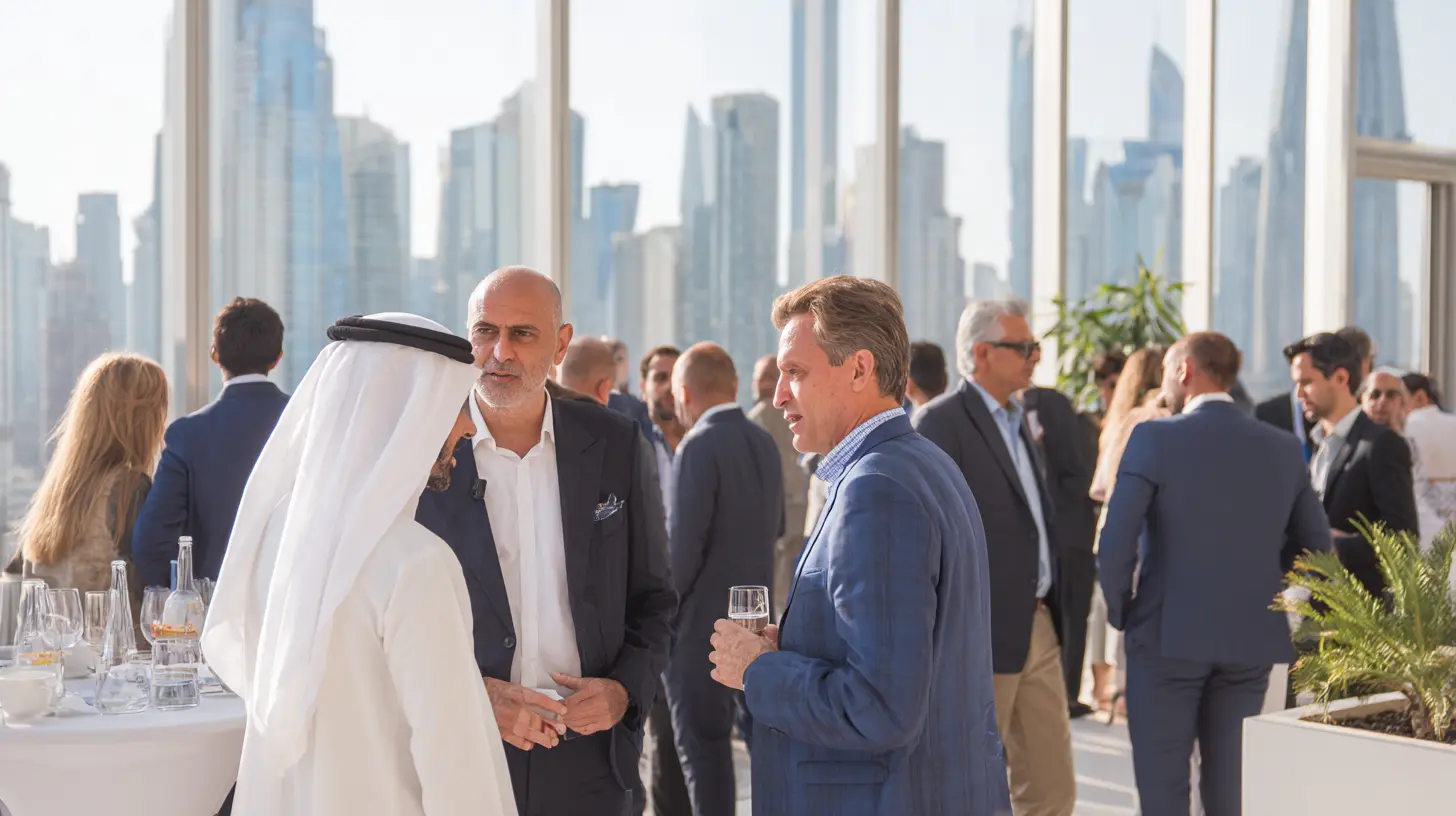
Why Networking Matters in Dubai's Real Estate Industry
Off-market deals, developer access, and referral networks. Here's how relationships actually drive Dubai's property market and why your network is your edge.
In Dubai Real Estate, the Deal Starts Before the Listing Goes Live.
There is an established understanding of the process of a property transaction. A buyer searches online, finds a property, makes contact with an agent, views the property, makes an offer, and the transaction is complete. It is a clean and straightforward process. It is the same process in Dubai. However, it is not where the most interesting deals are being done.
The most interesting deals are being done through conversation. A developer might tell an agent at a business breakfast in Business Bay about an imminent announcement of a new development before the announcement is made. An agent might tell an investor at a golf day in Jumeirah Golf Estates about the observations of the agent's buyer, resulting in the investor purchasing the agent's off-market villa. A broker might send an agent a WhatsApp message at 9 p.m. stating that the agent's buyer is looking for the exact same property that has now come to the market. A lawyer might refer an agent's buyer to the agent after years of working together because the lawyer knows the agent will respect the buyer's time.
Dubai is a relationship-driven marketplace unlike anything experienced by those from more structured property markets. In cities like London or New York, the systems do the work. MLS systems, standardized contractual documentation, regulated disclosure obligations, and an exhaustive audit trail ensure the process is governed. Dubai has systems too. In fact, the systems have become much more sophisticated over the last decade. However, the informal network sits atop these systems and does the bulk of the work.
This phenomenon can be partly explained by the maturity of the market. The real estate sector in Dubai, as we understand it today, is roughly twenty years old. A significant number of the people who created, contributed to, regulated, and invested in the sector are still active. Connections formed early on persist, and trust networks developed through hundreds of transactions are difficult to replace by a portal-based search system.
It can also be seen as a reflection of the composition of the market. In Dubai, there are buyers, investors, developers, and brokers from over a hundred different nationalities. Community networks, by nation, profession, or friendship, play a role in channeling the activity in the real estate sector that cannot be explained by the formal market data. A well-connected, Russian-speaking broker can tap into a potential pool of buyers that his well-qualified but unconnected competitor cannot, regardless of his qualifications.
To grasp the concept of networking in the context of this market—i.e., to understand who the players are, what they can do, and how to tap into these networks for new entrants into the sector—may be as essential as understanding yields, loan-to-value ratios, or trends in area prices. This article will focus on that subject.
Why Relationships Move Faster Than Portals
The practical argument for networking in Dubai real estate starts with speed and access. Properties in high-demand communities — a frond villa on the Palm, a specific floor in a sought-after Downtown tower, a distressed deal with a motivated seller — often transact before they're formally listed. The seller's agent calls three people they trust, one of them has a buyer, the deal is agreed in forty-eight hours. The portal listing never happens.
Buyers without relationships lose these deals not because they were outbid, but because they never knew the property existed. This is not an edge case. Off-market transactions in Dubai's prime residential segments represent a meaningful share of total deal volume. Exactly what share is hard to quantify because by definition these deals don't always show up in the data — but agents working the Palm, Downtown, DIFC, and Emirates Hills will tell you it's significant.
The same dynamic operates at the developer level. Launch allocations for popular off-plan projects are distributed through agent networks before public sale. Agents with strong developer relationships get early access — and their clients get to buy at launch pricing rather than post-announcement pricing, which in active markets can be meaningfully different. A well-connected agent is worth something concrete and measurable to a buyer in this market.
As property consultant and author Andrew Cummings, who has covered Gulf real estate markets for over fifteen years, wrote in his 2023 analysis for MENA Property Insights: "In Dubai, the relationship between an agent and a developer is not just a sales channel — it is the primary mechanism through which new inventory enters the buyer market. Agents without those relationships are working from a smaller universe of available product."
The Anatomy of a Dubai Real Estate Network
Understanding what a healthy professional network in this market actually looks like is more useful than general advice about "building connections." The relationships that matter most fall into a few clear categories.
Agent to Agent
The most underrated relationship in Dubai real estate is between agents at different brokerages. Referrals between agents — where one agent knows the buyer and another agent knows the listing — are common, and they require trust that takes time to build. An agent who has a reputation for sharing deals fairly, communicating clearly, and not cutting out the referral partner at the last minute builds a referral network that generates consistent deal flow. One who doesn't, doesn't.
This is why agents who invest in showing up to industry events, joining broker networks like the Dubai Brokers Network or the Arabian Gulf Real Estate network, and maintaining relationships with competitors as well as colleagues consistently outperform agents who work in isolation. The market is too relationship-driven for isolation to be a winning strategy.
Agent to Developer
Developer relationships determine which agents get early access to launches, which ones are invited to soft-launch events before public sale, and which ones get their calls returned when a client has a question that needs a fast answer. These relationships are built through sales volume — developers pay attention to which agents shift units — but also through reputation, professionalism, and showing up consistently at developer events and briefings.
New agents entering the market often underestimate how long it takes to build meaningful developer relationships. A shortcut is joining a brokerage that already has those relationships in place — the agency's existing track record with major developers transfers partially to new agents on the team, at least in terms of access if not in terms of personal rapport.
Agent to Professional Services
The referral network that connects real estate agents with mortgage brokers, lawyers, accountants, and relocation consultants is one of the most valuable professional ecosystems in the Dubai market. A buyer coming to Dubai for the first time typically needs all of these services — they need a mortgage, they need a lawyer to review the SPA, they may need a tax adviser to understand implications back home, they may need a relocation company to manage the physical move.
Agents who have strong, trusted relationships with professionals in each of these categories can offer a genuinely different service to clients — one that reduces friction, saves time, and builds the kind of trust that leads to repeat business and referrals. These relationships are reciprocal: the lawyer refers property clients to the agent, the mortgage broker refers buyers who need an agent, and so on.
Investor to Investor
The investor community in Dubai is its own network within a network. Family offices, high-net-worth individuals, institutional buyers — many of them know each other, compare notes, and influence each other's decisions. A recommendation from a trusted peer in this community carries more weight than any marketing material. Deals that start as informal conversations at industry events or private dinners frequently conclude as significant transactions.
Events like Cityscape Global, the Arabian Property Awards, and the various MIPIM side events that Dubai now hosts bring this community together in formal settings. The informal channels — private groups, community dinners, referral introductions — are harder to access but more valuable when you're in them.
Where the Networking Actually Happens
Knowing that networking matters is one thing. Knowing where to actually do it is more useful.
Industry Events
Cityscape Global — held annually in Dubai — is the largest real estate exhibition in the MENA region and the single highest-density networking event in the market. Developers launch projects, agents meet investors, and the entire ecosystem is in one place for three days. Going to Cityscape to look at stands is a tourist activity. Going to Cityscape to have twelve targeted conversations with specific people is how professionals use it.
The Arabian Property Awards, MIPIM Arabia, and the various developer-hosted launch events throughout the year serve similar functions at smaller scale. Each one is an opportunity to be seen, to reinforce existing relationships, and to make new introductions.
Property consultant Robin Teh of Savills Dubai, writing in the firm's 2024 UAE Market Outlook, observed that "the agents and investors who consistently close the best deals in Dubai are disproportionately present at industry events — not because events directly generate transactions, but because visibility in the community is itself a form of trust-building that eventually converts."
Breakfast and Lunch Circuits
Dubai has a strong business breakfast culture — early starts, short meetings, high density of decision-makers in rooms. Several property-focused networking groups run regular breakfast events. The Dubai Business Breakfast network, various chamber of commerce groups, and brokerage-hosted investor mornings are all worth attending for agents and investors who want to build relationships outside their immediate circle.
The advantage of these smaller events over Cityscape is depth. You can have a real thirty-minute conversation at a breakfast. You cannot have that conversation at a trade show.
Digital Networks
LinkedIn is genuinely used in Dubai's real estate industry — not just as a CV platform but as a channel for market commentary, deal announcements, and professional introductions. Agents and investors who publish consistent, useful content on LinkedIn build visibility with a relevant audience over time. The bar for quality is not high — most real estate content on LinkedIn is either generic or promotional — which means good content stands out.
WhatsApp groups are the informal network that everyone is in and nobody talks about publicly. Broker groups, investor groups, community groups — these are where off-market whispers, deal opportunities, and market intelligence circulate faster than any formal channel. Getting into the right groups requires being known and trusted, which brings it back to in-person networking as the foundation.
You can see the kind of work our team does across Dubai's key communities on our areas page — which gives some context for where our network is strongest and how we work with buyers and investors across the market.
Gaia Realty Original Research: How Buyers Find Deals in Dubai, Q1 2026
We surveyed 120 buyers and investors who transacted in Dubai residential real estate between Q3 2025 and Q1 2026, asking how they first became aware of the property they ultimately purchased.
- Agent referral from existing relationship: 34% of respondents
- Online portal (Property Finder, Bayut, Dubizzle): 28%
- Developer direct (event, launch, email list): 17%
- Personal or professional network referral: 12%
- Social media (Instagram, LinkedIn): 6%
- Other (walked past, saw signage, etc.): 3%
Key findings from the same survey:
- Buyers who transacted via agent referral or personal network reported higher satisfaction with the process than portal-led buyers — 87% vs 71% rating the experience as smooth or very smooth
- Off-market or pre-market properties accounted for 22% of all transactions in the sample
- Buyers who used a personally referred agent were 40% less likely to report post-transaction issues than buyers who selected an agent via portal search
- Average time from initial contact to signed SPA was 18 days for network-referred transactions versus 34 days for portal-initiated ones
Building a Network If You're New to the Market
If you're entering Dubai's real estate market as an agent, investor, or developer without an existing network, the path is straightforward even if it's not fast.
Start with your natural community. Every nationality, professional background, and industry sector has its own nodes in Dubai's network. If you're a finance professional, the DIFC community is a logical starting point. If you're South Asian, the business and property networks within that community are large, active, and well-connected. If you're European, the business councils and chamber events are worth attending early.
Show up consistently. The single most common mistake new entrants make is attending a few events, not immediately seeing results, and concluding that networking doesn't work for them. Relationships compound over time. The person you have a five-minute conversation with at a breakfast in March may refer you a significant deal in October. The timeline is longer than people expect and the results are less linear than a sales funnel.
Give before you take. The fastest way to build a useful network in any market is to be genuinely helpful to the people you meet before you need anything from them. Share a market update that's useful to someone. Make an introduction without expecting anything back. Refer a deal to another agent when you can't serve the client well yourself. These behaviours build the kind of reputation that generates inbound referrals — which is ultimately what a good network delivers.
Our agents work across Dubai's major communities and have built relationships across the developer, investor, and professional services ecosystem over years in this market. If you're looking to connect with the market through people who already know it well, that's a reasonable place to start.
Questions People Ask About Networking in Dubai Real Estate
Do I really need an agent with a network, or can I find everything on portals?
Portals show you what's publicly listed. The best deals — off-market villas, pre-launch allocations, motivated sellers — don't always make it that far. An agent with relationships finds you options a portal never will.
How do I know if an agent actually has the relationships they claim?
Ask specifically. Which developers have they launched product with in the last twelve months? Can they name the projects and the contacts? Vague claims about "strong developer ties" are not the same as demonstrated access.
Is networking more important for agents or for investors?
Both, but differently. For agents it's the engine of the business. For investors, a strong personal network reduces the information gap — you hear about opportunities earlier and get better intelligence on what a fair price looks like.
What are the best events to attend for real estate networking in Dubai?
Cityscape Global is the biggest. Arabian Property Awards, MIPIM Arabia, and developer launch events are worth adding. Regular breakfast networking groups offer better depth of conversation than trade shows.
How long does it take to build a useful network in Dubai?
Twelve to eighteen months of consistent effort to build something genuinely useful. Faster if you come with transferable relationships — a professional background with natural crossover, or a strong existing community connection.
Does social media networking actually convert in this market?
LinkedIn works for visibility and inbound inquiries if your content is consistently useful. Instagram works for brand building. Neither replaces in-person relationships — they complement them.
Can international investors network effectively without being based in Dubai?
Yes, but it requires deliberate effort. Flying in for Cityscape and one or two other annual events, combined with consistent digital presence and a trusted local agent relationship, keeps you connected without requiring residency.
Is it worth joining formal networking organisations like chambers of commerce?
Depends on which one. The British Business Group, the French Business Council, and similar national chambers have active real estate subgroups and are worth the membership fee for the access they provide. Generic networking clubs with no real estate focus are usually not worth the time.
What's the etiquette around sharing off-market deals?
Discretion is default. If someone shares an off-market opportunity with you, you don't broadcast it. Burning that trust once is enough to be cut out of future deal flow permanently. The informal market runs on reputation.
How important are WhatsApp groups for deal flow?
Very. The most active deal intelligence in the market circulates through broker and investor WhatsApp groups before it appears anywhere else. Getting into those groups requires being known — which is why in-person networking is still the foundation.
Does nationality or language affect networking opportunities here?
It creates natural community clusters. Arabic, Russian, Hindi, Mandarin, and English-speaking networks each have their own active real estate subgroups. Being multilingual or bicultural is a genuine professional advantage in this market.
What's the biggest networking mistake new agents make?
Treating every conversation as a sales opportunity. People disengage fast when they feel prospected. The agents who build the strongest networks in Dubai are the ones who show genuine curiosity about what the other person is working on — deals follow from that, over time.
The Network Is the Market. Build It Accordingly.
The Dubai property market is a large, evolving, and increasingly well-researched industry. The data is better. The rules are clearer. The portals are more comprehensive. And all of that represents significant progress. It should not be ignored.
None of that has changed the fact that it remains a relationship-based industry. The agent who answers the phone when an off-market villa becomes available did not get that listing because they have a better website or a better portal listing. They got it because they have done ten deals with the seller’s lawyer over five years and have earned a level of trust. The investor who gets allocation on a popular off-plan launch at launch pricing did not get it because they have a better website. They got it because they have bought three deals from that developer and because the sales director answers their calls.
These are relationships that take time to build. They require a level of presence, a level of usefulness, a level of reliability, and a level of patience in a market that often lacks it. They require a career that compounds rather than resets every year in search of a new lead. They require access to what the market keeps to itself from the wider public and what it gives to those it knows well. The agents and investors who have secured the strongest positions in Dubai over the past decade have done so not because they have better analysis but because they have better relationships. Analysis is a given. The network is what gives you a competitive advantage.
If you want to access Dubai's property market through a team that's been building those relationships for years, we're here. Reach out and we'll take it from there.
Related stories

A First-Timer's Guide to Vetting Dubai's Developers
Buying off-plan in Dubai requires more than just loving the renders. This guide walks you through the essential steps for vetting a developer's track record to protect your first property investment.

Living in the Limelight: Dubai's Cultural Neighbourhoods
Discover the premium you'll pay and the lifestyle you'll gain when you buy a home near Dubai's top arts and culture hubs. From Al Quoz to Downtown, we explore what it truly costs to live a creative life.
The True Cost of an Empty Dubai Flat
A detailed breakdown of how vacancy periods silently destroy rental yields and a practical guide for Dubai landlords to minimize this often-underestimated expense.
Echoes, in your inbox
One thoughtful email a month. Market insight, new launches, no spam.