

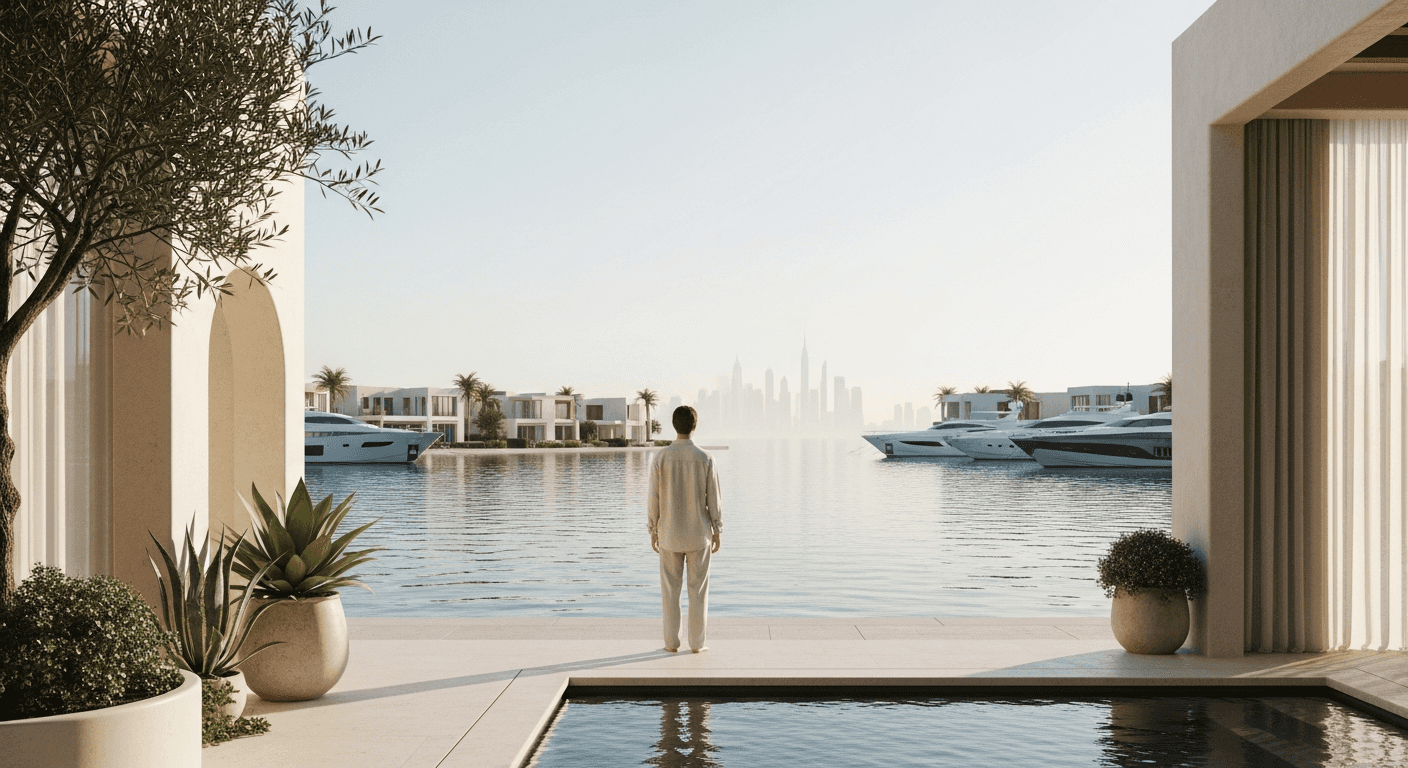
The 'Golden Acre' Effect in Dubai
I explore how finite land in Dubai's prime districts is creating a new class of ultra-valuable property, reshaping investment logic for the coming decade.

For two decades, the story of Dubai property was one of infinite horizons. If you needed more coastline, you built a palm. If you needed a new financial centre, you zoned a patch of desert. That era is now decisively over. The most powerful force shaping property values in Dubai today is not expansion, but constraint. I call this the 'Golden Acre' effect: the powerful value premium being created by acute Dubai land scarcity in our most established and geographically finite districts.
Here is what I will analyse in this report:
- The 'Golden Acre' theory: why physical limits are Dubai's new value driver.
- Case Study 1: The unshakeable premium of coastal communities like Palm Jumeirah and Dubai Marina.
- Case Study 2: How Jumeirah transformed from a quiet suburb into an ultra-prime development frontier.
- The new economics of demolition and redevelopment on prime land.
- How developers are shifting their focus towards high-value urban infill development.
- The trade-offs for buyers: weighing the higher cost of entry against long-term security.
- My forecast on where the next 'Golden Acres' are likely to emerge.
The Theory of the Golden Acre
Dubai’s defining characteristic has always been its ambition to overcome physical limitations. The city’s narrative is built on projects that defy geography, from the world's tallest building to man-made archipelagos. This history has conditioned many investors to think of supply as perpetually elastic. The reality, I argue, has fundamentally changed. We have now reached a point of maturity where the most desirable locations are, for all practical purposes, full. The limited supply effect Dubai is experiencing is no longer a temporary market condition; it's a permanent structural feature of its prime real estate landscape.
The 'Golden Acre' is my term for a plot of land or a property within a geographically contained, fully-developed, and highly desirable district. These are areas bounded by the sea, a creek, or dense existing infrastructure, where no more meaningful new land can be created. Think of Bluewaters Island, an enclave with a fixed number of apartments and townhouses, or the fronds of the Palm Jumeirah. The value of these locations is no longer just a function of the building that sits on the land, but of the irreplaceability of the land itself. This is a classic economic principle: when demand is sustained and supply is fixed, prices must find a new, higher equilibrium.
What makes this different from any other city? In London or New York, this dynamic has existed for centuries. In Dubai, it is a relatively new phenomenon. For years, the answer to rising demand in a popular area like the Marina was to simply build another one next door, like Jumeirah Lakes Towers. The answer to demand for waterfront villas was to launch a new master community with a man-made lagoon. That option is disappearing for the most prime corridors. You cannot build another Bluewaters next to Bluewaters. You cannot add more beach frontage between the Four Seasons and the Burj Al Arab. The land between Sheikh Zayed Road and the sea is now a closed system. This finality is what underpins the Golden Acre's immense value proposition.
This shift has profound implications. It bifurcates the market into two distinct categories: the geographically constrained prime areas, and the inland, expandable suburban communities. While areas like Damac Hills and Damac Hills II or Arabian Ranches offer fantastic lifestyles and value, their supply can, in theory, continue to expand into the surrounding desert. The supply in Jumeirah Bay cannot. This distinction is crucial for understanding future mature district property appreciation. The price ceiling in a Golden Acre location is dictated purely by what the wealthiest global buyers are willing to pay for absolute scarcity, not by the cost of construction or the price of the next-best alternative in a new development.
Case Study 1: The Coastal Premium of Palm Jumeirah & Dubai Marina
 Featured project
Nowhere is the Golden Acre effect more evident than in Dubai's prime coastal communities. Palm Jumeirah and Dubai Marina are perhaps the city's most globally recognised addresses, and their value trajectory offers a masterclass in the power of supply constraints. When they were first launched, they were seen as audacious, even risky. Today, they are the bedrock of Dubai’s prime market, precisely because their physical footprint is now fixed.
Consider Palm Jumeirah. Created by developer Nakheel, its fronds and crescent offer a finite number of beachfront villa plots and a limited shoreline for apartment towers. Once the last plot was sold and developed, the supply of new, direct-from-developer homes essentially dropped to zero. Any new project, such as the recent branded residences on the Palm's West Beach, requires the demolition or radical redevelopment of an older asset — a hotel or an older apartment block. This is a complex and expensive process, meaning new supply comes to market at a significant premium, pulling the value of existing properties up with it. The demand for a villa on the Palm is not just for a luxury home; it's for a piece of an iconic, finished, and irreplaceable location. This is why we see record-breaking prices for signature villas and why land plots on the fronds command astronomical sums. There are simply no more to be made.
Dubai Marina tells a similar story, but in a vertical context. Master-developed by Emaar Properties, the Marina is a dense, meticulously planned district built around a man-made canal. For over a decade, it was a constant construction site. Today, the vast majority of plots are built out. The few remaining opportunities for development, such as the site of the former Marina Yacht Club, are exceptionally rare and command intense bidding from developers. The result is projects like Marina Shores, one of the very last waterfront plots, which launched at prices that reflected this scarcity. This limited supply effect Dubai is pushing values for older, well-maintained towers with prime views to new heights. Buyers recognise that the opportunity to own a front-row view of the marina and the sea is diminishingly small. This confidence in future value retention is a direct consequence of the area reaching its physical capacity.
“The conversation about Dubai property is no longer just about 'what's next?'; it's increasingly about 'what's left?'. The value of scarcity is finally eclipsing the allure of the new.”
This dynamic also creates a virtuous cycle. Because these areas are mature, they possess a density of amenities — restaurants, beach clubs, transport links like the Tram and Metro, that newer communities can take years, if not decades, to replicate. This established infrastructure makes them more attractive to both end-users and tenants, ensuring robust rental demand and justifying the higher capital values. The premium you pay to enter the Marina or the Palm is not just for the property; it’s for access to a fully-formed, irreplaceable ecosystem. This is a key reason why prime land values Dubai in these districts have shown such resilience and strong growth compared to areas with a long pipeline of future supply.
Case Study 2: Jumeirah's Transformation into an Ultra-Prime Frontier
If Palm Jumeirah and the Marina are examples of planned scarcity, the district of Jumeirah offers a more organic, and in many ways more fascinating, case study. For decades, Jumeirah (along with its neighbour Umm Suqeim) was a quiet, low-rise suburb dominated by sprawling, often dated, villas inhabited by legacy Emirati families and long-term expatriates. It was prestigious but sleepy. Over the past five to seven years, it has transformed into one of the world's most active markets for urban infill development, driven entirely by the value of its land.
What changed? The key was the gradual opening up of plots to redevelopment. As the value of land began to skyrocket, owners of older, single-family villas were presented with an irresistible arbitrage opportunity. A developer could acquire a 15,000 sq ft plot with a 40-year-old villa, demolish the existing structure, and, subject to zoning permissions, build a stunning contemporary mansion or a collection of boutique townhouses. The sale price of the new property would far exceed the acquisition and construction costs, creating enormous profit. This process has been repeated hundreds oftimes along streets like Al Wasl Road and Jumeirah Beach Road, completely reshaping the architectural fabric and price points of the area.
This is the Golden Acre effect in its rawest form. The land in Jumeirah 1, 2, 3, and Umm Suqeim is the most valuable residential real estate on the Dubai mainland. Its proximity to the sea, Downtown Dubai, and the city’s best schools and amenities makes it irreplaceable. Projects like Jumeirah Bay Island, developed by Meraas, represent the pinnacle of this trend. An artificial island connected by a bridge from the Jumeirah coastline, it was conceived as an enclave for the ultra-wealthy, with a Bulgari resort and a handful of mansion plots. These plots have since traded for record-breaking per-square-foot prices, setting a new benchmark for prime land values Dubai. The buyers are not just purchasing land; they are purchasing a permanent, unassailable position in Dubai's most exclusive postcode.
This has also spurred a new category of boutique developers who specialise in this type of high-value infill. They build one-off villas or small-scale residential projects like those from developers such as Muraba or Omniyat, which are architecturally significant and cater to a buyer seeking discretion and uniqueness over the master-community lifestyle. These projects often sell off-market for tens, or even hundreds, of millions of dirhams. This activity has a powerful ripple effect, recalibrating the perceived value of every property in the vicinity. The owner of an older villa now understands their asset not just as a home, but as a potential development site with a value many multiples of what it was a decade ago.
The New Economics of Redevelopment
The shift towards infill and redevelopment is governed by a simple but brutal economic calculation. The 'land residual value' — what a developer can afford to pay for a plot, is determined by the potential revenue from the new project (Gross Development Value or GDV) minus the costs of construction, financing, and a target profit margin. In Golden Acre districts, the GDV has risen so dramatically that it justifies paying enormous sums for the land itself, including the cost of demolishing whatever currently sits on it.
This has created a two-tier market within these mature districts. On one hand, you have the original, often un-renovated, properties. On the other, you have the brand-new or fully refurbished homes. The price gap between them is immense. In my experience, an old villa in a prime Jumeirah location might be valued almost entirely on its plot value. A buyer will look at it and see a price tag of, say, AED 30 million, understanding that they will likely spend another AED 15-20 million to demolish and rebuild. The finished product, a modern 15,000 sq ft mansion, could then be worth AED 80 million or more. The original structure has almost zero value; all the value is in the 'Golden Acre' it occupies.
This dynamic presents both challenges and opportunities. For existing homeowners, it represents a massive, often life-changing, windfall. For aspiring buyers, it raises the barrier to entry significantly. The 'bargain' fixer-upper in a prime location is becoming a thing of the past. If a property is in a location ripe for redevelopment, its price will be bid up by developers to its land-value potential, pricing out most end-user families who simply want a home to live in. This is a crucial factor contributing to mature district property appreciation and one that buyers must understand when evaluating their options.
Here’s a simplified breakdown of the costs involved in a typical redevelopment scenario for a prime villa plot:
- Acquisition (Old Villa on 15,000 sq ft plot): AED 30,000,000
- DLD Transfer Fee (4%): AED 1,200,000
- Agency Fee (2% + 5% VAT): AED 630,000
- Trustee & Admin Fees: Approx. AED 10,000
- Demolition & Site Preparation: AED 200,000
- Design, Engineering & Permits: AED 800,000
- Construction Cost (12,000 sq ft GFA @ AED 1,500/sq ft): AED 18,000,000
- Landscaping & Pool: AED 1,000,000
- Financing & Contingency (Approx. 10%): AED 5,084,000
Total Project Cost (Illustrative): AED 56,924,000
This simplified model, which excludes many smaller costs, shows how a project can easily exceed AED 55 million before a single piece of furniture is moved in. For this to be viable, the end-market valuation must comfortably exceed this figure, which is why we are now seeing new-build mansions in Jumeirah and on the Palm transact for between AED 80 million and AED 200 million. It’s a high-stakes game predicated entirely on the scarcity and desirability of the underlying land.
Developer Strategy: From Master Plan to Micro-Site
The Golden Acre effect is forcing a strategic pivot among Dubai's most astute developers. The traditional model, pioneered by giants like Emaar and Nakheel, was based on acquiring vast tracts of desert or sea and creating entire cities from scratch. This involved massive upfront infrastructure investment but offered economies of scale and total control over the environment. While large-scale master communities are still being launched in areas with available land like the push towards Expo City or south of the city, the focus at the very top end of the market has shifted.
Today, the most sophisticated developers are increasingly behaving like property surgeons, not city builders. They are hunting for individual plots or small clusters of plots in prime, built-out locations. Their skill is not in master-planning, but in navigating complex approvals, executing logistically challenging construction in dense areas, and creating a product whose quality and design justifies a record-breaking price on a small footprint. This is the essence of urban infill development. We see this with developers like Omniyat, whose projects like The ORLA on Palm Jumeirah involved acquiring and re-imagining a prime plot to create a new, ultra-luxury landmark.
This shift also brings new players into the market. The capital required to buy one plot in Jumeirah, while substantial, is far less than that needed to launch a 1,000-villa master community. This has allowed the emergence of boutique, family-office-backed, or specialist high-end developers. They may only build one or two projects a year, but each is a statement piece designed to maximise the value of its Golden Acre location. Their competitive advantage is design, quality, and exclusivity, not scale.
This strategic shift has a direct impact on the types of properties coming to market. In these prime infill locations, we are seeing fewer mid-market buildings and more branded residences, limited collections of townhouses, or one-off mansions. The land is simply too expensive to justify building anything but the most premium product. For buyers, this means that while the choice in new-build properties in these areas is limited, the quality is often exceptional. These projects are designed for a discerning global clientele who prioritise location and quality above all else, and for whom price is a secondary consideration to securing a truly unique asset.
The Buyer's Dilemma: Cost of Entry vs. Long-Term Value
For anyone looking to browse properties for sale in Dubai, this market bifurcation creates a critical strategic choice. Do you pay the significant premium to enter a Golden Acre district, or do you opt for a newer, often larger, property for the same price in an emerging suburban community? There is no single right answer; the optimal choice depends entirely on your priorities, budget, and long-term goals.
Let’s consider a hypothetical budget of AED 5 million. In a developing community like JVC or Arjan, this budget could secure a spacious townhouse or even a four-bedroom villa. The property would be new, with modern amenities and part of a growing community. The potential for near-term capital appreciation might be tied to the completion of surrounding infrastructure and the overall growth of the area. However, there is also a large and ongoing pipeline of similar properties, which can place a ceiling on price growth and rental yields during periods of high supply.
Now, take that same AED 5 million budget to a Golden Acre district like Dubai Marina. Here, it might secure a well-maintained two-bedroom apartment in a ten-year-old tower, but with a full sea view. You are getting less space and an older building, but you are buying into a location with fixed supply, proven rental demand, and a level of amenity density that cannot be replicated. The long-term value of this property is, in my view, more secure. Its performance is less dependent on future construction and more on the enduring appeal of its irreplaceable location. The mature district property appreciation here is driven by scarcity, not just novelty.
Here is a checklist of factors for buyers to weigh when making this decision:
- Space vs. Location: Are you prioritising square footage and number of bedrooms, or the prestige and convenience of a prime, central address?
- New-Build vs. Established: Do you prefer a brand-new property with a warranty, or are you comfortable with an older building that has a track record and potentially lower service charges?
- Rental Yield vs. Capital Preservation: Newer areas can sometimes offer higher net rental yields initially, as purchase prices are lower. Established areas may offer slightly lower yields but provide superior long-term capital preservation and stability.
- Community Maturity: Do you want to be part of a community from its early stages and grow with it, or do you want to move into a fully-formed neighbourhood with all amenities in place from day one?
- Supply Pipeline: Research the future development plans for the area. Is your community one of many phases to come, or is it fundamentally complete? The Dubai Land Department's Dubai REST app and open data portals can provide insights into upcoming supply.
Ultimately, investing in a Golden Acre district is a bet on the enduring power of location and scarcity. It requires a higher upfront investment and a willingness to accept that you might get 'less property for your money' in terms of pure size. However, the trade-off is a level of security and long-term value retention that is increasingly hard to find in a city that is still growing.
Forecast: Identifying the Next Golden Acres
Looking ahead, the forces of scarcity will continue to reshape Dubai's property landscape. While the prime coastal and downtown areas are the most obvious examples today, I believe the Golden Acre effect will begin to manifest in a new set of locations over the next five to ten years. Identifying these areas early is key to sound long-term investment strategy. At Gaia Living, we spend a great deal of our research effort on this forward-looking analysis.
One category to watch is established, mid-rise communities with limited expansion potential. Areas like the Greens & Views, developed by Emaar, are a prime example. This community is now fully built out, with mature landscaping and a strong sense of identity. It's surrounded by other established areas and major roads, leaving no room for new phases. As demand for well-managed, central, and green communities grows, the fixed supply in The Greens will likely lead to significant value appreciation. It possesses many of the same characteristics as a prime coastal area, just at a more accessible price point.
Another frontier is areas undergoing major infrastructure-led transformation. The redevelopment around the Dubai Canal has effectively created a new, finite waterfront in the heart of the city, turning areas of Business Bay and Al Jaddaf into prime real estate. Similarly, the development of projects like Mina Rashid Yachts & Marina is transforming a historic port area into a new, but geographically contained, luxury enclave. These are districts where the 'Golden Acre' is being newly minted through strategic government and developer-led initiatives.
Finally, I believe we will see the 'island effect' replicated. The success of Bluewaters and Jumeirah Bay has provided a clear template. Projects like Dubai Island (formerly Deira Islands) and the renewed vision for Palm Jebel Ali are monumental in scale, but they are ultimately finite. Once their master plans are complete and their coastlines are defined, they will become closed ecosystems. While they are in their early phases today, investors with a very long-term horizon should be analysing their unique geography. In 20 years, a well-chosen plot on Palm Jebel Ali could very well be considered a Golden Acre, benefiting from the same scarcity dynamics that drive value on Palm Jumeirah today.
The defining principle of Dubai's next property cycle will be scarcity. The highest, most durable returns will not come from betting on the next sprawling suburb, but from identifying and securing a position within the city's finite 'Golden Acres'. This requires a shift in mindset from prioritising the new to valuing the irreplaceable. This is the core of our investment thesis at Gaia Living and the advice we provide to our most discerning clients.
Sources
- Dubai Land Department (DLD): dubailand.gov.ae
- Dubai REST Application (DLD): dubairest.gov.ae
- Central Bank of the UAE: centralbank.ae
- UAE Government Portal (Fees and Procedures): u.ae
Questions, answered
- What is the 'Golden Acre' effect in Dubai real estate?
- The 'Golden Acre' effect describes how the finite, irreplaceable land in Dubai's most established and geographically constrained communities, like Palm Jumeirah, is creating a permanent value premium. This scarcity drives intense competition for plots and properties, leading to significant price appreciation.
- Why are property values rising so much in mature Dubai districts?
- Values are rising due to a combination of fixed land supply, mature infrastructure, established community appeal, and a flight to quality from global investors. Unlike new developments, you cannot create more land in areas like Jumeirah or Bluewaters Island, which creates a powerful supply-side constraint.
- Is it more expensive to buy property in an established area like Dubai Marina?
- Yes, the cost of entry is significantly higher. You are paying a premium for the location, views, and established amenities. However, this premium often translates into stronger long-term value retention and rental demand compared to properties in less central, developing areas.
- What is urban infill development in Dubai?
- Urban infill development involves redeveloping underused or older plots within established city areas. In Dubai, this often means demolishing an old villa in a prime location like Jumeirah to build a modern mansion or a boutique low-rise apartment building, maximising the value of the scarce land.
- Which areas in Dubai are considered 'Golden Acres'?
- Prime examples include Palm Jumeirah, Jumeirah Bay Island, Bluewaters Island, and parts of Jumeirah and Umm Suqeim. These areas have strong geographic boundaries, mature infrastructure, and extremely limited or non-existent new land for development.
- What fees are involved in buying a property in Dubai?
- The main upfront costs include the Dubai Land Department (DLD) transfer fee of 4% of the property value, a Trustee Office fee of around AED 4,200, an agency fee of 2% plus VAT, and any applicable mortgage arrangement fees. Buyers should budget for roughly 7-8% of the purchase price in total fees.

Amara translates DLD transaction data, supply pipelines, and macro signals into clear calls on where Dubai's market is heading. She writes the numbers most brokers only feel.
Related stories
Dubai's Big Squeeze: Smaller Plots, Denser Living
Dubai real estate is undergoing a fundamental shift towards smaller plot sizes and higher density. We analyse the economic drivers, the impact on property values, and what this new era of compact urban living means for both homebuyers and investors.
Resort Living as Your Dubai Reality
Explore how to trade temporary staycations for a permanent home with five-star amenities in Dubai. I'll break down the real costs, best communities, and lifestyle trade-offs of embracing high-end resort living every day.
Finding Your Tribe in Dubai's Villa Communities
I explore which of Dubai's renowned villa communities attract specific expat nationalities and lifestyle groups, offering insights to help you find a place that feels like home.
Echoes, in your inbox
One thoughtful email a month. Market insight, new launches, no spam.