

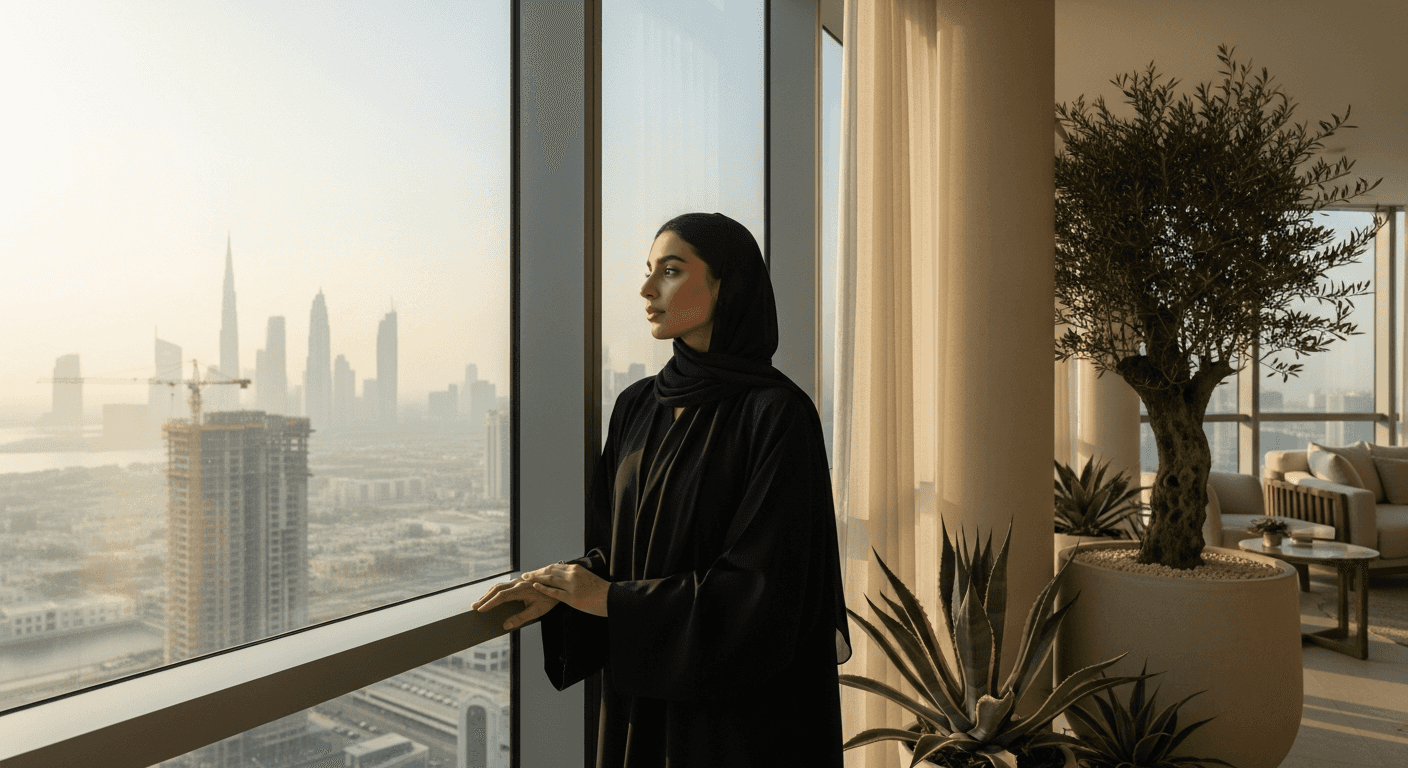
The Big Shift: Dubai's New Demand for Family Homes
A fundamental demographic shift is reshaping Dubai's property market, as demand for larger family homes forces developers to rethink their strategies. I analyse the drivers, the communities, and the real costs involved for today's buyers.

The long-held image of the Dubai expatriate is fading. For years, the market was defined by the transient professional — young, single or coupled, here for a few years of work before moving on. That stereotype is now dangerously out of date, and developers or investors still clinging to it are missing the most significant structural change in Dubai's property market in a generation.
Here's what we'll explore:
- The key demographic shifts creating a permanent demand for family homes.
- How Dubai's leading developers are responding with new project types and layouts.
- A spotlight on the master communities that are successfully meeting this demand.
- The financial reality: a full, line-by-line cost breakdown of buying a family villa.
- The changing definition of a 'family home' and the rise of the 'vertical villa'.
- My analysis of the risks and opportunities for both homebuyers and investors.
- The future outlook for this foundational segment of the Dubai property market.
Beyond the Bachelor Pad: Dubai's New Demographics
For two decades, a significant portion of Dubai's residential development was geared towards a fast-moving, cyclical market. The focus was often on studios and one-bedroom apartments, assets that were easy to rent out and could be traded quickly by international investors. This model served its purpose, but the ground has irrevocably shifted beneath it. The primary driver of today's market is the family unit, and not just for a short-term posting, but for a lifetime.
This fundamental change is underpinned by deliberate and highly effective government policy. The introduction and expansion of long-term residency options, most notably the 10-year Golden Visa, have been game-changers. By providing a clear path to long-term stability, these visas have transformed the psychological calculus for expatriates. Dubai is no longer just a place to earn; it's a place to live, raise children, and build a future. This sense of permanence is the bedrock of the new `residential demand trends`. Families who see a ten, twenty, or thirty-year horizon in the UAE don't rent if they can afford to buy. They seek stability, community, and a tangible stake in the city's future, which is precisely what homeownership provides.
Layered on top of this policy-driven shift are powerful social and economic currents. The global upheaval of the early 2020s triggered a worldwide 'flight to space' as people re-evaluated their living arrangements. In Dubai, this was not a temporary blip but the catalyst for a lasting preference. Families who experienced lockdowns in cramped apartments are now unwilling to compromise on having private outdoor areas, home offices, and playrooms for their children. This desire for more square footage is a core tenet of the `family housing Dubai` boom. It's a qualitative demand that directly translates into a quantitative need for villas, townhouses, and larger-format apartments, a demand that continues to outstrip ready supply in prime communities.
Finally, we cannot ignore the powerful effect of Dubai's rising global status. The city has become a magnet for high-net-worth individuals (HNWIs) and successful entrepreneurs from across the globe, who are relocating their families and businesses. For this demographic, a spacious, well-appointed home is not a luxury but a baseline expectation. They arrive seeking not just a house, but an entire lifestyle package: proximity to world-class schools, premium healthcare, safe public spaces, and high-end retail. Their arrival has injected a new level of demand at the premium end of the market, pulling up prices and expectations for `Dubai large family villas` and setting a new benchmark for what constitutes a desirable family home.
The Developer's Pivot: From Studios to Sprawling Estates
 Featured project
The most astute developers in the region have recognised that these `demographic shifts real estate` signals are not cyclical noise but a deep, structural change in their target market. The response has been a marked and accelerating pivot in development strategy. The era of launching tower after tower of identical small units is giving way to a more nuanced approach, one that prioritises community, space, and the specific needs of the end-user family.
We are witnessing a strategic recalibration of the supply pipeline. Major players like Emaar Properties, who have always had a strong footing in master-planned communities, are doubling down. The continued expansion and immense popularity of developments like Dubai Hills and Arabian Ranches III are testaments to this strategy. These aren't just collections of houses; they are fully integrated ecosystems built around family life. The planning incorporates schools, clinics, retail centres, vast parks, and sports facilities from day one. This holistic approach to `property development family homes` is the new gold standard. Developers understand that families are not just buying a property; they are buying into a community and a lifestyle.
Similarly, developers like Nakheel and Damac are heavily invested in delivering new phases of villa and townhouse communities that cater to this demand. The focus is on providing a variety of layouts and sizes, from three-bedroom townhouses for young families to expansive six and seven-bedroom mansions for larger, multi-generational households. This shift is also visible in the very architecture and design of these new projects. We're seeing larger garden plots, the inclusion of maid's and driver's rooms as standard, dedicated home office or study spaces, and more flexible floor plans that can adapt as a family grows. These are not cosmetic changes; they are direct responses to feedback from the market and a clear understanding of what the modern family requires.
This pivot extends beyond just new greenfield developments. We're also seeing it influence projects in more established urban areas. A decade ago, a new tower in Business Bay or Dubai Marina would have likely been 80% studios and one-beds. Today, a new premium launch in a similar area will have a much healthier mix of two, three, and even four-bedroom units, designed to attract families who want an urban lifestyle without sacrificing space. It is a tacit admission from the industry that the family buyer is now a primary, not secondary, target customer across almost all segments of the market. This change is resource-intensive and requires long-term vision, but the developers who get it right are locking in a loyal and stable customer base for years to come.
Community Spotlight: Where are Families Flocking?
When our clients at Gaia Living ask where they should look for a family home, the conversation invariably turns to a handful of master-planned communities that have perfected the formula. While every family has unique priorities, these areas consistently deliver on the key requirements: excellent schools, abundant green space, robust amenities, and a genuine sense of community.
Dubai Hills: Arguably the gold standard for modern family living in Dubai. Developed by Emaar, it represents the culmination of decades of experience in community building. Its central location, set between Al Khail Road and Mohammed Bin Zayed Road, offers superb connectivity. But its true appeal lies within its boundaries. The community offers the magnificent Dubai Hills Park, a championship golf course, the Dubai Hills Mall, and top-tier healthcare with King's College Hospital. The property mix is diverse, ranging from contemporary townhouses in Maple and Sidra, which appeal to young families, to the ultra-luxury mansions of Hills Grove Villas, which attract HNWIs. This variety ensures a vibrant and mixed community, where families at different life stages and income levels can find a home. It's a blueprint for the future of suburban Dubai.
Arabian Ranches: The original and, for many, still the benchmark for family villa living. Its mature, lush landscaping gives it a settled, established feel that newer communities can't yet replicate. The enduring appeal of the Ranches lies in its simplicity and focus on community life. The Arabian Ranches Golf Club and the Jumeirah English Speaking School (JESS) campus are pillars of the community. While the original phase remains highly sought-after for its character and larger plots, the newer expansions, Arabian Ranches II and III, have introduced more modern layouts and a wider range of amenities, ensuring the brand remains relevant. For families seeking a warm, unpretentious, and deeply rooted community atmosphere, Arabian Ranches is often the first and last stop.
Jumeirah Golf Estates: For those at the higher end of the market, JGE offers an unparalleled lifestyle. Centred around two Greg Norman-designed championship golf courses, Fire and Earth, the community is defined by its stunning views and exceptional build quality. These are not cookie-cutter villas; each enclave has its own distinct architectural style, from Tuscan-inspired designs in Sanctuary Falls to the contemporary aesthetic of Redwood Park. The properties are typically larger, with generous plot sizes and premium finishes. The country club provides a social hub, and the proximity to the city's main arteries makes it surprisingly convenient. It's a community that appeals to families who prioritise luxury, privacy, and an active, outdoor lifestyle.
Beyond this top tier, a growing number of other communities offer compelling value propositions for families. Town Square by Nshama has been a phenomenal success, delivering affordable townhouses and apartments centered around a vibrant central park and retail strip. Further out, communities like Damac Hills and Damac Hills II provide a wide array of options, often with attractive payment plans, clustered around amenities like the Trump International Golf Club and Malibu Bay wave pool. These areas demonstrate that the demand for family housing exists across the price spectrum, and the market is responding with diverse and appealing options.
The Financial Reality: Deconstructing the Cost of a Family Villa
Understanding the headline price of a villa is only the first step. For any family planning a purchase, it's crucial to budget for the full, all-in cost. Dubai's transaction costs are transparent and regulated, but they add up. In my experience, many first-time buyers underestimate the total cash required upfront. Let's break down the numbers for a hypothetical purchase of a four-bedroom villa in a desirable community like Dubai Hills or Arabian Ranches.
Let's assume a purchase price of AED 5,000,000. If you are an expatriate resident requiring a mortgage, the Central Bank of the UAE mandates a minimum down payment. For a first property purchase under AED 5 million, this is 20%. Here’s a line-by-line breakdown of the upfront costs you would face:
- Purchase Price: AED 5,000,000
- Mortgage Loan (80% LTV): AED 4,000,000
- Down Payment (20% of Price): AED 1,000,000
Now for the associated fees, which are payable at the time of transfer:
- Dubai Land Department (DLD) Transfer Fee: 4% of the purchase price. This is arguably the largest single closing cost. On a AED 5M property, this amounts to AED 200,000. This fee is typically split 50/50 between buyer and seller, but it is common for the buyer to cover the full amount as part of the negotiation.
- DLD Administrative Fee: A fixed fee payable to the DLD for processing the title deed transfer. This is currently AED 4,200 (including VAT).
- Property Registration Fee (for properties > AED 500k): Another DLD fee, amounting to AED 4,000 + VAT.
- Real Estate Agency Fee: This is typically 2% of the purchase price, plus 5% VAT. So, (0.02 x 5,000,000) * 1.05 = AED 105,000.
- Mortgage Registration Fee: This is paid to the DLD to register the mortgage against the property's title deed. The fee is 0.25% of the total loan amount. 0.0025 x AED 4,000,000 = AED 10,000.
- Bank Mortgage Arrangement/Processing Fee: This varies between banks but can be up to 1% of the loan amount, plus VAT. Let's assume a competitive 0.5%, which would be (0.005 x 4,000,000) * 1.05 = AED 21,000.
- Property Valuation Fee: The bank will require an independent valuation before approving the loan. This costs between AED 2,500 and AED 3,500. Let's budget AED 3,150 (including VAT).
- Trustee Office Fee: This is for the services of a RERA-approved Trustee who facilitates the transfer process. This is typically a fixed fee of AED 4,200 (including VAT).
Adding it all up, the total estimated cash required upfront is:
Total Upfront Cash = AED 1,000,000 (Down Payment) + AED 347,550 (Fees) = AED 1,347,550
This means that to buy a AED 5 million villa, you need nearly AED 1.35 million in cash on hand. This is a significant sum and underscores the importance of thorough financial planning. It’s also vital to remember ongoing costs. Service charges for villas are lower than apartments, typically ranging from AED 2.50 to AED 6.00 per square foot on the built-up area annually, but for a 4,000 sq.ft villa, this can still be AED 10,000 to AED 24,000 per year. These figures, governed by RERA, cover the maintenance of community parks, pools, security, and infrastructure. Understanding both the upfront and recurring costs is fundamental to making a sustainable investment in `family housing Dubai`.
More Than a Villa: The Rise of the 'Vertical Family Home'
While the demand for `Dubai large family villas` dominates headlines, a parallel and equally important trend is emerging: the rise of the large-format luxury apartment, or what I call the 'vertical family home'. This challenges the traditional notion that a family needs a horizontal, ground-level house with a private garden. For a growing segment of the market, a spacious, well-designed apartment in a prime location offers a more compelling lifestyle.
This trend is a direct response to a specific type of family buyer: one who values location, views, and amenity-rich living over a private plot of land. Think of families who want to be in the heart of the action, within walking distance of cafes, restaurants, and the beach. For them, the prospect of a long commute from a suburban villa community is a non-starter. They are willing to trade a garden for a panoramic sea view from the 40th floor, provided they don't have to compromise on internal living space.
Developers have been quick to cater to this niche. In premium locations like Palm Jumeirah, Emaar Beachfront, and Bluewaters Island, new towers are being launched with a significant inventory of three, four, and even five-bedroom apartments and penthouses. These are not just standard apartments with an extra bedroom tacked on. They are thoughtfully designed with family living in mind, featuring large living and dining areas, expansive balconies that function as outdoor living rooms, generous storage, and en-suite bathrooms for all bedrooms. Some ultra-luxury projects even include private pools on the balcony, effectively creating a villa experience in the sky.
This is a trade-off, of course. What you gain in location and views, you lose in ultimate privacy and ground-floor outdoor space. Service charges are also significantly higher in these premium towers, reflecting the cost of maintaining multiple swimming pools, state-of-the-art gyms, 24/7 concierge services, and the building's facade and systems. However, for many affluent families, especially those with older children or who travel frequently, this lock-and-leave convenience is a major selling point. It's a lifestyle choice that combines the spaciousness of a family home with the effortlessness of five-star hotel living. Developers like Meraas with its work at City Walk and Bluewaters, and Select Group in Dubai Marina, have become masters of this product type, proving that the definition of a 'family home' in Dubai is becoming more diverse and sophisticated.
“The era of Dubai as a transient stopover is over. Developers who fail to build for the rooted, multi-generational family are building for a market that no longer exists.”
Navigating the Supply Squeeze: Buyer and Investor Strategy
With demand for quality family homes consistently high, both end-users and investors face a competitive market. The supply of ready, well-located villas and large apartments is tight, leading to upward pressure on prices. Navigating this environment requires a clear strategy.
For homebuyers, the primary decision point is often between buying a ready property on the secondary market or purchasing off-plan directly from a developer. Each path has distinct advantages and risks. The secondary market offers the significant benefit of certainty and speed. You can see, touch, and inspect the exact property you are buying. You can move in immediately after the transfer is complete, avoiding a long wait and the uncertainty of construction timelines. The downside is price. You are buying in a seller's market, and desirable properties often attract multiple offers, pushing prices to a premium. You may also face the additional cost of renovation or upgrades, as older properties may not have the modern finishes or layouts that are now in vogue.
Conversely, the off-plan launches market offers the potential for better value. Developers often price off-plan projects attractively to generate sales momentum, meaning you could secure a property at a lower price than a comparable ready unit. You also get a brand-new home, built to the latest standards, with a warranty on construction. Most importantly, developers offer highly attractive, post-handover payment plans, which can significantly ease the financial burden compared to securing a large mortgage. The risks, however, are real. Construction delays are always a possibility, and you are buying a product based on floor plans and marketing materials. That said, Dubai's regulatory framework, with mandatory escrow accounts and the Oqood registration system managed by the Dubai Land Department (DLD), provides a strong safety net for buyers' funds.
For investors, this market segment presents a compelling case for capital appreciation. While the net rental yields on villas (typically 3-5%) are often lower than those on smaller apartments (5-7%+), the total return profile can be superior. This is because the demand from family tenants is stable and long-term. Families tend to rent for longer periods, reducing vacancy rates and turnover costs. More importantly, the structural undersupply of large family homes in the face of growing demand creates a powerful dynamic for price growth. In my view, an investment in a well-located three or four-bedroom townhouse or villa today is less of a pure yield play and more of a strategic bet on long-term capital growth, driven by the city's fundamental demographic evolution.
Here is a simple checklist we advise our family clients to use when evaluating a property:
- School Run Test: How close are the schools you want for your children? Do a test run during peak morning traffic.
- Healthcare Access: Where is the nearest clinic and hospital? Check their specialities and reputation.
- Amenity Audit: Walk the community. Are the parks, pools, and playgrounds well-maintained and genuinely usable?
- Commute Reality: What is the real-world commute time to your place of work, not just the off-peak time quoted in a brochure?
- Service Charge History: Request the past two years of service charge statements from the seller or owner's association. Are they stable? Are there any large, upcoming special assessments?
- Future-Proofing: Does the layout have flexibility? Is there a room that could become a home office, a guest room, or a playroom as your needs change?
My Verdict: Is the Big Squeeze Here to Stay?
After observing Dubai's property cycles for many years, I can say with confidence that the current demand for family homes is not a fleeting trend. This is not a bubble. This is a fundamental realignment of the market, driven by deep, structural changes in who is choosing to make Dubai their permanent home. The government's visionary visa policies, combined with the city's unmatched quality of life, safety, and global connectivity, have created a powerful and sustainable gravitational pull for families from around the world.
The implications are profound. The `property development family homes` segment will, in my opinion, be the primary engine of the residential market for the foreseeable future. The intense demand for space and community is here to stay, and it will continue to reward developers who deliver the right product and investors who position themselves accordingly. The era of speculative, short-term plays in small apartments is not over, but it has been eclipsed by the more stable, long-term demand from end-user families putting down roots.
Looking ahead, I anticipate this trend will continue to shape the city's physical and economic landscape. We will see the launch of new, large-scale master communities further inland as developers seek out available land parcels. There will be an increased focus on the redevelopment and modernisation of older villa communities to bring them up to current standards. And the innovation in 'vertical family homes' will continue, with architects and developers pushing the boundaries of what is possible in a high-rise format. The premium for space, quality, and community will not only persist but likely grow.
The shift towards family-oriented housing is the most significant and durable trend in Dubai real estate today. For buyers, it means investing in a lifestyle and a community, not just bricks and mortar. For investors, it represents a strategic opportunity for long-term capital growth, anchored in the city's successful transformation into a permanent home for global families.
Sources
- Dubai Land Department (DLD): https://dubailand.gov.ae/
- Central Bank of the UAE (CBUAE): https://www.centralbank.ae/
- The Official Portal of the UAE Government: https://u.ae/
Questions, answered
- What is driving the demand for larger family homes in Dubai?
- The demand is driven by key demographic shifts, including long-term visa reforms like the Golden Visa which encourage families to put down roots, a post-pandemic preference for more space, and an influx of global high-net-worth individuals seeking a higher quality of life in Dubai.
- What are the total upfront costs to buy a family villa in Dubai?
- For a villa priced at AED 5 million, the upfront costs are typically around 25-27% of the purchase price. This includes the mortgage down payment (at least 20% for expats), the 4% DLD transfer fee, agency fees, and various registration and administrative fees, totalling approximately AED 1.35 million.
- Which communities in Dubai are most popular with families?
- Established and new master-planned communities are highly sought-after. Key areas include Dubai Hills Estate for its modern amenities and central location, Arabian Ranches for its mature community feel, and Jumeirah Golf Estates for luxury living. More accessible options can be found in communities like Town Square and DAMAC Hills.
- Are developers in Dubai building more family-sized homes now?
- Yes, there is a clear pivot in development strategy. Major developers are now focusing more on launching villa and townhouse communities, as well as larger 3, 4, and 5-bedroom apartments, to meet the sustained demand from end-user families, a shift from the previous focus on smaller, investor-grade units.
- Is a large family home in Dubai a good investment?
- From my perspective, yes, particularly as a long-term capital growth asset. While rental yields on villas may be lower than on smaller apartments, the demand from high-quality, long-term family tenants is strong. The structural nature of this demand suggests strong potential for capital appreciation in the coming years.
- Besides villas, what other family housing options are available in Dubai?
- The market for 'vertical family homes' is growing rapidly. These are large 3, 4, or 5-bedroom apartments and full-floor penthouses in prime locations like Palm Jumeirah, Bluewaters Island, and Downtown Dubai. They offer the space of a villa combined with the premium amenities and views of a luxury tower.
Omar tracks the announcements that move the market — new launches, regulation, mega-projects, and developer moves — and tells you what they actually mean for buyers.
Related stories
Dubai's Established Charm: The Case for Older Homes
In a city focused on the future, I believe the smartest move for many buyers is to look back. Dubai's seasoned communities offer space, character, and surprising value that new builds often can't match.
The True Cost of Owning a Dubai Property
Beyond the purchase price, your annual budget for a Dubai home must account for service charges, utilities, and maintenance. I'll break down every ongoing expense you need to plan for.
Calculating ROI on Dubai Rental Upgrades
As a landlord in Dubai, you can't just follow trends. I'll show you how to calculate the precise ROI of minor property upgrades to genuinely increase your rental yield.
Echoes, in your inbox
One thoughtful email a month. Market insight, new launches, no spam.