

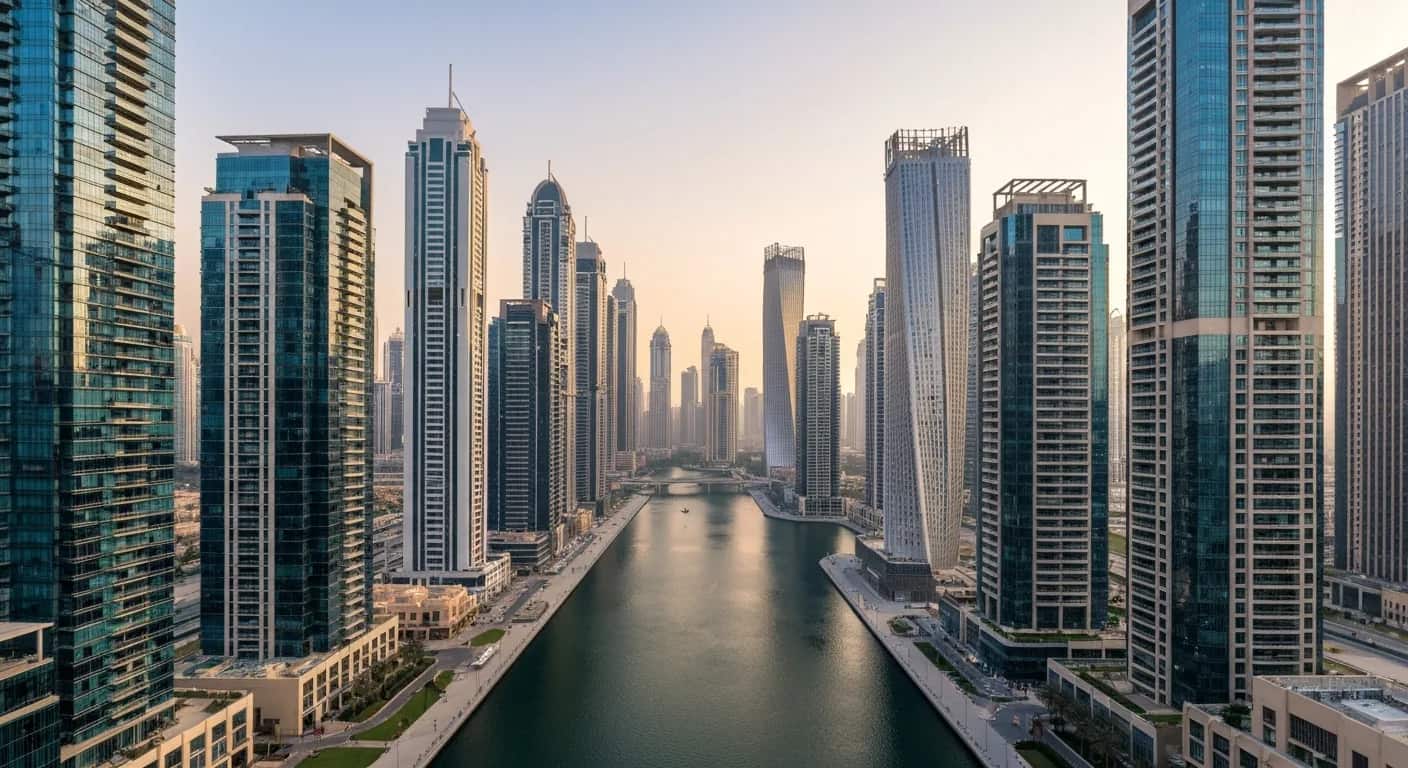
Supply pipeline 2026-2027: Dubai communities at risk
Supply pipeline 2026-2027 shapes which Dubai neighbourhoods could see price and rental pressure; hotspots include large masterplans and high‑rise clusters where completions cluster.

Supply pipeline 2026-2027 matters because where completions cluster, prices become a function of nearby supply, not developer brand. Buyers and landlords must assess concentration, tenant demand types and the mechanics — escrow, Oqood, mortgage caps and developer payment plans — that will determine whether new stock is absorbed or accumulates.
Thesis: why the 2026-27 supply wave will be decisive for Dubai
My thesis is simple: the 2026-27 development pipeline will separate resilient neighbourhoods from those that face meaningful price and rental correction, not because Dubai will stop growing, but because delivery patterns and product homogeneity change local market microeconomics. Dubai's headline growth — population inflows, corporate relocations, Golden Visa uptake — underpins demand at a macro level. But real estate is local. Where multiple large projects complete in a short window, and they target the same buyer or tenant segment, absorption softens and incentives increase. That dynamic is the heart of the risk this cycle.
Why local concentration matters: transactions are price-discovery events. Buyers and tenants compare immediate alternatives: a new apartment in Business Bay with a sea-facing high-rise two streets away, or a villa in Dubai Hills versus a fresh community of similar villas at a lower price per sq ft in MBR City. When supply is spread geographically and across product types, markets digest it. When completions cluster — same price band, same unit types, same developer sales strategy — the marginal buyer gains bargaining power and developers/employers must find new incentives to move stock.
This is not to predict a market collapse. Dubai's regulatory framework — land-title clarity, escrow accounts for off-plan projects, Oqood registration for off-plan sales, and developer obligations around completion — moderates risk compared with less-regulated markets. Yet those safeguards don't eliminate micro-level oversupply effects. Escrow systems protect buyers' funds but can also accelerate completions: once funding is in place, developers may push projects to delivery, increasing near-term stock. For investors, the interplay between delivery timing, mortgage availability and tenant demand will be the deciding factor between modest yield compression and a prolonged price correction in specific communities.
Where the bulk of new supply is concentrated: identifying the clusters
 Featured project
Supply in 2026-27 is not evenly spread across Dubai; it is concentrated in a handful of masterplans and high-rise corridors. Large master-developments such as Mohammed Bin Rashid City (MBR City), Dubai Hills Estate, Dubai Creek Harbour, and Dubai South are delivering a mix of villas, townhouses and apartments. Simultaneously, high‑rise clusters — Business Bay, Dubai Marina, Jumeirah Lake Towers (JLT) — continue to add strata product at scale. The combination of large-scale masterplans and dense towers increases the chance that many units which appeal to the same tenant or buyer cohort complete in the same market window.
Developers' product strategies amplify concentration. Major groups—Emaar, Nakheel, Dubai Holding, Dubai Properties and several private developers—tend to repeat successful unit mixes: one‑ to three‑bed apartments in towers targeting young professionals and families; gated villa communities aimed at owner-occupiers and long-term tenants. When these developers push similar product types into proximate locations — for example mid-market villas in Dubai Hills and MBR City, or entry and mid-level apartments in JVC and Business Bay — the local market faces direct competition rather than complementary diversification.
Geography and infrastructure matter. Metro connectivity, road access and nearby schools determine real absorption rates. Areas that lack a metro link but depend on road access, such as certain pockets in Jumeirah Village Circle (JVC) and parts of Dubailand, will have to compete more on price and community amenities when new supply lands nearby. Conversely, communities with growing infrastructure — the extension of transit, new schools, hospitals and retail (for instance near Dubai Creek Harbour and parts of Dubai Hills) — may see better absorption, but only if the product matches local demand. The short point: look where projects cluster and what transport and amenities are already supporting or failing to support tenant demand.
Communities under the greatest pressure: Dubai Hills and MBR City
Dubai Hills and Mohammed Bin Rashid City represent the classic masterplan oversupply risk: large land banks, multiple developers and a significant pipeline of villas, townhouses and apartments all designed for middle- to upper-middle income buyers. These communities have strong developer brands and new infrastructure, but their very scale multiplies the potential for local oversupply. When similarly priced villas and townhouses from different phases come to market in quick succession, buyers use newer product as leverage to negotiate price and post‑delivery incentives for earlier inventory.
Demand dynamics complicate matters. Dubai Hills has historically attracted end-use buyers looking for owner-occupier amenities — parks, schools, golf course adjacency — while MBR City has positioned itself as a mixed-use flagship with premium pockets and more speculative midmarket stock. Both communities rely on a mix of owner-occupier and investor demand. If mortgage availability tightens or banks maintain conservative loan-to-value policies, the pool of qualified buyers for large-ticket villas shrinks, slowing absorption. Tenant demand for villas is robust in Dubai generally, but there is a ceiling to how many households can or will pay premium rents in a submarket that sees fresh supply of similar product.
Price bands and resale dynamics are crucial. When new phases sell at promotional prices or include attractive post-handover plans, secondary market owners face price visibility downward. This is particularly true where units are homogeneous: two or three similarly sized four-bedroom villas, comparable finishes and identical community amenities leave only price, payment terms and timing to distinguish them. The result is discounting pressure, extended marketing campaigns, and a shift in yield expectations for landlords. For owners and investors in Dubai Hills and MBR City, the near-term risk is concentrated to the subsegments where product is most similar — mid-priced villas and townhouses rather than the rare super-prime enclaves that enjoy structural scarcity.
High-rise apartment clusters: Business Bay, Marina and JLT vulnerabilities
High-rise corridors present a different oversupply mechanism. Towers stack thousands of apartments vertically, and when multiple towers complete in a short window, the market suddenly has a high number of like-for-like one- and two-bedroom units seeking the same tenant profile: young professionals, small families and expatriate households. Business Bay is emblematic: it attracts corporate tenants because of its centrality and office density, yet the developer pipeline continues to add a significant number of apartments targeting those exact tenants. Marina and JLT have similar dynamics — the trade-off is that these areas are well-known, highly serviced and have amenities, which can dampen but not eliminate price pressure.
Apartment supply also interacts with service charge economics. High-density towers can mean higher per‑unit service costs, especially for large-lobby developments, hotel‑style amenities and extensive communal facilities. As new towers enter the market and managers attempt to maintain value, owners face rising service charges that can compress net yields. Landlords competing on net rents will find their margins squeezed if service charges rise while rents are stagnant or falling. This is a structural cost that makes high-rise clusters more sensitive to oversupply, because tenants can often find slightly cheaper alternatives a short distance away in a competing tower.
Investor profiles matter: many buyers in these clusters are yield-driven. They rely on strong rental demand and expect turnover. When supply increases, yields compress, and turnover increases; investors accustomed to certain cashflow profiles may realise negative gearing or prolonged voids. Developers may counter with incentives — rental guarantees, furniture packages, flexible payments — that briefly prop up sales but add risk to long-term price stability. Where multiple towers by different developers offer the same incentives, the market shifts to a promotional equilibrium that ultimately resets expectations and reduces the total return for investors.
Peripheral and affordable clusters: JVC, JVT, Al Furjan and Dubailand dynamics
Peripheral masterplans and affordable clusters form the spine of Dubai's mid-market rental and ownership demand. Jumeirah Village Circle (JVC), Jumeirah Village Triangle (JVT), Al Furjan and pockets of Dubailand capture families and workforce tenants priced out of the city centre. Their resilience depends on affordability, access to schools and community retail, and crucially, the extent to which new supply in similar price bands arrives nearby. The risk here is not only oversupply but also product cannibalisation — developers in adjoining zones offering lower entry prices or better payment plans that siphon demand.
These communities historically absorbed demand because they offered larger floorplans for lower prices than central districts, but infrastructure and travel times are increasingly important to tenants. If traffic congestion or a lack of planned transit persists, tenants and buyers will price those negatives in. Developers in these areas may respond by cutting prices, extending payment terms or offering rental guarantees to secure sales. Such tactics can stabilise sales volumes but also set new, lower price anchors, which are difficult for existing owners to compete against without providing concessions of their own.
Landlord economics are also different: yields in mid-market clusters are typically higher than central high-rises, but tenant churn can be greater due to the more price‑sensitive tenant base. If new mid-market supply floods these areas, average rents can fall and void periods lengthen. For investors focused on cashflow, the practical response is tighter underwriting of rents, a diversification of unit sizes (to broaden the tenant base), and close monitoring of new project handovers in proximate masterplans. From a policy perspective, phasing approvals and incentivising mixed-tenure product could help mitigate the risk, but absent central coordination, market forces will likely drive a realignment of prices and yields in these peripheral hubs.
Islands, luxury and constrained-supply assets: Palm, Creek Harbour and Bluewaters
Islands and waterfront flagship developments — Palm Jumeirah, Dubai Creek Harbour, Bluewaters — sit in a different risk category. These locations benefit from scarcity and iconic positioning, which historically supports pricing resilience. However, they are not immune to oversupply dynamics: concentrated completions of similar luxury apartments or villas can create local competition among high‑net‑worth buyers and tourist-linked demand. The mitigating factor for these assets is uniqueness: few new developments can replicate a Palm-facing villa or a Creek Harbour waterfront penthouse. That structural scarcity provides a buffer against widespread discounting.
Yet buyer composition matters. Much of the demand for these properties is discretionary and tied to wealth flows, second-home motives and lifestyle choices. In a period of global volatility or tighter international liquidity, these buyers can pause activity, lengthening sales cycles. Developers often turn to incentives — flexible post‑handover plans, leaseback agreements, VIP mortgage access — to stimulate sales, and those incentives can shift the effective price landscape for comparable resale stock. For landlords, the short-term rental market can be a stabiliser in tourism-facing mixed-use islands, but regulation on short-term leases and changing tourism patterns influence yields.
Finally, infrastructure and service costs are significant. Maintaining beachfront promenades, private marinas and island utilities increases service charges, and when multiple luxury projects deliver concurrently, the pool of qualified buyers or high-paying tenants does not necessarily expand at the same rate. This means that even luxury communities require careful management of supply timing and product differentiation to avoid localized softening. For investors, the lesson is to separate true uniqueness — an island villa with private beach access and long-term scarcity — from marketed 'luxury' that competes on finishes rather than location.
“Oversupply is not a market‑wide threat in Dubai; it is a local liquidity and product‑mix problem that plays out block by block.”
Mechanisms that will mitigate or amplify local oversupply
Several structural forces will determine whether new supply is absorbed or whether communities see price and rental adjustment. First, financing and mortgage availability shape the buyer pool. Banks' underwriting standards, the Central Bank's macroprudential guidance and lender confidence in specific micro‑markets determine how many buyers can access mortgages and at what loan‑to‑value. Tighter lending reduces leverage for owner-occupiers and squeezes the investor cohort; looser lending expands the buyer base but can overheat demand. The crucial point is that lending policy interacts with delivery timing: a wave of completions into a tighter lending environment magnifies price pressure.
Second, developer tactics matter. In the off‑plan market, escrow protections and Oqood registrations provide comfort to buyers and capital to developers. But developers still choose pricing, incentives and handover schedules. When a developer with deep pockets chooses to protect brand perception and holds prices, another developer may discount to clear stock, triggering a local price battle. The use of rental guarantees, furniture packages and flexible payment plans are short‑term fixes that reset buyer expectations and make price discovery more volatile. Regulatory oversight of marketing claims and resale transfers (including NOC requirements) can moderate aggressive tactics, but market competition often favours promotional offers in practice.
Third, tenant demand drivers — corporate relocations, tourism trajectories, and long-term population growth — create the base load for absorption. Immigration policy and visa routes (Golden Visa categories for investors and skilled professionals) support medium-term demand, but these flows are uneven. For example, corporate office growth in Business Bay or a new campus in Dubai Hills increases local rental absorption; conversely, if employment growth slows or firms opt for hybrid work, demand for larger apartments and proximate villas will be weaker. Infrastructure completions (metro expansions, road upgrades, new schools and hospitals) also affect absorption, but there is a lead time between infrastructure delivery and market response.
Finally, operational costs — service charges, utility tariffs and community upkeep — affect net returns and thus investor appetite. High service charges reduce net yields and make price cuts more likely when rents soften. Municipal fees and Dubai Land Department transaction costs are a smaller part of the calculus, but they influence resale turnover and investor mobility. In sum, the market's micro-dynamics — financing, developer strategy, tenant flows and operational costs — are the mechanisms that will amplify or blunt the oversupply risk in each community.
How investors and developers should recalibrate strategy for 2026-27
For investors, the immediate implication is to be surgical about location and product type. Avoid buying into communities where multiple large completions are scheduled within 12–24 months of each other unless you have a specific tenant or owner‑occupier use case. Prioritise product differentiation: unique floorplans, scarce orientations (canal, sea or golf), or properties in communities with demonstrable infrastructure and school pipelines. For cashflow investors, meticulously model service charges, realistic vacancy assumptions and potential rental decline scenarios rather than relying on historical yields.
Developers must consider phasing and product mix as strategic tools. Flooding a submarket with homogeneous units invites price competition. Instead, staging deliveries, diversifying unit sizes and adding clear amenity differentiators (schools, retail anchors, public realm quality) help improve absorbability. Where feasible, developers can coordinate indirectly by timing launches and offering staggered handovers to avoid simultaneous stock impact. On the financing side, developers with strong balance sheets who can afford to be patient will gain pricing power when promotional competitors exhaust their cash or inventory.
Policymakers and regulators have a role as well. Better visibility and cadence of project approvals, perhaps through public reporting of projected completions by masterplan, would help the market price risk more efficiently. RERA and DLD already provide safeguards (escrow, title registration, transaction transparency), but additional focus on phasing large-scale approvals and encouraging mixed-tenure projects can reduce micro-level oversupply. For investors, staying close to transaction-level data — registration volumes, resale spreads, service charge trends and rental listings — is essential. The winners in 2026-27 will be the buyers and developers who anticipate where similar product arrives and price accordingly.
Verdict: who wins, who recalibrates and what to watch next
My verdict is layered. Dubai will not experience a uniform oversupply crisis; instead, a handful of communities with concentrated completions and homogeneous product will face meaningful local pressure. High-risk clusters include masterplans where multiple villa and townhouse phases complete simultaneously (notably Dubai Hills and parts of MBR City), high-rise corridors where a glut of one- and two-bedroom units arrives (Business Bay, Marina, JLT), and mid-market peripheral areas that receive repeat product without commensurate transport or amenity upgrades (JVC, Al Furjan, Dubailand pockets).
Winners will be locations with structural scarcity, differentiated product and improving infrastructure — select corners of Creek Harbour, certain waterfront or island projects where unique access and limited land remain. Developers who stagger delivery, offer varied product and invest in amenities will outpace those who solely compete on price. Investors who underwrite conservatively, focus on net yields and prioritise differentiation (either by unit type or by community selection) will avoid the sharpest impacts. Watch three leading indicators over the next 12–18 months: registration volumes by submarket (DLD transactional data), new project handover schedules and effective rental advertised rates versus closing rents. Those metrics will show if a community is absorbing stock or entering competitive discounting.
The supply pipeline in 2026-27 creates local winners and losers: expect price and rental pressure where like-for-like completions cluster (Dubai Hills, MBR City, Business Bay, JVC), but recognise that infrastructure, product differentiation and financing conditions will determine the depth and duration of any correction.
For market participants the prescription is clear: map handovers, compare unit-level competition within a one- to two-kilometre radius, and stress-test your financing assumptions against higher vacancy and rising service charges. Dubai's fundamentals remain strong, but the next 18 months will be a test of micro-market discipline rather than macro-level demand alone. As head of market research at Gaia Living, I will watch phasing data, resale spreads and advertised incentives closely; those signals will separate tactical buying opportunities from structural risk.
— Amara Nasser, Head of Market Research, Gaia Living
Questions, answered
- What is the main concern regarding the 2026-2027 Dubai property supply pipeline?
- The primary concern is that clustered delivery of similar property types in specific neighbourhoods could lead to local oversupply, causing price and rental pressure. This dynamic shifts bargaining power to buyers and tenants, necessitating developer incentives.
- Which specific Dubai communities are most vulnerable to oversupply in 2026-2027?
- Communities with large masterplans and high-rise clusters are most at risk, including Mohammed Bin Rashid City (MBR City), Dubai Hills Estate, Business Bay, and Jumeirah Lake Towers (JLT). These areas are expected to see significant concentrations of new units.
- How does local concentration of new supply affect Dubai property prices and rents?
- When many similar properties complete in a short period within the same area, it increases competition among sellers and landlords. This grants marginal buyers and tenants greater bargaining power, potentially leading to price and rental corrections or increased incentives from developers.
- What role does infrastructure play in the absorption of new property supply in Dubai?
- Infrastructure like metro connectivity, road access, schools, and hospitals significantly impacts absorption rates. Areas with strong, growing infrastructure tend to digest new supply better, while those lacking essential amenities may struggle with absorption and rely more on competitive pricing.
- Are all Dubai communities equally affected by the new supply pipeline?
- No, the new supply is not evenly distributed across Dubai. It is concentrated in specific masterplans and high-rise corridors, meaning some communities will experience significant pressure while others remain more insulated due to less new inventory.
- What factors can help absorb the upcoming property supply in Dubai?
- Key factors include strong tenant demand, robust infrastructure development, effective mortgage availability, and developers' strategic payment plans. Dubai's regulatory framework, with escrow and Oqood, also moderates overall market risk.

Amara translates DLD transaction data, supply pipelines, and macro signals into clear calls on where Dubai's market is heading. She writes the numbers most brokers only feel.
Related stories

Dubai's Big Squeeze: Smaller Plots, Denser Living
Dubai real estate is undergoing a fundamental shift towards smaller plot sizes and higher density. We analyse the economic drivers, the impact on property values, and what this new era of compact urban living means for both homebuyers and investors.

Resort Living as Your Dubai Reality
Explore how to trade temporary staycations for a permanent home with five-star amenities in Dubai. I'll break down the real costs, best communities, and lifestyle trade-offs of embracing high-end resort living every day.

Finding Your Tribe in Dubai's Villa Communities
I explore which of Dubai's renowned villa communities attract specific expat nationalities and lifestyle groups, offering insights to help you find a place that feels like home.
Echoes, in your inbox
One thoughtful email a month. Market insight, new launches, no spam.