

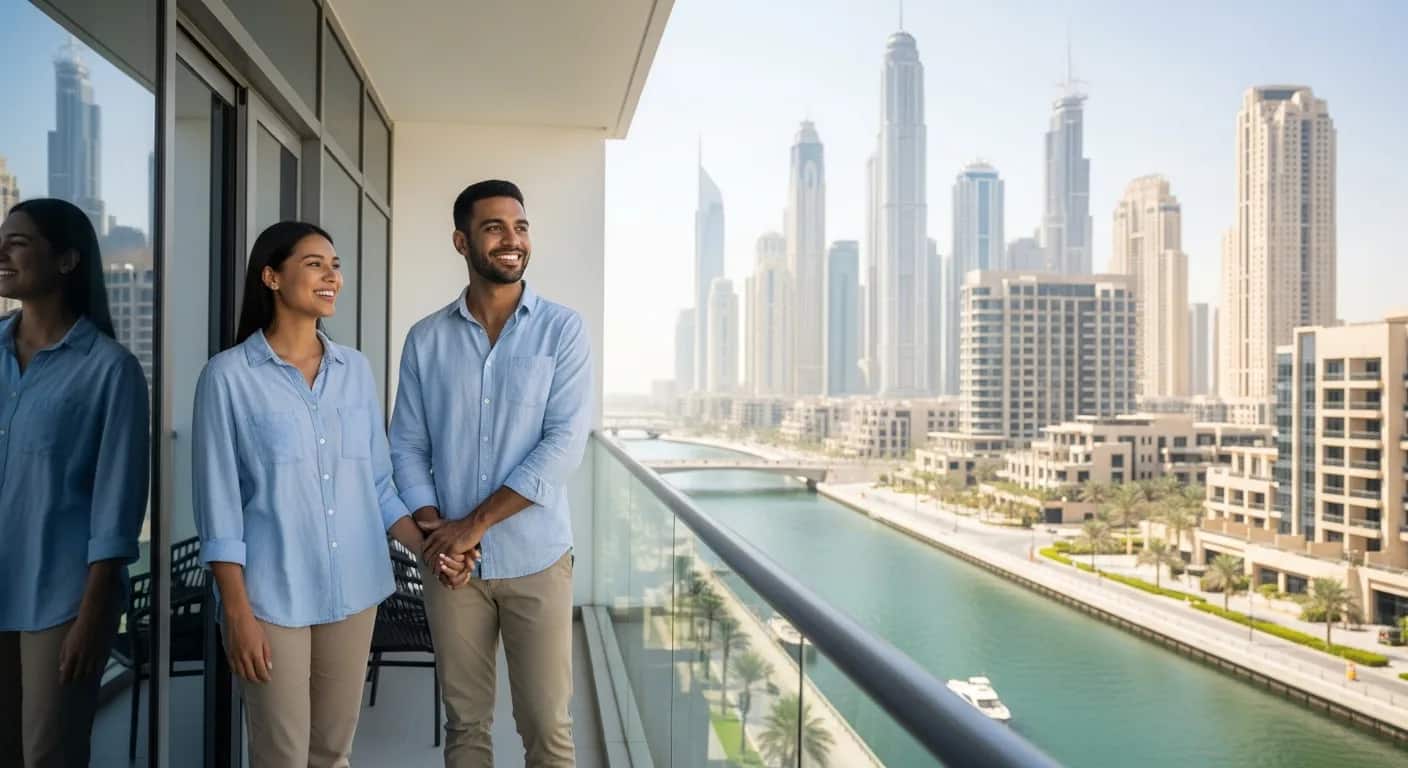
Off-Plan vs. Ready Property in Dubai: Which is Right?
I'll walk you through the critical differences between buying an off-plan and a ready property in Dubai, helping you decide which path aligns with your finances and goals.

As a first-time buyer specialist at Gaia Living, the first question I always ask my clients is not *where* they want to buy, but *how*. The path you take to homeownership in Dubai splits into two very different journeys: buying a ready property you can see and touch today, or investing in an off-plan property that exists only on paper and in an architect's vision.
This decision between 'ready' and 'off-plan' is the most fundamental choice you will make, shaping your finances, timeline, and risk exposure for years to come. There is no single correct answer, only the answer that is right for you. My goal with this guide is to give you the clarity and confidence to find it.
Here's what we'll explore in detail:
- The fundamental differences between a tangible home and a future asset.
- A line-by-line breakdown of the costs for both ready and off-plan purchases.
- How financing works: comparing traditional mortgages with developer payment plans.
- The practical implications of timing, from moving in tomorrow to waiting years.
- A clear-eyed look at the risks of off-plan property in Dubai and how they are managed.
- The investment case for each, comparing immediate rental yield to potential capital growth.
- How your choice impacts what you can buy and the level of customisation.
- My final framework to help you make your personal decision.
The Core Difference: Immediate Home vs. Future Asset
At its heart, the distinction is simple. A ready property is a completed apartment or villa that you can inspect, purchase, and move into or rent out almost immediately. It exists in the physical world. You can walk through the rooms, check the view from the balcony, and feel the quality of the finishes. You can talk to residents in the building and get a sense of the community. When you browse properties for sale on our website, the vast majority are ready properties. They offer certainty.
An off-plan property, by contrast, is a property that has not yet been built. You are buying a promise from a developer, secured by a contract and a payment structure. Your purchase is based on floor plans, 3D renders, and a physical show unit that demonstrates the intended quality. These opportunities are often found in our off-plan launches section. This path requires a degree of imagination and patience. You are investing in a future asset, with the purchase taking place long before the handover of keys.
For a first-time buyer who needs a place to live, the appeal of a ready property is obvious. The process is tangible. You find a home you love in a community like Dubai Marina or Town Square, secure your financing, and within a couple of months, you are living in it. The risks are lower, and the reward — your own home, is immediate. This is the classic path to homeownership.
The off-plan route appeals to a different mindset. It can be for an investor seeking to maximise capital appreciation by getting in at the earliest possible price. It can also be for an end-user who isn't in a rush and is captivated by the idea of being the very first person to live in a brand-new home, often with access to amenities and technology that older buildings lack. They are willing to trade immediacy for potential financial upside and the allure of the new.
The Financial Deep Dive: Unpacking the Costs
 Featured project
This is where the difference becomes most pronounced. The payment structure and upfront costs for ready and off-plan properties are worlds apart. Many buyers are surprised by the total cash outlay required for a ready property, while the phased payments of off-plan can seem more accessible. Let's break it down with a realistic example: buying a one-bedroom apartment valued at AED 1,500,000.
Scenario 1: Buying a Ready Property (with a mortgage)
For a ready property, an expat buyer typically needs a significant amount of cash upfront, even with a mortgage. Under the Central Bank of the UAE's LTV (Loan-to-Value) rules, for a first property under AED 5 million, you can borrow a maximum of 80%. This means you must pay 20% yourself. But the costs don't stop there.
Here is a line-by-line breakdown of the typical upfront cash you would need for an AED 1.5M ready apartment:
- Property Price: AED 1,500,000
- Down Payment (20%): AED 300,000
- Dubai Land Department (DLD) Fee (4%): AED 60,000
- DLD Admin Fee: AED 580
- Property Registration Trustee Fee: approx. AED 4,200
- Agency Fee (2% + 5% VAT): AED 31,500
- Mortgage Arrangement Fee (up to 1% of loan amount + 5% VAT): approx. AED 12,600
- Mortgage Registration Fee (0.25% of loan amount): AED 3,000
- Property Valuation Fee: approx. AED 3,150
Total Upfront Cash Required: Approximately AED 415,030
As you can see, the total cash needed is closer to 28% of the property value, not just the 20% down payment. This is a critical calculation that every buyer must make. These are mandatory costs to legally transfer ownership and secure financing.
Scenario 2: Buying an Off-Plan Property
Now let's look at the same AED 1,500,000 apartment, but purchased off-plan directly from a developer like Emaar Properties or Damac. The upfront cost is significantly lower, and the payments are spread out. The structure of `off-plan payment plans Dubai` is the main attraction here.
Here is a typical cost breakdown for an off-plan purchase:
- Property Price: AED 1,500,000
- Booking Fee / Initial Deposit (usually 10-20%): AED 150,000 (assuming 10%)
- Dubai Land Department (DLD) Fee (4%): AED 60,000
- Oqood (Off-plan registration) Fee: approx. AED 5,250
Total Upfront Cash Required: Approximately AED 215,250
This is nearly half the upfront cash required for a ready property. The remaining 90% of the property's price is then paid in instalments over the construction period, and sometimes even for a few years after handover. This makes entering the market feel much more manageable for buyers who have a steady income but haven't saved up the ~30% lump sum needed for the secondary market.
Payment Structures: Mortgages vs. Developer Plans
The financial mechanics extend beyond the initial deposit. How you pay for the remainder of the property is a defining feature of the ready vs. Off-plan debate.
For a ready property, the vast majority of buyers use a mortgage. In Dubai, this process is well-regulated by the Central Bank of the UAE. As mentioned, for your first property, you can borrow up to 80% as an expat (85% for UAE Nationals). The loan is repaid over a term of up to 25 years. This is a long-term financial commitment with a bank, and your eligibility will depend on your income, employment stability, and credit history. While it’s a large commitment, it allows you to own a tangible asset right away, building equity while you live in it or collect rent from it.
Off-plan, however, operates on a completely different model. The primary funding mechanism is the developer payment plan. These plans are a powerful marketing tool for developers and a major reason why buying off-plan in Dubai is so popular. Mortgages for off-plan properties are rare and limited to select projects. Instead, you pay the developer directly according to a pre-agreed schedule. Common payment plans include:
- Construction-Linked Plans (e.g., 60/40): You pay instalments as construction milestones are met. For example, 10% on booking, 10% when 20% of construction is complete, 10% at 40%, and so on, with the final 40% due upon handover. This aligns your payments with the developer's progress.
- Fixed-Schedule Plans (e.g., 50/50): You pay a percentage every 6 months or every year, regardless of the construction stage, with the final 50% due on handover. This provides payment predictability.
- Post-Handover Payment Plans (e.g., 40/60 with 3 years PHPP): This is perhaps the most attractive option for investors. You might pay 40% during construction, and then the remaining 60% is paid in instalments over several years *after* you have received the keys. This allows you to rent out the property and use the rental income to help cover the remaining payments.
These payment plans effectively provide interest-free financing from the developer. This is a huge advantage. However, you are tied to the developer's timeline and must have the cash available for each instalment. A missed payment can lead to penalties and, in the worst case, the termination of your contract and loss of funds already paid, as per the terms of your Sale and Purchase Agreement (SPA) and DLD regulations.
Timing and Access: Move In Now or Wait?
The practical difference in timing is stark and has significant lifestyle and financial implications. The chief among the `benefits of ready property Dubai` is immediacy. From the day you select your property, the transaction can be completed in as little as 30-45 days if you're a cash buyer, or 6-8 weeks if you're getting a mortgage. Once the title deed is in your name, you get the keys. The property is yours.
This speed is invaluable for end-users. If your rental lease is ending, or you've just moved to Dubai and want to put down roots, a ready property provides a home. There's no uncertainty, no waiting. For an investor, this means you can place a tenant and start earning rental income almost immediately, beginning the journey to a positive return on your investment from day one. You know the exact condition of the property, the service charges, and the achievable rent in the current market, allowing for precise financial planning.
“Buying ready is a transaction; buying off-plan is a project. You need to decide if you want to be a home-owner or a project manager.”
Buying off-plan is a game of patience. A typical off-plan project takes anywhere from two to four years to complete. During this time, your capital is tied up in an illiquid asset. You cannot live in it, and you cannot rent it out. You are paying instalments on a property that doesn't yet exist. Your money is working, you hope, by securing a future asset at today's price, but it is not generating any cash flow. This waiting period is a significant opportunity cost.
Beyond that, the handover date provided by the developer is an estimate. Construction delays are a real possibility. While contracts regulated by the Dubai Land Department (DLD) give developers a grace period (often 12 months) to deliver beyond the anticipated completion date without penalty, a delay can still disrupt your plans. If you were planning to move in after your lease expires, a delay could force you to find temporary accommodation. If you were an investor counting on rental income from a certain date, that income is pushed back, affecting your ROI calculations.
Risk and Regulation: Navigating the Market Safely
This is, without a doubt, the area that concerns first-time buyers the most, particularly when considering the `risks of off-plan property Dubai`. The good news is that Dubai's real estate market has matured significantly, with a strong regulatory framework designed to protect buyers. Understanding this framework is key to investing safely.
The biggest risk in an off-plan purchase is project failure or significant delay. You are trusting a developer to deliver on their promise. To mitigate this, Dubai's Real Estate Regulatory Agency (RERA) has implemented several crucial safeguards:
1. Mandatory Escrow Accounts: Developers are legally required to open a separate escrow account for each project. All funds you pay go directly into this account, which is managed by a RERA-approved bank. The developer can only withdraw funds to pay for construction costs as verified by an independent consultant. This prevents them from using your money for other purposes. 2. Oqood Registration: When you buy an off-plan property, your purchase is registered on an initial contract called an 'Oqood' with the DLD. This is an official government record of your ownership stake in the unbuilt property, ensuring the developer cannot sell the same unit to someone else. 3. Developer Requirements: RERA requires developers to prove they own 100% of the land for the project and have either paid a 20% construction guarantee into the escrow account or completed 20% of the project before they can begin selling units.
Despite these excellent protections, risks remain. A developer could still face financial trouble, leading to a stalled project. While RERA can and does intervene in such cases, the process to either restart the project with a new developer or liquidate the escrow account and refund buyers can be long and complex. The other primary risk is a quality deficit — the finished product may not match the glossy brochures or the show home. This is why developer reputation is paramount. Sticking with established master developers like Nakheel, Emaar, or Meraas significantly reduces these risks.
Ready properties carry a different, and generally lower, set of risks. The primary risk is discovering latent defects after the purchase — issues with plumbing, AC, or structural integrity that weren't apparent during viewings. A professional snagging report before finalising the purchase is essential to minimise this. You also need to do due diligence on the building's maintenance history and the financial health of the owner's association. But the fundamental risk of non-delivery is entirely absent. What you see is what you get.
Investment Potential: Capital Appreciation vs. Immediate Yield
When comparing `ready property Dubai vs off-plan`, investors are often weighing two different paths to returns: capital appreciation and rental yield. Off-plan is primarily a play on capital appreciation. The core investment thesis is that the price you pay today will be significantly lower than the market value of the completed property in a few years. For instance, you might buy an apartment for AED 1.5M off-plan. By the time it's handed over in three years, if the market has performed well, it could be valued at AED 1.9M. You have realised a gross profit of AED 400,000 on paper without ever having to rent it out. This potential for high growth is a powerful lure, especially in rising markets or in new master communities like Dubai Hills or Creek Harbour during their early phases.
The trade-off is the lack of rental income during the construction period. For three years, your money is tied up without generating cash flow. Your return is entirely dependent on market growth. If the market stagnates or declines during the construction period, your anticipated capital gain could evaporate or even turn into a loss.
A ready property is the opposite. It is primarily an income-generating asset from day one. An investor buying a ready apartment in an established, high-demand rental area like Jumeirah Beach Residence or Downtown Dubai can calculate their expected net rental yield with a high degree of accuracy. You take the annual rent, subtract service charges, maintenance costs, and any mortgage payments, and what's left is your net income. This provides a steady, predictable cash flow. While the property may also appreciate in value over time, the immediate focus is on the yield.
Let's put this into perspective. That AED 1.5M ready apartment might generate an annual rent of AED 100,000. With service charges of AED 25,000, your gross yield is 6.7%, and your net yield before financing is 5%. For many investors, particularly those seeking stable income, this is far more attractive than the speculative nature of off-plan. The `benefits of ready property Dubai` are tangible and immediate cash flow.
Choice and Customisation: What You See vs. What You Imagine
Finally, the two paths offer very different experiences for choice. When you buy a ready property, your choice is limited to what is currently available on the market. You might find the perfect layout in a building with a less-than-perfect view, or the perfect view from an apartment that needs renovation. It is a process of compromise. The advantage, however, is that there are no surprises. You can physically stand in the property and assess every detail — the natural light, the noise levels, the precise condition of every fixture and fitting. This certainty is very reassuring for many buyers.
Off-plan offers a different kind of choice. You are buying into a brand-new development, often with the latest design trends, smart home technology, and state-of-the-art resident amenities like gyms, pools, and co-working spaces. You get to be the very first owner. In some cases, particularly with more high-end or villa projects, you may even have a choice of interior finish palettes, allowing for a degree of personalisation. Your choice is based on marketing materials, but you are choosing from a 'perfect' product on paper.
However, you are also buying a unit within a larger, unbuilt community. You can't be 100% certain about your eventual view — another building might partially obstruct it later. You can't know the exact quality of the final construction until it's complete. You are trading the certainty of the known for the potential of the new. For those who value having a home that has never been lived in, with a fresh warranty and modern specifications, this is a trade they are happy to make.
The choice between off-plan and ready property isn't about which is 'better,' but which is better suited to your personal financial situation, timeline, risk appetite, and life goals. A young professional with limited savings but a good income might find an off-plan payment plan is their only route to ownership, while a family needing to move immediately for school enrolments would only consider a ready property.
My Verdict: A Framework for Your Decision
After guiding hundreds of first-time buyers through this exact dilemma, I've developed a simple framework to help you decide. It comes down to honestly answering three questions about yourself:
1. What is your financial reality? - Choose Ready if: You have saved a significant lump sum (at least 25-30% of the property value) and have a stable income that qualifies you for a mortgage. You prefer a predictable, long-term payment schedule (a mortgage) to staggered, short-term cash instalments. - Choose Off-Plan if: You have a smaller initial deposit but a strong, steady income that can comfortably cover instalments over 2-4 years. The idea of an 'interest-free' payment plan direct to the developer is more appealing than taking on long-term bank debt right away.
2. What is your timeline and purpose? - Choose Ready if: You need a home to live in *now* or want to start earning rental income immediately. Certainty and speed are your top priorities. You are an end-user putting down roots or an investor focused on immediate cash flow. - Choose Off-Plan if: You are not in a rush to move in and can wait 2-4 years for the property to be built. Your primary goal is to maximise potential capital appreciation, and you are comfortable with your capital being illiquid for the construction period.
3. What is your personal risk tolerance? - Choose Ready if: You are risk-averse. You want to eliminate the possibility of construction delays, quality issues, or project failure. You need the psychological comfort of seeing, touching, and inspecting the exact property you are buying. - Choose Off-Plan if: You have a higher risk tolerance and are comfortable with the managed risks of the Dubai market. You trust in the regulatory system (escrow, Oqood) and are willing to do the due diligence to select a reputable developer. You are excited by the potential reward that comes with this calculated risk.
Ultimately, there is a place for both types of properties in a healthy real estate portfolio. Many of my clients start with a ready property for their own home and later venture into an off-plan purchase as a pure investment once they are more familiar with the market. At Gaia Living, we are here to provide the data, insights, and guidance for whichever path you choose. The most important step is the first one: understanding yourself and your goals. Once you have that clarity, the right property will follow.
## Sources - Dubai Land Department (DLD): https://dubailand.gov.ae - Central Bank of the UAE (CBUAE): https://www.centralbank.ae - UAE Government Portal (Property Purchase Information): https://u.ae
Questions, answered
- Is buying off-plan property in Dubai cheaper than ready property?
- Initially, yes. Off-plan properties are typically offered at a lower price per square foot than their completed counterparts in the same area. This price advantage is a key incentive, but you must factor in the risks and the waiting period before you can use or rent out the property.
- What happens if my off-plan project in Dubai is delayed?
- Your Sale and Purchase Agreement (SPA) should outline the developer's obligations and potential compensation for significant delays. RERA regulations provide a framework for this, often allowing the developer a grace period (usually 12 months) before penalties apply. In severe cases of non-delivery, RERA can intervene to cancel the project and facilitate refunds from the escrow account.
- Can I get a mortgage for an off-plan property in Dubai?
- It is less common. While some banks offer off-plan mortgages, they are restricted to specific projects from major developers and often have stricter criteria. Most off-plan purchases are funded through developer payment plans, with buyers potentially seeking a mortgage for the final balloon payment upon handover.
- What are the biggest 'hidden' costs when buying a ready property?
- The main costs beyond the price are the 4% Dubai Land Department (DLD) transfer fee, a 2% agency fee, a trustee registration fee (approx. AED 4,200), and your mortgage arrangement fees (if applicable), which can be up to 1% of the loan amount. You should also budget for initial service charge payments and connection fees for utilities (DEWA).
- Which is better for getting a Golden Visa, off-plan or ready?
- Both can qualify you for a Golden Visa, provided the property value meets the minimum AED 2 million threshold. For ready properties, the full value must be paid. For off-plan properties from approved developers, you only need to have paid a minimum of AED 2 million to the developer to be eligible to apply, even if the property is not yet complete.
- How do I check if an off-plan project is legitimate and approved?
- You can verify any project's legitimacy through the Dubai Land Department's official channels. Use the Dubai REST app to check the project's details, its escrow account number, and its registration status. Only deal with RERA-registered brokers and developers, and always ensure your payments go to the project's designated escrow account, never directly to the developer.

Hana demystifies the buying journey for first-timers and expats — mortgages, visas, escrow, and the paperwork. No jargon, no assumptions.
Related stories
Dubai's Established Charm: The Case for Older Homes
In a city focused on the future, I believe the smartest move for many buyers is to look back. Dubai's seasoned communities offer space, character, and surprising value that new builds often can't match.

The True Cost of Owning a Dubai Property
Beyond the purchase price, your annual budget for a Dubai home must account for service charges, utilities, and maintenance. I'll break down every ongoing expense you need to plan for.
Calculating ROI on Dubai Rental Upgrades
As a landlord in Dubai, you can't just follow trends. I'll show you how to calculate the precise ROI of minor property upgrades to genuinely increase your rental yield.
Echoes, in your inbox
One thoughtful email a month. Market insight, new launches, no spam.