

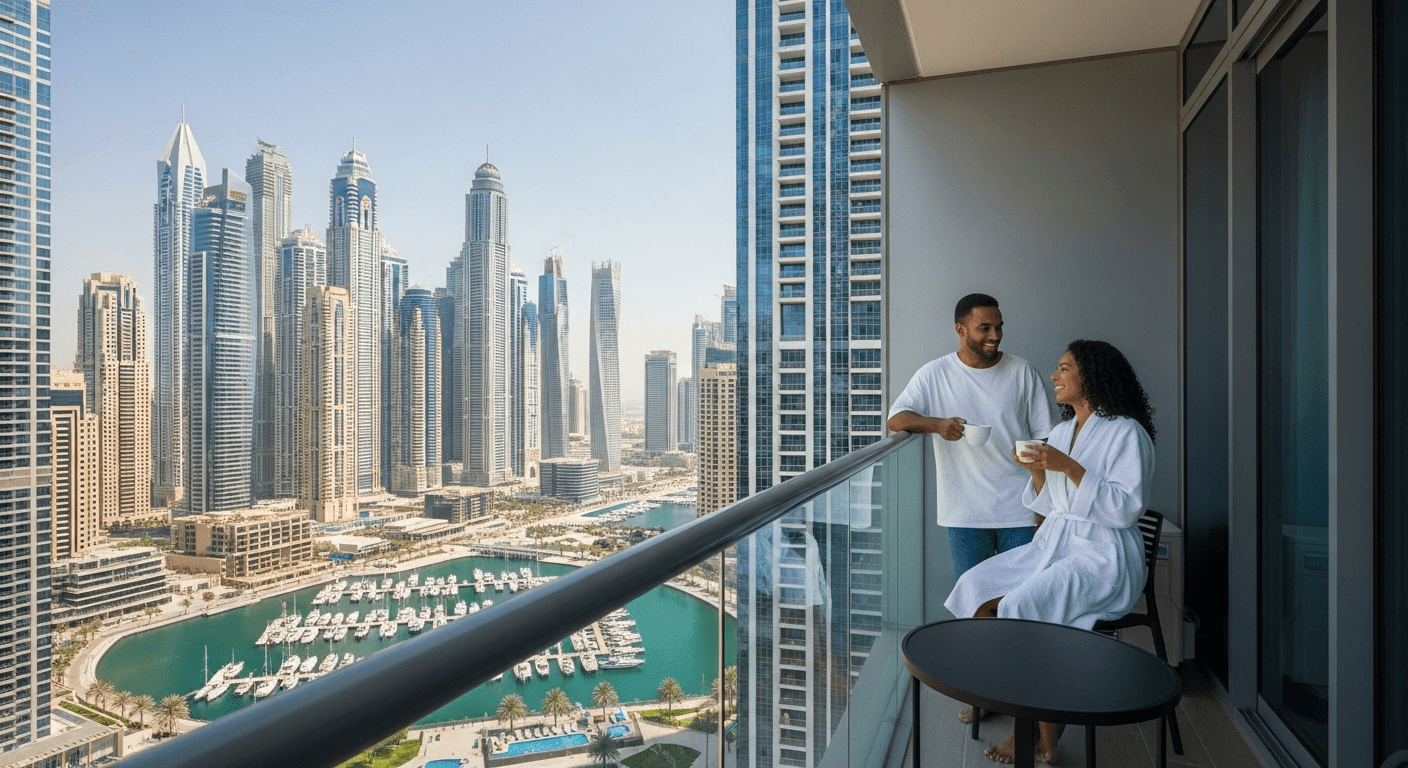
Off-Plan vs. Ready: An Investor's Guide to Dubai Apartments
I'm comparing the financial realities of buying off-plan versus ready apartments in Dubai, using a detailed analysis of specific towers and communities to guide your investment strategy.

The question of whether to invest in an off-plan or a ready apartment is one of the most common, and most critical, that we address with clients at Gaia Living. It’s the foundational choice in any `apartment investment strategy Dubai`, pitting the promise of future growth against the security of a present-day asset. The answer is never simple, and it certainly isn't the same for every investor. My goal here is not to give you a one-size-fits-all solution, but to dissect the mechanics of each choice and provide a framework for your own decision, grounded in a `specific tower analysis` of real Dubai properties.
Here is the ground we will cover:
- The fundamental cost structures of buying off-plan versus ready.
- A realistic look at capital appreciation potential for each strategy.
- A comparison of rental yields and the importance of immediate cash flow.
- Specific Tower Analysis I: A ready tower in Downtown Dubai versus an off-plan project in Creek Harbour.
- Specific Tower Analysis II: The premium world of branded residences on Palm Jumeirah.
- Critical risk mitigation strategies for both off-plan and ready purchases.
- My final verdict on how to choose the right path for your financial goals.
The Fundamental Choice: Immediate Asset vs. Future Potential
At its core, the `off-plan vs ready property` debate is a conflict between two investment philosophies. Buying a ready apartment is an investment in the present. You are acquiring a tangible, physical asset that you can see, touch, and inspect. The building is complete, the amenities are operational, and the surrounding community is established. You know exactly what you are getting, from the view out of the window to the quality of the lobby's marble. For a risk-averse investor, this certainty is invaluable. The moment the title deed is in your name, that property can be placed on the rental market to start generating an income stream. It becomes a working part of your portfolio from day one. It is an asset in the truest sense of the word.
Buying off-plan, conversely, is an investment in the future. You are purchasing a concept, a set of architectural drawings, and a promise from a developer. You are placing a bet that the finished product will not only meet the standards depicted in the glossy brochures but that the surrounding area will mature and the market will value the property more highly upon completion than it does today. This path requires a different mindset. It demands patience, a higher tolerance for uncertainty, and a focus on long-term capital growth over immediate cash flow. The primary appeal is financial use and the potential for significant value uplift. You are, in essence, partnering with the developer to create a new asset, and the reward for taking that early-stage risk is the potential for outsized returns.
In my experience, the psychological difference is profound. Clients who favour ready properties often prioritise control and predictability. They want an asset they can manage, that produces a monthly statement, and that feels solid and dependable. It’s often part of a wealth preservation or income generation strategy. On the other hand, clients drawn to `Dubai off-plan investment` are typically focused on wealth creation. They are comfortable with the abstract nature of the purchase and the delayed gratification. They understand that for a period of two to four years, their capital will be illiquid and unproductive, deployed in the service of a much larger potential payoff at the end of the construction cycle. Understanding which of these investor profiles you fit is the first and most important step in the decision-making process.
The Cost Breakdown: Unpacking the Upfront Investment
 Featured project
To make a truly informed decision, you must look past the headline price and understand the full cash outlay required for each path. The difference in upfront capital is one of the most compelling arguments for off-plan. Let's run a `specific tower analysis` on the costs for a hypothetical AED 2,000,000 apartment to see how this plays out in practice. This isn't just theory; these are the real numbers you need to budget for.
First, let's look at buying a `ready apartments Dubai` unit, perhaps in an established community like Dubai Marina. The numbers are straightforward but substantial.
Scenario A: Ready Apartment Purchase (Cash Buyer) - Purchase Price: AED 2,000,000 - Dubai Land Department (DLD) Transfer Fee (4%): AED 80,000 - DLD Admin Fee: ~AED 580 - Trustee Registration Fee: AED 4,200 (including VAT) - Agency Fee (2% + 5% VAT): AED 42,000 - Developer's No Objection Certificate (NOC) Fee: AED 1,050 (this varies, but is a typical figure) - Total Upfront Cash Required: AED 2,127,830
As you can see, you need the full purchase price plus roughly 6.4% in associated fees immediately. If you were using a mortgage, the UAE Central Bank's rules typically require a minimum 20% down payment for residents on a first property under AED 5 million, meaning you'd still need over AED 400,000 in cash plus all the associated fees. The barrier to entry is high.
Now, let's contrast this with an off-plan purchase from a reputable developer like Emaar Properties in an area like Dubai Hills. The payment structure completely changes the cash flow dynamic.
Scenario B: Off-Plan Apartment Purchase - Purchase Price: AED 2,000,000 - Initial Down Payment (e.g., 20%): AED 400,000 - DLD Oqood Registration (4%): AED 80,000 - DLD Admin Fee: ~AED 580 - Total Upfront Cash Required: AED 480,580
The difference is stark. With an off-plan property, you control a AED 2 million asset for an initial outlay of less than a quarter of that amount. The remaining 80% (AED 1,600,000) is spread over several years via a construction-linked payment plan. This use is the single greatest financial advantage of buying off-plan. It allows an investor to enter the market with significantly less capital or to acquire a larger portfolio for the same initial investment. Many developers are now even offering post-handover payment plans, further reducing the immediate financial burden, although this often comes at a slightly higher overall price.
Capital Appreciation: The Hunt for Growth
The primary motivation for most `Dubai off-plan investment` is capital appreciation. The model is simple: buy at the initial launch price and benefit from the value increase as the project moves from a plan on paper to a completed building in a thriving community. This growth isn't just speculative; it's driven by tangible factors. As construction progresses, risk decreases. As infrastructure like roads, parks, and schools is built around the project, its appeal and value increase. By the time the property is handed over, it's a de-risked, finished product in a more mature location, and its market price should reflect that.
We've seen this play out time and again across Dubai. Early investors in projects within master-planned communities by developers like Meraas or Emaar have often seen significant returns. Take Emaar Beachfront as an example. When the first towers were launched, it was a concept — a new peninsula of land with a promise of private beach access. The entry prices reflected this future-facing vision. Investors who bought a two-bedroom apartment then for, say, AED 2.5 million might find that by the time the building was handed over and the community's lifestyle was established, a similar unit in a new launch or on the secondary market was commanding AED 3.5 million or more. This represents a substantial gain on their initial staggered investment, not on the full purchase price, which magnifies the percentage return.
“In off-plan, you are buying the 'value delta' between a concept and a reality. In a ready property, you are buying stability and income.”
Ready properties also appreciate, of course, but the dynamic is different. Their growth is tied more closely to broader market cycles, city-wide demand, and incremental improvements within an already established area. You might benefit from a new metro line opening nearby or a general rise in Dubai's property market, but you've missed the initial, often explosive, growth phase tied to the project's creation. For ready properties, appreciation is a slower, more marathon-like process. The exception is when you buy a ready unit in a community that is still undergoing major catalytic development. For example, buying a handed-over apartment in certain parts of Business Bay still offers growth potential as the canal front continues to be activated with new retail and hospitality. The risk, however, is that you are paying today's market price for that potential, whereas the off-plan buyer paid yesterday's price for it.
Rental Yields & Cash Flow: The Ready Property Advantage
While off-plan wins on potential capital growth, the story is completely reversed for income. This is where `ready apartments Dubai` have an undeniable, commanding advantage. The day you receive the keys and the title deed is registered, your asset can start working for you. Within weeks, you can have a tenant in place and rental cheques coming in. This immediate cash flow is crucial for many investors, particularly those financing their purchase with a mortgage, as the rent can partially or fully cover the monthly payments.
Let's return to our ready apartment example in Dubai Marina with a purchase cost of AED 2,127,830. A standard two-bedroom apartment of this value could realistically command an annual rent of around AED 150,000. This gives us a gross yield of 7% (150,000 / 2,127,830), which is strong. However, as an experienced advisor, I always tell clients to focus on the *net* yield. You must account for the real costs of ownership.
Net Yield Calculation for Ready Apartment: - Gross Annual Rent: AED 150,000 - *Less* Service Charges: Let's assume AED 22 per sq. Ft. for a 1,200 sq. Ft. apartment = AED 26,400 - *Less* Property Management Fee (optional but common for overseas investors, ~5% of rent): AED 7,500 - *Less* Provision for Maintenance/Void Periods (a prudent 5% of rent): AED 7,500 - Net Annual Income: AED 108,600 - Net Yield: 5.1% (AED 108,600 / AED 2,127,830)
This 5.1% net return is a real, tangible income stream that you receive year after year. For an off-plan property, the net yield for the first three years is zero. Not only does it not generate income, but you are also actively deploying capital into it through the payment plan. This opportunity cost is a major factor. The money you pay in construction-linked instalments could have been earning returns elsewhere. Therefore, the `buying off-plan vs ready` decision is also a question of your personal cash flow needs and what role you want this asset to play in your financial life. Are you building a passive income machine, or are you planting a seed that you hope will grow into a much larger tree?
Specific Tower Analysis I: Downtown Dubai (Ready) vs. Creek Harbour (Emerging/Off-Plan)
Let's make this comparison concrete by looking at two flagship communities from the same master developer, [Emaar Properties](/developers/emaar], but at different stages of their life cycle. This provides an excellent `specific tower analysis`.
Our ready example is a tower like Opera Grand in Downtown Dubai. This is the epitome of a prime, established, blue-chip asset. Completed several years ago, it offers residents immediate proximity to the Burj Khalifa, The Dubai Mall, and the Dubai Opera. When you buy an apartment here, you are buying into a known quantity. The build quality is proven, the views are fixed, and the demand from high-calibre tenants is consistent. An investor purchasing a two-bedroom apartment in Opera Grand today is likely looking for stability and prestige. The potential for dramatic, 50% capital appreciation in a short period is low; the building and the area are fully valued. The growth will be more measured, moving with the top end of the Dubai market. However, rental yields are solid and vacancy rates are minimal. The service charges are high (often in the AED 25-30 per sq. Ft. range) due to the premium location and extensive amenities, which eats into net yield, but the quality of the asset provides a strong defense against market downturns. This is a wealth preservation play.
Now, let's pivot to a new off-plan launch in Creek Harbour. Here, you are buying into a vision. Creek Harbour is a massive, city-within-a-city project planned around the future Dubai Creek Tower. When you buy an off-plan apartment here, you are paying a price per square foot that is significantly lower than in Downtown Dubai. Emaar might launch a project here with a 90/10 payment plan, meaning you only pay 10% on handover. This allows an investor to secure a property with a relatively small upfront investment. The entire investment thesis rests on the future materialization of the master plan. As the Creek Marina, Central Park, and retail districts are completed and populated, and as the Creek Tower progresses, the perceived value of the entire area is expected to rise, pulling property prices up with it. The risk is that this vision could be delayed or altered. Construction timelines can slip, and global economic factors can impact the pace of development. For the three or four years of construction, your money is locked in with no return. The reward for taking this risk is the potential to see your property's value increase substantially by the time you get the keys, delivering a powerful return on your initial invested capital.
An investor in Opera Grand is buying a finished masterpiece. An investor in Creek Harbour is commissioning a future one. The former is for the income-focused portfolio holder; the latter is for the growth-focused speculator. Both are valid strategies, but they serve entirely different goals.
Specific Tower Analysis II: The Premium World of Branded Residences
Another fascinating lens through which to view the off-plan versus ready debate is the ultra-luxury segment of branded residences, particularly on an iconic location like Palm Jumeirah. This sub-market amplifies the characteristics of both strategies.
Consider a ready, branded residence like those managed by Dorchester or other five-star hotel operators. When you browse properties for sale in these towers, you are not just buying an apartment; you are buying a lifestyle package and a powerful brand association. The price per square foot carries a significant premium over a non-branded luxury building nearby. The service charges are also at the very top of the market, as they must cover the costs of 5-star hotel-level concierge, security, and maintenance. For an investor, the appeal is the potential for very high rental income, especially on the short-term let market, where tourists and business executives will pay a premium for the brand and the service. The brand also provides a 'moat' of sorts, helping to protect the asset's value during market fluctuations. The purchase is a turn-key investment in a proven, high-demand product.
Now, compare this with a new `Dubai off-plan investment` in a branded residence, perhaps from a developer known for luxury like Select Group or a new project by Nakheel on the Palm. Here, you are buying the promise of that same elite lifestyle at a future date. The allure is securing a piece of what is being marketed as the 'next iconic landmark' at its initial launch price. The potential for capital appreciation is immense. If the project is delivered successfully and captures the imagination of the global elite, its value upon completion can far exceed the initial investment. We saw this with the Royal Atlantis; early buyers secured their units at prices that look like bargains today. The risk, however, is also magnified. You are betting that the developer will execute the five-star vision flawlessly and that the chosen hotel operator's brand will retain its prestige. Any failure to deliver on this ultra-luxury promise can severely impact the anticipated value. The payment plans are often still attractive, but the entry ticket, even off-plan, is substantial.
In this segment, the choice is between buying a proven trophy asset with stable, high-end rental income (ready), or speculating on the creation of the *next* trophy asset for maximum capital growth (off-plan). Both require significant capital, but the risk and reward profiles are worlds apart.
Risk Mitigation: Due Diligence for Both Strategies
No investment is without risk, and a core part of my role is to help clients navigate these challenges. Your `apartment investment strategy Dubai` must include a rigorous due diligence process, whether you're buying off-plan or ready.
For an off-plan purchase, your focus should be on the developer and the project's legal standing. Here's my personal checklist:
- Developer Track Record: This is non-negotiable. Scrutinize the developer's history. Have they delivered past projects on time? What is the quality of their finished buildings? At Gaia Living, we strongly advise sticking with established, top-tier developers with a deep portfolio of successfully completed projects. Their reputation is their most valuable asset.
- RERA & Escrow Account: Verify the project's registration on the official Dubai REST app. A legitimate project will have a RERA registration number and a designated Escrow account. This is a crucial protection mandated by the Dubai Land Department (DLD), ensuring your payments are held securely and only released to the developer as they meet certified construction milestones.
- Master Plan Analysis: Don't just look at your tower; analyze the entire community plan. Is the developer also responsible for the promised infrastructure (roads, parks, retail)? A master developer like Aldar or Emaar has a vested interest in building out the entire ecosystem, which de-risks your investment.
- Read the SPA: The Sales and Purchase Agreement is your legal contract. Review it with a legal professional. Pay close attention to the completion date, the penalties for delays, and the specifications of the unit and finishings.
For a ready property, the risks shift from construction and delivery to the physical condition and financial health of the existing building.
- Professional Snagging/Inspection: Before finalizing the purchase, hire an independent inspection company to conduct a thorough snagging of the apartment. This will identify any defects, from plumbing issues to faulty AC units, which can be rectified by the seller before transfer.
- Building Financials: This is a step many buyers miss. Ask for the recent service charge accounts for the building. Are the charges reasonable for the amenities offered? Is the owner's association well-funded, or are there large, unfunded future liabilities for major repairs (e.g., chiller replacement, facade work)?
- Title Deed Verification: Use the DLD's services to verify the seller's ownership and ensure the Title Deed is clean, with no outstanding mortgages or legal claims against it.
- Check Actuals: Don't rely on advertised rental prices. Check property portals for actual listings of comparable rented units in the *same building*. This gives you a realistic picture of the achievable rent and potential vacancy periods.
The best investment strategy isn't just about choosing off-plan or ready; it's about executing your chosen strategy with meticulous, professional-level due diligence.
The Verdict: Tailoring Your Apartment Investment Strategy
After walking through the costs, returns, risks, and specific examples, we can draw some clear conclusions. There is no single winner in the `off-plan vs ready property` showdown. The superior choice is entirely dependent on you — your capital, your timeline, and your definition of 'return'.
If your primary objective is capital appreciation and you have a medium to long-term investment horizon (3-7 years), then a carefully selected off-plan property is likely the better tool. The ability to use financial use by controlling a large asset with a small down payment, combined with the value uplift from construction and community maturation, offers a path to returns that is very difficult to achieve with a ready property. The ideal strategy here is to focus on early-phase launches within large master plans being executed by top-tier developers in emerging areas with committed infrastructure investment, such as Dubai South or along the E311 and E611 corridors.
If, however, your goal is steady income, lower risk, and immediate portfolio diversification, then a ready apartment is the undisputed champion. It is a tangible asset that produces cash flow from the moment you own it. It's ideal for investors who need their capital to be productive immediately, those looking for a relatively safe store of value, or buyers who plan to use a mortgage and require rental income to service the debt. The best strategy here is to target well-maintained buildings in established, high-demand rental communities like Dubai Marina, Downtown, or JVC, paying close attention to service charges and building quality to maximize your net yield.
Ultimately, many of the most successful investors we work with at Gaia Living don't see this as an either/or proposition. They build a balanced portfolio. They might have a core of a few ready apartments in prime locations generating predictable income, which provides the cash flow and stability to then take calculated risks on one or two off-plan projects with high growth potential. By combining both strategies, they get the best of both worlds: income for today and growth for tomorrow. The key is to understand the distinct role each asset plays in your broader financial plan.
## Sources - Dubai Land Department (DLD): https://dubailand.gov.ae/ - Real Estate Regulatory Agency (RERA): Part of the DLD website. - The Central Bank of the UAE (CBUAE): https://www.centralbank.ae/ - The Official UAE Government Portal: https://u.ae/
Questions, answered
- Is my money safe when buying an off-plan property in Dubai?
- Yes, your investment is protected by stringent regulations. Developers must register projects with the Dubai Land Department (DLD) and place your funds in a secured Escrow account, which is managed by an accredited bank. Funds are only released to the developer upon reaching specific construction milestones verified by RERA.
- Can I get a mortgage for an off-plan property in Dubai?
- Generally, traditional mortgages are not available for off-plan properties until they are close to completion. Instead, investors use the developer's payment plan during the construction phase. Some developers offer post-handover payment plans, and banks may offer mortgage financing on these once the property is handed over.
- What are the real upfront costs of buying a ready apartment in Dubai?
- Beyond the purchase price, you must budget for a 4% DLD transfer fee, a trustee fee of around AED 4,200, an agency fee of 2% plus VAT, and a No Objection Certificate (NOC) fee from the developer which can range from AED 500 to AED 5,000. These fees typically add 6-7% to the property's price.
- Which provides a better return: off-plan or ready apartments?
- It depends on your goal. Ready apartments provide immediate rental income and cash flow. Off-plan properties offer the potential for higher capital appreciation upon completion, as you buy at a lower price, but they generate no income during the construction period.
- How much are service charges in Dubai and how do they affect my ROI?
- Service charges in Dubai apartment buildings typically range from AED 14 to AED 30+ per square foot annually, depending on the building's quality, location, and amenities. These are a significant operational cost that directly reduces your net rental income and must be factored into your return on investment (ROI) calculations.
- What is an Oqood certificate in Dubai?
- Oqood is the initial registration certificate for an off-plan property purchase in Dubai. It is issued by the Dubai Land Department and serves as proof of your ownership rights until the final Title Deed is issued upon the property's completion and handover. The fee for Oqood registration is 4% of the property price.

Ravi lives and breathes apartment living — from studio yields in JVC to branded residences on the Palm. Floor plans, service charges, and view lines are his love language.
Related stories
Right-Sizing Your Dubai Villa for a New Chapter
As an empty nester or active retiree, your idea of the perfect Dubai home shifts. I explore the best villa communities that prioritise lifestyle and low-maintenance living over sheer size.

Dubai's AC Dilemma: The Real Cost of Cooling
Your apartment's air conditioning is more than just a utility—it's a major factor in your monthly budget and comfort. I'll break down the real costs and benefits of Dubai's two main cooling systems, helping you choose your next home wisely.
Managing Multiple Offers: A Dubai Seller's Playbook
Receiving multiple offers on your Dubai property is an excellent problem to have, but handling it incorrectly can cost you time and money. Here’s my strategic playbook for managing competitive bids to secure the best possible outcome.
Echoes, in your inbox
One thoughtful email a month. Market insight, new launches, no spam.