

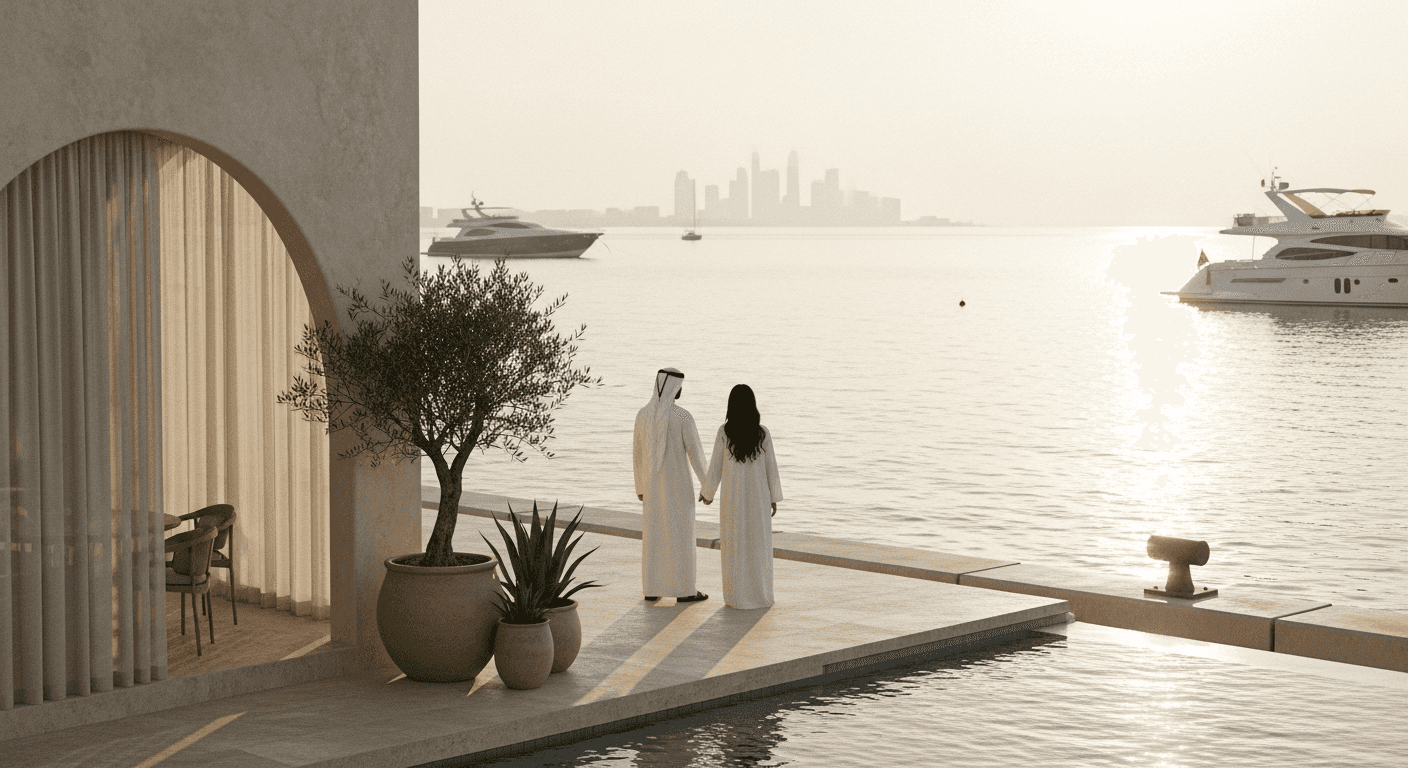
New Frontiers vs. Established Charm in Dubai
Is it wiser to invest in the proven character of an established Dubai neighbourhood or bet on the future value of an emerging one? This guide weighs the lifestyle and financial trade-offs.

The perennial question I hear from clients, whether they're new to the city or seasoned residents looking for a change, is one of the most fundamental in Dubai real estate. It’s a choice that pits the tangible against the possible: should you invest in the proven, lived-in charm of an established neighbourhood, or take a chance on the promising blank canvas of a new frontier? This is far more than a simple budget calculation; it’s a deep-seated decision about lifestyle, value, and your vision for the future.
Here at Gaia Living, we guide our clients through this complex decision every day. In this detailed review, we'll explore the critical factors that should influence your choice:
- Defining the core differences between “Established” and “Emerging” communities.
- The Lifestyle Equation: Comparing community feel, amenities, and character.
- The Value Proposition: A deep dive into purchase prices, ongoing costs, and potential returns.
- Case Study 1: The urban heart of Downtown Dubai versus the future metropolis of Dubai South.
- Case Study 2: The waterfront icon of Palm Jumeirah versus the challenger coast of Al Marjan Island.
- The Developer Factor: Why a developer's pedigree matters more than you think.
- Navigating the Risks: A clear-eyed look at what can go wrong in both new and old communities.
- My Verdict: A framework to help you choose the right path for your specific goals.
The Great Divide: What Defines "Established" vs. "Emerging"?
Before we can compare, we need to agree on our terms. The line between an established community and an emerging one isn't just about age; it's about maturity. In my experience, the distinction boils down to predictability. An established area offers a predictable lifestyle and a predictable value curve. An emerging area offers a prospective lifestyle and a potential, but less certain, value explosion. It’s the difference between buying a completed story and buying the first chapter.
Established neighbourhoods are the bedrock of modern Dubai. Think of places like Dubai Marina, Downtown Dubai, the original fronds of Palm Jumeirah, and the first phases of Arabian Ranches. These are communities where the dust has long since settled. The infrastructure is complete, the landscaping is lush and mature, and the rhythm of daily life is well-defined. You have a full complement of schools, clinics, supermarkets, and cafes. The property you see is the property you get, and the community you visit today will be largely the same community you live in tomorrow. This stability comes at a price — a premium for certainty and convenience. The `dubai property value evolution` in these zones is characterized by steady, sustainable growth rather than dramatic spikes.
Emerging neighbourhoods, or the 'new frontiers', are a different proposition entirely. These are the areas on the expanding edge of the city, representing Dubai's relentless ambition. This category includes brand new master-planned cities like Dubai South, vast developing zones like parts of Dubailand, and revitalised or newly imagined areas like Emaar Beachfront or the islands of Ras Al Khaimah. Often, purchasing here means buying `off-plan launches`, securing a property that exists only in architectural renders and a sales office model. The appeal is powerful: you get in on the ground floor, often with attractive lower prices and developer-led payment plans. You’re betting on the future, on the completion of a grand vision. This is where the highest potential for capital appreciation lies, but it's also where the risks are most pronounced. This is the heart of the `emerging neighbourhoods dubai` conversation.
The Lifestyle Equation: Community, Amenities, and Character
Beyond the financials, the lived experience in these two types of communities can be worlds apart. Your choice fundamentally shapes your daily life, your commute, your weekends, and your sense of belonging. An `established dubai areas comparison` must begin with the intangible quality of 'place'. In an area like Jumeirah or Umm Suqeim, the character has been built over decades. It's in the old-growth ghaf trees, the corner shawarma shops that have been there for 20 years, and the organic, slightly chaotic street layouts. In a more modern but established community like Jumeirah Beach Residence (JBR), the character is one of vibrant, 24/7 energy, with the beach, restaurants, and entertainment forming a smooth ecosystem of convenience. The lifestyle is immediate; the day you move in, the entire neighbourhood is at your service.
The trade-off is that this character is fixed. You are buying into a pre-existing culture. For many, this is a huge plus. For others, it can feel limiting. Service charges are also typically higher, reflecting the cost of maintaining extensive, mature facilities and landscaping. In a premium tower in Dubai Marina, you might pay AED 22-28 per square foot annually for amenities like multiple pools, large gyms, and 24-hour concierge services. This cost maintains the premium lifestyle that justifies the property's value. The parks are green, the security is visible, and everything just works. This is the promise of maturity fulfilled.
Conversely, the lifestyle in an emerging community is one of promise and potential. In a new `master-planned communities dubai pros cons` analysis, the 'pro' is a clean slate. You get brand new, state-of-the-art amenities — think sparkling gyms, resort-style pools, and contemporary architecture. You are also part of a pioneering community, where neighbours are all starting their journey together, forging a new identity for the area. Places like Town Square or Damac Hills and Damac Hills II were designed from scratch to foster a specific family-centric lifestyle, with a focus on parks, sports facilities, and community events. The energy is one of growth and excitement.
The 'con' is that you often live with the consequences of that growth. For the first few years, your view might be of a construction site. The promised metro station or grand central park may be years away. You will likely be more car-dependent as retail and F&B options slowly populate the area. The initial sense of community can feel transient, as many early buyers may be investors rather than end-users. It requires patience and a tolerance for the inconveniences of a neighbourhood finding its feet. The lifestyle is not delivered on day one; it's an investment you make over time, hoping the brochure's vision becomes a lived reality.
The Value Proposition: A Deep Dive into Costs and Returns
This is where the decision becomes sharpest. Let’s talk about the cold, hard numbers. The financial logic behind choosing established versus emerging is a classic risk-reward calculation. Established areas offer lower risk and stable, predictable returns. Emerging areas offer higher risk but the potential for significantly higher rewards. Neither is inherently 'better'; they simply serve different financial strategies and risk appetites. A comprehensive `new dubai communities review` must be grounded in these financial realities.
In an established area like Downtown Dubai, you pay a significant premium for the address and the certainty it provides. A two-bedroom apartment with a Burj Khalifa view could easily command a price of AED 4 million to AED 6 million or more. Rental yields might be a modest 5-6% gross, which after accounting for service charges (e.g., AED 25/sqft) and maintenance, results in a net yield of maybe 3.5-4.5%. The real value proposition here is wealth preservation and stable, albeit slower, capital appreciation. These properties are blue-chip assets, less susceptible to market shocks. They are 'safe havens' in a dynamic market.
In an emerging area, the numbers tell a different story. A similar-sized two-bedroom apartment in a developing community in Dubailand might cost AED 1.5 million to AED 2.2 million. The initial service charges might be a more palatable AED 14/sqft. If you can rent it out successfully upon handover, you might achieve a gross yield of 7-8%. The big prize, however, is capital growth. Early investors in now-established communities like Dubai Hills saw the value of their properties double or even triple as the master plan was delivered and the community matured. This is the grand ambition of every investor in an off-plan project. But this potential is not guaranteed. It is contingent on the developer delivering, the infrastructure arriving, and market sentiment remaining positive.
To make this concrete, let's break down the upfront costs of purchasing a hypothetical AED 3,000,000 property. The percentages are governed by Dubai law and are the same regardless of the area, but the baseline price difference is key.
Sample Upfront Cost Breakdown for an AED 3,000,000 Property:
- Purchase Price: AED 3,000,000
- Dubai Land Department (DLD) Transfer Fee: 4% of purchase price = AED 120,000. (As mandated by the Dubai Land Department (DLD)).
- DLD Registration Fee: AED 4,200 (for properties over AED 500k).
- Real Estate Agency Fee: 2% of purchase price + 5% VAT = AED 60,000 + AED 3,000 = AED 63,000.
- NOC (No Objection Certificate) Fee: Varies by developer, typically AED 500 - AED 5,000. Let's estimate AED 1,500.
- Total Upfront Cost (cash purchase): Approximately AED 3,188,700.
If you are financing, the costs change. A resident expat typically needs a 20% down payment for a first property under AED 5M, according to Central Bank of the UAE regulations. On our AED 3M property, that's AED 600,000 for the down payment, plus all the fees above, and additional bank charges like a valuation fee and mortgage registration fee (0.25% of loan amount). The total cash required upfront for a mortgaged purchase would be significantly higher than just the fees.
Case Study 1: The Urban Heart vs. The Future Metropolis
To illustrate this divergence, there's no better comparison than Downtown Dubai and Dubai South. One is the established, beating heart of the city; the other is a vision of its future on a colossal scale.
Downtown Dubai, the masterpiece of developer Emaar Properties, is perhaps the world's most famous square kilometre. It’s a masterclass in creating a complete, integrated urban experience. The lifestyle here is one of ultimate convenience and prestige. You can walk from your apartment in the Burj Khalifa or Opera Grand to the Dubai Mall, watch the fountains, dine at a world-class restaurant, and see a show at the Dubai Opera, all without ever needing a car. This walkability and concentration of iconic landmarks create a powerful and enduring appeal. The community is mature, vibrant, and commands some of the highest real estate values in the city. Buying here is buying into a globally recognized gold standard. The risk is minimal, the lifestyle is guaranteed, but the entry price is formidable and the potential for explosive growth has largely been realized.
Now, journey 35 kilometres south to Dubai South. This 145-square-kilometre master plan is a city in the making, anchored by the Al Maktoum International Airport and the legacy of Expo City. The vision is breathtaking: a self-sustaining hub for 1 million residents, with dedicated zones for logistics, aviation, commerce, and living. The residential component offers a starkly different value proposition. You can acquire a spacious townhouse or villa for the price of a small apartment in Downtown. The lifestyle is quieter, more suburban, and currently, far more car-dependent. Early residents live with the promise of future retail, future schools, and future connectivity. The `dubai property value evolution` here is entirely forward-looking.
My take is that the choice between these two is a choice of timeline. If you need the city's best amenities at your doorstep today and are focused on wealth preservation, Downtown is the unequivocal choice. You are paying a premium for a finished product. If you have a 10-to-15-year horizon, believe in Dubai's southern expansion, and want to maximize your potential capital gain, Dubai South presents a compelling, albeit higher-risk, opportunity. You are buying into a vision, and your return will depend on how faithfully that vision is executed.
Case Study 2: Waterfront Prestige vs. The Next Coastal Haven
The allure of waterfront living is a primary driver of Dubai's luxury market. Here, the comparison between the icon, Palm Jumeirah, and a major emerging contender, Al Marjan Island in Ras Al Khaimah, is fascinating.
Palm Jumeirah, the globally renowned project by Nakheel, is the definition of established luxury. For nearly two decades, it has been the address for waterfront villas and apartments. The lifestyle is one of resort-style indulgence and exclusivity. Residents have access to private beaches, world-famous hotels like Atlantis and FIVE Palm, and a dizzying array of high-end dining. The fronds offer privacy and direct water access for villa owners, while shoreline apartments provide stunning sea views. The brand equity of a Palm Jumeirah address is immense, attracting a global elite. However, this comes with some of the highest property prices and service charges in the UAE. Traffic on the 'trunk' can be a concern, and the area's popularity means it's perpetually busy. You are buying a globally recognized trophy asset, a safe and prestigious store of value.
The right Dubai address isn't found on a map; it's a reflection of your timeline, your tolerance for risk, and the life you intend to live the day you get the keys.
Now look north to Ras Al Khaimah and the man-made archipelago of Al Marjan Island. For years, it was a quiet destination known for its luxury hotels. Today, it is poised for explosive growth, catalysed by the announcement of the UAE's first integrated resort. This has ignited a wave of development, with new projects from major players like Aldar and local powerhouses like Al Hamra. Al Marjan offers a chance to buy into a beachfront lifestyle at a price point that is a fraction of Palm Jumeirah's. A luxury two-bedroom apartment here might be priced similarly to a standard one-bedroom in a less premium part of the Palm. The proposition is a bet on the future of Ras Al Khaimah as a major tourism and residential hub. The lifestyle is still forming, the infrastructure is scaling up, and the community is in its infancy. It's a classic `emerging neighbourhoods dubai` scenario, albeit in a neighbouring emirate, offering ground-floor investment in what could become the next great coastal destination.
The Developer Factor: Pedigree vs. The New Wave
In Dubai's property market, the name on the sales contract is almost as important as the address. The track record and reputation of the developer are critical components of your risk assessment, particularly when buying off-plan. This is a crucial element of any `new dubai communities review`.
Established, 'tier-1' developers like Emaar Properties, Nakheel, and Meraas are institutions. They have delivered not just buildings, but entire cities and lifestyles. When you buy into an Emaar master plan like Dubai Hills or Arabian Ranches, you are buying into an ecosystem. You can be confident that the parks will be green, the community centres will be well-managed, and the overall quality will be high. This pedigree provides a huge degree of security. It de-risks the investment significantly, which is why their properties command a premium from day one. They are not just selling a home; they are selling a guarantee of quality and community management. For many buyers, especially those from overseas, this peace of mind is non-negotiable.
Then there is the new wave of private developers. Many, like Binghatti, Damac, and Azizi, have become major players in their own right, delivering thousands of units and shaping entire districts like Jumeirah Village Circle (JVC) and Business Bay. They often compete by offering more competitive pricing, faster construction timelines, and innovative designs. The upside is the potential for great value. The risk is greater variability in quality, delivery timelines, and post-handover community management. While Dubai's robust regulations, enforced by RERA and the escrow account system, protect buyers' funds, they don't guarantee the final quality or the living experience.
My advice is always to perform rigorous due diligence. Don't be swayed by a flashy brochure alone. Before investing with any developer, new or old, we at Gaia Living help our clients by verifying key details:
- Developer and Project Registration: Check the official RERA project tracker available via the Dubai REST app.
- Escrow Account Details: Ensure the project has a RERA-approved escrow account, meaning your payments are protected.
- Track Record: Research the developer's previously completed projects. Visit them if you can. Do they look like the renders? Are residents happy?
- Master Plan: Understand the project's place in the wider area. What infrastructure is planned? What is the timeline?
Navigating the Risks: Construction, Infrastructure, and Market Cycles
No investment is without risk, and it's crucial to be clear-eyed about the potential downsides of both new and established communities. For emerging areas, the primary risk is execution. Construction delays are common in any market, and they can impact your financial planning, especially if you're paying rent while waiting for your new home. A more significant risk is a mismatch between the promised vision and the delivered reality. The glittering renders might show a bustling retail promenade, but the reality upon handover could be a handful of empty shops for the first few years. Infrastructure, like connecting roads, public transport, and essential services like schools and clinics, can also lag behind residential handovers, leading to early years of inconvenience and isolation.
For established areas, the risks are different. The primary financial risk is stagnation. You are unlikely to see the explosive 50-100% gains that early investors in new areas hope for. Your investment is more about stability and income. There is also the physical risk of aging assets. A 15-year-old building, no matter how well-built, will require more maintenance than a brand-new one. This can manifest in higher service charges or the potential for special assessments to cover major upgrades like chiller replacements or façade work. Finally, the very popularity of established areas can be a drawback. Traffic congestion in areas like Dubai Marina or Downtown during peak hours is a real lifestyle compromise for some.
Ultimately, mitigating these risks comes down to research and expert advice. For new communities, it's about betting on the right developer and the right master plan. For established communities, it's about conducting a thorough inspection of the specific property and understanding the financial health and management of the building or community association. In either case, a patient, long-term view is your best defense against short-term market volatility.
Key takeaway: Established neighbourhoods sell you a proven reality at a premium price. Emerging communities sell you a promising future at a discounted price. Your decision hinges on whether you are investing in the present or betting on the future.
My Verdict: Crafting Your Personalised Neighbourhood Strategy
After walking through the lifestyles, the numbers, and the risks, where do I land? There is no universal 'winner' in the debate between new frontiers and established charm. The 'best' choice is intensely personal, a direct function of your life stage, financial goals, and risk tolerance. My role, and the role of our team at Gaia Living, is not to push you towards one or the other, but to provide the clarity you need to make the right decision for you.
In my view, established communities are the superior choice for end-users who prioritize immediate quality of life and stability. If you are a family moving to Dubai and need excellent schools, parks, and a ready-made community from day one, the premium for an address in Arabian Ranches, Dubai Hills, or Jumeirah is justified. If you are a professional who values a short commute and the vibrant energy of urban living, the convenience of Downtown or the Marina is worth the price. For conservative investors seeking a reliable rental income stream and long-term wealth preservation, these blue-chip areas offer a fortress-like defense for your capital.
On the other hand, emerging communities hold an undeniable allure for a different profile of buyer. If you are a young professional or couple with a longer time horizon, the lower entry price and potential for high capital appreciation can be a powerful wealth-building tool. If you value space above all else and are willing to trade a longer commute for a larger home, the new frontiers offer far more square footage for your dirham. For the savvy, research-driven investor with a higher risk tolerance, getting in early on a well-planned, well-located project in an area like Dubai South or along the growing northern coastline can yield life-changing returns. You are, in essence, becoming a partner in Dubai's growth story.
Your task is to honestly assess your own priorities. Are you buying a home for the next three years or the next thirty? Is your primary goal lifestyle or appreciation? Are you a pioneer who enjoys the excitement of the new, or do you find comfort in the proven and predictable? Once you have the answers, your path will become much clearer. The beautiful thing about Dubai's property market is that it offers a world-class option for every answer.
Sources
- Dubai Land Department (DLD): https://dubailand.gov.ae/
- Central Bank of the UAE: https://www.centralbank.ae/
- UAE Government Portal: https://u.ae/
Questions, answered
- Are new communities in Dubai cheaper than established ones?
- Yes, emerging communities generally offer a lower price per square foot and more attractive payment plans from developers. However, you are buying into future potential, and amenities and infrastructure may still be under development.
- What are the risks of buying in an emerging Dubai neighbourhood?
- The main risks include construction delays, infrastructure (like roads and schools) lagging behind residential handovers, and the possibility that the community's final character and appreciation don't meet initial expectations. Diligent research on the developer's track record is crucial.
- What are the typical service charges in Dubai?
- Service charges vary significantly. In prime, established towers like those in Downtown Dubai or Dubai Marina, they can range from AED 20 to AED 35 per square foot annually. In newer communities, they are often lower, perhaps AED 12 to AED 18, but can increase as the community matures.
- Is it better to buy for lifestyle or for investment in Dubai?
- The best purchase aligns both. Established areas offer a premium, immediate lifestyle with stable, predictable returns. Emerging areas offer the potential for higher capital growth but may involve lifestyle compromises in the short term, making them a choice that depends on your personal timeline and risk appetite.
- How has the Dubai property value evolution differed between old and new areas?
- Established areas have seen steady, mature growth and have proven resilient during market downturns, holding their value well. Emerging areas exhibit more volatility; they can offer explosive growth as they mature and connect to the city's infrastructure, but also carry the risk of stagnation if the vision doesn't materialize.
- What are the main pros and cons of master-planned communities in Dubai?
- The pros of master-planned communities are integrated amenities, cohesive design, and a strong sense of community. The cons, especially in new developments, can be the long wait for all amenities to be completed, ongoing construction, and a sometimes uniform, less organic feel compared to older neighbourhoods.

Yusuf writes about how Dubai actually lives — waterfront mornings, community dining, walkability, and the lifestyle premium built into an address.
Related stories
Dubai's Big Squeeze: Smaller Plots, Denser Living
Dubai real estate is undergoing a fundamental shift towards smaller plot sizes and higher density. We analyse the economic drivers, the impact on property values, and what this new era of compact urban living means for both homebuyers and investors.
Resort Living as Your Dubai Reality
Explore how to trade temporary staycations for a permanent home with five-star amenities in Dubai. I'll break down the real costs, best communities, and lifestyle trade-offs of embracing high-end resort living every day.
Finding Your Tribe in Dubai's Villa Communities
I explore which of Dubai's renowned villa communities attract specific expat nationalities and lifestyle groups, offering insights to help you find a place that feels like home.
Echoes, in your inbox
One thoughtful email a month. Market insight, new launches, no spam.