

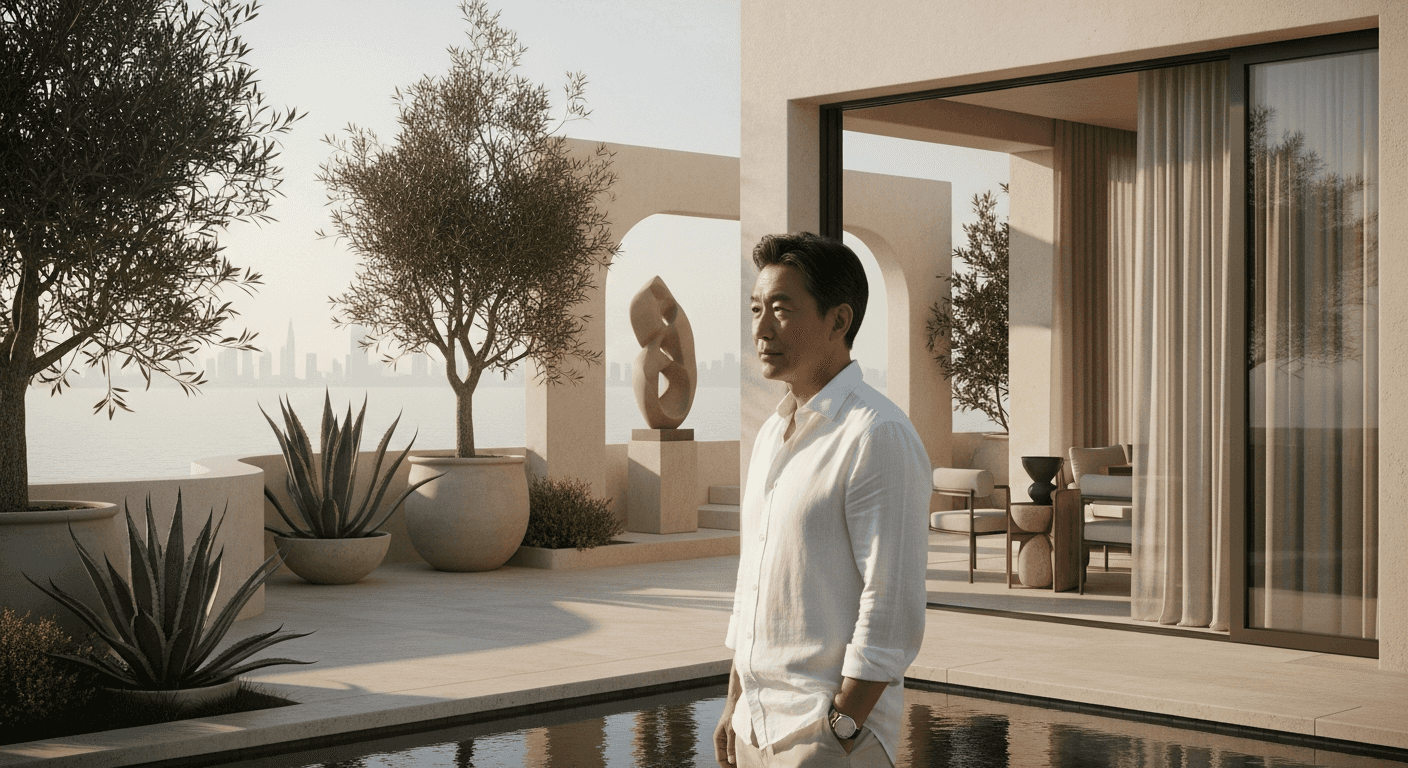
Living with Art: Dubai's Top Art Collector Neighbourhoods
For art collectors and cultural patrons, choosing a home in Dubai is about more than square footage. Discover the neighbourhoods that place you at the heart of the city's vibrant and maturing art scene.

For years, the story of Dubai was written in steel and glass, a vertical ascent that captured the world's imagination. But for those of us who live here, a more nuanced narrative has been unfolding at ground level. A city that was once defined by its architectural superlatives is now cultivating a soul, and at the heart of this evolution is a thriving, multifaceted art scene.
Here's what we'll explore:
- The shift in Dubai's cultural landscape from state-led projects to a vibrant, grassroots scene.
- Al Quoz and its creative heart, Alserkal Avenue, and the residential areas that orbit it.
- The polished, high-finance art world of the Dubai International Financial Centre (DIFC).
- Downtown Dubai, where culture is presented on the city's grandest stage.
- The rise of 'art-integrated' residences and what they mean for the future of luxury property.
- The practical design considerations for creating a home that is also a private gallery.
- A breakdown of the financials and whether proximity to culture genuinely adds value to a property.
- My personal verdict on where I believe the best opportunities lie for a life enriched by art.
From Spectacle to Substance: Dubai's Cultural Coming-of-Age
I remember a time when the primary cultural outings in Dubai were connected to heritage sites or the occasional touring international show. The city’s creative energy was palpable but diffused. The ambition was always there, channelled first into building the infrastructure of a global hub. The focus was on creating a stage, and for a long time, the world-class architecture was the performance. Today, that stage is filled with actors, artists, and storytellers who are shaping a distinctively local, yet globally connected, cultural identity. This transformation from spectacle to substance is the single most exciting development in Dubai's maturation as a world city, in my view.
This isn't to diminish the importance of the major state-led initiatives. Events like Art Dubai and the establishment of institutions like the Jameel Arts Centre have been critical catalysts. They provided the framework and the international spotlight. Yet, what gives the scene its texture and authenticity is the ecosystem that has grown around these anchors. It's the independent galleries, the artist-run studios, the non-profit foundations, and the community spaces that have flourished in their wake. This is a city that now has both the monumental vision of the Museum of the Future and the raw, creative energy of a warehouse gallery in Al Quoz.
For a discerning buyer, particularly an art collector or cultural patron, this shift has profound implications for where you choose to live. It’s no longer just a question of finding a villa with large walls to hang a collection. It's about positioning yourself within this new cultural geography. It’s about proximity not just to a gallery, but to a community. It's the ability to walk from your apartment to an exhibition opening, to have a coffee shop conversation with a gallerist, or to be a short drive from the studio of an artist whose work you admire. Choosing a home becomes an act of curation itself — curating a lifestyle that is immersed in and supports the creative fabric of the city.
This evolving landscape offers distinct choices, each with its own character, price point, and lifestyle proposition. From the industrial chic of Al Quoz to the polished corridors of DIFC and the grand boulevards of Downtown, the right address can be the key to unlocking a richer, more engaged life in Dubai. The question for the modern patron is not just where to house their art, but where to house themselves to best experience the culture they cherish.
The Authentic Core: Al Quoz & Alserkal Avenue
 Featured project
If you want to find the true pulse of Dubai's contemporary art scene, you go to Al Quoz. For decades, this area was a sprawling, low-rise grid of warehouses, light industrial workshops, and labour accommodations. It was functional, gritty, and not on any tourist map. But it was precisely this rawness — and the availability of large, affordable spaces, that attracted the first wave of pioneering gallerists. They saw the potential in these cavernous, unadorned sheds to create a new kind of art destination, one that stood in stark contrast to the polished gleam of the rest of the city. At the centre of this transformation is Alserkal Avenue, a former marble factory compound that has been brilliantly repurposed into the region's foremost arts and culture district.
Walking through Alserkal is a sensory experience. The corrugated metal and exposed ductwork of the warehouses remain, but they now contain world-class contemporary art galleries like Leila Heller Gallery, The Third Line, and Carbon 12. You'll find the city's only independent arthouse cinema, Cinema Akil, buzzing with film lovers. There are artisan coffee roasters, concept stores, a vinyl record shop, and performance spaces. This is the heart of `gallery district living` in its most authentic form. It's a place of creation and conversation, not just consumption. The community here is real, forged through a shared passion for culture, and that energy is infectious. For a collector, living near Alserkal means having this entire ecosystem on your doorstep.
Of course, you cannot live *in* Alserkal Avenue. The challenge, and the opportunity, lies in finding `Alserkal Avenue nearby homes`. This requires looking at the established and emerging residential communities that orbit this industrial heartland. For those seeking space and seclusion, Al Barari is a compelling option. A 15-minute drive away, it feels like another world. Known for its lush, botanical-garden-like landscaping and magnificent villas, it offers the ultimate blank canvas. Homes here are true `luxury art property`, featuring vast, double-height living areas, expansive walls, and private gardens large enough for significant sculptural installations. It's a sanctuary that offers a verdant, peaceful contrast to the industrial energy of Al Quoz.
Another excellent choice is the area around Meydan, particularly communities like District One and Sobha Hartland. These master-planned developments offer modern villas and mansions with clean lines and generous proportions, ideal for displaying contemporary collections. Their location is strategic, placing residents within easy reach of not only Al Quoz but also Downtown and DIFC. A villa in Meydan provides the scale and modernity that many collectors crave, allowing them to design a home around their art. For a more established feel, the villas in Jumeirah or Umm Suqeim offer proximity and character, though they may require more significant renovation to create the open, light-filled spaces that best serve a collection. The premium for these locations is about access — not just to art, but to a life less ordinary.
DIFC: The Polished Financial and Arts Nexus
If Al Quoz is the soulful, independent heart of Dubai's art scene, the Dubai International Financial Centre (DIFC) is its impeccably tailored, blue-chip brain. This is where high finance and high art intersect with smooth sophistication. The atmosphere is entirely different: instead of industrial warehouses, you have the sleek, travertine-clad corridors of Gate Village, a purpose-built cluster of buildings dedicated to fine dining and world-renowned art galleries. This is a curated, polished environment where global auction houses like Christie's hold previews and the galleries — such as Tabari Artspace and AWC Gallery, represent established international and regional artists.
The lifestyle in DIFC is one of absolute integration. It is, in my opinion, the most complete and walkable urban district in Dubai. Residents can walk from their apartments to their offices, to a Michelin-starred lunch at Zuma, and then to a gallery opening in the evening, all without ever needing a car. This concentration of amenities creates a powerful network effect. The community here is composed of financiers, lawyers, and consultants who are often serious collectors themselves. The conversations that happen in the courtyards of Gate Village are as much about market trends in art as they are about capital markets. This makes it an ideal location for the `cultural patron homes` of those who value convenience, prestige, and being at the centre of the establishment.
Living options within DIFC are primarily high-end apartments in landmark towers. Buildings like Index Tower, with its distinctive Foster + Partners design, and the residential offerings within Central Park Towers and the Gate Village itself, are highly sought after. These are not just apartments; they are vertical homes designed for a specific global clientele. They often feature higher ceilings, floor-to-ceiling windows with stunning cityscapes, and minimalist aesthetics that provide a superb backdrop for art. A large painting against a view of the skyline from the 50th floor makes a powerful statement. The challenge here is not a lack of wall space, but curating a collection that works within the context of a modern, high-rise apartment rather than a sprawling villa.
The premium for living in DIFC is tangible and justified by its unique proposition. You are paying for an unparalleled level of convenience and access. The service charges reflect the premium nature of the buildings and the district's immaculate maintenance. However, the rental demand is consistently strong, driven by the captive audience of professionals working within the free zone. For a collector who splits their time between cities or desires a sophisticated, lock-up-and-leave base in Dubai, a DIFC residence is an impeccable choice. It represents a fusion of business, leisure, and culture that is difficult to replicate anywhere else in the city.
Downtown Dubai: Living on a Grand Cultural Stage
Where DIFC is polished and Al Quoz is authentic, Downtown Dubai is pure spectacle. This is the city’s grand cultural living room, master-planned by Emaar Properties to be a global icon. The anchor and undeniable star of the show is the Dubai Opera, a magnificent dhow-shaped architectural masterpiece that hosts a world-class calendar of ballet, opera, theatre, and concerts. Living in Downtown, particularly in the Opera District, means that this incredible cultural resource is, quite literally, your neighbour. The entire area is designed to feel like a permanent festival, with public art installations scattered throughout the Mohammed Bin Rashid Boulevard, the dazzling Dubai Fountain shows, and the towering presence of the Burj Khalifa.
This is culture on a grand, accessible, and unapologetically impressive scale. It appeals to a buyer who wants to be at the epicentre of the city's buzz. The lifestyle is one of vibrant, cosmopolitan energy. You can stroll from your apartment to a pre-theatre dinner, watch a performance by the Mariinsky Ballet, and be home ten minutes after the curtain falls. This immediacy to world-class entertainment is a luxury that few global cities can offer with such ease. The entire district is a sign of Emaar's vision of creating integrated lifestyle destinations where every need — from retail at Dubai Mall to dining and culture, is within a short walk.
Properties in the Opera District, such as Opera Grand or the Address Residences, were conceived with a culturally-inclined buyer in mind. These are some of the most sought-after `Dubai art residences` because their interior architecture often reflects the artistic purpose of their location. You'll find apartments and penthouses with grand proportions, high ceilings, and panoramic windows that frame the iconic landmarks. These homes are designed not just to be lived in, but to be a stage for a sophisticated life. For an art collector, the generous layouts and stunning views provide a dramatic canvas for displaying significant pieces.
Of course, living on the main stage comes at a premium. This is some of the most valuable real estate in Dubai. To make this tangible, let's break down the approximate upfront costs for purchasing a secondary-market two-bedroom apartment in the Opera District, which could be valued at around AED 5,500,000.
- Purchase Price: AED 5,500,000
- Dubai Land Department (DLD) Transfer Fee (4%): AED 220,000
- Real Estate Agency Fee (2% + 5% VAT): AED 115,500
- Trustee Office Fee: Approximately AED 4,200 (including VAT)
- Developer No Objection Certificate (NOC) Fee: Ranges from AED 500 to AED 5,000; let's estimate AED 1,575.
- Title Deed Issuance Fee: Approximately AED 580.
- Total Upfront Cost (without mortgage): Approximately AED 5,841,855
It's important to remember that if you are financing the purchase, the UAE Central Bank mandates a minimum down payment, which for a non-national resident on a property over AED 5 million is typically 35%, plus all the associated fees. Annual service charges in these premium towers can range from AED 25 to AED 35 per square foot, covering the maintenance of the world-class amenities. The investment here is not just in property; it's in a landmark lifestyle.
The Next Wave: Art-Integrated Residences
As the Dubai property market continues to mature, we're witnessing a fascinating evolution in the concept of luxury. The most forward-thinking developers are no longer just selling square footage; they are selling a curated vision of life. This has given rise to a new generation of `Dubai art residences` — properties where art is not an afterthought but is woven into the very DNA of the building from its inception. This goes beyond simply placing a sculpture in the lobby. It's about a holistic approach where architecture, interior design, and art collaborate to create a unique and immersive living experience, effectively building a `fine art community` from the ground up.
This trend is manifesting in several ways. We are seeing more direct collaborations between developers and artists. A notable example is the partnership between Binghatti and the artist Francky Monet, where artistic motifs and design philosophies are integrated into the architectural fabric of their towers. While this leans more towards 'artistic design' than displaying collections, it signals a market appetite for homes that express a distinct creative point of view. Another approach is the rise of the ultra-luxury, boutique developer, such as AHS Properties. They create one-of-a-kind villas in prime locations like Emirates Hills and Palm Jumeirah that are conceived as private galleries. These homes are built with the collector in mind, featuring museum-quality specifications from the outset.
“A home near a gallery isn't just a convenience; it's a bet on the enduring value of culture in a city that's finally building its own.”
Looking ahead, I expect this trend to accelerate, particularly in new off-plan launches. Developers understand that in a competitive market, a strong cultural identity can be a powerful differentiator. Imagine a new residential tower curated by a leading international gallery, with a rotating collection of art in the common areas and exclusive access for residents to art advisory services. Or a master community by a developer like Meraas, known for their design-led destinations like City Walk, that incorporates artist studios, workshops, and public art trails into its master plan. These are the kinds of concepts that will define the next frontier of luxury living in Dubai.
For the buyer, these art-integrated developments offer a compelling proposition. They provide a turnkey solution for a culturally enriched lifestyle. You are not just buying a home; you are buying into a pre-packaged fine art community with a built-in aesthetic and social life. The value proposition is tied to the uniqueness and quality of the curation. The key is to look beyond the marketing and assess the authenticity of the developer's commitment to art. Is it a genuine integration that enhances the living experience, or is it merely a branding exercise? The most successful projects will be those where the art feels essential, not just decorative.
The Collector's Canvas: Practicalities of a Home Gallery
Identifying the right neighbourhood is only the first step. For a serious collector, the property itself must function as a private gallery — a safe, stable, and beautiful environment to house, protect, and enjoy their acquisitions. This requires a level of technical consideration that goes far beyond typical property hunting. In my work with clients who are collectors, we move past the standard checklist of bedrooms and bathrooms and focus on a specific set of architectural and technical criteria. A beautiful villa is of little use if it cannot properly accommodate the art it is meant to display.
First and foremost is the issue of space and volume. This means more than just large rooms. It means generous, uninterrupted wall space, free from an excess of doors, windows, or built-in cabinetry. I advise clients to literally measure the linear feet of 'hangable' wall. Ceiling height is equally critical; a standard ceiling can feel oppressive and limiting, while heights of 3.5 metres or more — especially in double-height reception areas, provide the volume needed for large-scale contemporary works to breathe. The flow of the space is also important. An open-plan layout allows for long sightlines, letting you appreciate pieces from different angles and distances, creating a more dynamic viewing experience.
Beyond the physical space, environmental controls are non-negotiable. Dubai's climate, with its high heat and humidity, is the enemy of delicate artworks. Standard residential air conditioning is designed for human comfort, not archival preservation. A true `luxury art property` requires a sophisticated, multi-zone HVAC system capable of maintaining a constant temperature and, crucially, a stable relative humidity (typically around 50%). Lighting is another complex science. While abundant natural light is a desirable feature in any home, direct sunlight contains UV rays that can cause irreversible damage to paintings, photographs, and textiles. The ideal home will have thoughtfully placed windows, perhaps north-facing, and be fitted with UV-filtering film. This should be complemented by a professional-grade, flexible lighting system, such as museum-quality track lighting, that allows you to illuminate each piece perfectly without causing heat damage.
Finally, there are the structural and logistical considerations. A significant sculpture can weigh several tonnes, and the floor must be engineered to support that load. For new builds or major renovations, this means consulting with a structural engineer to reinforce specific areas. Access is another often-overlooked but vital point. How will you get a large, crated artwork into the property? We've had to assess service elevators, window sizes, and even crane access for penthouses and villas. To assist our clients, we often use a practical checklist during viewings:
- Wall & Volume Assessment: Measure linear feet of uninterrupted walls. Confirm ceiling heights, especially in key display areas.
- Lighting Analysis: Evaluate natural light exposure. Are windows UV-protected? Assess the quality and flexibility of existing artificial lighting.
- Climate Control Review: Inspect the HVAC system. Can it provide stable, zoned humidity and temperature control? Is it museum-grade?
- Structural Load Capacity: For villas, review engineering plans if available. For apartments, check the building's specifications for floor loading limits.
- Access & Installation Pathways: Measure doorways, hallways, and elevators. Can a standard large art crate navigate the space from the street to the wall?
- Security & Fire Suppression: Review the existing security systems. Does the fire suppression system use water sprinklers (damaging) or a gas-based alternative (safer for art)?
The Art Premium: Does Culture Add Financial Value?
This is the question every investor client asks: does living in a culturally rich neighbourhood translate into a tangible financial return? It’s a crucial point, and the answer is yes, but the premium is not always direct or easily quantifiable. It is better understood as a powerful driver of demand and a creator of long-term, resilient value. Proximity to a vibrant cultural scene enhances a neighbourhood's 'stickiness' — its ability to attract and retain a desirable demographic of residents who are invested in the community for reasons that go beyond pure real estate metrics.
In a place like DIFC, the value proposition is clearest. The smooth integration of office, residential, dining, and gallery spaces creates a complete urban ecosystem. This convenience and prestige command a clear price premium over apartments in less integrated, single-use towers nearby. The demand from a captive audience of high-earning professionals keeps rental yields robust — typically in the 5-7% gross range, and vacancies low. The 'art premium' here is bundled into the overall 'DIFC premium,' which is based on lifestyle, walkability, and prestige. It's a proven and bankable model.
For communities near Alserkal Avenue, the effect is more nuanced but equally important. The presence of the gallery district has been instrumental in changing the perception of Al Quoz and surrounding areas like Meydan. It has added a layer of cultural cachet and desirability that simply did not exist a decade ago. This 'halo effect' lifts the entire area, making it more attractive to a broader range of end-users and tenants. While you might not be able to draw a direct line from a gallery opening to a 5% increase in your villa's value, the cumulative effect of a thriving creative hub is a rising tide that lifts all boats. It diversifies the area's appeal and protects its value by making it a more interesting and dynamic place to live.
For bespoke `luxury art property` — the AHS-style villas or custom-built mansions, the value is inherent in the product itself. The initial cost reflects the high level of design, materials, and specialized systems. The 'art premium' is baked into the price from day one. The investment case here rests on scarcity and uniqueness. You are buying a one-of-a-kind asset. Its future appreciation will depend on finding another discerning buyer who values that same unique vision. While the pool of potential buyers is smaller than for a standard villa, they are also often less price-sensitive and are seeking something that cannot be replicated. As per Gaia Living policy, we never guarantee returns, but in my professional opinion, investing in a property that is part of a vibrant, authentic cultural fabric is one of the smartest ways to secure lasting value in a maturing market like Dubai.
For collectors and cultural patrons in Dubai, the smartest property investment is one that enriches your life as much as your portfolio. Choosing a home in a neighbourhood with a vibrant arts scene like those surrounding Alserkal Avenue, DIFC, or the Opera District is a vote of confidence in the city's cultural future, which is a key driver of long-term, resilient property value.
My Verdict: Curating Your Life in Dubai
Having walked through these distinct cultural landscapes, the choice of where to live as an art lover in Dubai is wonderfully varied. There is no single 'best' answer; the right choice is deeply personal and depends entirely on the kind of life you wish to curate for yourself and your collection. Each of the city’s primary art hubs offers a compelling, yet fundamentally different, proposition.
If your heart beats for the raw, authentic energy of the art world, and you value space and privacy above all, then I would point you towards the villas orbiting Al Quoz. A modern home in a community like Meydan or a green sanctuary in Al Barari provides the grand canvas your collection deserves. It positions you as a patron in the truest sense — close enough to the creative core to be an active participant, yet with the seclusion to enjoy your art in a space of your own making. This is the choice for the pioneer, the one who wants to be close to where art is being made and debated.
If your life is fast-paced, global, and revolves around the city's commercial core, then a residence in DIFC is unmatched. It offers a level of polished convenience and integration that is the epitome of sophisticated urban living. The ability to move smoothly between your office, a world-class restaurant, and a blue-chip gallery is a rare luxury. This is the address for the collector who wants a dynamic, plugged-in lifestyle, where their home is a sleek, secure base in the heart of the action.
For those who are captivated by culture on a grand, spectacular scale, Downtown Dubai and its Opera District are the clear choice. It’s a life lived on the front row, with the city's most iconic landmarks and performance venues as your backdrop. It's a vibrant, 24/7 destination that offers unparalleled access to international entertainment. This is the home for the person who loves the energy of a global metropolis and wants to be immersed in its dazzling cultural offerings.
As for my personal view? If I were placing my own collection, I would be drawn to the balance offered by a community like Meydan's District One. It combines the best of both worlds. You have the modern architecture and generous space of a new villa, providing that perfect 'white cube' to build a collection within. At the same time, you are just a short, straight drive from the authentic pulse of Alserkal Avenue on one side and the grand spectacle of Downtown on the other. For me, that blend of private sanctuary and easy cultural access represents the most compelling version of a life well-lived in the new, culturally rich Dubai. It's a choice that looks to the future, in a city that is finally creating a masterpiece of its own.
If you are a collector looking to find the perfect home for your art and your life, we at Gaia Living understand the unique requirements. We would be delighted to have a conversation with you. You can browse our current properties for sale or explore the city's communities in more detail on our website.
Sources
- Dubai Land Department (DLD): dubailand.gov.ae
- Central Bank of the UAE: centralbank.ae
- UAE Government Portal: u.ae
Questions, answered
- What is the best area in Dubai for art lovers?
- It depends on your lifestyle. Al Quoz (near Alserkal Avenue) offers authentic gallery district living, DIFC provides a polished urban hub with blue-chip galleries, and Downtown Dubai is centred around the spectacular Dubai Opera.
- Are there specific residences designed for art collectors in Dubai?
- Yes, ultra-luxury developers like AHS Properties design villas with features like high ceilings and reinforced floors for collections. Newer apartment projects in Downtown's Opera District also cater to this, and many branded residences are integrating art into their core design.
- How much does it cost to buy a property in an art-centric area?
- Prices vary widely. A two-bedroom apartment in DIFC or Downtown could range from AED 3 million to over AED 7 million, while a villa in a nearby community like Al Barari or Meydan suitable for large collections would start from AED 8 million and can exceed AED 50 million.
- Does living near an art gallery increase property value in Dubai?
- Proximity to an established cultural hub like DIFC or a vibrant community space like Alserkal Avenue generally supports stronger property values and rental demand. It contributes to the area's overall desirability and lifestyle appeal, which are key drivers in the premium market.
- What features should an art collector look for in a Dubai home?
- Prioritise high ceilings (>3m), large, uninterrupted wall spaces, controlled natural light with UV protection, museum-grade climate control (HVAC), and structural support for heavy pieces. Also consider access for the safe installation of large artworks.

Yusuf writes about how Dubai actually lives — waterfront mornings, community dining, walkability, and the lifestyle premium built into an address.
Related stories
Dubai's Established Charm: The Case for Older Homes
In a city focused on the future, I believe the smartest move for many buyers is to look back. Dubai's seasoned communities offer space, character, and surprising value that new builds often can't match.
The True Cost of Owning a Dubai Property
Beyond the purchase price, your annual budget for a Dubai home must account for service charges, utilities, and maintenance. I'll break down every ongoing expense you need to plan for.
Calculating ROI on Dubai Rental Upgrades
As a landlord in Dubai, you can't just follow trends. I'll show you how to calculate the precise ROI of minor property upgrades to genuinely increase your rental yield.
Echoes, in your inbox
One thoughtful email a month. Market insight, new launches, no spam.