

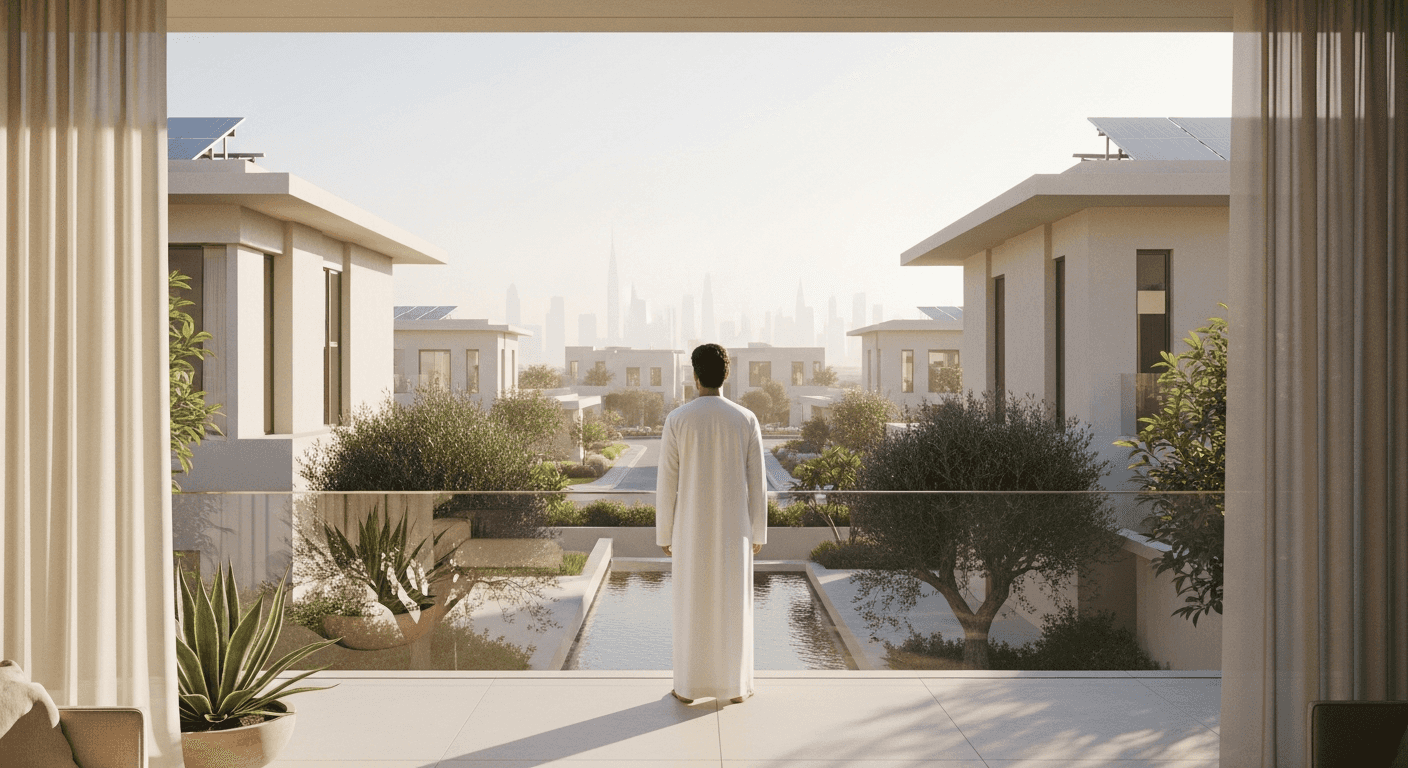
Living Smarter: Dubai's Green & Tech-Ready Villa Homes
Discover the Dubai villa communities leading in sustainability and smart home integration. I explore where to find future-proof family homes that promise lower bills and a higher quality of life.

For years, the story of the Dubai villa was one of pure indulgence — sprawling spaces, private pools, and air conditioning powerful enough to defy the desert. That narrative is changing. A new, more intelligent form of luxury is taking root, one that pairs grand living with green consciousness and smart technology. These are the future-proof villas that our clients at Gaia Living are increasingly asking for, homes that are not just beautiful, but also efficient, healthy, and responsible.
Here's what we'll explore in this guide:
- The government vision and market demand driving Dubai's green shift.
- What 'sustainability' really means in the context of a Dubai villa.
- The smart home technologies that genuinely add value to family life.
- A deep dive into pioneering green communities, from established icons to new innovators.
- A practical cost analysis: Is a green villa a better investment?
- The choice between buying new and retrofitting an older home.
- My final verdict on where the market for smart, green homes is headed.
The Green Revolution: Why Dubai is Prioritising Sustainability
This shift isn't happening in a vacuum. It's a deliberate, top-down and bottom-up movement. The leadership of the UAE has laid out a clear path with ambitious goals like the Dubai 2040 Urban Master Plan and the UAE Net Zero by 2050 Strategic Initiative. These aren't just policy documents; they are blueprints for a future where economic growth and environmental stewardship go hand in hand. For real estate, this translates into stricter building codes, new green rating systems like Dubai Municipality's 'Al Sa'fat', and a clear push from authorities like DEWA for renewable energy adoption.
In my conversations with families looking for their forever home, I see the other side of this equation: a fundamental change in buyer priorities. The post-pandemic world has made us all more aware of our immediate environment. Families want homes that offer better indoor air quality, more connection to nature, and the peace of mind that comes with a lower carbon footprint. The financial incentive is, of course, a huge driver. As I'll break down later, the potential for significant savings on DEWA bills is a powerful motivator, turning sustainability from a 'nice-to-have' into a core financial consideration.
Developers have responded with remarkable speed. What was once a niche occupied by a few pioneering projects has become a competitive advantage. Today, almost every major off-plan launch from developers like Emaar Properties, Meraas, and Aldar features sustainability as a key pillar. They are competing on the efficiency of their HVAC systems, the inclusion of solar panels, and the quality of their smart home integration. It marks a maturation of the Dubai market, moving from a focus on sheer scale to a more refined, intelligent approach to building communities. This is conscious luxury, and in my view, it's the new standard.
Deconstructing the 'Green Villa': From Solar Panels to Greywater
 Featured project
'Sustainable' and 'eco-friendly' are terms that get thrown around a lot in property brochures. But what do they actually mean for you and your home? When we at Gaia Living assess a property's green credentials, we look past the marketing and focus on tangible features that deliver real results in terms of efficiency and comfort. It's a combination of smart design, active technology, and resource management.
First is passive design — the silent workhorse of an efficient home. This is about designing the villa to work with the climate, not against it. It includes things like high-performance, double-glazed windows with low-emissivity coatings that block heat but not light. It means using high-quality insulation in the walls and roof to keep the cool air in. The very orientation of the villa on its plot can make a difference, minimizing exposure to the harshest afternoon sun. These features don't require any energy to run, but they drastically reduce the load on your air conditioning, which is the single biggest consumer of electricity in any Dubai home.
Next are the active systems. This is the technology you can see and control. The most prominent example is solar photovoltaic (PV) panels on the roof, which generate free electricity from the sun. Under DEWA's Shams Dubai initiative, you can connect these to the grid, reducing your bill and even exporting surplus power. Solar water heaters are another simple, effective technology. The most critical component is an energy-efficient HVAC system. Modern VRF (Variable Refrigerant Flow) systems are far superior to older units, offering better zoning, quieter operation, and significantly lower energy consumption. Paired with LED lighting throughout the home, these active systems are the engine of an energy-efficient villa.
Finally, there's the focus on water and materials. Dubai is a desert city, and water conservation is critical. Leading green communities incorporate greywater recycling systems, where water from showers and washing machines is treated and reused for irrigation. Inside the home, low-flow taps and toilets can reduce consumption without sacrificing performance. The landscaping itself plays a role, with a move towards beautiful, drought-resistant native plants that require less water. Even the construction materials matter — developers are increasingly using locally sourced or recycled materials and low-VOC (Volatile Organic Compound) paints that lead to healthier indoor air quality. These elements combine to create a home that is truly lighter on the planet and on your wallet.
The Connected Home: Smart Features That Genuinely Improve Life
Parallel to the green revolution is the rise of the smart home. The two are deeply intertwined. A truly smart home is an efficient one. For example, a smart thermostat learns your family's schedule and adjusts the AC automatically, ensuring you're not cooling an empty house. This alone can cut cooling costs by 10-15%. But the benefits of smart homes in Dubai go far beyond just energy savings; they offer a level of convenience, comfort, and security that families now see as essential.
In my experience showing properties, the most appreciated smart features are the ones that solve everyday problems. Integrated climate and lighting control is at the top of the list. Being able to set scenes — a 'Welcome Home' scene that turns on hallway lights and sets the AC to a comfortable temperature, or an 'All Off' button by the front door, simplifies daily routines. Systems from brands like Lutron, Crestron, or KNX provide a robust backbone for this, allowing you to control everything from a single app or elegant wall panels. Voice control via Amazon Alexa or Google Assistant adds another layer of convenience, especially when your hands are full.
Security is another major driver for smart home adoption. Video doorbells, smart locks that can be opened remotely for a delivery or a family member, and integrated CCTV cameras accessible on your phone provide invaluable peace of mind. For families with young children, this is non-negotiable. Other features that resonate strongly include automated blinds and curtains, which can be scheduled to close during the hottest part of the day to reduce solar gain, and smart control of the pool and irrigation systems, optimizing water and chemical use. A well-designed smart home simplifies the management of a large villa, making it feel more manageable and responsive.
When you're looking at smart homes Dubai, it's important to understand the different levels of integration. Some developers offer a basic 'smart-ready' package, which might include a smart thermostat and a video doorbell. Others, particularly in the luxury segment, deliver a fully integrated, bespoke system as standard. When we advise clients, we encourage them to ask about the underlying platform. Is it a closed, proprietary system, or an open one that allows for future expansion? A future-proof villa should have a flexible and scalable smart home infrastructure that can adapt as technology evolves.
Community Spotlight: Al Barari, The Original Green Haven
Long before 'sustainability' became a marketing buzzword, there was Al Barari. I've been visiting this community for over a decade, and it remains, in my opinion, the undisputed benchmark for luxury green living in Dubai. Developed by the visionary Zaal family, Al Barari was founded on a simple but radical idea: to dedicate the majority of its land to nature. An incredible 60% of the development is made up of lush, themed gardens, sparkling waterways, and meandering walking trails. Driving through its gates feels like leaving the desert and entering a botanical sanctuary.
This isn't just aesthetic landscaping; it's a functioning ecosystem that has a measurable impact on the microclimate. The density of foliage and the presence of water bodies create an environment that is palpably cooler and quieter than surrounding areas. The villas, which are known for their spacious layouts and high-quality finishes, are designed to merge with this landscape. Large windows and terraces create a smooth indoor-outdoor connection. While some of the earlier phases might not have the very latest smart home tech built-in, their passive design is excellent, and many homeowners have invested heavily in retrofitting them with state-of-the-art systems.
Living in Al Barari is a complete lifestyle choice. It's for families who value privacy, space, and a deep connection to nature. The community's amenities are extensions of this ethos. You have 'The Farm', one of Dubai's most beloved restaurants, set amidst gardens and streams. There's the Body Language health club with its superb gym and pool, and the Heart & Soul spa. The community is self-contained yet well-connected, just off Sheikh Mohammed Bin Zayed Road. Of course, maintaining this level of botanical perfection comes at a cost. Service charges in Al Barari are at the higher end, typically ranging from AED 6 to AED 8 per square foot on the built-up area annually. But for residents, this isn't just a fee; it's an investment in an unparalleled quality of life.
“The most valuable feature of a future-proof villa isn't the marble finish or the private pool; it's the promise of lower running costs and a higher quality of life for years to come.”
Community Spotlight: Dubai Hills Estate, The Modern Family's Choice
If Al Barari represents bespoke, nature-first luxury, then Dubai Hills Estate represents the new gold standard for master-planned family communities that integrate green principles at scale. As a flagship project by Emaar Properties, it brilliantly combines premium living with incredible convenience and a thoughtfully designed green infrastructure. It's one of the communities we at Gaia Living recommend most often to families looking for a balanced, modern lifestyle.
The genius of Dubai Hills lies in its master plan. It's woven around a spectacular 18-hole championship golf course, but the green spaces extend far beyond the fairways. A 'green corridor' with parks, playgrounds, and over 50 kilometres of cycling and jogging tracks connects the various neighbourhoods. This encourages an active, outdoor lifestyle. Emaar has also incorporated sustainability at the infrastructure level, with energy-efficient street lighting, water-saving irrigation for public areas, and a design that promotes walkability, especially around the central hub of Dubai Hills Park and Dubai Hills Mall.
For the villas, you have a wide spectrum of options, from the contemporary three-bedroom townhouses in Maple to the ultra-luxury mansions in Hills Grove Villas. The newer phases, in particular, are built to high standards of energy efficiency. Emaar typically includes a solid baseline smart home system in these properties, covering climate control and lighting, which homeowners can then expand upon. The design aesthetic is modern and clean, with large windows to maximize natural light. While the plots are generally more compact than in a community like Al Barari, the trade-off is access to a staggering array of world-class amenities right on your doorstep. You have the mall, the hospital, several top-tier schools like GEMS International School and King's College Hospital, all within the community. This holistic approach makes it one of the most compelling examples of smart, green living Dubai has to offer.
Community Spotlight: The Sustainable City & Expo City
For those who want to commit fully to a sustainable lifestyle, Dubai offers communities that are living laboratories for the future. The most established of these is The Sustainable City, located on Al Qudra Road. This project, developed by Diamond Developers, is a globally recognized model for sustainable urban development. Its goal is to be a Net Zero Energy community, and it achieves this through a combination of clever design and on-site generation. Every villa and parking structure is covered in solar panels, producing enough electricity to meet the community's needs over the course of a year.
Life in The Sustainable City is different. The residential clusters are car-free, with residents using electric buggies to get around, creating a safe, quiet environment for children. The community features 11 biodome greenhouses that function as urban farms, growing produce for residents. All wastewater is treated and recycled for irrigation, and waste is sorted for recycling and composting on-site. The villas themselves are designed for maximum efficiency, with north-facing orientations to avoid direct sun and UV-reflective paint. While the aesthetic is more uniform than in other communities, the appeal lies in the strength of its ethos. It attracts a community of like-minded individuals who are passionate about living lightly on the earth. In my experience, it's a place that people either fall in love with instantly or find too prescriptive — there's very little middle ground.
Looking to the future, Expo City Dubai is poised to become the next major hub for smart and sustainable urban living. Built on the legacy of the Expo 2020 site, it is being reimagined as a clean, green, human-centric city of the future. The infrastructure is already there: it's the first community in the region to be registered under the WELL Community Standard pilot. It's designed as a '15-minute city', where residents can access all their daily needs by foot or bicycle. The existing buildings, like Al Wasl Plaza and Terra — The Sustainability Pavilion, are marvels of sustainable architecture. The new residential launches, including both apartments and villas, are being built to the highest green standards. For buyers looking to invest in a vision of the future, Expo City offers a unique and compelling proposition.
The Financials: Analysing the 'Green Premium'
This is the question I get asked most often by clients: does buying a sustainable villa mean paying more? The answer isn't a simple yes or no. While there can be a higher initial purchase price for a new-build villa equipped with premium green tech, the more important calculation is the Total Cost of Ownership over time. A 'cheaper' villa with poor insulation and an inefficient AC unit can end up costing you far more over a five or ten-year period.
Let's run some illustrative numbers. These are not exact quotes but are based on realistic market assumptions for a hypothetical 5,000 sq. Ft. villa. The goal is to understand the financial dynamics at play.
Scenario A: Standard Villa (Older Build) * Purchase Price: AED 8,000,000 * Upfront Fees (4% DLD + ~3% Trustee/Agency/Misc): ~AED 560,000 * Total Upfront Cost: AED 8,560,000 * — * Estimated Annual DEWA Bill: AED 60,000 * Estimated Annual Service Charge (at AED 5/sqft): AED 25,000 * Total Annual Running Cost: AED 85,000
Scenario B: Energy-Efficient Villa (New Build) * Purchase Price: AED 8,400,000 (5% premium) * Upfront Fees (4% DLD + ~3% Trustee/Agency/Misc): ~AED 588,000 * Total Upfront Cost: AED 8,988,000 * — * Estimated Annual DEWA Bill (40% saving): AED 36,000 * Estimated Annual Service Charge (at AED 6/sqft): AED 30,000 * Total Annual Running Cost: AED 66,000
In this simplified model, the green villa has an annual running cost that is AED 19,000 lower. The upfront 'green premium' of AED 428,000 (difference in total upfront cost) would theoretically be paid back by the running cost savings in about 22 years. However, this calculation is incomplete. It doesn't factor in the likely higher appreciation in value of the greener villa, its higher appeal on the rental market, or the cost of major AC replacement which is more likely in the older villa. The resale value is a key factor; as green building standards become the norm, less efficient properties may be seen as 'dated' and command a lower price. The 'green premium' is better viewed as an investment in future value.
What about retrofitting? This is a very popular option. Installing a solar PV system on a typical villa can cost between AED 25,000 and AED 50,000, with a payback period through DEWA savings of just 5-8 years. Upgrading to a modern, efficient AC system can be a larger investment, but the comfort and savings are immediate. For owners of older villas in prime locations, a green retrofit is one of the smartest investments you can make, boosting both your quality of life and your property's marketability.
Investing in a sustainable, smart villa is no longer a niche choice but a strategic one. These homes offer tangible savings, superior living environments, and are better positioned for long-term value appreciation in a rapidly modernising Dubai.
My Verdict: Beyond the Buzzwords
Having spent years walking through every type of villa community Dubai has to offer, from the original Jumeirah homes to the latest off-plan launches in the desert, the trend is undeniable and exciting. The convergence of sustainability and smart technology is creating a fundamentally better home product. It's a shift from prioritizing opulence for its own sake to valuing intelligent, efficient, and healthy design.
My advice to any family looking to buy a villa in Dubai today is to place these factors at the top of your checklist. Don't just be impressed by a show home's Italian marble; ask about the R-value of the insulation. Don't just nod when they mention a smart home; ask what brand the system is and whether it's an open platform. Ask for a history of DEWA bills if you're buying a resale property. Ask about the cooling system — is it an old-fashioned chiller or a modern VRF system? These are the questions that will determine your long-term happiness and financial well-being in the home.
Ultimately, the move towards energy efficient villas and connected homes is about quality of life. It’s the comfort of a home that maintains a perfect temperature without running up a shocking bill. It’s the peace of mind that comes from knowing your home is secure, whether you're at work or on vacation. And it's the quiet satisfaction of living in a community that gives you back green space, clean air, and a connection to nature. This is the new Dubai dream, and it's smarter, greener, and more attainable than ever.
Sources
- UAE Net Zero by 2050 Strategic Initiative: UAE Government Portal
- Dubai Land Department (for fee information): Dubai Land Department
Questions, answered
- Are sustainable villas in Dubai more expensive to buy?
- There can be a slight upfront premium for new builds with advanced green technology. However, the long-term savings on utility bills and higher resale value often offset this initial cost, making it a sound financial decision.
- Which Dubai communities are best for eco-friendly living?
- Al Barari is the original benchmark for luxury green living with extensive landscaping. The Sustainable City is a purpose-built, net-zero energy community, while newer developments like Expo City and parts of Dubai Hills Estate integrate sustainability at the master-plan level.
- Can I make my current Dubai villa more energy-efficient?
- Yes, retrofitting is a popular option. You can install solar panels, upgrade to a more efficient AC system, improve insulation, and install smart thermostats. These upgrades can significantly reduce your DEWA bills and improve your home's comfort.
- What kind of savings can I expect from an energy-efficient villa?
- Savings vary, but it's not uncommon for a well-designed green villa to see a 20-40% reduction in electricity and water bills compared to a conventional home of the same size. This is achieved through solar power, better insulation, and water-recycling systems.
- What smart home features are standard in new Dubai villas?
- Many new villas by top developers like Emaar and Meraas include a basic package with smart climate control, lighting automation, and smart home security. More advanced, fully integrated systems are often available as an upgrade or are standard in high-end luxury properties.

Sophia profiles Dubai's villa communities — schools, commute times, green space, and the intangible feel of a neighbourhood. She writes for families putting down roots.
Related stories
Dubai's Established Charm: The Case for Older Homes
In a city focused on the future, I believe the smartest move for many buyers is to look back. Dubai's seasoned communities offer space, character, and surprising value that new builds often can't match.
The True Cost of Owning a Dubai Property
Beyond the purchase price, your annual budget for a Dubai home must account for service charges, utilities, and maintenance. I'll break down every ongoing expense you need to plan for.
Calculating ROI on Dubai Rental Upgrades
As a landlord in Dubai, you can't just follow trends. I'll show you how to calculate the precise ROI of minor property upgrades to genuinely increase your rental yield.
Echoes, in your inbox
One thoughtful email a month. Market insight, new launches, no spam.