

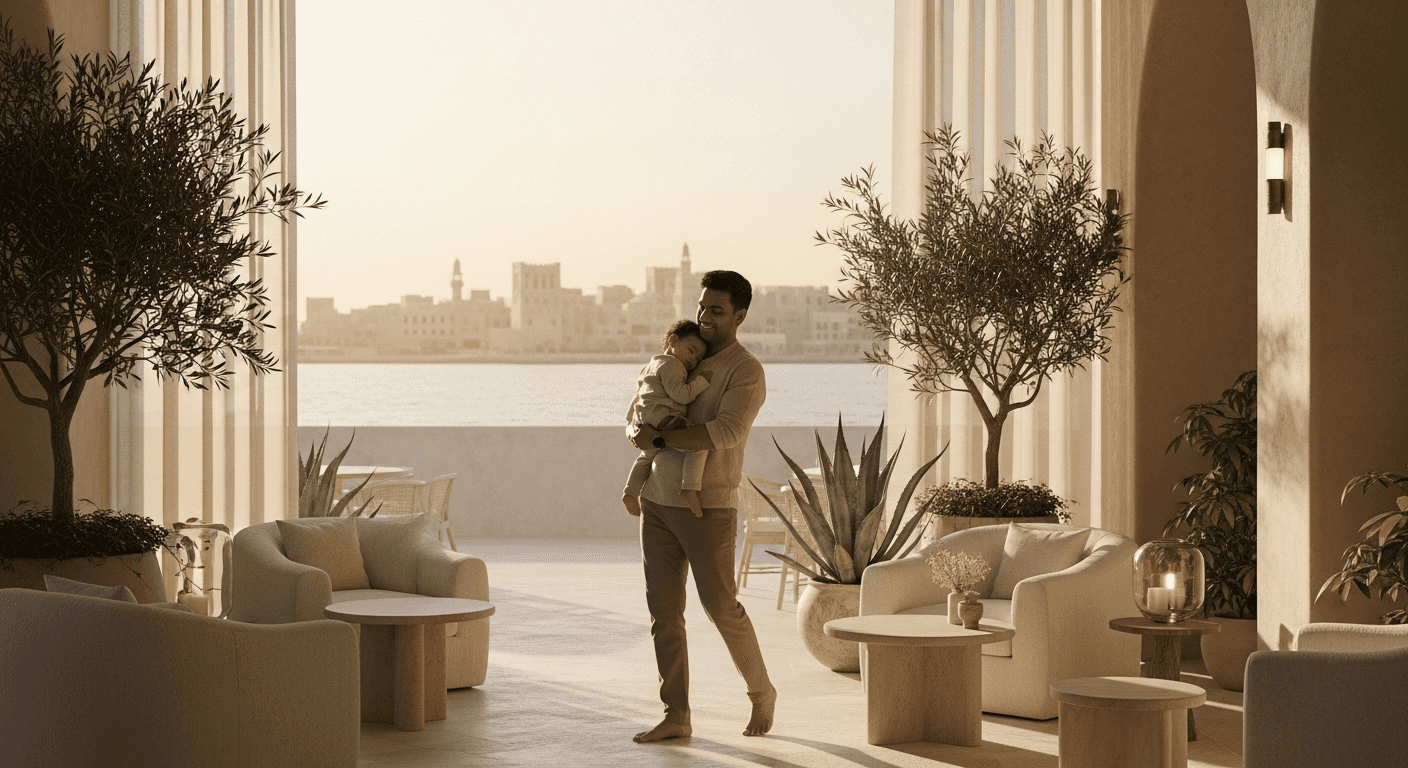
Living History: The Allure of Old Dubai Property
Beyond the skyscrapers lies the soul of the city. I'll guide you through the unique appeal of Dubai's heritage neighbourhoods, from the restoration challenges to the profound lifestyle rewards.

In a city defined by the future, a select few are turning to the past, seeking a connection that glass and steel cannot provide. This is a look at living within Dubai's history, a world away from the familiar skyline.
Here's what we'll explore:
- The soul of the city: Why traditional Dubai communities offer a different kind of luxury.
- Defining 'Heritage': What qualifies a property as historic in Dubai?
- A tour of key districts: Al Fahidi, Al Shindagha, and the hidden residential pockets of the souks.
- The ownership puzzle: Navigating freehold rules, leaseholds, and the reality for expat buyers.
- The restoration challenge: Balancing authentic preservation with modern comfort.
- The real numbers: A transparent look at the costs of buying and maintaining a piece of history.
- The lifestyle dividend: What daily life is truly like in Dubai's cultural heart.
- My final verdict: Is a heritage home a wise move for you?
Introduction: Beyond the Glass and Steel
I often tell my clients that to truly understand Dubai, you need to experience two walks. The first is at night, through the canyons of light and ambition that form Dubai Marina or Business Bay, where the future feels not just visible but tangible. The second walk is at dawn, through the silent, sandy-hued alleyways of the Al Fahidi Historical Neighbourhood. Here, the air is different. It’s cooler, softer, and carries the scent of history, of saltwater from the nearby Creek, and the faint, lingering aroma of spices from the souks. This is where the story of modern Dubai began, and for a discerning few, it's where their own Dubai story finds its most meaningful chapter.
For years, the conversation around Dubai real estate has orbited around superlatives: the tallest, the newest, the most luxurious. Yet, a quieter, more profound trend is taking hold. It is a search for authenticity, for a sense of place that transcends the latest architectural marvel. This has ignited interest in the rare and precious commodity of Old Dubai property. These are not just assets to be bought and sold on a spreadsheet; they are pieces of a collective memory, homes that carry the weight and wisdom of the past. Buying one is less a transaction and more an act of stewardship.
The appeal of heritage homes Dubai lies in their profound contrast to the city's prevailing aesthetic. Instead of floor-to-ceiling glass, you find thick, coral-block walls that breathe with the climate. Instead of a balcony overlooking a superhighway, you find a secluded inner courtyard, open to the sky, that serves as the tranquil heart of the home. It’s a different definition of luxury — one measured in character, narrative, and a connection to the very origins of this incredible city. In my work at Gaia Living, I meet many people drawn to Dubai for its dynamism and opportunity, but a special few are looking for its soul. And more often than not, they find it here, by the Creek.
What Defines a 'Heritage Home' in Dubai?
 Featured project
The term 'heritage home' is often used loosely, but in Dubai, it carries a specific weight and is protected by official designation. A true heritage property isn't just old; it’s a building of architectural and historical significance, formally recognized and preserved under the careful watch of the Dubai Municipality's Architectural Heritage and Antiquities Department. These are structures that tell the story of the region's pre-oil era, built by merchants and pearl divers from the materials the land and sea provided. They are the physical embodiment of Emirati culture and ingenuity.
The architectural language is distinct and deeply functional. The most iconic feature is the *barjeel*, or wind tower, a brilliant feat of natural air conditioning that catches the prevailing winds and funnels cool air down into the living spaces. The layout typically revolves around a central courtyard, a private, shaded open-air room that provided ventilation, light, and a secure space for family life away from the public gaze. The walls themselves are part of the story, often constructed from *faroush*, a type of sea stone or coral block, mixed with gypsum and clay. You can still see the fossilized imprints of marine life in these walls, a direct link to the Creek that was the city's lifeblood. Roofing was made from palm fronds (*arish*) and mangrove poles, and intricately carved teak wood was used for doors and decorative screens.
It is vital to distinguish these authentic, protected buildings from modern developments that adopt a 'neo-traditional' style. Areas like Souk Al Bahar in Downtown Dubai or certain villa communities are designed with arches, earthy tones, and wind tower motifs. They offer a nod to the past, but they are contemporary structures with concrete frames and central AC. A true heritage home is a different proposition entirely. Its preservation is governed by strict regulations that dictate everything from the type of plaster you can use to the colour you can paint the shutters. The goal is not imitation but conservation, maintaining the building's historical integrity for future generations. This distinction is the single most important factor in understanding the market for traditional Dubai communities.
A Tour of Traditional Dubai Communities
To appreciate the lifestyle these properties offer, you must walk the streets. Dubai's historical heart is not a single, monolithic zone but a collection of distinct districts, each with its own character and rhythm. The experience of living in one differs greatly from the others, and understanding this is key to appreciating the cultural district property Dubai has to offer.
First and foremost is the Al Fahidi Historical Neighbourhood, previously known as Bastakiya. To me, this is the jewel in the crown. It's a beautifully preserved labyrinth of narrow lanes (*sikkas*) designed to create shade and encourage airflow. The area has been thoughtfully repurposed into a vibrant cultural hub. Here, historic merchant houses have become boutique art galleries, quaint guesthouses like the XVA Art Hotel, and quiet cafes where you can sit in a leafy courtyard and feel a century away from the city's bustle. Al Fahidi living is about quiet contemplation, artistic immersion, and a deep sense of peace. It's an almost pedestrian-only enclave where the primary sounds are birdsong and the distant call to prayer. The properties here are the most sought-after, representing the pinnacle of heritage home ownership.
Just across the Creek, accessible by a one-dirham abra ride, lies the Al Shindagha Historical District. This area has a more official, monumental feel. It was historically the residence of the ruling Al Maktoum family, and the home of the late Sheikh Saeed Al Maktoum is a centrepiece. Today, Shindagha is a world-class museum district, with beautifully restored buildings housing institutions like the Perfume House and the Saruq Al-Hadid Archaeology Museum. While many buildings are part of the public museum complex, the surrounding area contains historic residences that share this incredibly rich context. Living here means being immersed in the official narrative of Dubai's history, with the waterway and its bustling boat traffic as your front yard.
Finally, there are the residential pockets within and surrounding the Deira and Bur Dubai souks. This is heritage living at its most raw and vibrant. Imagine a home situated above a fragrant spice shop or a glittering textile store. This is not the serene, curated experience of Al Fahidi. It's loud, energetic, and deeply connected to the city's commercial pulse. It's a life lived in the thick of it all, where your neighbours are shopkeepers who have been there for generations and your daily errands involve haggling for saffron and navigating handcarts loaded with goods. For the right person, this is the most authentic urban experience Dubai can offer, a world away from the manicured lawns of suburban villas.
The Intricacies of Ownership: A Critical Hurdle
This is the point in the conversation where romance meets reality. For all their charm and cultural significance, owning a piece of Old Dubai is legally complex, particularly for non-GCC nationals. It's a subject we at Gaia Living approach with absolute clarity, as misunderstanding the rules can lead to profound disappointment. The primary issue is that the vast majority of Dubai's historic districts are not located within the freehold zones designated by the government.
As a rule, freehold ownership — where a buyer owns the property and the land it sits on outright, is restricted to specific areas in Dubai. You can find the official maps and regulations on the Dubai Land Department (DLD) website. The historic hearts of Bur Dubai and Deira predate this system and largely fall outside its boundaries. For Emirati and other GCC nationals, the path to owning a heritage property is more straightforward, though it is still subject to all the heritage preservation laws and approvals from Dubai Municipality. The sale process is often private and discreet, handled between families or through specialist agents.
For the expat buyer, this presents a significant barrier. The dream of purchasing a 150-year-old courtyard house in Al Fahidi and calling it your own is, in most cases, not legally possible through direct freehold title. So, what are the options? In some jurisdictions, long-term leasehold structures like a *Musataha* right (which grants the right to develop or use a piece of land for a set period) can provide a form of tenure, but these are exceptionally rare for individual historic homes. The reality is that the most direct route for an expat to 'own' in this context is often through a modern property that happens to be located nearby.
This is the practical, pragmatic solution we often explore with clients who love the Old Dubai aesthetic. There are numerous freehold apartment buildings in Bur Dubai, for example, that place you within walking distance of the souks and the Creek. A more contemporary interpretation can be found in newer master-planned communities. A project like Emaar Properties' Dubai Creek Harbour is a prime example. While it consists of modern towers, its master plan is oriented towards the historic Creek, offering incredible views and a lifestyle that connects with the old city via water taxis, all while providing the security of a straightforward freehold title. This 'heritage-adjacent' strategy allows one to enjoy the cultural richness of Old Dubai without the legal and logistical complexities of owning a protected building.
The Art and Science of Restoration
Let’s imagine for a moment that you are one of the fortunate few who can acquire a heritage property. The purchase is merely the first step in a long and rewarding journey: the restoration. This is not a simple renovation project; it is a meticulous process that is part archaeology, part artistry, and governed by strict regulations. The guiding principle is authenticity. The goal is to return the building to its former glory while sensitively integrating the comforts of modern life. It's a task that requires patience, significant capital, and a deep respect for the building's character.
Everything begins and ends with the Dubai Municipality. Before a single tool is lifted, you must secure a No Objection Certificate (NOC) for the proposed work. This involves submitting detailed plans that show how you will preserve the historical integrity of the structure. You cannot simply knock down a wall to create an open-plan living space or replace traditional windows with large panes of glass. Every detail, from the composition of the wall plaster to the design of the wooden doors, is scrutinized. The authorities are not being obstructive; they are acting as guardians of a finite cultural resource.
One of the greatest challenges is sourcing the right materials and craftsmen. The original coral stone is no longer harvested from the sea. Restoration often relies on reclaimed materials or specialised substitutes approved by the heritage department. Finding masons who know how to work with traditional gypsum plaster or carpenters skilled in carving intricate latticework (*mashrabiya*) requires a deep network of contacts. This is not a job for a standard contractor accustomed to building concrete villas. It demands specialists who understand the old ways of building, who know how a *barjeel* functions and how to repair a palm-frond roof. This expertise comes at a premium.
Then comes the delicate dance of integrating modern amenities. How do you install air conditioning without disfiguring the building with visible ducts and units? The solution often involves clever concealment — running ductwork through thickened floor cavities or custom-built cabinetry. How do you provide high-speed internet, modern plumbing, and sophisticated lighting systems without chasing wires and pipes across priceless 150-year-old walls? It requires immense creativity and surgical precision from architects and engineers. The most successful restorations are those where the modern conveniences are felt but not seen, allowing the soul and texture of the original building to remain the hero.
Counting the Cost: The Financial Reality of a Heritage Property
This is where the dream is stress-tested against a budget. The financial commitment of acquiring and maintaining a heritage home is substantial and differs significantly from a standard property purchase in Dubai. There are no public price lists or easy comparables for these unique assets. Sales are rare, often private, and the price is determined by a unique combination of size, location, condition, and that intangible quality — historical significance. A small, beautifully restored courtyard house in a prime Al Fahidi location could, hypothetically, command a price anywhere from AED 5 million to over AED 15 million, but this is a highly speculative estimate for an exceptionally scarce asset class.
For a more accessible and quantifiable example, let's consider the 'heritage-adjacent' strategy: buying a modern freehold property in an area like Bur Dubai. This provides a clear financial picture. Here is a realistic, line-by-line breakdown of the upfront costs for a hypothetical two-bedroom apartment priced at AED 2,000,000:
- Purchase Price: AED 2,000,000
- Dubai Land Department (DLD) Transfer Fee: 4% of purchase price = AED 80,000
- Real Estate Agency Fee: 2% of purchase price + 5% VAT = AED 42,000
- DLD Registration Trustee Fee: Approximately AED 4,200 (including VAT)
- Title Deed Issuance Fee: Approximately AED 580
- NOC Fee from Developer: Varies, typically AED 500 - AED 5,000
- Mortgage Registration Fee (if applicable): 0.25% of loan amount
- Total Estimated Upfront Cost (without mortgage): Approximately AED 2,127,780
This is a clear, predictable path. Financing is also more straightforward. Under Central Bank of the UAE regulations, first-time expat buyers can typically borrow up to 80% of the property's value, though securing a mortgage on a true, designated heritage property would be a far more complex negotiation with a lender, who may be wary of the unique nature of the asset.
Ongoing costs also diverge. A modern apartment will have a predictable annual service charge, perhaps AED 15-25 per square foot, covering building maintenance, security, and amenities. For a heritage home, there is no service charge. You are the sole party responsible for the upkeep. A leaking roof, a crack in the ancient coral wall, or sourcing a specialist to repair a carved teak door — these are unbudgeted, potentially very high costs that fall directly on the owner. The restoration itself can easily cost millions of dirhams, sometimes far exceeding the original purchase price. This is not an investment for the faint of heart or the light of wallet.
The Lifestyle Dividend: A Day in the Life
After navigating the complexities of ownership and cost, what is the reward? It is a quality of life that is, in my opinion, unmatched in Dubai. It’s a dividend paid not in rental yield, but in daily experiences. Imagine waking not to the hum of an eight-lane highway, but to the sound of doves cooing in your courtyard and the distant chime of an abra's bell on the Creek. Your morning coffee isn't on a small balcony but in your own private, open-air sanctuary, with the sky as your ceiling and the textured walls of your home enclosing you in serene privacy.
Your commute can be a walk. Instead of getting into a car, you stroll through shaded sikkas to a meeting at a nearby gallery or take the abra across the water to the spice and gold souks. The neighbourhood is your amenity. You don't need a soulless community centre gym when your daily constitutional is a walk through a living museum. The community here is real and deeply rooted. You build relationships not just with other residents but with the shopkeepers, the artists, and the boat captains whose families have been there for generations. There is a texture to social life that is impossible to replicate in a modern tower.
“You don't just own the walls; you become a custodian of a story. That's a responsibility and a privilege far beyond what any glass tower can offer.”
Of course, it's essential to be realistic. This romantic picture has its practical counterpoints. Parking is a constant challenge. During peak tourist season, your quiet lane can become crowded. You won’t find a temperature-controlled Olympic swimming pool or a state-of-the-art gym just an elevator ride away. In the height of summer, the walk to the Metro station can feel long. Life in a heritage home requires a trade-off: you exchange the smooth, friction-free convenience of modern developments for something deeper, more soulful, and infinitely more memorable. It's a choice to live a life with more texture, even if it means a little more effort.
My Verdict: Is a Heritage Home Right for You?
After weighing the unique beauty against the significant hurdles, my conclusion is clear. The decision to pursue a heritage home Dubai is less a financial calculation and more a question of identity and purpose. It is not a move for everyone, and it shouldn't be. These properties are finite treasures, and they belong with those who will cherish them most.
Who is the ideal buyer? In my experience, it is a person for whom the story of the home is as valuable as the structure itself. Often, they are Emirati or GCC families with a deep personal connection to the history of the area, seeking to preserve a piece of their own lineage. It could be a cultural philanthropist, an artist, or a historian who sees the home not as a residence but as a passion project, a legacy to be protected. This buyer is patient, well-capitalized to handle the demanding restoration, and sees the property's value in cultural, not purely monetary, terms. They are not looking for a 7% ROI; they are looking for a 100% return on the soul.
For the vast majority of buyers, including most expats I work with at Gaia Living, this path is impractical. But that does not mean the dream of living with history is out of reach. The far more sensible and accessible strategy is to embrace the 'heritage-adjacent' approach. Buy a modern, freehold apartment or townhouse in a location that offers a direct connection to these cultural districts. Consider the older freehold buildings in Bur Dubai or Deira. Look at the new, exciting developments reshaping the Creek's shoreline, like Dubai Creek Harbour, which consciously blends futuristic living with a reverence for the waterway that started it all. This approach gives you the best of both worlds: the security and convenience of modern ownership and the daily joy of being connected to the city's historic heart.
Owning a true Old Dubai property is a rare and complex pursuit, best suited for passionate custodians with a deep connection to the UAE's history. For most buyers, the smarter play is to purchase a modern freehold home on the periphery of these districts, enjoying the culture without the significant legal and financial hurdles.
## Sources - Dubai Land Department (DLD): https://dubailand.gov.ae/en/#/ - Central Bank of the UAE: https://www.centralbank.ae/en/ - Dubai Municipality: https://www.dm.gov.ae/ - UAE Government Portal: https://u.ae/en
Questions, answered
- Can a foreigner buy a heritage home in Old Dubai?
- Generally, no. Most historic areas like Al Fahidi are not designated freehold zones, meaning direct ownership is restricted to GCC nationals. Expats often buy modern freehold properties in adjacent areas like Bur Dubai or Creek Harbour to enjoy the proximity to these cultural districts.
- What are the renovation rules for a historic property in Dubai?
- Renovations are strictly controlled by the Dubai Municipality's Architectural Heritage and Antiquities Department. Owners must obtain a No Objection Certificate (NOC) for any work, and all modifications must preserve the building's authentic character, using traditional materials and techniques.
- Are heritage homes in Dubai a good investment?
- They are more of a passion project than a typical investment. While their scarcity gives them immense cultural value, the market is illiquid, restoration costs are high, and rental yields are not competitive with modern properties. The 'return' is primarily in the unique lifestyle and the privilege of owning a piece of history.
- What are the main heritage neighbourhoods in Dubai?
- The primary heritage neighbourhoods are the Al Fahidi Historical Neighbourhood, the Al Shindagha Historical District by the Creek, and the residential areas surrounding the Deira and Bur Dubai souks. These areas form the heart of what is known as 'Old Dubai'.
- How much does it cost to maintain a heritage home in Dubai?
- Unlike modern apartments with predictable service charges, maintaining a heritage home involves direct, often unpredictable costs for specialist repairs. Sourcing authentic materials and skilled craftsmen can be very expensive, and ongoing upkeep can be significantly higher than for a new-build property.
- Can I get a Golden Visa by buying an Old Dubai property?
- Yes, if the property meets the minimum investment threshold (currently AED 2 million) and you can legally own it. For most expats, this would apply to a modern freehold property near a heritage area, rather than a restricted historic building itself.

Yusuf writes about how Dubai actually lives — waterfront mornings, community dining, walkability, and the lifestyle premium built into an address.
Related stories
Dubai's Established Charm: The Case for Older Homes
In a city focused on the future, I believe the smartest move for many buyers is to look back. Dubai's seasoned communities offer space, character, and surprising value that new builds often can't match.
The True Cost of Owning a Dubai Property
Beyond the purchase price, your annual budget for a Dubai home must account for service charges, utilities, and maintenance. I'll break down every ongoing expense you need to plan for.
Calculating ROI on Dubai Rental Upgrades
As a landlord in Dubai, you can't just follow trends. I'll show you how to calculate the precise ROI of minor property upgrades to genuinely increase your rental yield.
Echoes, in your inbox
One thoughtful email a month. Market insight, new launches, no spam.