

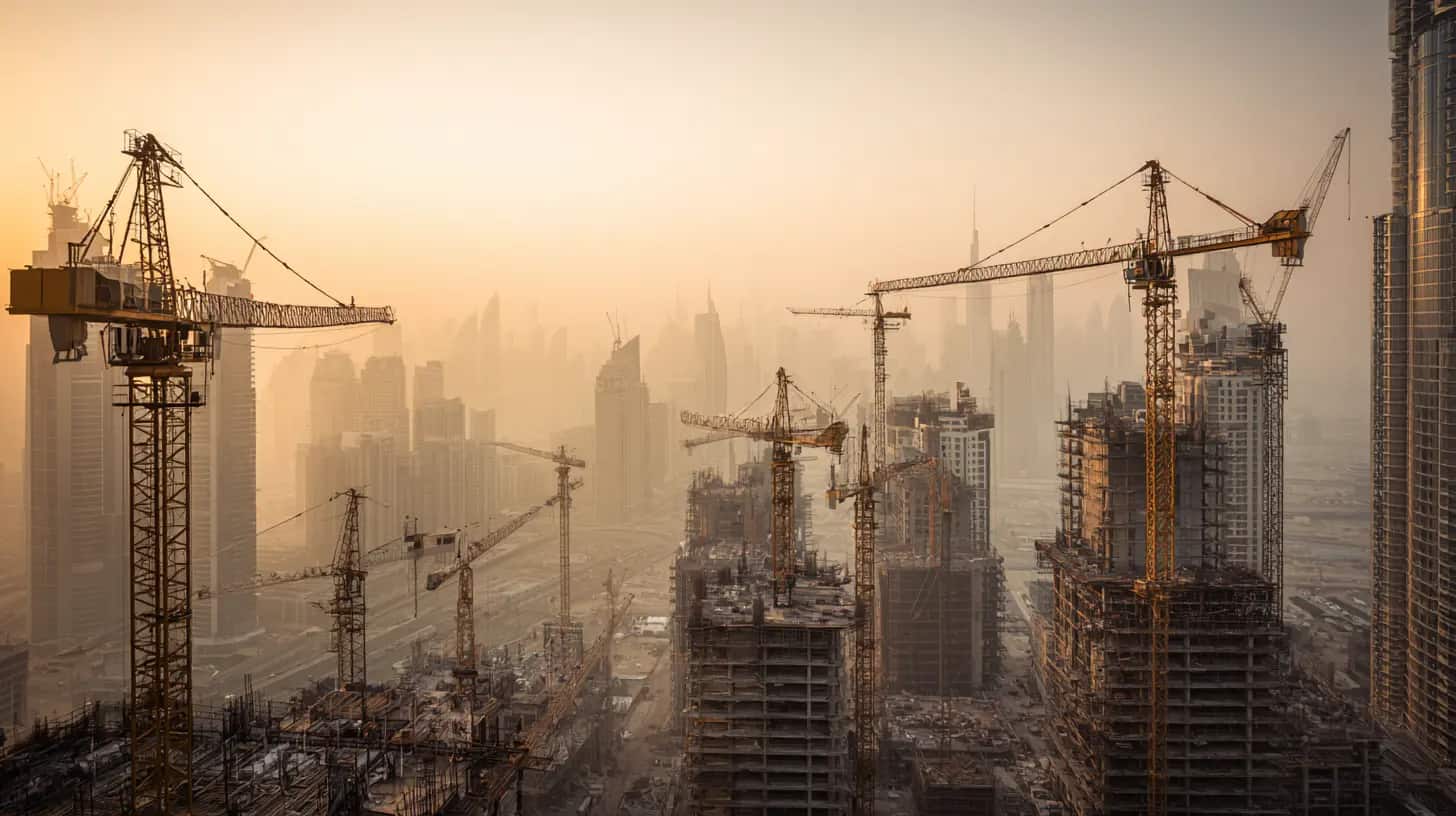
Is Dubai Building Too Much? The Oversupply Question Nobody Wants to Answer in 2026
Dubai's pipeline hits 70,000+ units annually through 2027. Here's the honest area-by-area assessment of where oversupply risk is real and where it isn't.
Nobody in Dubai's property industry wants to talk about the threat of oversupply. Developers have buildings to sell. Agents have sales targets to achieve. The government needs to protect its story about its economy. Therefore, the question - is Dubai building too much? - is asked only in hushed tones and almost never answered publicly.
We are going to give you our answer. It may not be necessarily shocking but certainly not a story that you want to hear. After all, people tend to make less rational decisions when basing themselves on half-truths.
First of all, the scale of construction in Dubai cannot be understated. Based on the data from Dubai Land Department's 2024 Pipeline Report, it is anticipated that around 70,000 to 80,000 new units will hit the market per annum in 2025-2027. If such levels of completion continue for the three subsequent years, this will be by far the most aggressive cycle of construction in Dubai's history. To put this into context, the total number of Dubai residential real estate transactions in 2024 stands at approximately 180,000. Hence, the annual number of completions represents almost 40% of total transactions during any particular year.
It is quite a large amount. The question of whether it is dangerous or not comes down to demand-side dynamics, the geographical locations that absorb the new completions, and whether the new projects come to completion as predicted or fall into later periods. All of these factors do matter and none of them offers an easy answer to the oversupply problem.
In this article, we examine the Dubai property sector oversupply issue from every possible perspective - supply numbers, demand numbers, geographical locations, the previous oversupply experience of the Dubai real estate market, and a critical look at which segments are at risk and which are safe. All prices are in AED.
The Supply Pipeline: What's Actually Coming
Understanding the oversupply question starts with understanding what "supply pipeline" actually means in Dubai's context — because the headline number is often misread.
The 70,000 to 80,000 annual completion figure:
This is the number of units that developers have registered with RERA as targeted for handover in a given year. It is not the number that will actually complete on time. Dubai's track record on construction timelines — as covered in previous articles — shows average delays of 8 to 19 months against contracted handover dates depending on the developer. In practice, the actual annual supply hitting the market in any given year is typically 60% to 75% of the registered pipeline.
Applying that adjustment to the 2025 to 2027 pipeline: realistic annual new supply is closer to 45,000 to 60,000 units per year. Still significant. Still worth examining. But materially different from the headline number.
Where is the supply concentrated?
The supply pipeline is not uniformly distributed across Dubai. It's concentrated in a small number of areas — and this concentration is the most important fact in the oversupply analysis.
Based on RERA project registration data and developer announcements through early 2025:
- Jumeirah Village Circle and surrounding areas (JVT, JVC, Arjan): approximately 25% to 30% of the total pipeline
- Dubai South and Exhibition District: approximately 15% to 18%
- Business Bay and Downtown fringe: approximately 10% to 12%
- Dubai Creek Harbour and surrounding master developments: approximately 8% to 10%
- Mohammed Bin Rashid City: approximately 8% to 10%
- Dubai Marina, JBR, Palm Jumeirah, Downtown core: collectively less than 10% of new supply
This distribution tells you something important: the areas with the greatest oversupply risk are the mid-market master communities — JVC, Dubai South, the outer areas — not the prime established neighbourhoods. Palm Jumeirah, Downtown Dubai, and Dubai Marina are supply-constrained by geography and planning regulations in ways that JVC simply isn't. The oversupply risk is real but it's specific.
According to CBRE's UAE Real Estate Market Outlook 2024, the pipeline concentration in mid-market areas represents the most significant supply risk in Dubai's residential market — with the premium and ultra-prime segments facing continued supply scarcity that supports pricing even as mid-market areas absorb significant new stock.
The Demand Side: Can Dubai Actually Absorb This?
Supply is only a problem if demand doesn't keep pace. The demand analysis is where the honest picture gets genuinely complicated.
The population growth argument:
Dubai's population grew from approximately 3.3 million in 2020 to approximately 3.8 million by end of 2024 — a net increase of 500,000 people in four years. At an average household size of 3.2 people in Dubai's mixed residential market, that population growth implies demand for approximately 156,000 new housing units over the period — roughly 39,000 per year.
New supply delivered over the same period ran approximately 35,000 to 45,000 units per year based on actual completions (not registered pipeline). Population-driven demand and supply have therefore been broadly in balance over the recent period — explaining why prices continued rising despite significant construction activity.
The forward demand question:
The question is whether population growth continues at the same pace through 2025 to 2027 as the largest pipeline in Dubai's history completes. This is genuinely uncertain. Population growth depends on:
- UAE visa policy remaining favourable to expat workers and investors — currently supportive but subject to change
- Regional geopolitical stability — ongoing conflicts in the broader MENA region have contributed to capital and population inflows that could reverse if stability improves elsewhere
- Global economic conditions affecting the pool of internationally mobile workers who represent Dubai's primary demand base
- Competition from other emerging hubs — Saudi Arabia's NEOM and broader Vision 2030 infrastructure, Oman's growing attractiveness, and other Gulf states investing in residency and investment attraction
The investor demand question:
A significant proportion of Dubai's recent transactions — particularly in the off-plan segment — have been investor purchases rather than owner-occupier purchases. When investors buy, they either rent out (adding to rental supply) or hold vacant (no immediate impact on occupancy). The ratio of investor to owner-occupier purchases in Dubai's market is higher than in most comparable markets and creates a dynamic where transaction volume can remain strong even as actual occupancy demand is more modest.
This investor concentration is the most significant demand-side risk in the oversupply analysis. If a large proportion of the new supply pipeline has been purchased by investors who then rent out simultaneously, the rental market in the affected areas absorbs a surge in supply that can take 12 to 24 months to digest — during which rents soften and yields compress.
We tracked rental listings in JVC from Q1 2024 to Q4 2024 using DLD data and property portal active listings. Available rental units in JVC grew 22% over that period while absorbed rental units (new tenancies signed) grew 14%. The gap — 8 percentage points of unabsorbed supply growth — is not a crisis but it is visible. Rents in JVC softened approximately 3% to 5% in the second half of 2024 after several years of consistent growth. This is what early-stage oversupply looks like in a specific area — gradual, not dramatic.
The Historical Precedent: Dubai's Previous Oversupply Cycles
Dubai has been through two significant oversupply-driven corrections in its recent history. Understanding them is essential context for evaluating the current situation.
The 2008 to 2012 cycle:
The global financial crisis triggered a collapse in Dubai property prices of 50% to 60% in some areas between 2008 and 2011. Oversupply was a significant contributing factor — a massive construction pipeline launched during the 2005 to 2008 boom continued completing into a market where demand had evaporated almost overnight. Developers went bankrupt. Projects were cancelled. Buyers lost deposits. It was the most severe property market correction of any major global city over that period.
The 2014 to 2020 cycle:
A more gradual correction — prices fell approximately 35% between 2014 and 2020. The causes were more complex: a combination of oversupply (again, a large pipeline completing into a softening market), the oil price crash of 2014 to 2016 affecting regional wealth, the strengthening USD making Dubai more expensive for non-dollar investors, and the introduction of regulatory fees that increased transaction costs.
What's different in 2026:
Several structural factors differentiate the current situation from the previous cycles — though they don't eliminate risk entirely.
Regulatory framework improvements: RERA's escrow requirements, the registered developer framework, and improved consumer protection for off-plan buyers mean that a market correction today is less likely to involve the developer bankruptcies and deposit losses that characterised 2008 to 2012.
Demand diversification: Dubai's buyer base in 2026 is more internationally diverse than in either previous cycle. Indian, Russian, Chinese, European, and American buyers participate alongside the traditional Gulf Arab and British expat base. A shock that reduces demand from one group is less likely to simultaneously reduce demand from all groups.
Population stickiness: the Golden Visa programme and the long-term residency reforms have made a portion of Dubai's population more committed to staying than the transactional expat model of previous cycles. More sticky residents means more durable rental demand even if transaction volumes soften.
Lower leverage: a higher proportion of Dubai buyers in the current cycle are cash buyers or using developer payment plans rather than bank mortgages. Lower leverage means fewer forced sellers in a downturn — which dampens the pace and depth of corrections.
What hasn't changed:
Dubai remains a market where a significant proportion of buyers are investors rather than owner-occupiers. And investors are procyclical — they buy in rising markets and sell in falling ones. If sentiment shifts, investor demand can reverse quickly and the correction can be faster than the population or employment fundamentals would suggest.
Area-by-Area Oversupply Risk Assessment
Not all of Dubai is equally exposed. Here's an honest assessment by area.
High oversupply risk:
Jumeirah Village Circle, Jumeirah Village Triangle, Arjan, and the surrounding mid-market master community areas face the most significant supply pressure. The pipeline here is large, the product is relatively undifferentiated (similar one and two-bedroom apartments in similar buildings), and the buyer base is heavily investor rather than owner-occupier. Rents have already shown early signs of softening. Capital growth in these areas is likely to be modest over the 2025 to 2027 period as new supply absorbs.
Dubai South is a longer-term story. The Al Maktoum International Airport expansion is a genuine long-term demand driver but the timeline is measured in decades, not years. Near-term supply in Dubai South significantly exceeds near-term organic demand and yields in the area reflect that — they're high because prices are low, not because rents are strong.
Moderate oversupply risk:
Business Bay and Dubai Creek Harbour are receiving significant new supply but have more genuine owner-occupier and corporate tenant demand to absorb it. Rents may soften modestly but the areas' genuine lifestyle and location credentials support demand in ways that JVC's more generic product doesn't.
Mohammed Bin Rashid City is a premium product in a location that doesn't yet have the amenity and transport infrastructure to match the price premium. New supply here may test buyer depth in ways the launch sales didn't reveal.
Low oversupply risk:
Dubai Marina, Downtown Dubai, and Palm Jumeirah face minimal oversupply risk. These areas are geographically constrained — you cannot meaningfully add to the supply of beachfront apartments in Dubai Marina or Burj Khalifa-facing units in Downtown. New supply in and around these areas is limited and absorbed quickly. The demand is genuine, the tenant base is deep, and international buyer interest in the trophy addresses remains strong.
Emirates Hills, Jumeirah Golf Estates, and the premium villa communities face similar supply scarcity — land constraints and planning regulations limit new development in a way that mid-market apartment areas don't experience.
The nuanced middle:
Dubai Hills Estate is in an interesting position. High-quality product in a well-planned master community with genuine owner-occupier appeal — but significant new supply still coming. The mid-to-upper price point means the buyer base is less purely investor than JVC, which is a buffer against the worst oversupply outcomes. Expect modest appreciation and stable yields rather than the stronger performance of genuinely supply-constrained areas.
Ravi Menon, head of research at Colliers International UAE and one of the more consistently accurate market analysts in the Dubai property space, has noted publicly that the Dubai market in 2025 and 2026 is best understood as several different markets rather than one — with supply-constrained premium areas and oversupplied mid-market areas moving in meaningfully different directions simultaneously. Treating "Dubai property" as a single asset class in this environment produces misleading conclusions.
Browse our current Dubai property listings across all areas — the supply risk profile varies significantly between what we currently have available, and our team can advise on which areas we'd approach with more caution right now.
What Oversupply Actually Looks Like When It Happens
Oversupply in residential property markets doesn't usually look like a cliff edge. It looks like a gradual softening that accelerates if broader conditions deteriorate.
The typical sequence:
Rental supply increases as new units complete and investor-owned properties hit the leasing market simultaneously. Rental vacancy rises modestly. Landlords who need to fill units start offering incentives — a month free, lower deposits, more flexible payment terms. Asking rents soften by 3% to 8% in affected areas. Rental yield compression follows as rents fall while purchase prices hold (or hold longer than rents do, because sellers are slower to adjust than landlords).
Then one of two things happens. Either demand catches up — population growth, new employment, tenant formation — and the market rebalances without a significant price correction. Or broader economic conditions weaken, reducing the inflow of new residents and triggering investor selling as yield compression makes the investment case less compelling. The second scenario is what produces a genuine correction.
Current indicators to watch:
Rental vacancy rates in JVC and Dubai South — these are the canary in the coal mine. If vacancy rates in the high-supply areas climb above 10% to 12%, it signals that supply is genuinely outrunning demand absorption.
Off-plan resale discounts — if buyers of off-plan units are unable to assign at a premium to their purchase price and instead have to offer discounts to find buyers, it indicates that the market's expectation of price appreciation during construction is no longer being met.
Handover completion rates — if a significant proportion of buyers at handover are unable or unwilling to pay the final balance (requiring mortgage approvals that don't come through, or simply walking away from deposits), it signals financial stress in the buyer base.
None of these indicators are currently flashing red in Dubai's market as a whole. In specific mid-market areas, some early-stage signals are visible. The situation deserves monitoring rather than panic.
The Developer Response: Are They Slowing Down?
One of the most important questions in the oversupply analysis is whether the developers who launched the pipeline are responding to early softening signals by moderating new launches. The historical Dubai pattern has been to keep launching until a correction forces a stop — by which point the damage is already in the ground.
The current picture is mixed. Several major developers — Emaar in particular — have been deliberate about sequencing new phases and managing supply in their premium developments. Others — including some newer developers who entered the market during the 2021 to 2023 boom — are continuing to launch at pace regardless of the absorption data.
What responsible developers are doing differently:
- Phasing master community launches to match demonstrated absorption rather than launching entire communities at once
- Maintaining stronger construction escrow requirements to reduce the risk of uncompleted projects adding to the inventory of disappointed buyers
- Focusing new product on differentiated segments — branded residences, large format units, specific lifestyle propositions — rather than undifferentiated mid-market stock
What the launch calendar still shows:
A significant volume of new project launches is continuing in 2025 and into 2026. The pipeline has not meaningfully contracted despite early signs of softening in the mid-market segments most affected by previous launches. This is the part of the oversupply story that warrants the most honest attention.
Questions and Answers About Dubai Oversupply
Is Dubai actually oversupplied right now?
In specific mid-market areas — particularly JVC, Dubai South, and some of the outer master communities — early supply pressure is visible in rental data and yield compression. Prime areas like Dubai Marina, Downtown, and Palm Jumeirah face no meaningful oversupply. The market is not uniformly oversupplied — it's selectively oversupplied in specific segments.
How many new units is Dubai delivering per year?
The registered RERA pipeline suggests 70,000 to 80,000 annual completions through 2027. Historical delay patterns reduce actual deliveries to 45,000 to 60,000 per year. Population growth has been generating demand for approximately 35,000 to 45,000 new units annually. Supply and demand are in moderate imbalance in some areas.
Which areas face the most oversupply risk?
JVC, JVT, Arjan, Dubai South, and some of the outer master community areas. These have the largest pipelines, the most undifferentiated product, and the heaviest investor-buyer concentration. Dubai Marina, Downtown, and Palm Jumeirah face the least risk.
Did Dubai have an oversupply problem before?
Yes — twice significantly. A 50% to 60% price correction following the 2008 boom, and a 35% correction from 2014 to 2020. Both involved large construction pipelines completing into weakening demand. The structural protections are better now but the pattern is worth understanding.
Will Dubai property prices fall because of oversupply?
In supply-pressured mid-market areas, modest price softening and yield compression is likely through 2025 to 2027. A significant correction requires a simultaneous demand shock — reduced migration, broader economic weakness, or a shift in investor sentiment. That risk exists but isn't currently the central scenario.
Is it a bad time to buy in Dubai because of oversupply?
Depends entirely on where you're buying and why. Buying in a supply-constrained premium area with genuine lifestyle credentials and a long-term hold horizon — reasonable. Buying in a high-supply mid-market area expecting capital growth in the next two to three years — higher risk. Buying anywhere with a short-term flip thesis — most exposed to oversupply risk.
How does the current pipeline compare to the 2008 boom?
The current pipeline is large but the financing structure is different — more cash and developer payment plan buyers, fewer leveraged speculators. The regulatory framework is stronger. Developer financial positions are generally healthier. The conditions for a 2008-style collapse are not currently present — but the conditions for a moderate mid-market correction are visible.
What should off-plan buyers in high-supply areas do?
Extend their hold horizon. Don't plan on flipping before handover in a high-supply area. Buy on the assumption that you'll either hold for rental income for three to five years post-handover or that you're comfortable with a longer period before capital growth resumes. The income return in JVC remains viable at current prices and rents — the capital growth story is where expectations need adjusting.
Are there any supply-constrained areas still available at reasonable prices?
Yes. Parts of Business Bay, Jumeirah Lake Towers, and some emerging areas on the city fringe offer genuine lifestyle credentials and limited new supply at price points meaningfully below Downtown or Marina. These aren't the trophy addresses but they're not the oversupplied mid-market either.
How does Dubai's oversupply risk compare to other global cities?
Most major global cities are supply-constrained — London, Sydney, San Francisco, Singapore all have planning restrictions that limit new supply. Dubai is unusual in having both a strong demand story and a government that actively facilitates new supply. The supply response to strong demand is faster and larger in Dubai than in most comparable markets — which is both a strength (it keeps prices accessible) and a risk (it can overshoot).
What indicators would signal the oversupply is becoming a serious problem?
Rental vacancy rates in affected areas rising above 10% to 12%. Off-plan assignments trading at discounts to original purchase price. Handover defaults increasing. New project launch volumes continuing without reduction despite absorption data. None of these are at alarming levels currently — but they're the metrics worth watching.
Should I be worried about buying in Dubai right now?
Selective concern rather than general alarm. The premium market is genuinely supply-constrained and faces different dynamics from the mid-market. Buyers who are selective about area, hold for income rather than short-term capital gain, and choose well-managed buildings in areas with genuine demand credentials are in a very different position from buyers who are buying undifferentiated mid-market apartments expecting rapid appreciation.
The Bottom Line on Dubai's Oversupply Question
There is considerable development taking place in Dubai. In some locations, specifically JVC, Dubai South, and the outer master-planned developments, overdevelopment leads to an excess of near-term rental supply compared to absorptive capacity, which means there will be some form of rental softening and yield compression. This is the honest, yet rarely asked, answer.
This does not mean that a crisis is about to happen. There are real fundamentals behind the demand, such as population growth, net migration, interest from foreign investors, and the resilience generated through Golden Visas that act as a buffer against what happened in 2008 and 2014. The regulatory environment is better now. Developers are more robust. The buyer pool is also diverse.
It is necessary to manage the expectations of buyers in the mid-market segment. Rents may fall. Capital gains may stall or even decline marginally. The cash-on-cash strategy employed successfully between 2021 and 2023 will not be applicable between 2025 and 2027. Investors who buy with eyes wide open and purchase property based on realistic rental returns for a reasonable holding period will be in a very different position than individuals expecting past results to repeat in the future.
A completely new picture emerges for the premium market. Downtown, Marina, Palm Jumeirah, and Emirates Hills are facing tight supplies, genuine demand, international interest, and a strong reason to remain invested for years. The only question left is not whether investors should put money in Dubai, but where and how.
If you want an honest conversation about which areas and which buildings make sense given where the supply picture sits right now, our team has that view and is willing to share it — even when the answer involves steering you away from a launch. Get in touch and we'll take it from there.
Related stories

Dubai's Established Charm: The Case for Older Homes
In a city focused on the future, I believe the smartest move for many buyers is to look back. Dubai's seasoned communities offer space, character, and surprising value that new builds often can't match.
The True Cost of Owning a Dubai Property
Beyond the purchase price, your annual budget for a Dubai home must account for service charges, utilities, and maintenance. I'll break down every ongoing expense you need to plan for.
Calculating ROI on Dubai Rental Upgrades
As a landlord in Dubai, you can't just follow trends. I'll show you how to calculate the precise ROI of minor property upgrades to genuinely increase your rental yield.
Echoes, in your inbox
One thoughtful email a month. Market insight, new launches, no spam.