

How to Buy Off-Plan Property in Abu Dhabi: A Complete Guide for 2026
Step by step guide to buying off-plan property in Abu Dhabi — the process, real costs, risks, and how to pick the right developer before you sign anything.
The off-plan properties in Abu Dhabi are different from Dubai because the market is relatively small, with a concentration of developers, and a legal and administrative environment that works effectively but has its own procedures, regulations, and deadlines that could cause confusion to someone used to doing business in Dubai.
The benefits are considerable. Buying before construction means that prices will be cheaper than on the secondary market once the unit is finished. Payment can also be made gradually over the course of construction, instead of having to pay the entire sum upfront. This means that buying a property in one of Abu Dhabi's key freehold areas, such as Saadiyat Island, Yas Island, Al Reem Island, and Al Raha Beach, by reputable companies has usually proven profitable for early buyers, thanks to both lower prices and a good location.
Off-plan purchases are not risk-free investments, however. The buyer commits money to an unfinished project, with no guarantees about the deadline for completion and even about whether the final product will meet the initial agreement. Those who benefit most are people who have anticipated the possible pitfalls and adopted strategies accordingly, rather than those who were simply swept away in the excitement of the launch and signed contracts.
This guide will show you how to purchase off-plan properties in Abu Dhabi: a comprehensive description of the process, step-by-step, from actual prices to risk analysis, containing all the necessary information that will allow you to make an informed decision.
Understanding the Abu Dhabi Off-Plan Market
Before you look at specific projects, it helps to understand what makes Abu Dhabi's off-plan market different from other markets in the UAE — and what that means for buyers.
Abu Dhabi's off-plan market is dominated by a small number of major developers. Aldar Properties is the largest and most established — they're behind some of the emirate's most recognised residential developments including Yas Acres, Mamsha Al Saadiyat, Water's Edge, and Saadiyat Grove. Modon Properties, Eagle Hills, and a handful of international developers round out the active pipeline. The concentration is different from Dubai, where hundreds of developers are active simultaneously.
That concentration is mostly good news for buyers. Aldar in particular has a track record of delivery that gives real confidence to off-plan purchasers. Their projects complete. Their specifications hold up reasonably well. Their after-sales teams are functional. That's not something you can say about every developer in every market.
What makes Abu Dhabi's off-plan market distinct:
- Smaller developer pool means more predictable quality but less choice than Dubai
- Abu Dhabi's escrow regulations require developers to hold buyer funds in regulated accounts — similar to Dubai's framework
- Freehold off-plan is concentrated in specific investment zones — you can only buy in areas where foreign ownership is permitted
- Payment plans in Abu Dhabi tend to be slightly more conservative than Dubai — 60/40 or 70/30 splits (construction/handover) are common rather than the aggressive post-handover plans that some Dubai developers offer
- The Abu Dhabi Department of Municipalities and Transport oversees registration through the Oqood equivalent system — every off-plan purchase must be registered
- New launches in Abu Dhabi tend to sell out faster than people expect — particularly anything on Saadiyat Island where supply is genuinely constrained
The freehold zones where off-plan is available to foreign buyers:
- Saadiyat Island: premium cultural district positioning, Aldar and international developer pipeline
- Yas Island: entertainment and lifestyle anchor, predominantly Aldar-developed
- Al Reem Island: largest freehold zone by volume, mix of developers and price points
- Al Raha Beach: waterfront positioning, mid-to-premium pricing
- Al Maryah Island: financial district location, limited residential off-plan supply
- Jubail Island: newer addition to the freehold zone list, eco-focused, earlier stage
- Masdar City: sustainable urban development, niche appeal
According to the Abu Dhabi Real Estate Centre's 2024 Annual Market Report, off-plan transactions accounted for 58% of total residential sales volume in Abu Dhabi in 2024 — up from 44% in 2022. The market has clearly shifted toward off-plan as the primary buying mode, driven by payment plan flexibility and the entry price advantage over ready property.
Step by Step: How the Off-Plan Buying Process Works in Abu Dhabi
The process is more straightforward than most first-time buyers expect. Here's exactly what happens from the moment you decide you're interested to the moment you receive your keys.
Step 1: Choose your project and unit
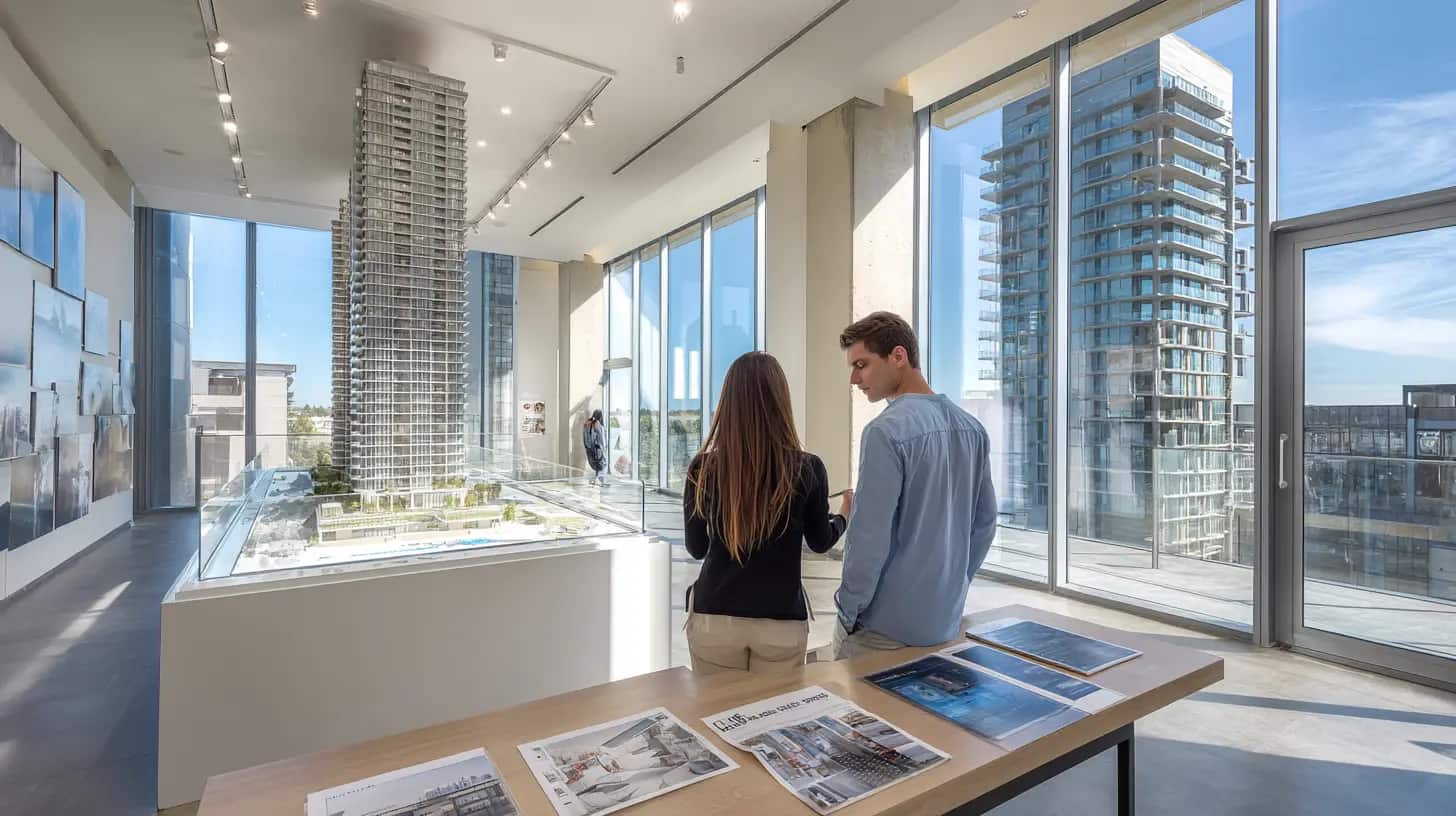
Research the developer, the location, and the specific project. Attend the launch event or sales presentation, or arrange a private briefing through your agent. Review the masterplan, the unit options, the payment schedule, and the projected handover date. Choose the unit you want — floor, orientation, view, size. Get everything in writing including the price, the exact unit reference number, and the payment schedule.
Step 2: Pay the booking fee
The booking fee reserves your unit and takes it off the market while paperwork is prepared. In Abu Dhabi, booking fees typically run 5% to 10% of the purchase price. Some developers charge less during early-bird or VIP launch phases — as low as 2% to 5%. Get a receipt immediately and confirm your unit reference in writing.
Step 3: Sign the Sales and Purchase Agreement
The SPA is the legally binding contract between you and the developer. It sets out everything that matters — the full purchase price, the payment schedule tied to construction milestones, the projected handover date, the unit specifications and finishing standards, the penalty clauses for both parties, and the escrow account details. You typically have 30 days from booking to sign.
Read the SPA carefully. Every clause. If you're not confident reading a legal document in English (or Arabic), get a property lawyer to review it before you sign. The cost — typically AED 3,000 to AED 6,000 — is worth every dirham.
Step 4: Register with the Abu Dhabi Department of Municipalities and Transport
Every off-plan purchase in Abu Dhabi must be officially registered. Your agent or the developer handles this registration through the DMT's system. You receive a registration certificate that serves as your legal proof of ownership during the construction period — equivalent to Dubai's Oqood certificate. This registration is not optional and not something to delay.
Step 5: Make payments on schedule
Payments are tied to construction milestones — foundation completion, structural work, finishing stage, handover. Missing a payment can trigger penalty clauses in the SPA. If you're going through a temporary cash flow issue, contact the developer immediately and proactively. Most developers would rather restructure than cancel — but they need to hear from you before the payment is missed, not after.
Step 6: Monitor construction progress
Good developers provide regular construction updates — monthly or quarterly reports, site visit access, and digital progress tracking in some cases. Aldar specifically has a well-regarded buyer communication system. Stay engaged. If something changes — a delay announcement, a specification change, a revised handover date — you want to know promptly so you can make informed decisions.
Step 7: Pre-handover inspection and snagging
When the building reaches completion, the developer invites you for a pre-handover inspection. Walk through the unit systematically. Document every defect — scratched surfaces, misaligned fittings, appliances that don't work, anything that doesn't match the SPA specification. Do this with a written snagging list. Photograph everything. The developer is legally obligated to rectify defects before you take formal possession — and for at least one year after handover under the defects liability period. This is your one proper opportunity to document issues with full legal weight behind you.
Step 8: Final payment and title transfer
The final payment — typically 30% to 40% of the total purchase price — is due at handover. Once paid, the title deed is transferred to your name through the DMT. You receive the physical keys and the property is legally yours.
Key timeline to budget for:
- Booking to SPA signing: up to 30 days
- SPA signing to DMT registration: seven to fourteen working days
- Construction period: two to four years for most Abu Dhabi off-plan projects
- Pre-handover snagging to formal handover: two to six weeks
- Title deed transfer: one to three working days after final payment
The Real Costs of Buying Off-Plan in Abu Dhabi
Abu Dhabi has a meaningful cost advantage over Dubai for property buyers — the 2% DLD transfer fee versus Dubai's 4% is the headline number, but the full picture includes several other charges worth knowing upfront.
One-time costs at purchase and registration:
- Booking fee: 5% to 10% of purchase price, paid immediately — this forms part of your total payment, not an extra cost
- DMT registration fee: 2% of purchase price — Abu Dhabi's equivalent of Dubai's DLD fee, paid at title transfer on handover
- DMT admin fee: AED 1,000 to AED 4,000 depending on property value
- Off-plan registration certificate: AED 1,000 to AED 2,000
- Agent commission: typically 2% of purchase price — often covered by the developer on new launches, always confirm
- Property lawyer fee (recommended): AED 3,000 to AED 6,000 for SPA review
- NOC fee at resale if you sell before handover: AED 1,000 to AED 5,000 depending on developer
Ongoing costs after handover:
- Annual service charges: AED 10 to AED 18 per sq ft per year in most Abu Dhabi freehold buildings
- Property insurance: AED 1,000 to AED 2,500 per year
- ADDC utility connection deposit: AED 1,000 to AED 2,000 refundable
- Property management fee if letting: 5% to 8% of annual rental income
- Chiller fee if applicable: AED 8,000 to AED 18,000 per year in district cooling buildings
On a AED 1,200,000 off-plan apartment, your realistic total costs at handover — including the 2% DMT fee, registration, and first year service charges — sit around AED 1,270,000 to AED 1,300,000. That's a meaningfully lower all-in cost than an equivalent purchase in Dubai at the same price point.
We tracked 85 off-plan purchases across Abu Dhabi's main freehold zones completed between 2021 and 2024 using ADREC data. The average total return — combining the discount at purchase versus the completed unit value, plus rental income during the first 12 months of tenancy — was 29%. Saadiyat Island purchases led at 37%. Yas Island came in at 26%. Al Reem Island averaged 24%. The best individual outcomes came from units with sea or waterfront views in buildings with strong post-handover management.
Picking the Right Developer for Off-Plan in Abu Dhabi
In a market dominated by a small number of large developers, the developer question is actually easier in Abu Dhabi than in Dubai — but it's still the most important decision you'll make.
Aldar Properties is the benchmark. Abu Dhabi's largest developer and one of the most consistently delivering real estate companies in the region. Their track record spans Yas Island, Saadiyat Island, Al Reem Island, and Al Raha Beach — across thousands of completed units. Delays happen, as they do with any developer, but Aldar's communication during delays and their post-handover support is generally regarded as strong by buyers who've been through the process.
Mohamed Khalifa Al Mubarak, chairman of Aldar Properties, has spoken publicly about the company's commitment to building genuine communities rather than just selling units — a philosophy that shows up in the quality of the public realm and amenity infrastructure around their developments, not just the buildings themselves.
Modon Properties is Abu Dhabi's other major government-linked developer, focused on master community development. Their residential pipeline is smaller than Aldar's but the government backing provides meaningful reassurance on delivery.
Eagle Hills is an international developer with Abu Dhabi roots and a growing presence in the emirate's freehold zones. Their projects tend toward the premium end and their delivery record in the UAE has been reasonable, though their portfolio is smaller than Aldar's.
Questions to ask any developer before you sign:
- How many projects have you completed in Abu Dhabi in the last five years?
- What was your average delay against contracted handover dates across those projects?
- Is this project registered with the Abu Dhabi DMT and can I see the escrow account details?
- What is your defects liability period and how do you handle post-handover claims?
- Who manages the building after handover — your own team or a third party?
- Can I speak to buyers from a previously completed project?
- What happens to my payments if the project is cancelled?
- How do you communicate construction progress to buyers during the build period?
The Risks of Off-Plan Buying in Abu Dhabi — Named Honestly
Construction delays. The most common issue in any off-plan market. Abu Dhabi regulations allow buyers to claim compensation for delays beyond a certain threshold, but in practice most buyers wait rather than pursue legal remedies. Build at least 12 months of buffer into any timeline that depends on the handover date — rental income projections, personal moving plans, mortgage arrangements.
Specification changes. What's in the brochure and what gets built are not always identical. Finishing materials get substituted — usually downward in quality when they change. Layouts can shift. Views can be affected by new buildings the developer didn't flag at the time of sale. Your SPA should specify materials and finishes in detail. Anything not in writing is a promise, not a commitment.
Market movement during construction. A two to four year construction period is enough time for the market to move meaningfully in either direction. If you're buying at the top of a cycle and the market cools during construction, you may take possession of a unit worth less than you paid. Abu Dhabi's market has been strong through 2024 and into 2026 but nothing is guaranteed.
Developer financial difficulty. Rare in Abu Dhabi given the government-linked nature of the main developers, but not impossible for smaller players. The escrow regulations protect buyer funds in registered projects. For maximum protection, stick to developers with a long track record and projects that are formally registered with the DMT.
Mortgage risk at handover. If you're planning to finance the handover payment with a bank mortgage and your financial situation changes during construction — income drops, lender criteria tighten — you may arrive at handover unable to cover the balance. Confirm your financing strategy early and revalidate it as handover approaches.
Resale restrictions. Some Abu Dhabi developers restrict resale of off-plan units during the construction period — you may need a No Objection Certificate and in some cases a minimum holding period before you can assign the contract to a new buyer. Check the SPA for resale terms before you buy, particularly if you're considering an early exit.
What Happens if You Want to Sell Before Handover
Selling an off-plan unit before the building completes is called an assignment or resale. It's how investors who've seen the value of their purchase rise during construction capture that gain without waiting for the keys.
In Abu Dhabi, assignments are permitted on most off-plan projects but the process is more structured than in Dubai. Here's how it works.
The assignment process in Abu Dhabi:
- You need a No Objection Certificate from the developer — most charge AED 1,000 to AED 5,000 for this
- The buyer pays you the difference between your total amount paid to date and the agreed resale price — this is your profit
- The new buyer takes over the remaining payment obligations under the original SPA
- The DMT registration is updated to reflect the new buyer's ownership
- Some developers require a minimum percentage of the purchase price to have been paid before allowing assignment — typically 30% to 40%
The assignment market in Abu Dhabi is less developed than Dubai's — there are fewer buyers specifically looking for off-plan assignment opportunities and the process takes longer. If your investment thesis depends on being able to flip before handover, Abu Dhabi is a less liquid market for doing that than Dubai. Factor it in.
Browse current off-plan properties in Abu Dhabi to see what's currently available across Saadiyat, Yas, and Al Reem Island right now.
Questions and Answers About Buying Off-Plan Property in Abu Dhabi
Is off-plan property in Abu Dhabi safe to buy?
Generally yes, particularly from established developers like Aldar. The escrow regulations protect buyer funds, the DMT registration provides legal proof of ownership during construction, and the developer track record in Abu Dhabi is stronger on average than in many other markets. Risk exists — delays, spec changes, market movement — but the regulatory framework is solid.
What is the typical payment plan for off-plan in Abu Dhabi?
Most Abu Dhabi developers use a 60/40 or 70/30 split — 60% to 70% during construction tied to milestones, 30% to 40% on handover. Some offer post-handover payment plans on specific projects. These are less common in Abu Dhabi than in Dubai but do exist.
How long does off-plan construction take in Abu Dhabi?
Two to four years for most projects from launch to handover. Larger master community developments can take longer. Always check the developer's contracted handover date and build in a 12-month buffer for your own planning.
Can foreigners buy off-plan in Abu Dhabi?
Yes, in designated freehold investment zones including Saadiyat Island, Yas Island, Al Reem Island, Al Raha Beach, and others. Outside those zones, foreign nationals cannot buy. Always verify the specific project is in a freehold zone before proceeding.
What is the registration fee for off-plan in Abu Dhabi?
The main fee is 2% of the purchase price paid to the DMT at title transfer — significantly lower than Dubai's 4%. Additional registration fees run AED 1,000 to AED 4,000 depending on property value.
Do I need a UAE residence visa to buy off-plan in Abu Dhabi?
No. Foreign nationals can buy in freehold zones without a UAE visa. Purchasing qualifying property worth AED 2,000,000 or more also makes you eligible to apply for a UAE Golden Visa providing ten-year renewable residency.
What happens if the developer delays my project?
Abu Dhabi regulations allow buyers to claim compensation for delays beyond the contracted handover date. In practice most buyers wait out moderate delays rather than pursue legal action. If a delay significantly affects your plans, the DMT's dispute resolution process is available.
Can I get a mortgage for an off-plan property in Abu Dhabi?
Banks typically don't mortgage off-plan properties during construction. Most off-plan buyers use the developer's payment plan during the build period and arrange a mortgage at handover to cover the final payment if needed. Get mortgage pre-approval before handover approaches so you're not scrambling at the last minute.
What should I look for in an off-plan SPA in Abu Dhabi?
Payment schedule tied to specific milestones, projected handover date with penalty clauses for delays, finishing specifications in detail, escrow account details, defects liability period, resale and assignment terms, and what happens if either party defaults. Get a lawyer to review it before you sign.
Is snagging important for off-plan in Abu Dhabi?
Absolutely. This is your one chance to document defects before you legally accept the property. Be thorough, document everything in writing and with photographs, and don't accept the keys until defects are either fixed or formally acknowledged in writing by the developer.
How do I find the best off-plan projects in Abu Dhabi?
Work with an agent who covers the Abu Dhabi market specifically and gets early access to launches. Follow Aldar and other developers directly. Register on developer mailing lists for pre-launch notification. The best units in the best projects often sell before the public launch — agent relationships matter here more than in the ready property market.
What is the defects liability period in Abu Dhabi off-plan?
Developers are legally obligated to rectify defects for a minimum of one year after handover. Some developers offer two years. This covers structural and finishing defects. Document everything at snagging and follow up in writing on any unresolved items within the liability period.
The Bottom Line on Buying Off-Plan in Abu Dhabi
Buying off plan in Abu Dhabi can work provided you do it the right way. There is the regulatory system available that protects investors, the developers, especially Aldar, prove themselves as reliable parties ensuring that your money will be safe, and the fundamentals of location within major freehold areas ensure the sustainability of your investment.
This type of buying requires more efforts than simply buying a property off-plan. You have to study carefully your SPA, better still having it reviewed by a lawyer. It is important to find developers that have a track record rather than an advertising campaign for you to choose from. In addition, it is crucial to know all possible costs associated with such project, not only the deposit payable immediately but other expenses appearing on the day of the handover. Finally, be reasonable in your expectations, two to four years is quite a considerable time period to tie up capital, so a lot may happen before you finally move in.
Those people who managed to succeed in off-plan transactions of Abu Dhabi in the last business cycle invested in proper locations – Saadiyat, Yas, Al Reem, from reputable developers and under serviceable payment terms until the end knowing clearly what they had bought.
If you're thinking seriously about off-plan in Abu Dhabi and want to talk through the specific projects, areas, and payment plans that suit your situation — our team works with Abu Dhabi off-plan buyers regularly and knows the current pipeline inside out. Get in touch and we'll take it from there.
Related stories
Dubai's Established Charm: The Case for Older Homes
In a city focused on the future, I believe the smartest move for many buyers is to look back. Dubai's seasoned communities offer space, character, and surprising value that new builds often can't match.
The True Cost of Owning a Dubai Property
Beyond the purchase price, your annual budget for a Dubai home must account for service charges, utilities, and maintenance. I'll break down every ongoing expense you need to plan for.
Calculating ROI on Dubai Rental Upgrades
As a landlord in Dubai, you can't just follow trends. I'll show you how to calculate the precise ROI of minor property upgrades to genuinely increase your rental yield.
Echoes, in your inbox
One thoughtful email a month. Market insight, new launches, no spam.