

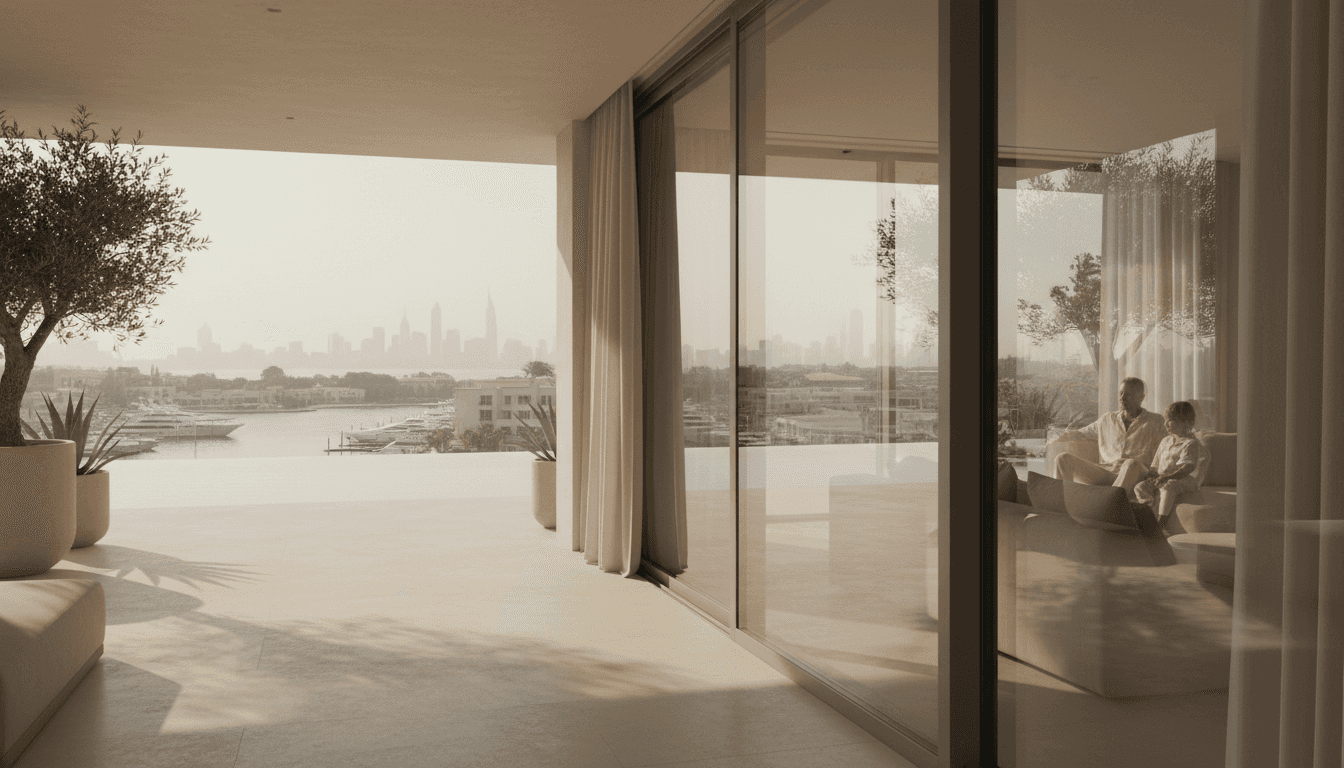
Homes for the Whole Family: Dubai's Best Neighbourhoods
Explore the best Dubai neighbourhoods for multi-generational living, from sprawling villas with annexes to paired apartments that keep family close but independent.

The concept of family in Dubai has always been expansive, reaching beyond the nuclear unit to include grandparents, uncles, aunts, and cousins. As a lifestyle specialist at Gaia Living, I see this reflected daily in the property briefs from our clients. It’s no longer just about a home for a couple and their children; it's about finding a base for the entire clan, a place where generations can coexist comfortably. This shift isn't just cultural; it's a practical response to a global city that attracts talent from all over the world, who in turn want their loved ones close.
Here’s what we'll explore in this guide to multi-generational living in Dubai:
- The evolving definition of a family home in the city.
- Key architectural features that support extended families.
- The legal and financial frameworks, from visas to purchasing costs.
- A deep dive into Dubai's best neighbourhoods for large families.
- The villa option: analysing space, privacy, and community.
- The apartment solution: creative ways to live together, separately.
- My personal verdict on finding the perfect family compound.
The New Family Blueprint
The traditional search for a family home in Dubai used to be fairly straightforward: a three or four-bedroom villa in a green, suburban community. That model is changing. Today, the request for large family homes Dubai often comes with a more complex set of requirements. Clients are asking for properties that accommodate visiting parents for six months of the year, a sibling’s family relocating to the city, or grown children who are studying or starting their careers but still living at home. It’s a beautiful, modern evolution of family life, and the Dubai property market is adapting to meet it.
This demand for multi-generational living Dubai has pushed developers and homeowners to think creatively about space. It’s not simply about more bedrooms. It’s about flexible layouts that offer both connection and independence. The ideal property might have a ground-floor bedroom suite for elderly parents who wish to avoid stairs, a separate guesthouse or majlis that can be converted into a studio annex, or even two properties adjacent to one another. The goal is to create a supportive family ecosystem where everyone has their own space but can come together easily for meals, celebrations, and daily life.
I’ve noticed this trend particularly among clients who have secured long-term residency through the Golden Visa program. Once their own status is secure, the first priority often becomes establishing a comfortable base for their parents and other relatives. This has created a distinct sub-market for homes for parents Dubai, where features like accessibility, proximity to healthcare, and quiet surroundings are paramount. It’s a move away from the flashy, transient stereotype of Dubai towards something more settled, rooted, and sustainable. This is about building a legacy, not just a lifestyle.
The market has responded in several ways. In the villa segment, we see a premium on homes with detached guest houses, driver's rooms, and maid's rooms that are large enough to be repurposed. In the apartment market, the rare but highly sought-after ‘dual-key’ unit — a single property on one title deed that is comprised of a main apartment and a smaller, self-contained studio with its own entrance, is the holy grail. More commonly, our clients will look to purchase two apartments next to or on top of each other, creating a 'vertical compound' within a single building.
Designing for Togetherness and Privacy
 Featured project
Finding the right physical structure is the cornerstone of successful multi-generational living. The ideal home balances shared spaces with private retreats, allowing an extended family Dubai property to function without friction. The architecture of the home needs to work for everyone, from a toddler to an octogenarian. In my experience, the most successful layouts incorporate specific features that cater to this dynamic.
First on the list is the ground-floor bedroom suite. This is non-negotiable for many families looking to accommodate elderly parents. It provides accessibility and comfort, eliminating the daily challenge of stairs. A well-designed suite isn't just a bedroom; it's a self-contained retreat with an en-suite bathroom, ample wardrobe space, and perhaps even a small seating area or direct access to the garden. Communities like The Meadows and many villas in Arabian Ranches often feature this layout, making them perennial favourites.
Second is the concept of the annex or the independent guest house. This is the gold standard for providing privacy. It allows family members to have their own front door, a small kitchenette, and a living space, while still being just steps away from the main family home. This is particularly valuable for adult children or a younger family unit living within the larger family structure. Luxury communities like Al Barari and certain custom-built villas on Palm Jumeirah excel at this, offering properties where the guest accommodation is as thoughtfully designed as the main residence. These are true interconnected homes Dubai, offering physical separation without emotional distance.
Where a separate structure isn't available, clever interior zoning becomes key. This could mean having multiple living areas — a formal sitting room for entertaining, a casual family room for movie nights, and perhaps a quiet study or library. This allows different age groups to coexist peacefully, pursuing their own activities without disturbing others. Developers like Emaar Properties have mastered this in their larger villa types, creating homes with a natural flow and distinct zones. For apartments, this might mean a larger layout with a study that can be closed off, or a living room spacious enough to be partitioned. It’s about creating pockets of privacy within a shared space.
The Financial and Legal Framework
Before you can enjoy the lifestyle, you need to navigate the practicalities. Structuring the purchase and residency for an extended family requires careful planning. The good news is that Dubai’s legal framework is increasingly supportive of long-term residents and their families. The key is understanding the rules and costs upfront to avoid any surprises.
The first consideration is visas. If you are a property owner in Dubai, you can sponsor your parents for a renewable residency visa. According to the official UAE Government portal, the main conditions are that you own a property of adequate size (a minimum of a two-bedroom apartment is usually required) and have a minimum monthly income to prove you can support them. This is a relatively straightforward process. Sponsoring other relatives, like siblings, is more complex and handled on a case-by-case basis, often requiring special permission from the authorities. It is crucial to get up-to-date advice on this from the General Directorate of Residency and Foreigners Affairs (GDRFA).
Next, the purchase itself. When buying a large property, you need to budget for more than just the sticker price. The upfront costs in Dubai are significant. Let's break down the purchase of a hypothetical AED 8,000,000 villa, which is a realistic price point for a good-sized 5-bedroom home in a desirable family community:
- Purchase Price: AED 8,000,000
- Dubai Land Department (DLD) Transfer Fee: 4% of the purchase price = AED 320,000
- DLD Admin Fees: Approximately AED 4,200
- Real Estate Agency Fee: 2% of the purchase price + 5% VAT = AED 168,000
- Property Registration Fee: AED 4,000
- No Objection Certificate (NOC) Fee: This varies by developer but is typically between AED 1,000 and AED 5,000. Let's budget AED 5,000.
- Mortgage Arrangement & Valuation Fees (if applicable): Around 1% of the loan amount + VAT. For a 75% loan-to-value mortgage (AED 6M loan), this would be roughly AED 63,000.
- Total Upfront Costs (with mortgage): Approximately AED 564,200
This amount is payable on top of your mortgage down payment, which for an expatriate resident on a property over AED 5 million, is at least 25% of the purchase price, or AED 2,000,000 in this case. Therefore, the total cash you would need to have ready is close to AED 2.6 million. Understanding these numbers, which are regulated by bodies like the Dubai Land Department (DLD) and the Central Bank of the UAE, is the first step to a smooth transaction.
Finally, consider the ownership structure. If multiple family members are contributing to the purchase, it's wise to register the property in joint names. Dubai law permits co-ownership, and having the names of all contributing parties on the Title Deed provides legal protection and clarifies ownership rights from the outset. This can also simplify inheritance planning down the line. We at Gaia Living always advise clients to seek professional legal advice to structure the purchase in a way that aligns with their family's long-term goals and financial contributions.
The Suburban Dream: Villa Communities
For many families, the ultimate expression of multi-generational living is a spacious villa in one of Dubai's leafy, self-contained suburbs. These family-friendly communities Dubai are designed around the concept of a complete lifestyle, offering not just homes but also parks, schools, clinics, and retail centres within a secure, gated environment. This is where the vision of children playing in the garden while grandparents watch from the patio truly comes to life.
Arabian Ranches, one of Dubai's most established and beloved communities, is a prime example. Developed by Emaar, it offers a wide variety of villa types, from three-bedroom townhouses to sprawling six-bedroom independent homes. What makes it exceptional for extended families is the maturity of the community. The trees are grown, the gardens are lush, and the sense of neighbourhood is palpable. Many of the larger villa types, like the 'Savannah' or 'La Coleccion' styles, feature ground-floor guest suites and generous plot sizes that allow for privacy. The community also has its own school, clinic, and golf course, meaning daily necessities are just a golf cart ride away.
Another top-tier option is The Meadows, part of the wider Emirates Living development. Like Arabian Ranches, it’s an Emaar masterpiece known for its tranquil lakes and green streetscapes. The villas here are often more spacious than in newer communities, with many having been upgraded and extended by long-term owners. It's not uncommon to find properties with a fully built-out annex or a converted majlis that serves as a perfect apartment for parents or adult children. The proximity to Sheikh Zayed Road provides excellent connectivity, yet the community itself feels like a peaceful retreat from the city's hustle.
For those with a higher budget seeking unparalleled luxury and space, Al Barari is in a class of its own. This is less a suburb and more a botanical paradise. The defining feature here is the sheer scale of the properties and the emphasis on nature. Villas are set on enormous plots, surrounded by dense foliage, themed gardens, and waterways. The homes themselves are palatial, often with six or seven bedrooms, private cinemas, basement levels, and separate guest quarters. Al Barari is for families who want ultimate privacy and a connection to nature, and are willing to pay the premium for it. It's an enclave that feels a world away from Dubai, yet is only a 15-minute drive from Downtown.
Newer communities are also entering the fray. Sobha Hartland and Sobha Hartland II in Meydan have made a significant impact with their focus on quality construction and expansive layouts. Sobha Realty offers large-scale villas and mansions that are designed with modern family needs in mind, often including elevators, multiple family living areas, and flexible spaces that can be adapted for extended family. The central location, close to Downtown and with its own international schools, makes it a compelling proposition for those who want suburban space without being too far from the city's core.
The Urban Solution: Creative Apartment Living
While villas are the default image of family life, they aren't the only option. For many, the convenience, amenities, and relative affordability of apartment living are more appealing. The challenge is replicating the space and privacy of a villa within a vertical community. It requires creativity, but I’ve seen clients achieve fantastic results, creating urban family compounds that are both practical and sophisticated.
“The most elegant solution for urban multi-generational living is not always a single, massive penthouse. It's often two well-chosen apartments, perfectly placed to give family members both a front door to lock and a connecting path to home.”
The most straightforward approach is to purchase two adjacent apartments. This is the ultimate 'together but separate' setup. Grandparents can have their own two-bedroom unit, for example, right next door to their children's three-bedroom home. This provides complete independence while making it effortless to share meals, help with childcare, or simply be there for one another. In some newer buildings, particularly in the off-plan launches phase, it's even possible to work with the developer to have an interconnecting door installed, creating a smooth flow between the two homes. This strategy works brilliantly in large residential towers in areas like Dubai Marina or Business Bay, where the sheer number of units increases the chance of finding adjacent properties for sale.
A more niche but highly effective option is the dual-key apartment. These are rare in Dubai but incredibly valuable. A dual-key unit is a single apartment on one title deed that is divided into two separate, lockable living spaces. Typically, this consists of a main two or three-bedroom apartment and an adjoining studio with its own entrance, bathroom, and kitchenette. This is the perfect setup for housing a single parent, a university student, or even for generating rental income while keeping family close. Because they are on one title deed, they are purchased as a single property, simplifying the transaction and associated fees.
Finally, there's the 'vertical stacking' approach. This involves buying two apartments in the same building, but on different floors. I had a client who did this brilliantly: they bought a large three-bedroom apartment on a mid-level floor for their own family, and a one-bedroom unit with a great view on a higher floor for the husband's mother. It gave her privacy and a sense of her own domain, while the shared amenities — pool, gym, and lobby, became natural meeting points. This works best in high-end buildings with excellent facilities and a strong sense of community, such as those found in Creek Harbour or on Bluewaters Island.
When choosing this route, the building's amenities are just as important as the apartments themselves. A building with a great pool, a kids' play area, a residents' lounge, and perhaps a cinema room provides the communal spaces that a private villa garden would. It extends the living space beyond the four walls of the apartment and provides a neutral ground for the family to gather. These shared spaces become the 'backyard' for the urban multi-generational family.
Community and Connectivity: The Final Piece
Choosing the right house is only half the battle. The success of a multi-generational setup depends heavily on the surrounding community and its connectivity. A home that is perfect on paper can feel isolating if it’s disconnected from the amenities and services that a large, diverse family needs. This is where deep neighbourhood knowledge becomes invaluable.
Access to quality healthcare is a primary concern, especially for families with elderly parents. A neighbourhood's value is significantly enhanced by its proximity to reputable clinics and hospitals. For example, communities around the Dubai Hills Estate benefit from the on-site Dubai Hills Hospital, a King's College Hospital facility. Similarly, living in areas like Jumeirah or Al Sufouh provides easy access to the cluster of top-tier medical facilities along Jumeirah Beach Road and Sheikh Zayed Road. When we advise clients on family-friendly communities Dubai, proximity to healthcare is always a key part of the conversation. It's a practical consideration that provides immense peace of mind.
Educational facilities are another pillar. For families with children spanning different age groups, from nursery to university, being in a location with a good selection of schools and easy access to university hubs is a major advantage. Communities like Al Furjan and Arabian Ranches are well-served by schools following various curricula. Proximity to Knowledge Park and Academic City, Dubai's main higher education zones, is a bonus for families with older children. The daily school run can be a major logistical challenge, and choosing a home that minimises this stress is a huge quality-of-life win.
Finally, consider the social and recreational infrastructure. What is there to do outside the home? A good family community offers something for everyone. This means shaded walking paths for a grandparent's morning stroll, safe and engaging playgrounds for young children, sports courts for teenagers, and cafes or community centres for social gatherings. It's this social fabric that transforms a collection of houses into a true neighbourhood. The master plans by developers like Nakheel and Emaar are successful precisely because they integrate these lifestyle elements from day one. They design public realms that encourage interaction and an active, outdoor lifestyle, which is essential for the wellbeing of a family with diverse needs and interests.
The perfect multi-generational home in Dubai is a thoughtful balance of architecture and location. It's a property that offers flexible private spaces within a community that provides the essential pillars of family life: healthcare, education, recreation, and a true sense of belonging.
My Verdict
For over a decade, I've watched Dubai mature from a city of ambition to a city of belonging. The rise of the multi-generational household is, for me, the clearest sign of this evolution. It speaks to a desire to put down deep roots, to build a future that includes the whole family. Finding the right property to enable this is one of the most rewarding challenges we undertake at Gaia Living.
If budget is no object and you seek true separation and privacy, the answer lies in the sprawling villas of Al Barari or the custom-built homes on Palm Jumeirah that feature distinct guest wings. These properties are designed as private family estates and offer an unparalleled level of space and seclusion.
However, for most families, the sweet spot is found in the established, master-planned communities. In my view, Arabian Ranches and The Meadows offer the best all-around package. Their combination of well-designed, spacious villas (many with ground-floor suites), mature landscaping, and comprehensive community amenities provides a time-tested formula for family happiness. They offer a grounded, neighbourhood feel that is difficult to replicate. Newer contenders like Sobha Hartland are catching up fast, offering more modern designs and a closer-to-the-city location, making them a very strong alternative.
The apartment solution is an increasingly viable and intelligent choice. Buying two adjacent units in a high-amenity building in a walkable area like Dubai Marina or Downtown is a fantastic way to balance independence with proximity. It offers a low-maintenance lifestyle with world-class facilities at your doorstep, a compelling trade-off against a private garden you have to maintain.
Ultimately, the right choice depends on your family's unique culture and priorities. Do you value the absolute privacy of a detached annex, or the simple convenience of being next door in an apartment? Is a large garden essential, or would you prefer a stunning city view and a shared pool? As you weigh these options, my advice is to think not just about the next year, but the next ten. A home that can adapt as your family grows and changes — as children become adults and parents grow older, is the wisest investment you can make.
## Sources - UAE Government Portal (u.ae) - Information on family visa sponsorship. - Dubai Land Department (DLD) - For information on property registration, fees, and regulations. - Central Bank of the UAE - For regulations regarding mortgages and financing. - Real Estate Regulatory Agency (RERA) - For rules governing service charges and developer obligations.
Questions, answered
- What is a multi-generational home in the Dubai context?
- In Dubai, a multi-generational home can be a large villa with a separate guest wing or annex, a 'dual-key' apartment with a self-contained studio, or simply two adjacent apartments or villas within the same community. The goal is to provide both proximity and privacy for extended family members.
- Are there specific visas for extended family members in Dubai?
- Yes, property owners in Dubai can sponsor their parents on a renewable residency visa, provided they meet certain criteria like a minimum monthly salary and owning a property with at least two bedrooms. Sponsoring other extended family members like siblings can be more complex and is assessed on a case-by-case basis.
- Which developers are best known for large family homes in Dubai?
- Emaar Properties is famous for its master-planned villa communities like Arabian Ranches and The Meadows. Sobha Realty, particularly in Sobha Hartland, and Al Barari are known for their exceptionally large, high-end villas. Nakheel Properties also offers substantial family villas on Palm Jumeirah and in other communities.
- What are the typical costs for buying a large family villa in Dubai?
- For a 5-bedroom villa in a desirable community, expect prices from AED 6 million to over AED 20 million. On top of the purchase price, budget for a 4% DLD transfer fee, a 2% agency fee, a No Objection Certificate (NOC) fee of up to AED 5,000, and other administrative costs, totalling around 7% of the property value.
- Can I find interconnected homes in Dubai off-plan?
- Yes, it's possible. Buying two adjacent apartments or townhouses off-plan gives you the opportunity to request modifications from the developer, such as adding an interconnecting door. This is most feasible in early construction stages and works best with boutique or flexible developers.
- How do service charges work for very large properties?
- Service charges are calculated per square foot of the property's Built-Up Area (BUA) and are approved by RERA. For large villas, this can amount to a significant annual cost, covering community maintenance, security, landscaping, and amenities. Typical rates in villa communities range from AED 2.50 to AED 6.00 per square foot per year.

Yusuf writes about how Dubai actually lives — waterfront mornings, community dining, walkability, and the lifestyle premium built into an address.
Related stories
Dubai Furnished Resale: Smart Bet or Overpriced Convenience?
A new wave of demand for high-end, turnkey apartments is reshaping Dubai's resale market. I analyse whether the premium for furnished properties is a shrewd investment or an expensive shortcut.
Mastering the School Run: Dubai's Best Villa Communities
Say goodbye to traffic stress. Sophia Al-Khoury reveals the Dubai villa communities with the easiest school access, ranking them on commute times and family-friendly infrastructure.
Valuing Your Dubai Apartment’s Concierge Services
I explore how to properly assess the real value of concierge and premium services in Dubai's luxury apartment market, weighing them against the service charges you pay.
Echoes, in your inbox
One thoughtful email a month. Market insight, new launches, no spam.