

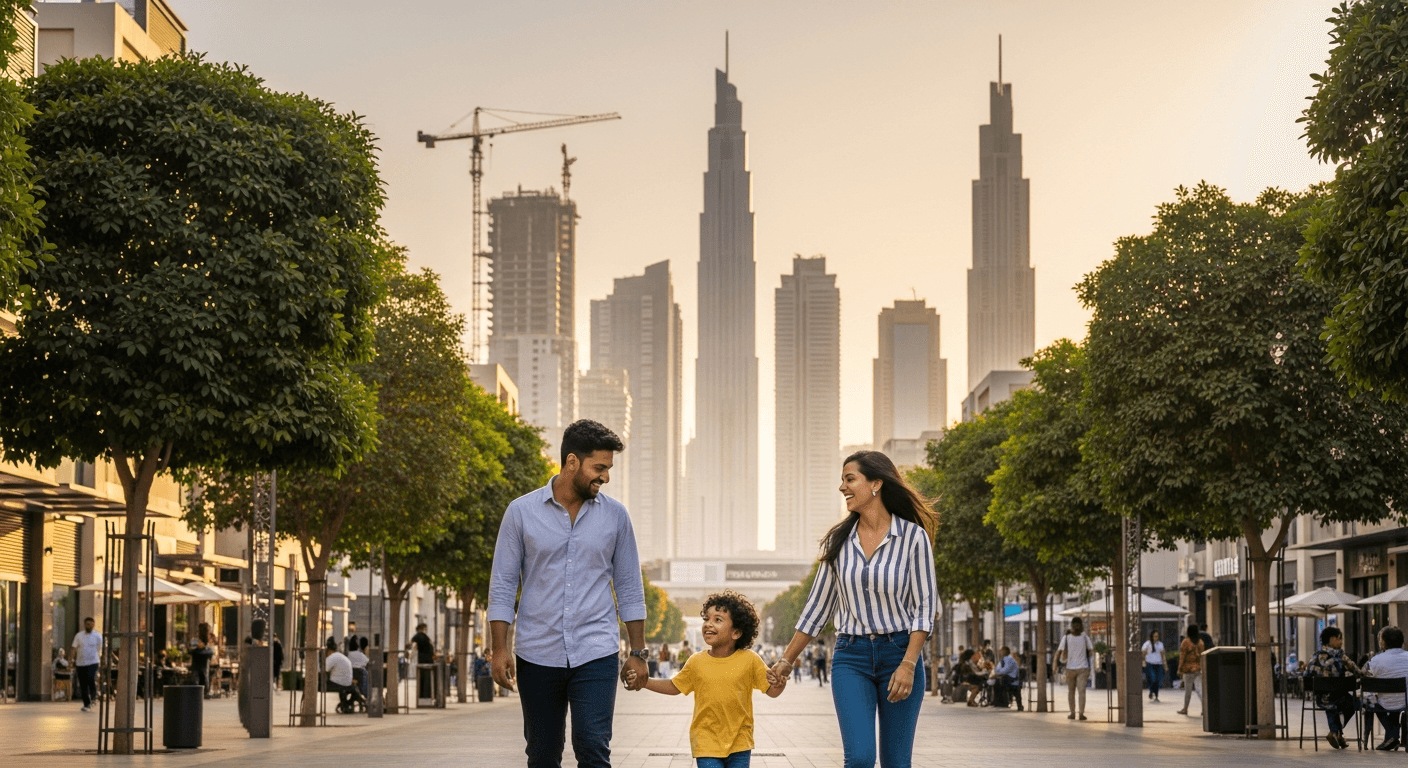
Free Zones: Dubai's New Residential Gravity Wells
Discover how Dubai's major economic free zones like DIFC, DMCC, and Dubai Internet City are creating powerful demand for nearby residential property, influencing prices, and defining new investment corridors.

The daily commute is dead. Or at least, Dubai's professional class is doing everything possible to kill it, creating powerful micro-markets around the city's major economic free zones. This isn't just about convenience; it's a fundamental reshaping of the property map.
Here’s what we'll explore in this analysis:
- The core concept: Proximity premium in a post-commute world.
- Deep dive: DIFC's influence on Downtown, Business Bay, and City Walk.
- The DMCC effect: How it anchors demand in JLT, Dubai Marina, and JBR.
- The Tech & Media Corridor: The pull of Dubai Internet/Media City.
- Emerging hubs: Dubai South and the future property landscape.
- Investment analysis: Yields, capital appreciation, and tenant profiles.
- The numbers: A real-world cost breakdown of buying near a free zone.
The End of the Commute: Why Proximity is the New Luxury
For years, the Dubai dream often involved a trade-off: a spacious villa in a suburban community for a lengthy commute into the city’s commercial heart. That equation is being aggressively rewritten. The single most powerful, yet often unstated, driver of residential demand I see in today’s market is the relentless pursuit of a shorter journey to work. This *economic zone residential pull* is more than just a preference; it’s becoming a non-negotiable requirement for a growing segment of tenants and buyers. This shift has profound implications for property values, rental yields, and the very character of entire neighbourhoods. It is, in my view, one of the most durable and predictable trends an investor can follow.
The underlying logic is simple. Dubai's economic free zones are concentrated pockets of high-value employment. A software engineer at Microsoft in Dubai Internet City, a financier at a hedge fund in the DIFC, or a commodities trader in DMCC are all part of a captive audience for nearby housing. As the city matures and traffic becomes a more significant daily friction point, the value proposition of living minutes from your office has soared. It’s no longer a simple matter of convenience; it’s about reclaiming one to two hours of your day. This translates into more time with family, for wellness, or for socialising — a tangible improvement in quality of life that high-earning professionals are willing to pay a premium for.
This trend is further cemented by government policy. The expansion of the Golden Visa and other long-term residency options, often tied to employment within these strategic sectors, encourages professionals to transition from transient renters to committed residents. When someone sees a five- or ten-year horizon in Dubai, their housing calculus changes. They're not just looking for a place to sleep; they are looking to build a life. This means proximity to work becomes intertwined with proximity to good schools, lifestyle amenities, and a sense of community. The result is the organic formation of '15-minute city' clusters around these economic engines, where residents can live, work, and play within a compact radius. At Gaia Living, when a client specifies their workplace, our search immediately narrows to a handful of proximate communities. It's the first and most important filter.
The Financial Epicentre: DIFC's Residential Demand Impact
 Featured project
Nowhere is this phenomenon more apparent than around the Dubai International Financial Centre (DIFC). As the leading financial hub for the Middle East, Africa, and South Asia (MEASA) region, DIFC is a magnet for high-calibre talent in banking, law, asset management, and fintech. This creates an intense and specific demand for housing that has reshaped the real estate landscape of its neighbouring districts: Downtown Dubai, Business Bay, and the more boutique community of City Walk. The *DIFC residential demand impact* is not just about volume; it's about the type and quality of properties that are sought after.
The typical tenant or buyer working in DIFC is discerning, time-poor, and has high expectations. They are not looking for basic accommodation. Their search criteria almost always include a list of sophisticated requirements. Walkability to the office, or at least a sub-ten-minute car ride, is paramount. This demand profile has directly fuelled the premium attached to properties in Downtown and the newer towers in Business Bay that border Sheikh Zayed Road. A one-bedroom apartment in a prime Downtown tower can command a rental premium of 20-30% over a similar-sized unit in a community 20 minutes away. Landlords know their target audience and the price they are willing to pay for location and convenience.
Developers have been quick to respond to this lucrative demographic. Look at the portfolio of Emaar Properties in Downtown Dubai. Projects like the Address Residences or the towers in the Opera District, such as Opera Grand, are tailor-made for this audience, offering five-star amenities, concierge services, and high-end finishes. Similarly, Meraas designed City Walk with a distinct, low-rise European aesthetic, targeting professionals who might want an alternative to high-rise living but still demand immediate access to the DIFC ecosystem. The success of these projects is a direct result of understanding the buyer. What a DIFC professional prioritises in a home is a specific bundle of features:
- Walkability: Direct pedestrian access or a very short commute to DIFC Gate Village.
- Premium Amenities: A state-of-the-art gym, a lap pool, and resident lounges are standard expectations.
- F&B and Retail: A rich selection of high-end restaurants, cafes, and shops within the building or immediate vicinity.
- Turnkey Living: A preference for furnished or semi-furnished units with high-quality maintenance and security.
- A Sense of Prestige: The address itself becomes part of the appeal, reflecting the resident's professional standing.
This ecosystem creates a virtuous cycle. The presence of high-income professionals attracts premium retail and dining, which in turn makes the area even more desirable to live in, further pushing up property values. For an investor, buying a property in Downtown or Business Bay is a direct play on the continued success and growth of the DIFC. You are not just buying square footage; you are buying a stake in Dubai’s financial core.
The JLT-Marina Nexus: The DMCC Housing Market Effect
If DIFC represents the peak of corporate finance demand, the Dubai Multi Commodities Centre (DMCC) represents breadth and scale. Located within Jumeirah Lakes Towers (JLT), DMCC is one of the world's largest and fastest-growing free zones, home to thousands of companies ranging from global commodity traders and diamond merchants to startups and small service firms. This sheer volume of employment has a profound *DMCC housing market effect*, creating a deep and diverse pool of rental demand that underpins the property markets of JLT, Dubai Marina, and Jumeirah Beach Residence (JBR).
Unlike the relatively uniform demographic of DIFC, the DMCC workforce is incredibly varied. This diversity translates directly into demand for a wider spectrum of housing. JLT itself, with its mix of standard, mid-range, and premium towers, is the primary beneficiary. It offers practical, relatively affordable housing options that are a magnet for the thousands of employees working just across the lake. A junior executive or startup founder can find a well-appointed studio or one-bedroom apartment in JLT at a price point that is significantly more accessible than in the neighbouring Dubai Marina. This has made JLT one of Dubai's most consistent performers for rental yields, often hovering in the 6-8% gross range for standard apartments, because the demand from DMCC is constant and robust.
The dynamic between JLT and Dubai Marina is a perfect case study in residential segmentation. While many DMCC employees choose the convenience and relative affordability of JLT, senior managers, business owners, and those with families often look across Sheikh Zayed Road to Dubai Marina and JBR. They are willing to pay a premium for the lifestyle: the beach access, the marina walk, the larger apartments with sea views, and the more vibrant nightlife. A two-bedroom apartment in Dubai Marina might rent for 25% more than a similar unit in JLT, but for a director at a major DMCC company, the lifestyle upgrade is worth the cost. This creates a clear value ladder for investors. You can invest in JLT for higher yield or in Dubai Marina for a blend of yield and the potential for stronger capital appreciation associated with prime waterfront real estate.
Crucially, this entire ecosystem is stitched together by world-class infrastructure. The Dubai Metro, with its dedicated stations for DMCC, Sobha Realty (serving Dubai Marina), and JBR, makes car-free commuting between home and work smooth. This connectivity is a critical asset that solidifies the relationship between these communities and the free zone. It ensures that the residential pull of DMCC extends beyond just the towers immediately adjacent to it, encompassing the entire well-connected corridor. For investors considering a *Dubai free zone property investment*, this nexus is compelling. It offers a choice between a high-yield strategy in JLT and a premium lifestyle/capital growth strategy in Dubai Marina, both underpinned by the same powerful economic engine of the DMCC.
The Tech & Media Corridor: Dubai Internet City's Pull
Long before the latest wave of free zones, Dubai established its credentials as a regional hub for technology and media with the creation of Dubai Internet City (DIC), Dubai Media City (DMC), and the adjacent Dubai Knowledge Park. This cluster, strategically located along Sheikh Zayed Road, has matured into a powerful economic zone that exerts a gravitational pull on a distinct set of residential communities. The *Dubai Internet City property growth* effect is most clearly visible in the evolution of areas like The Greens & Views, Barsha Heights (formerly TECOM), and its influence even extends to the fronds of Palm Jumeirah.
This corridor attracts a specific demographic: a blend of young tech professionals, creative media types, and academics. Their lifestyle preferences and housing needs differ from the finance-focused crowd of DIFC. There's less emphasis on formal luxury and more on community, convenience, and modern amenities. Fast, reliable internet, for example, is not a luxury but an absolute necessity. Many newer buildings in these areas now offer integrated co-working spaces or resident lounges that cater to a flexible work culture. The demand here is for a smooth, connected lifestyle that blurs the lines between work and leisure. This has shaped the character of the surrounding neighbourhoods in very specific ways.
Emaar's The Greens & Views community stands as a textbook example of residential development designed to serve a commercial hub. Developed in the early 2000s alongside DIC and DMC, its low-to-mid-rise buildings, lush landscaping, and community-centric feel were a direct response to the needs of the emerging professional class working nearby. It offered, and still offers, a tranquil, suburban atmosphere just minutes from the bustle of the tech and media offices. Its enduring popularity is a sign of the power of this model. On the other hand, Barsha Heights provides a higher-density, more affordable alternative, particularly popular with younger professionals and those in junior to mid-level roles. Its proximity and extensive F&B offerings make it a practical and vibrant place to live for those starting their careers in DIC or DMC.
For senior executives and founders at the major tech giants headquartered in DIC — companies like Google, Microsoft, and Oracle, the residential calculus often includes Palm Jumeirah. While not immediately adjacent, the ease of access via the Palm's trunk road makes it a highly desirable option, typically a 10-15 minute drive. They are willing to trade direct walkability for the unique waterfront lifestyle, larger living spaces, and prestige that a villa or signature apartment on the Palm provides. This demonstrates how a powerful economic zone can influence a range of residential sub-markets at different price points. An investor can choose to target the mid-market rental demand in The Greens or Barsha Heights, or aim for the premium segment by acquiring a property on the Palm with proven appeal to the C-suite executives of the tech world.
Emerging Frontiers: Dubai South and the Future
While the impact of established free zones like DIFC and DMCC is clear and present, the smart investor is always looking at the next frontier. Today, that frontier is undeniably Dubai South. Conceived as a 145-square-kilometre master-planned city, Dubai South is anchored by Al Maktoum International Airport (DWC) and the legacy site of Expo 2020, now Expo City. Its vision is to be a comprehensive hub for the logistics, aviation, commercial, and residential sectors, effectively creating a self-sustaining economic ecosystem. The residential property market here is still in its nascent stages, but it represents a powerful, long-term play on the principle of aligning real estate with economic growth.
The *economic zone residential pull* in Dubai South is currently being driven by a pioneering group of residents and investors. The primary demand comes from those working within the zone itself — in aviation support services, global logistics firms setting up operations around the airport, and the growing number of companies establishing headquarters in the business park. As DWC continues its phased expansion with the goal of becoming the world's largest airport, this employment base is set to grow exponentially. This is a classic ground-floor investment opportunity, where one is betting on the future influx of thousands of employees who will need a place to live.
The property landscape in Dubai South is dominated by off-plan launches from Dubai's master developers, including Emaar, who are building entire communities with a mix of villas, townhouses, and apartments. These projects are being designed from scratch to be integrated with the commercial and lifestyle components of the wider city. The pricing is, for now, significantly more accessible than in the established central parts of Dubai. This presents an opportunity for substantial capital appreciation as the area matures and the population grows. Early buyers are positioning themselves to benefit from the inevitable rise in demand that will accompany the zone's development over the next decade.
Beyond Dubai South, other specialized zones are creating their own localized demand. Dubai Science Park, a hub for the life sciences and pharmaceutical industries, is directly fuelling rental demand in nearby communities like Arjan, which offers new, affordable apartment stock, and the more premium, family-oriented villas of Al Barari. Similarly, Dubai Production City and Dubai Studio City have bolstered the rental markets in Jumeirah Village Circle (JVC) and Dubai Sports City. The pattern is consistent: where the government strategically cultivates an economic hub, a residential micro-market inevitably blossoms around it. For investors with a long-term perspective, identifying these emerging corridors before they reach maturity is a key strategy for outsized returns.
Investment Calculus: Yields, Tenant Profiles, and Long-Term Value
Understanding this trend is one thing; translating it into a successful investment strategy is another. Investing in property near a major free zone requires a clear-eyed analysis of the costs and benefits. It’s a strategy that fundamentally revolves around de-risking your investment by tapping into a stable, continuous source of tenant demand. However, it's not without its nuances. The primary trade-off is the entry price. The 'proximity premium' is real; a property within a 10-minute commute of DIFC will cost significantly more than an identical one 30 minutes away. You are paying upfront for access to a superior tenant pool.
This is where the analysis of tenant quality becomes critical. The key benefit of buying near a major free zone is the stability and reliability of the tenants you attract. A senior associate at a law firm in DIFC or an engineer at a multinational in DIC is likely to be on a multi-year employment contract, offering a landlord a degree of predictability that is invaluable. This demographic is less likely to default on rent and more likely to renew their lease, reducing costly vacancy periods and turnover costs. In my experience, the number one killer of real estate returns is vacancy. A property that sits empty for two months a year sees its effective yield plummet. The lower vacancy rates in areas with strong employment anchors are a powerful, if sometimes hidden, boost to an investor's net return.
This leads to a strategic choice between chasing the highest gross yield and prioritizing asset quality and stability. For example, an investor might find that a small studio in a secondary community offers a gross yield of 9% on paper. However, a one-bedroom apartment in Business Bay near the DIFC might offer a 6.5% gross yield. The inexperienced investor might gravitate towards the former. But the seasoned investor understands the context. The Business Bay apartment is likely to attract a higher quality tenant, experience fewer and shorter void periods, and benefit from stronger long-term capital appreciation due to its prime location. The net yield, after accounting for all costs and potential vacancies, may end up being very similar, but the Business Bay asset is fundamentally a lower-risk, higher-quality holding.
“The most valuable amenity a landlord can offer in Dubai is time. By buying next to a major free zone, you're selling your tenant a shorter commute, and that's a product with perennial demand.”
My advice to investors at Gaia Living is to model this trade-off carefully. Don't be seduced by headline gross yields alone. A *Dubai free zone property investment* is a fundamentals-driven strategy. You are investing in the economic bedrock of the city. The growth of these zones is a matter of strategic government policy, making it one of the most reliable macroeconomic trends to build a portfolio around. You are essentially aligning your capital with the city's own economic development plan, which, in a place like Dubai, is a very strong position to be in.
The Real Cost: A Worked Example of Buying Near a Free Zone
To make this tangible, let's walk through the real-world numbers. Theory is useful, but successful investment comes down to a clear understanding of the costs. Let's create a realistic scenario: an investor looking to purchase a one-bedroom apartment in Business Bay with the specific goal of renting it to a professional working in the nearby DIFC. This is a common strategy we see among our clients at Gaia Living, and it's a perfect illustration of the costs involved.
Let's assume a purchase price of AED 1,500,000 for a quality one-bedroom unit in a desirable tower. The upfront costs are significant and must be budgeted for. The Dubai Land Department (DLD) levies a transfer fee of 4% of the purchase price, which is the single largest transaction cost. In addition, there are administrative fees paid to a registration trustee to handle the title deed transfer. Here’s a line-by-line breakdown of the upfront costs for a cash buyer:
Upfront Costs (Cash Purchase) - Purchase Price: AED 1,500,000 - DLD Transfer Fee (4%): AED 60,000 - DLD Registration Trustee Fee: Approximately AED 4,200 (this is a fixed fee including VAT) - Agency Fee (2% + 5% VAT): AED 31,500 - Developer No Objection Certificate (NOC) Fee: Varies, but let's budget a typical AED 1,050 (incl. VAT) - Total Upfront Cash Outlay: AED 1,596,750
For a buyer using a mortgage, the upfront cash requirement is different. According to Central Bank of the UAE (CBUAE) regulations, a non-national expatriate must provide a minimum down payment of 20% for a first property under AED 5 million. The fees are calculated on the full property price, but the immediate cash needed is the down payment plus all fees.
Upfront Costs (Mortgage Purchase, 80% LTV) - Down Payment (20%): AED 300,000 - DLD Transfer Fee (4%): AED 60,000 - DLD Registration Trustee Fee: AED 4,200 - Agency Fee (2% + 5% VAT): AED 31,500 - NOC Fee: AED 1,050 - Bank Mortgage Arrangement Fee (est. 1% of loan): AED 12,000 - Mortgage Registration Fee (0.25% of loan): AED 3,000 - Property Valuation Fee: Approximately AED 3,150 - Total Upfront Cash Outlay: AED 414,900
It is critical for investors to understand these figures. The total cost of acquisition is nearly 7% above the purchase price. Beyond these initial costs, an owner must also account for recurring annual expenses. Service charges in a premium Business Bay tower can range from AED 18 to AED 25 per square foot per year. For an 800 sq. Ft. apartment, this could be AED 14,400 to AED 20,000 annually. These charges cover the maintenance of the building, pool, gym, and other common areas. Factoring these costs into your rental yield calculation is essential to understanding your true net return.
My Verdict: How to Position Your Property Portfolio
Having analyzed the mechanics and the numbers, my conclusion is clear: aligning your real estate investments with Dubai's economic free zones is one of the most robust, intelligent strategies available in this market. It anchors your investment to a tangible, enduring source of demand — high-quality employment. This is not a strategy based on market hype or speculative momentum; it's based on the simple, powerful logic of supply and demand in a city that is actively engineering its own economic growth.
For end-users who work in one of these major free zones, the decision is often more straightforward. I would urge you to calculate the 'hidden' costs of a long commute — not just fuel and car depreciation, but the intangible value of your time. In many cases, the premium paid for a home near your office is quickly offset by the gains in quality of life, reduced stress, and reclaimed hours each day. It’s an investment in your own well-being, which often provides the best return of all. Do the math for your personal situation; the results may surprise you.
For investors, the approach requires more nuance. The *Dubai free zone property investment* thesis is not a one-size-fits-all solution. It's a guiding principle that must be applied with specific market knowledge. An investor's portfolio could, for instance, include a high-yield apartment in JLT to capture the broad DMCC demand, complemented by a premium apartment in Downtown Dubai targeting the high-income DIFC tenant. This creates a balanced portfolio that captures different segments of the same underlying trend. The key is to look beyond the name of the community and analyze the specific source of tenant demand you are targeting.
The future of this trend is directly tied to the UAE Government's economic diversification strategy. As new specialized zones are announced and existing ones expand, they provide a roadmap for future property hotspots. The continued development of Dubai South, the growth of scientific and creative hubs, and the expansion of financial services will all create new residential gravity wells. Watching these developments is like having a leading indicator for the property market of tomorrow. My firmest belief is that the most successful property investors in the next decade will be those who best understand the intricate dance between Dubai's economic ambitions and its residential landscape.
Investing near Dubai's key economic free zones is a strategy that trades a higher entry price for lower vacancy risk, a higher-quality tenant pool, and long-term alignment with the city's core economic growth engines. It is a defensive and fundamentally sound approach to building a resilient property portfolio.
Sources
- Dubai Land Department (DLD) - dubailand.gov.ae
- Central Bank of the UAE (CBUAE) - centralbank.ae
- The Official Portal of the UAE Government - u.ae
Questions, answered
- Which Dubai free zones have the biggest impact on the property market?
- The Dubai International Financial Centre (DIFC) and the Dubai Multi Commodities Centre (DMCC) have the most significant impact due to their high concentration of well-paid professionals. DIFC influences demand in Downtown Dubai and Business Bay, while DMCC anchors the JLT, Dubai Marina, and JBR markets.
- Is it more expensive to buy property near a major free zone?
- Yes, there is a clear 'proximity premium.' Properties within a short commute of major employment hubs like DIFC or Dubai Internet City typically command higher sales prices and rents compared to similar properties elsewhere. Investors pay for lower vacancy risk and a high-quality tenant pool.
- What kind of rental yields can I expect from property near a free zone?
- Gross rental yields can be very competitive. For example, well-maintained apartments in JLT, driven by demand from DMCC, can achieve gross yields of 6-8%. While the entry price is higher in areas like Downtown near DIFC, the stability of rental income from high-salaried tenants is a key attraction.
- What is the 'economic zone residential pull'?
- This refers to the powerful trend of professionals choosing to live as close as possible to their workplace in a free zone. This demand reduces commute times, enhances quality of life, and creates stable, highly desirable residential micro-markets around these economic hubs.
- Are there emerging areas to watch for this trend?
- Yes, keep a close eye on Dubai South. As its logistics and aviation hubs grow, it is poised to become a major residential area driven by employment. Similarly, the growth of Dubai Science Park is increasing demand in adjacent communities like Arjan and Al Barari.
- What are the main upfront costs when buying a property in Dubai?
- The main costs include the property price, a 4% Dubai Land Department (DLD) transfer fee, a trustee registration fee (around AED 4,200), and a real estate agency fee (typically 2% plus VAT). If you're using a mortgage, you will also have bank arrangement and registration fees.
Omar tracks the announcements that move the market — new launches, regulation, mega-projects, and developer moves — and tells you what they actually mean for buyers.
Related stories
Beyond the Blueprint: The Retail Value Multiplier
It's a simple truth of Dubai real estate: proximity to quality retail and leisure isn't just a perk, it's a powerful driver of property value. I'll explain how operational hubs are creating measurable premiums for investors and residents.
Your Dubai Home Setup Guide
A step-by-step guide for new Dubai homeowners on connecting utilities, setting up essential services, and integrating into your new community.

The Productive Address in Dubai
The line between home and work has blurred for good. Discover the Dubai properties and communities designed for the focus, flexibility, and balance that modern professionals demand.
Echoes, in your inbox
One thoughtful email a month. Market insight, new launches, no spam.