

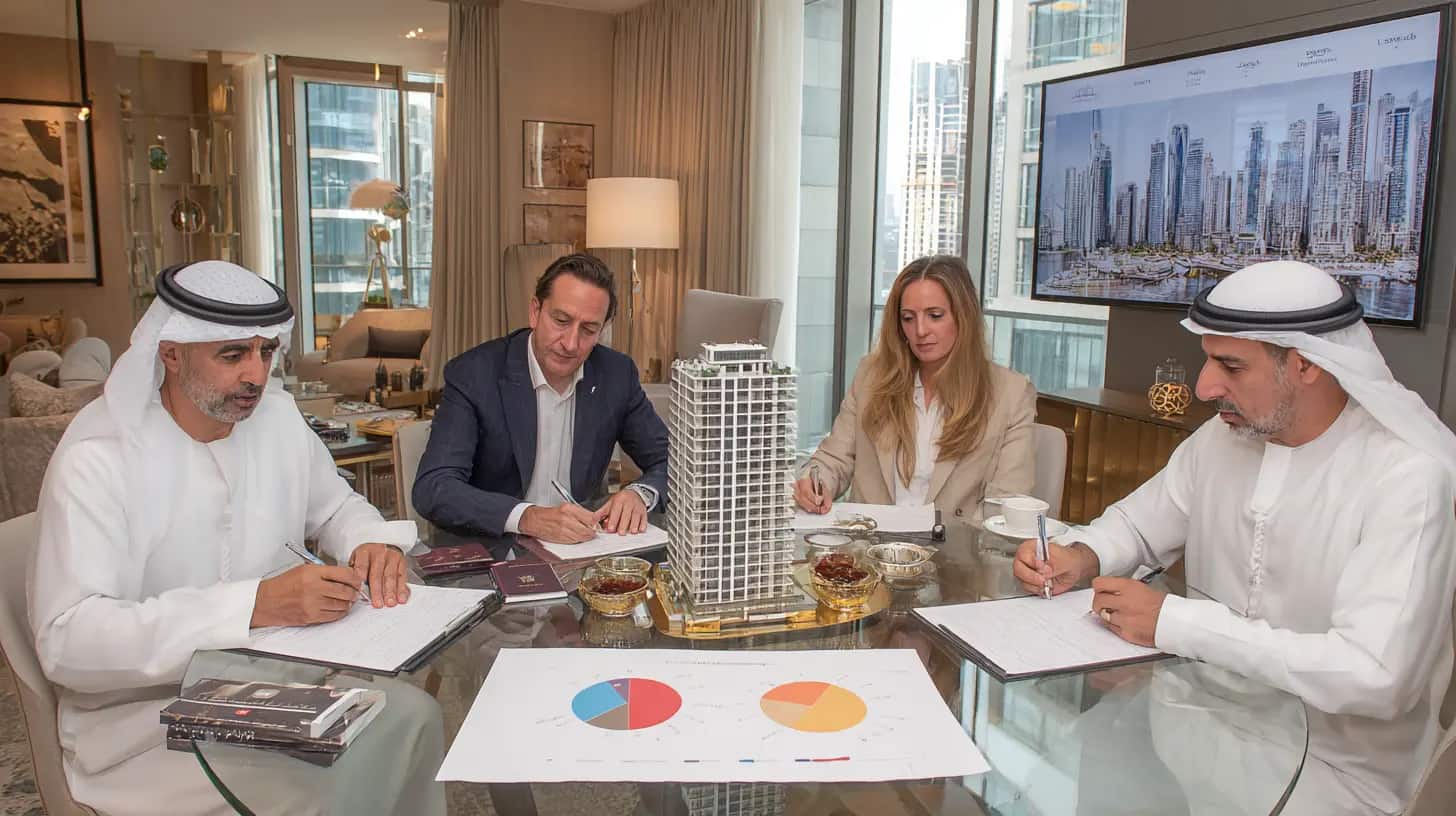
Fractional Property Ownership in the UAE: How It Works and Whether It's Worth It in 2026
The use of fractional ownership of property in the UAE is prevalent today. Although there is nothing new about using timeshare, real estate investment trust, and even privately held…
The use of fractional ownership of property in the UAE is prevalent today. Although there is nothing new about using timeshare, real estate investment trust, and even privately held syndicate concepts, fractional ownership of property in Dubai and Abu Dhabi made available to international investors via online platforms is a novel structure, enhanced access, and regulatory environment.
The idea is simple: instead of buying a whole Dubai apartment for AED 1,500,000, the investor buys a fraction, let's say 10%, paying just AED 150,000. In return, he gets a corresponding share of rental revenue, capital growth when selling the property, and even corresponding rights to occupy it if it is a vacation home. With minimal effort and without the hassle of direct ownership, the investor becomes exposed to a market he could not afford otherwise.
However, although the process looks easy, the truth can be far from it. The fractional ownership industry in the UAE encompasses a variety of products, including those based on legitimate legal structures and sophisticated frameworks with clear regulations up to something like profit-sharing schemes in the disguise of innovative tech products. Identifying one thing from another and knowing the right questions to ask before making any commitment is the point of this article.
Regulation is progressing in the UAE covering parts of the issue. DFSA has come out with guidelines concerning tokenised real estate assets. RERA introduced amendments to the regulation covering property fund structures. Still, regulation is evolving together with innovative solutions in the market, and not all platforms operating in the UAE operate under a clear legal and regulatory framework.
This article sheds light on the mechanism of fractional property ownership in the UAE, introduces major platforms along with their legal structures, pinpoints authentic risks, describes what you get by buying into a fractional ownership deal and what you don't, and makes a clear assessment of whether this kind of investment is worth your while. This article has no affiliation with any fractional ownership platform mentioned.
What Fractional Property Ownership Actually Means
The term "fractional ownership" covers several structurally different things that are often described with the same words. Before evaluating any specific platform or product, it's essential to understand which structure you're actually dealing with — because the legal protections, the exit options, and the risks are fundamentally different depending on how the ownership is structured.
Structure 1: Direct co-ownership (title deed fractionalisation)
You and other investors jointly own the property directly. Each owner's name or fraction is recorded on the title deed or in a legal structure that directly corresponds to the title deed. This is the clearest form of fractional ownership — you have a legally recognised ownership interest in a specific property registered with the Dubai Land Department or Abu Dhabi DMT.
The practical challenge is that UAE title deeds historically don't accommodate hundreds of fractional owners — they're designed for individual or small-group ownership. Some newer platforms are working with the DLD on structures that accommodate this. The regulatory clarity on how fractional title registration actually works at scale is still developing in 2026.
Structure 2: Special Purpose Vehicle (SPV) ownership
A company — typically an SPV incorporated in the UAE or a recognised offshore jurisdiction — owns the property. Investors buy shares in the SPV rather than a direct interest in the property. Your ownership is shares in a company that owns real estate, not direct ownership of the real estate itself.
This is the most common structure for fractional platforms operating at scale. It's legally cleaner than fractionalising a title deed and allows for more investors. The risk is that your protections as a shareholder in an SPV are different from — and in some respects weaker than — your protections as a direct property owner. If the SPV has debt, legal obligations, or other liabilities, those can affect your investment even if the underlying property is performing well.
Structure 3: Tokenised real estate
The property (or shares in a property-owning vehicle) is tokenised on a blockchain. Investors buy tokens that represent ownership fractions. The token is the ownership record. Platforms operating in the DIFC under DFSA oversight have a clearer regulatory framework for this than platforms operating outside regulated zones.
Tokenised real estate has genuine advantages — near-instant liquidity if there's a secondary market for the tokens, fractionalisation to very small amounts, and transparency of ownership records. The risks are the underlying platform risk (what happens to your tokens if the platform closes?), the liquidity risk (secondary markets for real estate tokens in the UAE are still thin), and the regulatory uncertainty for platforms operating outside the DFSA's jurisdiction.
Structure 4: Profit participation or revenue sharing
You pay a platform a sum of money and receive a share of rental income and/or capital gains from a property. You don't own shares in a company, tokens on a blockchain, or a fraction of a title deed. You have a contractual right to receive income — which is a very different legal position from ownership.
This structure offers the least protection. It's effectively an unsecured loan to the platform dressed up as investment. If the platform fails, you're an unsecured creditor. This structure is the one that most closely resembles the less-regulated end of the fractional ownership market and the one that requires the most caution.
According to the Dubai Financial Services Authority's 2024 Annual Report, the DFSA has been actively developing its regulatory framework for tokenised real estate and digital investment products — acknowledging that the pace of innovation in this space has outrun the initial regulatory structures. Products operating under DFSA oversight in the DIFC have the most established legal framework. Products operating outside the DIFC require buyers to assess the regulatory basis independently.
The Main Fractional Ownership Platforms in the UAE
The UAE fractional property market has a growing number of active platforms. Here's an honest assessment of the landscape without promoting any specific platform.
DFSA-regulated platforms (DIFC-based):
A small number of platforms have secured authorisation from the DFSA to offer regulated collective investment or real estate investment products from within the DIFC. These platforms operate under the most established legal framework available in the UAE for fractional property investment — investor protections, disclosure requirements, and oversight that directly supervised platforms in other jurisdictions would recognise.
If you're considering fractional property investment in the UAE, platforms with DFSA authorisation are the starting point for your comparison. The DFSA's register of authorised firms is publicly available on their website and is the quickest way to verify whether a platform has formal regulatory authorisation.
RERA-registered property funds:
Some fractional ownership products are structured as RERA-registered property funds under Dubai's Real Estate Investment Fund regulations. These have formal disclosure requirements, minimum fund standards, and oversight from RERA. The structure is closer to a traditional real estate fund than a technology-led fractional platform.
Unregulated platforms:
A meaningful portion of the fractional property platforms marketing to UAE buyers — including many of the most aggressively marketed ones — operate outside formal regulatory oversight. They may be incorporated in the UAE or in offshore jurisdictions. They may have Terms and Conditions that describe your investment in language that sounds like ownership but provides rights closer to a contractual entitlement. They may have no secondary market for your investment and no clear exit mechanism beyond hoping the platform organises a property sale.
The absence of regulation doesn't automatically make a platform fraudulent or a bad investment. But it does mean your protections are limited to what the platform's own terms provide and whatever remedies UAE courts might apply to a dispute — a process that can be slow and expensive.
Questions to ask any fractional platform before investing:
- Are you regulated by the DFSA, RERA, or another UAE financial authority? Can I see your authorisation?
- What legal structure represents my ownership — title deed fraction, SPV shares, tokens, or contractual right?
- Is there a secondary market for my investment and how liquid is it in practice?
- What is the exit mechanism — when and how do I get my money out?
- Who holds the underlying property title and how is it held independently of the platform?
- What happens to my investment if the platform fails or is acquired?
- What fees are charged — acquisition, management, exit, and carried interest?
- How are rental income distributions calculated and when are they paid?
- What is the minimum hold period and are there penalties for early exit?
- Can I see audited financial statements for properties already in the portfolio?
What You Actually Own — and What You Don't
This is the most important distinction in the entire fractional ownership conversation and the one that most marketing materials deliberately obscure.
Direct property ownership gives you:
A legal interest in a specific asset registered with a UAE authority. The right to use, lease, and sell that asset subject to any co-ownership agreement. Protection under UAE property law including the ability to enforce your ownership rights through UAE courts. Inheritance rights that pass with the asset.
SPV share ownership gives you:
Shares in a company that owns property. The right to dividends and capital distributions as declared by the SPV's management or board. Protection under UAE company law and the terms of the shareholders' agreement. No direct claim on the underlying property — your claim is on the company that owns it. If the company has debts or liabilities beyond the property, those can affect you.
Token ownership gives you:
Whatever the token's underlying legal structure provides. In a well-structured DFSA-regulated product, this can be equivalent to SPV share ownership with blockchain as the record-keeping mechanism. In a poorly structured product, it may represent a contractual entitlement that's difficult to enforce if the platform disappears.
Contractual revenue sharing gives you:
A right to receive payments as defined in a contract. No ownership of anything. If the platform fails before paying you, you're an unsecured creditor in whatever legal proceedings follow.
The practical test:
Ask the platform one direct question: "If your company went bankrupt tomorrow, what claim would I have on the underlying property or its proceeds?" The answer tells you everything about what you actually own.
We reviewed the terms and conditions of 12 fractional property platforms actively marketing to UAE buyers in 2024. Of those 12, four had DFSA or RERA regulatory authorisation. Three used SPV structures with legally enforceable shareholder agreements. Four offered contractual revenue-sharing arrangements with limited investor protections. One operated under terms that were ambiguous enough that we couldn't determine the ownership structure with confidence. The variance across that sample reflects the breadth of what "fractional ownership" currently means in the UAE market.
The Real Numbers: Returns, Fees, and What You Actually Keep
Fractional ownership platforms typically lead with gross rental yield numbers — the same 7% to 9% gross yield that appears in direct property investment discussions. What matters is what that number becomes after the platform's fee structure is applied.
Typical fee layers in UAE fractional property platforms:
- Acquisition fee: 1% to 3% of the investment amount, charged when you buy in
- Annual management fee: 1% to 2% of the property's value per year, regardless of income
- Platform fee on rental income: 10% to 20% of gross rental income collected
- Exit or disposal fee: 1% to 3% of sale proceeds when the property is eventually sold
- Carried interest: some platforms take 10% to 20% of capital gains above a hurdle rate on exit
What that fee structure does to a 7% gross yield:
On a AED 1,500,000 property generating 7% gross yield (AED 105,000 per year), with a 15% platform fee on rental income and a 1.5% annual management fee:
- Gross rental income: AED 105,000
- Platform fee on rental income (15%): AED 15,750
- Annual management fee (1.5% of property value): AED 22,500
- Net rental income to investors: AED 66,750
- Net yield on AED 1,500,000: 4.45%
On a 10% fractional stake in that property (AED 150,000 investment), your annual income is AED 6,675 — a 4.45% net yield on your investment before any platform-level or individual-level taxes.
Compare that to direct property ownership in the same building — where you'd keep the full rental income minus property management fees of 5% to 8% (AED 5,250 to AED 8,400) — leaving you with AED 96,600 to AED 99,750, a net yield of 6.4% to 6.65%.
The fractional ownership convenience comes at a meaningful yield cost. Whether that cost is worth paying depends on whether you have — or want — the capital and involvement of direct ownership.
The liquidity premium question:
The main argument for accepting a lower net yield through fractional ownership is liquidity and lower entry cost. If fractional ownership genuinely provides easier access and faster exit than direct property ownership, the yield discount might be justified. In practice, secondary markets for fractional UAE property investments are thin in 2026 — most platforms have limited or no secondary trading functionality. The liquidity premium that theoretically justifies the fee is often not yet real in the UAE market.
Who Fractional Ownership Actually Makes Sense For
Not the answer for everyone. Not the wrong answer for everyone either.
Fractional ownership makes genuine sense for:
- Investors who want UAE property exposure but don't have the AED 650,000 to AED 2,000,000 required for direct purchase in the main freehold areas
- Investors who want portfolio diversification across multiple properties or areas with a relatively modest total investment
- International buyers who want UAE market exposure without the complexity of direct ownership — no title deed management, no local bank account, no property management coordination
- Buyers who specifically want the short-term rental use rights some fractional holiday home platforms offer — access to weeks of use in a premium property at a fraction of the purchase cost
- Investors who are genuinely comfortable with the specific platform's regulatory status, legal structure, and exit mechanism after doing the research
Fractional ownership is probably not right for:
- Investors who can afford direct ownership and are being pushed toward fractional by a platform's marketing — the yield difference is real and direct ownership's legal protections are clearer
- Buyers who assume fractional ownership gives them the same legal standing as direct property ownership — it usually doesn't
- Investors who prioritise exit flexibility — secondary markets are thin and exit mechanisms vary widely between platforms
- Anyone who hasn't verified the platform's regulatory status, legal structure, and what they actually own under the terms
Sameer Al Ansari, former CEO of Dubai International Capital and a long-standing voice on alternative investment structures in the UAE, has noted publicly that fractional real estate represents a genuinely interesting democratisation of property investment — but that the regulatory framework needs to catch up with the pace of product innovation before retail investors can engage with full confidence. That view remains accurate in 2026, with the DFSA-regulated segment the clearest safe ground for investors who want fractional exposure with proper oversight.
Explore our Dubai property listings to see what direct ownership looks like at different price points — a useful comparison before deciding whether fractional ownership makes sense for your situation.
UAE Regulations and What They Currently Cover
The regulatory picture for fractional property ownership in the UAE is evolving. Here's where it stands.
DIFC / DFSA framework:
The most established regulatory framework for fractional property investment in the UAE sits within the DIFC, regulated by the DFSA. Products authorised by the DFSA — whether structured as funds, collective investment schemes, or tokenised securities — operate under disclosure requirements, minimum capital standards, and investor protection rules. This is the most analogous to regulated investment product frameworks in the UK, EU, or Australia.
RERA property funds:
Dubai's Real Estate Investment Fund (REIF) regulations, overseen by RERA, provide a framework for collective property investment outside the DIFC. Registered REIFs have specific disclosure and management requirements. The framework is less comprehensive than the DFSA's but provides more oversight than unregulated platforms.
The unregulated majority:
Most fractional property platforms actively marketing in the UAE in 2026 are operating outside formal regulatory oversight. This is not necessarily illegal — many activities that would require financial services authorisation in Europe or the US can be conducted in the UAE without equivalent regulation, depending on how the product is structured. But it means investor protections are limited to what the platform's own terms provide and what UAE civil courts can enforce on a case-by-case basis.
What to look for:
Ask any platform for their specific regulatory authorisation — not a general statement about being "UAE-regulated" or "RERA-compliant." Ask for the specific licence number and the issuing authority. Then verify that licence directly with the authority. A legitimate regulated platform will welcome this check. A platform that is evasive about its regulatory status is giving you important information.
Questions and Answers About Fractional Property Ownership in the UAE
What is fractional property ownership in the UAE?
It means buying a fraction of a property — typically 5% to 25% — through a platform that pools multiple investors. You receive proportional rental income and capital growth. The legal structure varies significantly between platforms, from direct co-ownership to SPV shares to contractual revenue sharing.
Is fractional property ownership legal in the UAE?
Yes, in various forms. DFSA-regulated fractional products in the DIFC have the clearest legal framework. RERA-registered property funds provide another regulated route. Unregulated platforms operate in a less defined legal space but aren't necessarily illegal — they just provide fewer investor protections.
What is the minimum investment for fractional UAE property?
It varies widely by platform. Some tokenised platforms allow investment from AED 500 to AED 5,000. More structured SPV-based platforms typically have minimums of AED 25,000 to AED 100,000. The lower the minimum, the more important it is to understand the legal structure — very small minimums often indicate a contractual rather than ownership-based product.
Do I get a title deed for fractional ownership?
Rarely in the current market. Most platforms use SPV or contractual structures rather than direct title fractionalisation. Some platforms are working with the DLD on title-based fractional structures but this is not yet standard. Ask the platform directly and get the answer in writing.
What happens to my fractional investment if the platform shuts down?
This is the critical risk question. For SPV-structured products, you're a shareholder in a company that owns property — the property still exists and has value, but realising it requires either finding a buyer for the SPV or liquidating the company and distributing proceeds. For contractual products, you're an unsecured creditor of the platform. Understanding the answer to this question for your specific platform is non-negotiable before investing.
Are fractional property returns better than direct ownership?
No — net returns are typically lower due to platform fees. Gross yields are similar to direct property (7% to 9% in prime Dubai areas) but platform management fees of 1% to 2% of property value annually plus 10% to 20% of rental income typically reduce net yield to 3% to 5%. Direct ownership — with a standard management fee of 5% to 8% of rent — delivers higher net yield for investors who can afford and manage direct ownership.
Can I sell my fractional stake easily?
In most UAE platforms, secondary market liquidity is limited. Some platforms have internal matching systems. Most don't have active secondary trading. You are generally dependent on either the platform organising a sale of the whole property, or the platform's internal buyback mechanism — neither of which is guaranteed or immediate.
What fees should I expect to pay on fractional UAE property?
Acquisition fees of 1% to 3%, annual management fees of 1% to 2% of property value, platform fees of 10% to 20% on rental income, and exit or disposal fees of 1% to 3% on sale proceeds. Some platforms also charge carried interest of 10% to 20% on capital gains above a hurdle rate. Total the fee impact before comparing gross yield numbers.
Is tokenised real estate the same as fractional ownership?
Tokenisation is a method of recording ownership fractions on a blockchain. The underlying ownership structure — whether SPV shares, direct title, or contractual rights — determines what the token represents. Tokenisation can be applied to well-structured or poorly structured products. The token format is less important than what the token legally represents.
Can a non-UAE resident invest in fractional UAE property?
Yes — most fractional platforms accept international investors and the lower entry threshold makes this accessible to buyers who couldn't afford direct UAE property purchase. Ensure your home country's financial regulations don't restrict investment in the platform's specific structure before committing.
What's the difference between fractional ownership and a REIT?
A REIT (Real Estate Investment Trust) is a publicly listed company that owns and manages a portfolio of properties. Shares are traded on a stock exchange with full market liquidity. Fractional ownership platforms typically focus on individual or small groups of specific properties with limited liquidity. REITs provide more liquidity and regulatory oversight but less specific property exposure. Emaar Development and Aldar REIT are examples of UAE-listed REITs with established track records.
Is fractional property ownership suitable for my pension or retirement savings?
Only if the specific product is authorised for pension investment by your home country's relevant pension regulator — which most UAE fractional property platforms are not. For UAE-based investors using an SMSF (Australian) or equivalent, the suitability depends on your fund's trust deed and investment strategy. Get specific financial advice before committing retirement savings to any fractional platform.
The Bottom Line on Fractional Property Ownership in the UAE
Fractional ownership in property in the UAE is a legitimate and real product category, with a certain niche investor profile being drawn toward its potential benefits. The entry threshold issue is very much valid – direct ownership in a freehold property usually begins at about AED 650,000, with prime spots having even higher starting prices. This makes fractional ownership a good option for those who wish to invest but cannot meet these minimums.
Yet there is a significant amount of diversity within the category itself. The DFSA regulated platforms in the DIFC can be considered the safest way of investing in fractional properties in the UAE due to their regulation and protection. Platforms using SPVs with legal shareholder agreements can be reasonably considered safe as long as the platform itself is properly structured. Contractual revenue-sharing platforms essentially look like an unsecured loan rather than property ownership. It is difficult to distinguish between these categories through marketing alone, with the details about the ownership structure needing to be sought directly from the platform.
Fees significantly affect the performance of the product regardless of the category chosen, and fractional ownership tends to yield a 1.5%-2.5% lower return net of fees than direct ownership per year. This may be justified only in the cases where direct ownership is simply impossible. Yet the decision on this point comes down to the quality of the structure, regulations, and ease of exit of the platform and whether the investor finds it worth it.
At the capital level where direct ownership is possible, namely around AED 650,000 for a one-bedroom in JVC, with higher values applicable to prime locations, we consider direct ownership with proper management to be the better choice both in terms of performance and legal protections.
If you want to explore both options and compare what direct ownership looks like at your budget level, our team can walk you through it. Get in touch and we'll take it from there.
Related stories

Dubai's Established Charm: The Case for Older Homes
In a city focused on the future, I believe the smartest move for many buyers is to look back. Dubai's seasoned communities offer space, character, and surprising value that new builds often can't match.

The True Cost of Owning a Dubai Property
Beyond the purchase price, your annual budget for a Dubai home must account for service charges, utilities, and maintenance. I'll break down every ongoing expense you need to plan for.

Calculating ROI on Dubai Rental Upgrades
As a landlord in Dubai, you can't just follow trends. I'll show you how to calculate the precise ROI of minor property upgrades to genuinely increase your rental yield.
Echoes, in your inbox
One thoughtful email a month. Market insight, new launches, no spam.