

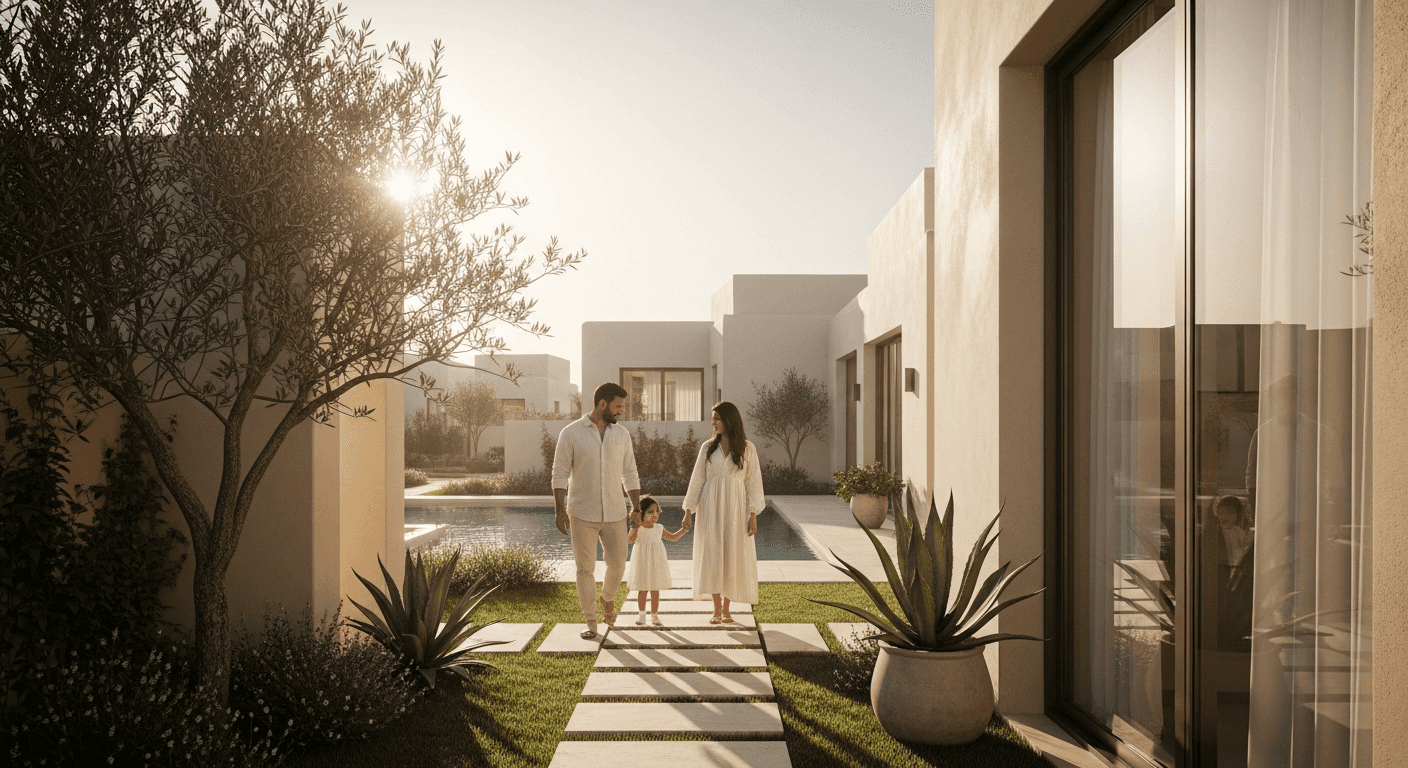
Entry Point to Elegance: Your First Dubai Family Villa
Thinking of upgrading from an apartment to a villa? As a family grows, so does the need for space. I’ll walk you through finding your first family villa in Dubai's most beloved established communities.

It’s a story I’ve heard countless times over coffee with clients, many of whom have become friends. A young couple moves to Dubai, falls in love with the city from a sparkling apartment in Dubai Marina, and starts a family. Then, the moment a toddler discovers how to run, the walls of that beautiful two-bedroom start to feel a little closer. The desire for a patch of green, for a quiet street where kids can ride their bikes, becomes a constant, gentle pull. This is the moment when the search for a first family villa begins, a significant and exciting milestone in any family’s Dubai story.
Here at Gaia Living, we see this transition as more than just a property search; it’s about finding a community that will shape your family’s life for years to come. In this guide, I want to take you beyond the listings and into the heart of what it means to find your family’s first real home in the city.
Here’s what we’ll explore:
- The 'Why' and 'When': Deciphering the right time to make the move from an apartment.
- Defining 'Entry Point': What AED 3-5 million really buys you in the villa market today.
- Spotlight on The Originals: A deep dive into Arabian Ranches, The Springs, and JVT.
- Exploring The New Classics: How communities like Al Furjan and DAMAC Hills offer compelling value.
- The Financials: A complete, line-by-line breakdown of the total cost of buying your villa.
- Beyond the Price Tag: Understanding service charges, maintenance, and other long-term costs.
- The School Run Factor: How mapping communities to top family-friendly schools can be the key.
- My Verdict: Weighing the trade-offs to make the best choice for your family's future.
The Great Migration: Why Families Are Seeking Villa Life
I often call it the 'great migration' — the move from vertical living in the city's glittering towers to horizontal living in its leafy suburbs. It’s a natural progression for so many residents. The initial allure of a high-floor apartment with a stunning skyline view is powerful, and for a professional couple or single person, it's often the perfect Dubai experience. You're close to the action, the amenities are superb, and life is conveniently contained. But family life introduces new variables into the equation. Suddenly, the balcony isn't quite a substitute for a garden, and the shared swimming pool, however beautiful, doesn’t allow for the same spontaneous splash-abouts as a backyard. The need for storage multiplies, as does the need for separate spaces where children can play and adults can find a moment of peace.
This shift isn't just about needing more square footage; it's a profound lifestyle choice. It’s about envisioning your children learning to ride a bike on a quiet cul-de-sac, about weekend barbecues in your own private garden, and about building relationships with neighbours over the park bench while the kids play. These are the intangible benefits that drive families to look towards villa communities. It’s the sound of birds in the morning instead of traffic, the sight of green parks and mature trees, and the sense of security that comes from being in a gated, family-oriented environment. This is the dream that fuels the search for the perfect family entry point homes.
Of course, it involves trade-offs. For many, it means a longer commute to the office in DIFC or Dubai Media City. It means swapping the immediate convenience of a ground-floor Carrefour for a weekly shop at a larger community centre. But for a growing number of families, the scales are tipping decisively in favour of space, community, and a different pace of life. This is particularly true in the post-pandemic world, where the home has become more central than ever — serving as an office, a school, and a sanctuary. The premium on private outdoor space has never been higher, and this has only accelerated the migration to villa living for first-time villa buyers Dubai.
What Does 'Affordable' Mean? Decoding the Entry-Point Villa Market
 Featured project
Let’s talk numbers, because in real estate, aspirations must meet reality. The term 'affordable' is relative, especially in a premium market like Dubai. When we discuss starter homes established communities, what are we really talking about in terms of price? In today's market, a realistic entry point for a well-located, three-bedroom family villa or townhouse is in the range of AED 3 million to AED 5 million. It’s crucial to manage expectations: this budget won't secure a sprawling, brand-new mansion on a golf course. Instead, it’s the key to unlocking a comfortable, well-built home in a community rich with amenities and character.
Within this bracket, you'll encounter a few main property types. The most common entry point is the townhouse, which is part of a row of houses and shares walls on both sides. This is often the most budget-friendly option and a fantastic first step on the property ladder. A step up is the semi-detached villa, which shares only one wall with a neighbour, offering a bit more privacy and often a slightly larger plot. Finally, you have the detached or independent villa, which stands alone on its own plot. Finding affordable detached villas Dubai is challenging, but in some communities, older, smaller detached villas can occasionally fall within the higher end of this entry-level price range.
It’s also important to understand that the market has evolved. The prices from five or six years ago are a distant memory. The key is not to get discouraged by past benchmarks but to understand the value proposition in the current climate. An AED 3.5 million townhouse in a mature community today comes with a decade or more of established infrastructure: grown trees providing shade, proven school routes, active community centres, and a stable, friendly neighbourhood. You are buying into a known quantity, a community with a soul. This is a very different proposition from buying off-plan in a remote, undeveloped area. For younger families, the certainty and immediate liveability of an established community often outweigh the allure of a brand-new but unproven alternative.
The Originals: Arabian Ranches, The Springs & JVT
When clients ask me where to start their search, I often point them towards the 'Originals' — the communities that defined family living in Dubai and continue to set the standard. These are places that have had time to mature, for trees to grow tall, and for a genuine sense of community to take root. They remain the gold standard for a reason.
First on my list is always Arabian Ranches. Developed by Emaar Properties, it is the quintessential Dubai family suburb. It’s not just a collection of houses; it’s a fully realised lifestyle. The community is divided into several distinct sub-communities, with the entry-point townhouses and smaller villas typically found in areas like Palmera and Al Reem. While prices here push the upper limit of our 'entry' bracket, often starting closer to AED 4 million, what you get in return is undeniable. The architecture is charming, the landscaping is immaculate, and the amenities are second to none, from the Arabian Ranches Golf Club to the Ranches Souk. Most importantly for families, it is home to the highly-regarded Jumeirah English Speaking School (JESS), making the morning school run a short walk or bike ride away.
Next is The Springs, another Emaar masterpiece. For years, The Springs has been the go-to for first-time villa buyers Dubai. It's a sprawling community of two and three-bedroom townhouses set around a series of beautiful lakes and parks. The properties are uniform in design, which creates a harmonious aesthetic, but the real magic is the layout. Winding paths, abundant green spaces, and community pools every few streets create an environment where children can play freely and neighbours become friends. While the homes are older and may require some cosmetic updating, their location is superb, set between The Meadows and Emirates Hills, with easy access to Sheikh Zayed Road. The community centres are bustling hubs, and the proximity to top schools like Dubai British School makes it a perennial favourite for families.
Rounding out the Originals is Jumeirah Village Triangle (JVT), developed by Nakheel. For a long time, JVT was considered the slightly more affordable cousin to the Emaar communities, but it has truly come into its own. What sets JVT apart is its plot-centric design; many of the townhouses and smaller villas here boast more generous garden sizes than their counterparts in The Springs. The community has seen significant development in recent years, with its own schools (like Sunmarke), parks, and a new community mall. For families who want a bit more private outdoor space for their money and appreciate the straightforward grid layout, JVT represents a fantastic balance of value, space, and community maturity.
The New Classics: Value in Al Furjan & DAMAC Hills
While the 'Originals' have a timeless appeal, a newer generation of communities has emerged over the last decade, now fully established and offering their own unique advantages. I call them the 'New Classics'. These communities, once considered up-and-coming, are now mature, vibrant, and present some of the most compelling value propositions for younger family villas Dubai.
Al Furjan, a Nakheel development, is a prime example. What was once a quieter outpost has been transformed by strategic infrastructure, most notably the Route 2020 Metro extension, which gives it a level of public transport connectivity that few other villa communities can match. This is a huge plus for families with teenagers or those with one partner commuting to the Marina/JLT area. The homes in Al Furjan, distinguished by their 'Quortaj' (North African) and 'Dubai' (local traditional) architectural styles, are known for being spacious. You often get more internal square footage for your money compared to older communities. The community has its own Pavilions with shops and restaurants, and the landscaping has matured beautifully, creating a pleasant, family-friendly environment. For those who prioritize space and connectivity, Al Furjan is a very smart choice.
Then there is Damac Hills and Damac Hills II. Focusing on the original DAMAC Hills, this community brought a different flavour to the Dubai suburbs. Centered around the spectacular Trump International Golf Club Dubai, it has a more contemporary, luxurious feel. Developed by Damac, it offers a vast range of properties, from compact townhouses in clusters like Brookfield and Trinity to larger independent villas. What impresses me most about DAMAC Hills, beyond the initial glamour, is the sheer quality and variety of the family amenities. There's a skate park, a wave pool, horse stables, a fishing lake, and numerous parks and sports facilities. It feels like a self-contained resort. Beyond that, the relocation of the prestigious Jebel Ali School to a state-of-the-art campus within the community was a game-changer, cementing its status as a top-tier family destination.
These New Classics demonstrate how the Dubai property market continually evolves. They learned from the Originals, often incorporating larger floor plans or more extravagant amenities to create a distinct identity. For a family entering the market today, they represent a chance to buy into a relatively new home within a fully functioning, amenity-rich community. The initial teething problems are long gone, and what remains is a fantastic opportunity to secure a modern family home with excellent long-term potential. They offer a different, but no less compelling, version of the Dubai family dream.
The Full Cost of Buying: A Line-by-Line Breakdown
This is the part of the conversation where I ask my clients to take a deep breath and put the glossy brochures aside. Finding your dream home is emotional and exciting, but buying it is a financial transaction that requires absolute clarity. The sticker price is just the beginning. Understanding the full, upfront cash outlay is the most important step in a successful and stress-free purchase. The rules set by the Central Bank of the UAE state that expatriate residents require a minimum 20% down payment for a first property valued under AED 5 million.
Let’s walk through a real-world example to see how the numbers add up. Imagine we've found a lovely 3-bedroom townhouse in JVT, and we've agreed on a purchase price of AED 3,500,000. Here is the breakdown of the cash you would need to have ready on hand to complete the purchase:
- Purchase Price: AED 3,500,000
- Down Payment (20% of Purchase Price): AED 700,000
- Dubai Land Department (DLD) Transfer Fee (4% of Purchase Price): AED 140,000
- DLD Registration Fee: AED 4,000 + 5% VAT = AED 4,200
- Mortgage Registration Fee (0.25% of Loan Amount of AED 2.8M): AED 7,000
- Real Estate Agency Fee (2% of Purchase Price): AED 70,000 + 5% VAT = AED 73,500
- Bank Mortgage Arrangement Fee (can be up to 1% of Loan): AED 28,000 + 5% VAT = AED 29,400
- Property Valuation Fee (Bank requirement): Approx. AED 3,000 + 5% VAT = AED 3,150
- Trustee Office Fee (to facilitate the transfer): Approx. AED 4,000 + 5% VAT = AED 4,200
- Developer No Objection Certificate (NOC) Fee: Varies, but let's budget AED 1,500
Total Upfront Cash Required: AED 962,950
As you can see, to buy a home for AED 3.5 million, you need nearly AED 1 million in liquid cash. The 4% DLD fee, mandated by the Dubai Land Department (DLD), is the largest single component after the down payment. It's a significant sum that often surprises first-time buyers. The agency fee is our commission for sourcing the property, negotiating the price, and managing the entire complex transfer process. The bank fees, valuation, and trustee costs are all standard parts of the mortgage and transfer procedure. This detailed breakdown isn't meant to scare you, but to empower you. Going into your search with this knowledge allows you to budget properly and negotiate from a position of strength.
Beyond the Purchase: Understanding Ongoing Costs
Securing the keys to your new villa is a momentous achievement, but it's important to remember that your financial commitment doesn't end there. Responsible homeownership involves planning for a series of ongoing costs. I always advise my clients to create a separate annual budget for their home, distinct from their monthly mortgage payments. This foresight prevents surprises and ensures you can enjoy your new home without financial stress.
“The perfect 'starter' villa isn't about finding the cheapest property; it's about finding the community where your family's life can unfold most happily.”
The most significant ongoing expense is the annual service charge. These fees are collected by the community management company to cover the upkeep of all shared areas — the landscaping, swimming pools, parks, security, and general maintenance of the community's infrastructure. In Dubai, service charges are calculated per square foot of your property’s Built-Up Area (BUA). For villa communities, these fees are generally lower than in high-rise towers with elevators and air-conditioned lobbies. You can expect a range of approximately AED 2.50 to AED 5.50 per square foot. So, for a 3,000 sq ft villa, your annual service charge could be anywhere from AED 7,500 to AED 16,500. In my experience, the older Emaar communities often have very reasonable charges, as they are well-managed and the initial infrastructure costs have long been amortized.
Next is your utility bill from DEWA (Dubai Electricity and Water Authority). Be prepared for this to be higher than in your apartment. You'll be cooling a larger space, and if you have a garden, your water usage will increase. Your DEWA bill also includes a 'housing fee', which is calculated as 5% of your property's average rental value as determined by RERA, paid in monthly instalments. Then there's the cost of maintenance within your own property line. Unlike renting, where you call the landlord for a leaky tap, you are now the landlord. This includes regular AC servicing (essential in Dubai!), plumbing, electrical work, painting, and any pest control. If your villa has a private pool, you'll also need to budget for its regular cleaning and chemical balancing. A good rule of thumb is to set aside 1-2% of your property's value each year for this maintenance fund. Finally, home insurance is mandatory if you have a mortgage, and it's simply a wise investment for any homeowner, protecting your biggest asset against unforeseen events.
The School Run: A Deciding Factor for Families
If there’s one factor that can trump all others in a family's decision-making process, it’s the school run. I’ve seen clients with a spreadsheet of their top five communities completely redraw their map after visiting schools. The daily grind of a long and stressful commute to get children to school and back can overshadow even the most beautiful home. In Dubai, where the quality of education is high but places can be competitive, choosing a community that is intrinsically linked to good schools is not just a convenience; it's a strategic life decision.
This is where the established communities truly shine. They have become hubs for some of the city’s best-regarded educational institutions. Take Arabian Ranches, for example. The presence of JESS, a top-tier, non-profit British curriculum school, right inside the community is arguably its biggest selling point for families. The ability for older children to walk or cycle to school is a luxury that is hard to put a price on. Similarly, The Springs and the wider Emirates Living area are home to outstanding schools like Dubai British School and Emirates International School. For decades, families have chosen these areas specifically to be within the catchment zone of these institutions.
This trend continues in the New Classics. The decision by Jebel Ali School, one of Dubai's oldest and most respected schools, to relocate its entire campus to Damac Hills and Damac Hills II was a massive endorsement of the community's family credentials. It instantly put DAMAC Hills on the radar for parents who might have previously overlooked it. In Al Furjan, the presence of The Arbor School, with its unique focus on eco-literacy and sustainability, attracts a specific type of family who values that educational philosophy. When we at Gaia Living are showing families around, the conversation is never just about bedrooms and garden size; it's about proximity to schools, the route, the traffic, and the availability of school buses. My advice is always to do the school run yourself at 7:30 AM before you commit to a property. It might just be the most important research you do.
To help with this, I often give clients this simple checklist for their property viewings:
- Time the Drive: Drive from the property to your preferred school(s) during peak morning and afternoon traffic.
- Check Bus Routes: Confirm the availability and cost of the school bus service for that specific address.
- KHDA Ratings: Check the latest inspection reports from the Knowledge and Human Development Authority (KHDA) for your shortlisted schools.
- Curriculum & Fit: Ensure the school's curriculum (e.g., British, IB, American) and ethos align with your family's values.
- Admissions Status: Contact the school's registrar to understand the current availability of places for your children's year groups.
My Verdict: Finding Your Place in the Sun
After guiding so many families on this journey, my core belief is this: the perfect family entry point homes are not found by ticking boxes on a spreadsheet alone. It's about finding the place that feels right, the community where you can see your family's story unfolding. The decision involves a series of personal trade-offs. Are you willing to accept an older, smaller home for the unbeatable location and mature greenery of The Springs? Or does the larger, more modern space and superb amenities of DAMAC Hills, albeit with a slightly longer commute, better suit your lifestyle? Is the metro connectivity of Al Furjan a non-negotiable, or does the prestige and proven track record of Arabian Ranches align more with your long-term goals?
There is no single right answer. I've worked with families who have happily chosen each of these options and more. The key is to approach the search with open eyes, armed with a realistic understanding of your budget and a clear list of your family’s unique priorities. Think about your life not just next year, but in five or ten years. Will the community grow with you? Are there sports facilities for when the kids are older? Is there a sense of place that makes you feel proud to call it home?
My role, and the role of our team at Gaia Living, is to facilitate this process of discovery. We listen to your story, understand your needs, and then use our deep, on-the-ground knowledge to connect you with the communities that will best serve you. We can explain the nuances of service charges in one building versus another, the subtle differences in build quality from one developer to the next, and the direction a community is heading in the years to come. We help you move from the overwhelming list of properties for sale to a curated shortlist of genuine possibilities.
The journey to your first family villa is a major life step. Prioritise your family's lifestyle — be it schools, green space, or community feel, over chasing the 'best deal'. A home in a mature, stable community is more than a financial asset; it's an investment in your family's happiness and well-being. The right community will pay you back every single day in ways that can't be measured on a balance sheet.
Sources
- Dubai Land Department (DLD): https://dubailand.gov.ae
- Central Bank of the UAE: https://www.centralbank.ae
Questions, answered
- What is a realistic starting budget for a family villa in an established Dubai community?
- A realistic budget for a 3-bedroom townhouse or semi-detached villa in a good established community starts from AED 3 million to AED 3.5 million. For a fully detached villa or a home in a premium community like Arabian Ranches, you should expect to budget closer to AED 4 million and above.
- How much cash do I need upfront to buy a villa in Dubai?
- You typically need 25-30% of the property's purchase price in cash upfront. This covers the minimum 20% mortgage down payment, the 4% DLD transfer fee, agency fees, and various other registration and administrative costs.
- Which are the best established communities for first-time villa buyers?
- Emaar's Arabian Ranches and The Springs are classic choices known for their mature landscaping and strong community feel. Nakheel communities like Jumeirah Village Triangle (JVT) and Al Furjan offer excellent value and larger plots, while DAMAC Hills provides extensive modern amenities.
- What are villa service charges in Dubai and how much are they?
- Service charges cover the maintenance of all common areas in your community, including parks, pools, security, and landscaping. For villas, they typically range from AED 2.50 to AED 5.50 per square foot of your property's built-up area annually.
- Are older villas in Dubai a good investment?
- Yes, an older villa in a prime, established community can be an excellent choice. While it may require some upgrades, the mature green spaces, central location, and strong community infrastructure often lead to stable demand and good potential for capital appreciation.
- How important is the school run when choosing a family villa?
- For most families in Dubai, proximity to a good school is a primary factor. A short school run can significantly improve daily quality of life, and communities built around top-tier schools like JESS in Arabian Ranches or Dubai British School near The Springs often command a premium for this reason.

Sophia profiles Dubai's villa communities — schools, commute times, green space, and the intangible feel of a neighbourhood. She writes for families putting down roots.
Related stories
Dubai's Established Charm: The Case for Older Homes
In a city focused on the future, I believe the smartest move for many buyers is to look back. Dubai's seasoned communities offer space, character, and surprising value that new builds often can't match.
The True Cost of Owning a Dubai Property
Beyond the purchase price, your annual budget for a Dubai home must account for service charges, utilities, and maintenance. I'll break down every ongoing expense you need to plan for.
Calculating ROI on Dubai Rental Upgrades
As a landlord in Dubai, you can't just follow trends. I'll show you how to calculate the precise ROI of minor property upgrades to genuinely increase your rental yield.
Echoes, in your inbox
One thoughtful email a month. Market insight, new launches, no spam.