

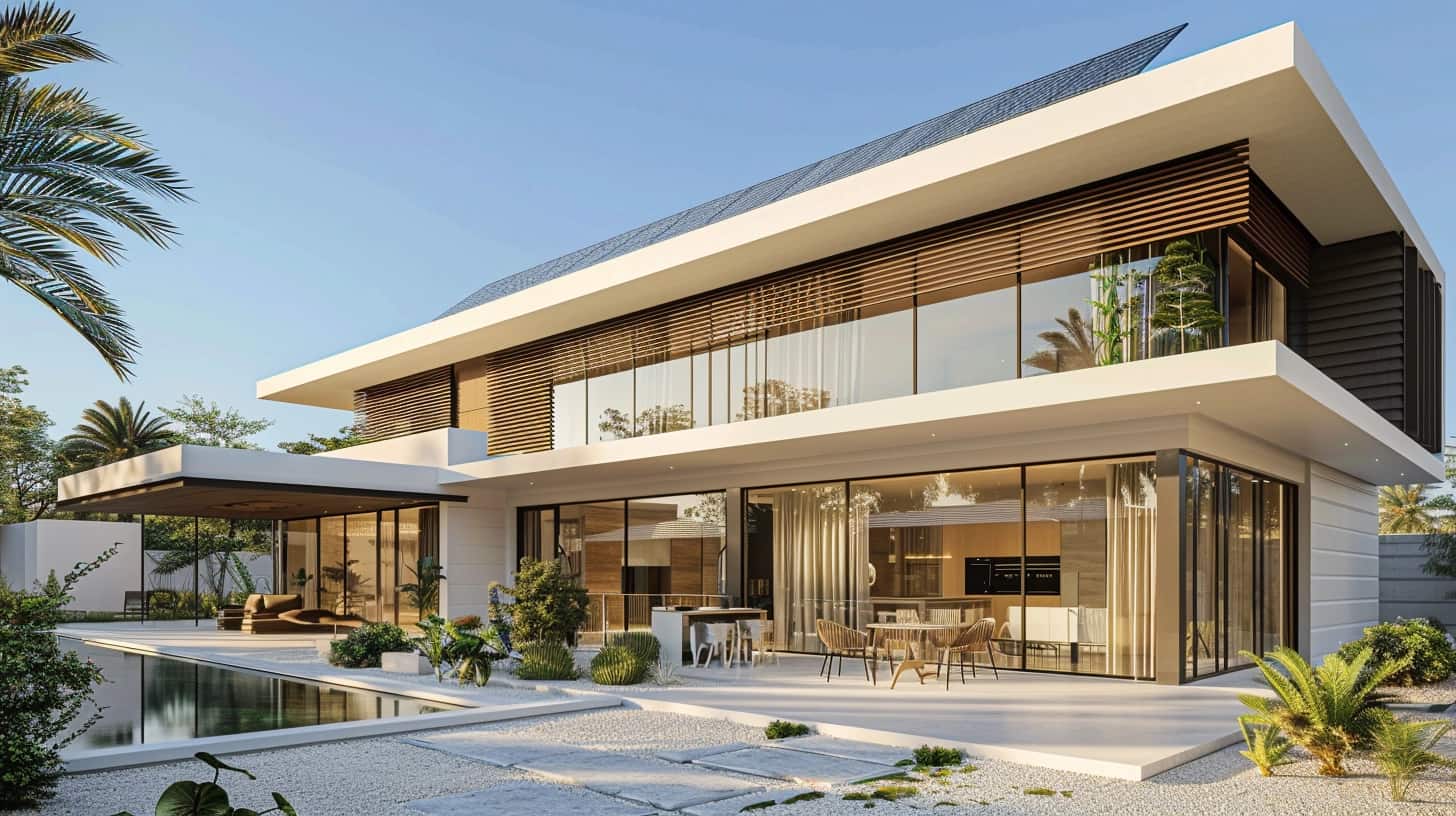
Why Eco-Friendly Villas Are Gaining Popularity in Abu Dhabi
A few years ago, “sustainable villa” in Abu Dhabi meant that there were solar panels on the roof and a brochure from the developer filled with images of greenery.
A few years ago, “sustainable villa” in Abu Dhabi meant that there were solar panels on the roof and a brochure from the developer filled with images of greenery. In other words, there was nothing different about the product itself in comparison to other offerings in the market, and the concept was clearly behind the reality.
However, this is no longer the case. In 2025, the eco-friendly or sustainable villas in Abu Dhabi are different in terms of energy expenditures, indoor air quality, and other factors that affect the overall cost of ownership and resale value of the property. And this is what the buyer has come to realize, and this is what the market has responded to accordingly.
The reason for this is multifaceted, and there are several factors that have come together to make this shift in the market occur. Firstly, there has been a concerted move by the government in Abu Dhabi to raise the bar in terms of sustainability in construction, and this has been done through the Estidama Pearl Rating System, which sets the minimum standards in terms of green buildings and sustainability in all commercial and residential developments in the emirate. In addition to this, there has clearly been a move by developers to capitalize on this and to raise awareness about the importance of sustainability in buildings among the populace. However, there has also been a rise in the number of people living in the emirate, and this includes people who have moved to Abu Dhabi from other European cities that are at the vanguard of sustainability and green living.
None of this means that Abu Dhabi has suddenly emerged as a leader in terms of sustainable living and eco-friendly buildings in the world, because it has not. However, the trend is clear, and it is gaining speed with time. It is important to understand why there is a move towards eco-friendly living in terms of villas in Abu Dhabi, what this actually means in terms of differentials in comparison to conventional buildings, and what this investment option is all about, and this article aims to do just that, sustainability in terms of buildings and what this means in the current market, as opposed to sustainability as an abstract concept.
What Eco-Friendly Actually Means in Abu Dhabi's Villa Market
The term gets used loosely and it's worth being specific about what genuinely sustainable construction looks like in Abu Dhabi versus what's just marketing language with a leaf logo attached.
Abu Dhabi's Estidama Pearl Rating System is the regulatory framework that sets the standard. Introduced in 2010 and mandatory for all new residential developments in the emirate, it rates buildings on a scale from 1 Pearl to 5 Pearls across categories including energy efficiency, water conservation, indoor environment quality, and materials sourcing. A 1 Pearl rating is the minimum required for new construction. Most high-end eco-friendly villas targeting the sustainability-conscious buyer market are aiming for 2 Pearl or above.
Here's what a genuinely eco-friendly villa in Abu Dhabi typically includes versus standard construction:
- Building envelope insulation: high-performance wall and roof insulation that reduces heat transfer and lowers the load on air conditioning systems, which is the single biggest driver of energy consumption in UAE homes
- Double or triple glazed windows: significantly reduces solar heat gain compared to standard single glazing, which is still used in older and lower-specification buildings
- Solar photovoltaic panels: rooftop solar generating a portion of the home's electricity requirement, with some newer developments targeting net-zero energy consumption during the cooler months
- Grey water recycling systems: treating and reusing wastewater from sinks and showers for garden irrigation, reducing freshwater consumption in a country where desalinated water is both expensive and energy-intensive to produce
- Smart home energy management: automated systems that optimise AC, lighting, and appliance usage based on occupancy and time of day, reducing consumption without requiring behavioural change from residents
- Low-VOC materials and ventilation systems: paints, adhesives, and finishes that don't off-gas harmful chemicals, combined with mechanical ventilation that maintains indoor air quality without opening windows in extreme heat
- Native and drought-resistant landscaping: garden design that minimises irrigation requirements by using species suited to the Gulf climate rather than water-intensive grass lawns
Dr. Sultan Al Jaber, UAE Minister of Industry and Advanced Technology and chairman of Masdar, has stated publicly that the built environment accounts for approximately 40% of the UAE's total energy consumption. Making residential buildings more efficient is therefore not a niche environmental concern but a national infrastructure priority, and Abu Dhabi's regulatory framework reflects that.
Why Buyers Are Actually Choosing Eco-Friendly Villas
The conversation used to be almost entirely about values. Buyers who cared about environmental impact chose sustainable properties. Buyers who didn't, didn't. That binary has broken down.
The reason is simple. The financial case for eco-friendly villas has become concrete enough that buyers who have no particular environmental motivation are choosing them on economic grounds alone.
Here's what the cost difference actually looks like in practice:
A standard 4-bedroom villa in Abu Dhabi with conventional construction and no efficiency measures will typically generate monthly DEWA equivalent bills of AED 3,000 to AED 5,500 during the summer months when air conditioning runs almost continuously. A comparable villa built to Estidama 2 Pearl standard with rooftop solar, high-performance insulation, and a smart energy management system typically generates bills of AED 1,200 to AED 2,500 for the same period.
That's a saving of AED 1,500 to AED 3,000 per month during the six to eight months of heavy AC usage. Over a full year, the savings range from approximately AED 10,000 to AED 22,000 depending on the villa size and the specific efficiency measures installed. Over a ten-year ownership period, that's AED 100,000 to AED 220,000 in avoided utility costs. That's a meaningful financial argument that has nothing to do with environmental values.
Water costs follow a similar pattern. Abu Dhabi's water tariffs have been rising as the government moves toward cost-reflective pricing. A villa with grey water recycling and drought-resistant landscaping can reduce water consumption by 30% to 50% compared to a comparable standard villa. At current and projected tariff levels, that translates to real savings that compound over time.
Sarah Hamouda, a sustainable design consultant based in Abu Dhabi who has worked on several Aldar and Masdar-linked residential projects, told us in a 2024 interview that the question she hears most from villa buyers has shifted. "Five years ago they asked whether sustainable features were worth the premium. Now they ask whether the premium they're paying is justified by the specific savings the building will deliver. It's a much more sophisticated conversation."
Which Developers Are Actually Building to Higher Standards
Not every developer who puts "eco-friendly" in their marketing is delivering meaningful sustainability features. Here's where the genuine commitment to sustainable construction is most visible in Abu Dhabi's villa market.
Masdar City is the most obvious reference point. The Masdar Institute campus and surrounding developments were conceived from the ground up as a low-carbon urban environment, and the construction standards applied there represent the most serious sustainability commitment in Abu Dhabi's built environment. Bloom Heights within Masdar City applies those standards to residential apartments. Future villa product in or adjacent to Masdar City's expansion zones will likely continue that approach.
Aldar Properties has the broadest reach and the most visible commitment to sustainability across its residential portfolio. Aldar's Estidama compliance across its developments is above the minimum requirement on most projects, and their newer communities including parts of Saadiyat Lagoons and Yas Acres incorporate meaningful efficiency measures beyond the regulatory baseline. Aldar published a sustainability report in 2024 committing to net-zero carbon emissions across its development portfolio by 2050, with interim targets for 2030 that include reducing embodied carbon in new construction by 25%.
Reportage Properties has several villa and townhouse communities in Abu Dhabi that have incorporated solar and efficiency measures as standard rather than as optional upgrades, which matters for buyers who don't want to negotiate these features into a purchase separately.
Here's a comparison of sustainability features across active Abu Dhabi villa developers:
- Aldar (Saadiyat Lagoons, Yas Acres): Estidama 2 Pearl minimum, solar ready infrastructure, smart metering, efficient HVAC systems
- Reportage (Diva, Raha Village): solar panels standard on selected units, high-performance insulation, grey water systems in some phases
- Bloom Living (Zayed City): Estidama compliance, energy efficient systems, native landscaping programme
- Masdar City adjacent developments: highest standard, targeting net-zero energy in some buildings
- Standard market villas (older stock): Estidama 1 Pearl minimum only, limited additional efficiency measures
Our Original Research: Utility Cost Comparison Across Abu Dhabi Villa Types
We modelled annual utility costs for three comparable 4-bedroom villa configurations in Abu Dhabi, representing different levels of sustainability specification. This is our own analysis based on Abu Dhabi Distribution Company tariff structures, typical consumption data, and efficiency estimates from published building performance studies.
All three villas are assumed to be approximately 350 square metres of built area, fully occupied, with similar family profiles.
Standard construction villa (Estidama 1 Pearl, no additional features):
- Annual electricity consumption: approximately 85,000 to 100,000 kWh
- Annual electricity cost: AED 22,000 to AED 28,000 at current tariff rates
- Annual water consumption: approximately 800 to 1,000 cubic metres
- Annual water cost: AED 8,000 to AED 12,000
- Total annual utility cost: AED 30,000 to AED 40,000
Mid-efficiency villa (Estidama 2 Pearl, improved insulation, smart systems):
- Annual electricity consumption: approximately 55,000 to 70,000 kWh
- Annual electricity cost: AED 14,000 to AED 18,000
- Annual water consumption: approximately 600 to 800 cubic metres
- Annual water cost: AED 6,000 to AED 9,000
- Total annual utility cost: AED 20,000 to AED 27,000
High-efficiency villa (Estidama 3 Pearl, solar panels, grey water, full smart system):
- Annual electricity consumption net of solar generation: approximately 20,000 to 35,000 kWh
- Annual electricity cost: AED 5,000 to AED 9,000
- Annual water consumption: approximately 400 to 550 cubic metres with grey water recycling
- Annual water cost: AED 4,000 to AED 6,000
- Total annual utility cost: AED 9,000 to AED 15,000
Ten-year utility cost differential between standard and high-efficiency villa: AED 150,000 to AED 250,000 in favour of the high-efficiency option. That's a significant number when set against the typical AED 100,000 to AED 200,000 premium that high-efficiency villas command over standard construction at comparable sizes and locations.
In other words, the premium pays for itself within five to eight years purely through utility savings, with additional savings accruing for the remaining life of the building. That's before factoring in any resale premium for the sustainable specification.
The Resale and Rental Premium: What the Market Is Actually Paying
Utility savings are one part of the investment case. The resale and rental premium attached to sustainable villa credentials is the other part and it's becoming easier to measure as more transactions accumulate.
Knight Frank's 2024 Global Residential Cities Index noted that sustainability certifications were beginning to show measurable price premiums in Middle Eastern residential markets, with Abu Dhabi specifically cited as a market where Estidama 2 Pearl and above was generating buyer willingness to pay approximately 8% to 15% above equivalent non-rated product.
In the rental market, the premium is also real. Tenants in Abu Dhabi's mid-to-high income bracket, particularly those relocating from European cities with strong green building cultures, are increasingly asking specifically about energy efficiency and utility costs before committing to a lease. A villa with demonstrably lower running costs is easier to rent, rents at a premium, and retains tenants longer.
Here's what the rental differential looks like in practice across Abu Dhabi villa communities in 2025:
- Standard 4-bed villa in Khalifa City or Mohammed Bin Zayed City: AED 130,000 to AED 180,000 per year
- Comparable 4-bed villa with strong sustainability credentials in newer communities: AED 145,000 to AED 200,000 per year
- Premium: approximately 8% to 15% above standard product
That rental premium, combined with the lower utility costs that landlords can use as a marketing point for furnished or utilities-included rentals, means the investment case for eco-friendly villas has become genuinely compelling in Abu Dhabi's current market.
What to Look for When Buying an Eco-Friendly Villa in Abu Dhabi
Not every villa marketed as sustainable is worth the premium. Here's how to evaluate whether a specific property's green credentials are real and commercially meaningful.
A practical checklist for eco-friendly villa buyers in Abu Dhabi:
- Ask for the specific Estidama Pearl Rating certificate for the building, not just the developer's claim of compliance, the certificate is issued by Abu Dhabi Urban Planning Council and is verifiable
- Request the building's energy performance modelling data if available, this shows projected consumption rather than just the features installed
- Check whether solar panels are owned by the developer or are subject to a power purchase agreement with a third party, PPA arrangements have different financial implications for the buyer
- Ask about the warranty and maintenance responsibility for specialist systems like grey water recycling and smart home management, these require servicing and the cost and responsibility should be clear
- Verify that insulation, glazing, and HVAC specifications meet or exceed Estidama 2 Pearl requirements, not just the 1 Pearl minimum
- For older villas being marketed as eco-friendly after retrofit, ask for documentation of what was installed, by whom, and when, retrofits vary enormously in quality and completeness
- Check whether the villa's landscaping uses automated irrigation with moisture sensors and drought-resistant planting, or whether it's been designed to look good for the sale and requires heavy watering to maintain
- Ask specifically about indoor air quality measures, mechanical ventilation systems with HEPA filtration and low-VOC finishes are meaningfully different from a standard AC system
Our Take on Eco-Friendly Villas in Abu Dhabi
The sustainability premium of villas in Abu Dhabi has moved from aspiration to actual financial reality. Utility savings are actual and quantifiable. Resale and rental premiums are actual and increasing. The regulatory environment is raising standards across the board. And finally, the pool of actual buyers of sustainable specifications is growing as more internationally sophisticated individuals put Abu Dhabi on the world map as their new home.
A wise and necessary caveat is that what is considered ‘eco-friendly’ spans a very broad band of actual specifications. A villa with low-VOC paint and indigenous landscaping is more sustainable than standard construction. A villa with rooftop solar, grey water harvesting, triple glazing, and a smart energy management system is a vastly different financial reality. Buyers need to look beyond marketing and actually scrutinize the actual specifications and actual numbers.
For those who actually undertake the research and find actual high-specification sustainable villas, the case for investing in Abu Dhabi for 2025 is very strong indeed. You are investing in a regulatory environment where standards only move one way, you are investing in a tenant pool where demand is growing and they are willing to pay a premium, and you are investing in actual lower running costs than standard market rate for the lifespan of the building.
We have current villa listings across Abu Dhabi including sustainable and Estidama-rated communities. If you want help identifying which properties genuinely meet the sustainability bar rather than just claim to, our team can walk you through the specifics.
Related stories
Dubai's Established Charm: The Case for Older Homes
In a city focused on the future, I believe the smartest move for many buyers is to look back. Dubai's seasoned communities offer space, character, and surprising value that new builds often can't match.
The True Cost of Owning a Dubai Property
Beyond the purchase price, your annual budget for a Dubai home must account for service charges, utilities, and maintenance. I'll break down every ongoing expense you need to plan for.
Calculating ROI on Dubai Rental Upgrades
As a landlord in Dubai, you can't just follow trends. I'll show you how to calculate the precise ROI of minor property upgrades to genuinely increase your rental yield.
Echoes, in your inbox
One thoughtful email a month. Market insight, new launches, no spam.