

Dubai's Economy Without the Property Hype: What's Actually Driving Growth in 2026
There are many ways one could describe the economic story of Dubai, but too often real estate tends to get the spotlight, perhaps to its unfairness.
There are many ways one could describe the economic story of Dubai, but too often real estate tends to get the spotlight, perhaps to its unfairness. Launches, record-breaking transactions and Golden Visas feature disproportionately in media discussions due to the obvious drama, high stakes and sheer sums of money involved in newsworthy property deals. However, there is a lot more to Dubai’s economy beyond real estate trends, which tends to receive less attention as a result.
According to Dubai Statistics Center data, Dubai’s GDP grew 3.4% in 2024—a decent, but hardly stellar, rate of expansion, and by design. Over the course of the past decade or so, Dubai authorities have been actively working on building an economy that would not depend on oil price volatility, nor would be prone to regular booms and busts driven by the same speculative property market. By all measures, they seem to be succeeding in their efforts. In fact, oil represents an infinitesimal share of Dubai’s GDP, with the remaining economy comprised of trade, logistics, finance, tourism, and increasingly robust technology industry within a jurisdiction that has made itself highly attractive to foreign investment and talent.
This article explores the drivers behind Dubai’s economic growth in 2026 – the sectors that underpin this expansion, policies behind them, issues they face, and finally whether the growth will prove sustainable. As already noted, this article will not talk about Dubai property. That deserves its own treatment. The focus here is on Dubai economy as a basis for its property market.
All data sources used herein include 2024 Dubai Economic Report, IMF UAE Article IV Consultation 2024, and World Bank MENA Economic Update 2024.
Trade and Logistics: The Foundation That Doesn't Get Headlines
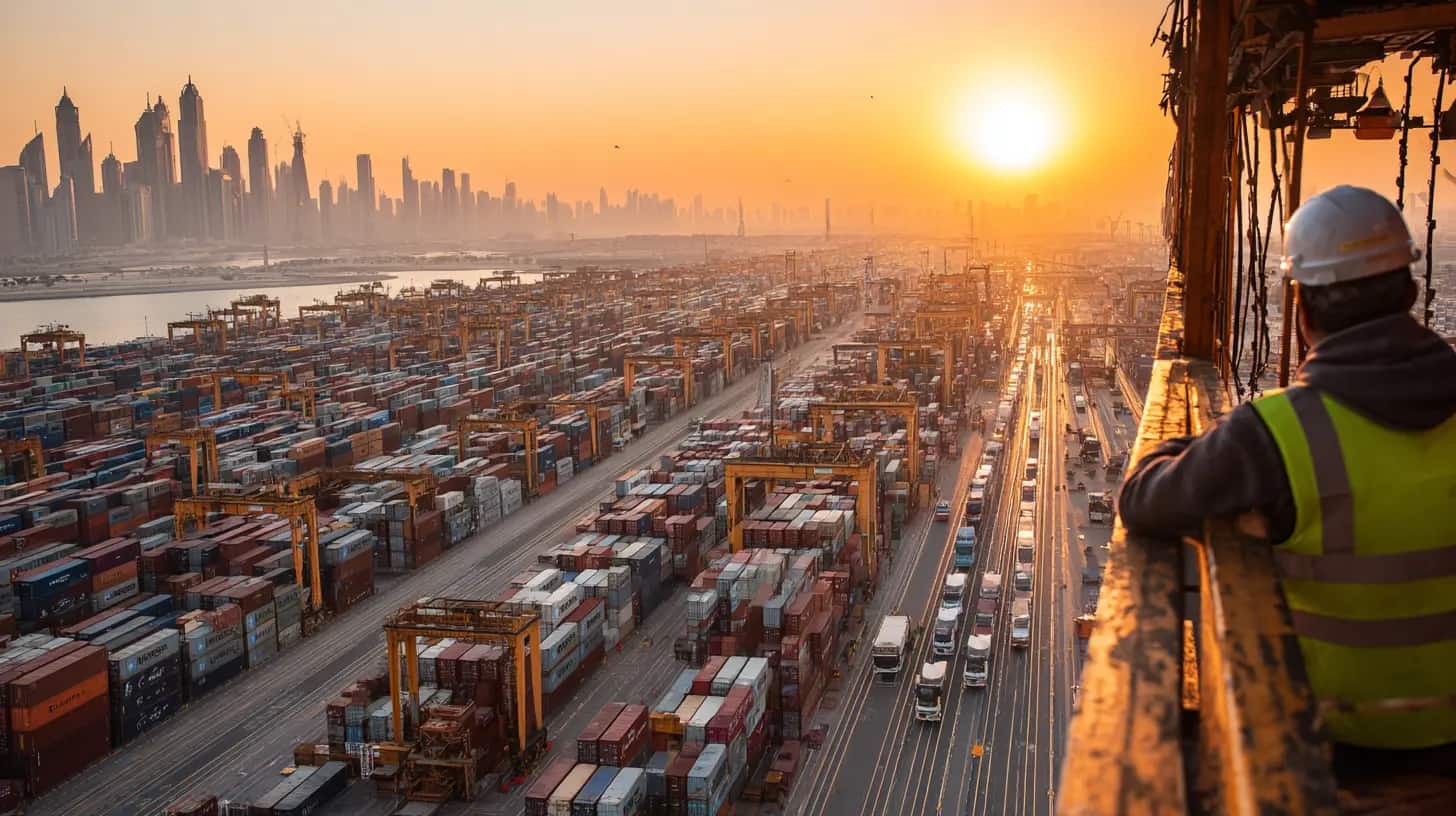
Dubai is, at its core, a trading city. That was true before the property boom, it was true during it, and it will be true after it. The emirate's position at the intersection of Europe, Asia, and Africa — with Jebel Ali Port, Al Maktoum International Airport, and the free zone infrastructure that surrounds them — makes it the natural logistics hub for a region containing over 3.5 billion people within an eight-hour flight radius.
Non-oil foreign trade in Dubai reached AED 2.4 trillion in 2024 according to Dubai Customs, an 11% increase on the previous year. That number is not driven by property investors flying in to sign SPAs. It's driven by container volumes, gold and jewellery re-export, textile trade, electronics distribution, and a food re-export business that supplies much of the MENA region.
What makes Dubai's trade position structurally strong:
- Jebel Ali Port is the largest port in the Middle East and the ninth-largest in the world by container volume. The infrastructure investment over 30 years has created a physical capacity moat that competitors cannot quickly replicate.
- Dubai's 30-plus free zones allow 100% foreign ownership, full profit repatriation, and zero corporate tax for qualifying activities — making them structurally competitive for international businesses that want a regional hub without navigating complex local ownership rules.
- The air cargo capacity at Dubai International Airport and the expanding Al Maktoum International Airport handles a freight volume that makes Dubai one of the top five air cargo hubs globally.
- The UAE has signed Comprehensive Economic Partnership Agreements (CEPAs) with India, Indonesia, Turkey, Israel, and a growing list of other major economies — reducing tariff barriers and increasing trade flow through Dubai specifically.
Sultan Ahmed bin Sulayem, chairman of DP World — the company that operates Jebel Ali and a global network of ports — has noted publicly that Dubai's trade infrastructure advantage compounds over time rather than depreciating. Each year of volume growth makes the ecosystem — freight forwarders, customs brokers, logistics companies, financial services around trade finance — deeper and harder to replicate elsewhere.
The honest challenge: global trade is subject to geopolitical disruption in ways that Dubai can influence but not control. The Red Sea shipping disruptions of 2023 and 2024 affected routes that flow through Dubai. A sustained reorganisation of global trade corridors — driven by US-China decoupling, sanctions regimes, or regional conflict — creates tail risks that the trade-dependent parts of Dubai's economy would feel.
Tourism: The Numbers Behind the Lifestyle Narrative
Dubai recorded 17.15 million international overnight visitors in 2024 — the highest in the emirate's history and a 9% increase on 2023. That makes Dubai the fourth most visited city in the world by international overnight arrivals, behind only Paris, London, and Bangkok.
The tourism contribution to Dubai's GDP runs at approximately 11.5% directly, rising to over 20% when indirect and induced effects are included. This is not small. And the government's tourism strategy is one of the more deliberate and sophisticated in the world — the Expo 2020 legacy, the entertainment investments on Yas Island's Dubai equivalents, the Formula One circuit, the Museum of the Future, the hospitality pipeline — all represent coordinated infrastructure investment aimed at sustaining and growing that visitor number over time.
What's driving tourism growth beyond the traditional luxury narrative:
- Medical tourism is growing faster than leisure tourism as a category. Dubai Healthcare City has positioned itself as a regional hub for medical procedures — cardiac surgery, oncology, orthopaedics — attracting patients from across the MENA region and South Asia who previously travelled to Europe or the US.
- Business events (MICE — Meetings, Incentives, Conferences, Exhibitions) account for a significant proportion of Dubai's international arrivals. Gitex, Arab Health, and Cityscape are among the world's largest events in their respective sectors and are anchored in Dubai.
- The entertainment pipeline is genuinely expanding — live music, major sporting events, the F1 Abu Dhabi Grand Prix weekend that overflows into Dubai, boxing and UFC events at Etihad Arena — creating new reasons for repeat visitation beyond the traditional shopping and beach proposition.
- The Indian and South Asian visitor market is the largest source by nationality and continues growing, underpinned by the deep cultural and economic connections between the subcontinent and the UAE.
The challenge:
Dubai's tourism model depends significantly on the continued operation of Emirates airline, which provides the connectivity that makes the city's visitor volume possible. Emirates is genuinely one of the world's best-run airlines but it's a single point of connectivity risk in a way that cities with multiple hub carriers don't face to the same degree.
Financial Services: Quiet Ambitions, Real Progress
Dubai's financial services sector doesn't generate the same breathless coverage as the property market but it's been growing consistently and is now large enough to matter to the broader economic story.
The DIFC — Dubai International Financial Centre — is the jurisdiction that matters most here. It operates as a common law jurisdiction with its own courts, its own regulators, and a legal framework that international financial institutions recognise and trust. The DIFC's tenant list has expanded from a handful of banks in 2004 to over 6,000 registered companies today, including the regional headquarters of most major global banks, asset managers, law firms, and accounting firms.
What's growing within financial services:
- Asset management: Dubai has attracted an increasing number of family offices and private wealth managers, driven partly by the Golden Visa programme and partly by the region's accumulation of private wealth. The total assets under management in DIFC-registered entities grew 14% in 2024.
- Fintech: the DIFC's FinTech Hive and the broader UAE regulatory sandbox have attracted over 200 fintech companies operating in payments, lending, insurance technology, and blockchain applications. Several have scaled to regional prominence.
- Islamic finance: Dubai has positioned itself alongside Kuala Lumpur as one of the global centres for sukuk (Islamic bond) issuance and Islamic banking products. The sukuk market globally has grown significantly and Dubai's share of that market has grown with it.
- Commodity trading: the Dubai Mercantile Exchange and DGCX (Dubai Gold and Commodities Exchange) handle significant volumes of energy and precious metals trading that most casual observers of Dubai's economy don't register.
The honest limitation:
Dubai is not London or New York. The depth of capital markets, the liquidity of the equity market, and the ecosystem of specialist financial services that only exist in the deepest global financial centres are not replicated in Dubai yet. The DIFC is excellent at what it does — regional hub, private wealth, trade finance, Islamic finance — and less relevant for the kinds of complex structured finance, primary equity issuance, or deep fixed income activity that London and New York dominate.
According to the IMF's UAE Article IV Consultation 2024, the UAE's financial sector is one of the most resilient in the MENA region, with well-capitalised banks, improving credit quality, and growing non-oil revenue streams that reduce fiscal dependence on hydrocarbon income. The assessment for Dubai specifically highlighted the DIFC's growth as a structural positive for the emirate's medium-term economic outlook.
Technology and the Digital Economy: Ambition Meeting Reality
Dubai's technology sector ambitions are large and loudly stated. The reality is more nuanced — genuine progress in some areas, more aspiration than substance in others.
What's genuinely working:
The free zone model applied to technology — Hub71 in Abu Dhabi, Dubai Internet City, Dubai Silicon Oasis — has attracted a real cluster of technology companies. These aren't all startups operating on government subsidy. Companies like Careem (acquired by Uber for $3.1 billion), Fetchr, and a growing number of B2B software companies have built genuine regional businesses from UAE bases.
The e-commerce and logistics technology sector has benefited from Dubai's physical infrastructure — the same ports and airports that move physical goods efficiently have become platforms for digital trade logistics, last-mile delivery optimisation, and cross-border e-commerce services that are growing rapidly as regional internet penetration deepens.
Artificial intelligence is being backed with real government capital. The UAE was one of the first countries to appoint a Minister of AI and has committed significant sovereign wealth fund capital to AI infrastructure — data centres, chip procurement, and AI research institutions. Whether this translates into a genuinely differentiated technology economy or primarily remains infrastructure servicing international AI companies operating in the region remains to be seen.
What's harder than it sounds:
Building a genuine technology innovation economy requires deep local talent — engineers, product managers, data scientists — who are native to the ecosystem rather than imported on short contracts. Dubai's expat-heavy talent model is excellent for scaling established business models but less suited to the patient, failure-tolerant, locally-embedded culture that produces genuinely innovative technology companies. The talent pool is improving but the gap between Dubai's technology ambitions and its technology output remains significant.
The cryptocurrency and blockchain story:
Dubai has been more aggressively pro-crypto regulation than most comparable jurisdictions. The Virtual Assets Regulatory Authority (VARA) has established a framework that has attracted several major crypto exchanges and Web3 companies to establish UAE operations. Whether this represents genuine economic value creation or primarily regulatory arbitrage remains contested — but the activity is real and the regulatory framework is more sophisticated than most observers expected when it was announced.
The Workforce and the Population Growth Story
Dubai's economic growth is inseparable from its population growth, and Dubai's population growth is inseparable from its immigration policy.
The emirate's population stood at approximately 3.8 million at the end of 2024 — up from approximately 3.3 million in 2020. That 15% population growth in four years is extraordinary for any major city and is the single most important driver of domestic consumption, residential demand, and services sector growth that underpins much of the economic data.
What's driving population growth:
The Golden Visa programme — ten years of renewable UAE residence available to property investors, skilled professionals, entrepreneurs, and exceptional talents — has attracted high-net-worth individuals and senior professionals in a way that temporary work visa systems don't. These are residents who buy property, enrol children in schools, establish businesses, and spend consistently rather than remitting income home while living cheaply and leaving at contract end.
Separately, the UAE's relative political stability during a period of significant regional turbulence — Yemen, Syria, Lebanon, Sudan — has made it a destination of choice for displaced capital and talent from across the MENA region and South Asia. The human consequences of regional conflict show up as Dubai economic tailwinds in ways that rarely get acknowledged directly.
The honest demographic challenge:
Dubai's population is overwhelmingly non-citizen — approximately 91% of Dubai's residents are foreign nationals. This creates a structural vulnerability that the economy manages but doesn't eliminate: the population can leave. A sustained economic downturn, a significant geopolitical event, or a major policy shift on residency could reduce the resident population faster than the infrastructure built to serve it can adapt. The 2014 to 2020 period — when Dubai's property prices fell 35% and population growth slowed — is the recent precedent for what that looks like. The government's policy response since then — the Golden Visa programme, the remote work visa, the retiree visa — represents a deliberate effort to make residents stickier and less transactional in their relationship with the emirate.
The Policy Architecture: What Makes This More Than a Cycle
Dubai's economic success is not accidental and it's not simply the product of oil wealth — Dubai has essentially no oil of its own. It's the product of deliberate policy decisions made over several decades and consistently maintained through political cycles that don't exist in the same form in democratic systems.
The policy decisions that matter most:
Zero personal income tax. Maintained consistently since the formation of the UAE despite significant pressure from international tax harmonisation frameworks including the OECD's Pillar Two minimum tax. The UAE introduced corporate tax at 9% in 2023 — the minimum required to avoid OECD blacklisting — but has preserved the personal income tax zero rate as a core pillar of talent attraction.
Free zone model. The ability to establish a 100% foreign-owned business in a free zone without a local partner, with full profit repatriation and sector-specific regulatory frameworks, has created an unusually attractive business formation environment. Over 35 free zones operating in the UAE serve different sectors and different business types with tailored regulatory frameworks that have been consistently improved rather than left static.
Infrastructure investment as economic policy. Dubai's government has treated infrastructure — ports, airports, roads, healthcare, education — as economic policy rather than public spending. The returns on the Jebel Ali investment alone have compounded through the logistics ecosystem that surrounds it for three decades.
Political stability and rule of law. The UAE's political system — a constitutional federation with hereditary rulers — produces a consistency of strategic direction that democratic systems with electoral cycles struggle to match. The long-term infrastructure bets that have paid off in Dubai required commitment across decades rather than electoral terms.
The genuine risks to the policy architecture:
The OECD's global tax agenda is the most significant external pressure on Dubai's economic model. The 9% corporate tax introduction in 2023 was a concession to that pressure. Further international pressure on free zone qualifying criteria and the definition of "substance" requirements could erode the free zone model's attractiveness for companies that use it primarily for tax efficiency rather than genuine operational reasons.
Regional geopolitical risk remains real. Dubai's economy has demonstrated resilience through multiple regional conflicts — but a significant escalation directly involving the UAE would test that resilience in ways the historical record hasn't fully captured.
Questions and Answers About Dubai's Economy
What percentage of Dubai's GDP comes from oil?
Less than 1%. Dubai has essentially no oil of its own — the emirate's GDP is overwhelmingly driven by trade, logistics, financial services, tourism, and real estate. This distinguishes Dubai sharply from Abu Dhabi, which has significant oil wealth, and from the broader UAE economic narrative which is often incorrectly applied to Dubai specifically.
What is Dubai's GDP growth rate?
Dubai's GDP grew 3.4% in 2024 according to the Dubai Statistics Centre. This is lower than the peak years of 2021 and 2022 but reflects a deliberate shift toward more sustainable, diversified growth rather than property and tourism-driven spikes.
What is Jebel Ali and why does it matter to Dubai's economy?
Jebel Ali is the largest port in the Middle East and one of the ten largest container ports in the world. It's the physical infrastructure that makes Dubai a genuine global trade hub — the free zone surrounding it, the logistics companies serviced by it, and the trade finance ecosystem around it collectively represent one of Dubai's most durable economic advantages.
Is Dubai's economy dependent on property?
More than is healthy but less than the coverage suggests. Real estate and construction contribute approximately 16% to 17% of Dubai's GDP directly. Trade, logistics, financial services, and tourism collectively contribute significantly more. The property sector is important but it's not the whole economy.
What is the DIFC and why does it matter?
The Dubai International Financial Centre is a common law financial jurisdiction within Dubai — effectively a separate legal and regulatory zone with its own courts and regulators modelled on international best practice. It houses the regional headquarters of most major global banks, law firms, and asset managers and is the primary reason Dubai functions as a genuine financial hub rather than just a wealthy consumer city.
How does the UAE corporate tax introduced in 2023 affect Dubai's economy?
The 9% corporate tax on profits above AED 375,000 introduced in June 2023 modestly increases the tax burden on businesses in the UAE mainland. Free zone companies that meet qualifying criteria can still access a 0% rate. The impact on Dubai's competitiveness as a business destination has been modest — the 9% rate remains significantly below most OECD countries — but it represents a structural shift from the zero-tax position that historically differentiated the UAE.
Is Dubai's population growth sustainable?
The government is actively trying to make it more so — the Golden Visa programme, the remote work visa, and various long-term residency options are designed to attract residents who are stickier and more economically embedded than temporary workers. Whether the growth of the last four years (15% population increase) continues at the same pace is uncertain. The fundamentals — safety, tax efficiency, lifestyle, and connectivity — remain attractive.
What is Dubai's biggest economic vulnerability?
The combination of trade route disruption risk and population mobility. Dubai's economic model depends on global trade flowing through it and on attracting and retaining a mobile, internationally-oriented resident population. A sustained disruption to either — through geopolitical conflict, trade route reorganisation, or a sustained decline in the UAE's relative attractiveness to internationally mobile talent — would be the most consequential economic risk.
How does Dubai compare to Abu Dhabi economically?
They're structured very differently. Abu Dhabi has significant oil wealth — approximately 6% of the world's proven oil reserves — and uses that wealth to fund sovereign wealth funds (ADIA, Mubadala), government spending, and economic diversification. Dubai has no oil and built its economy through trade, services, and real estate. Abu Dhabi is wealthier per capita. Dubai is more commercially dynamic and internationally connected.
What role does tourism play in Dubai's economy?
Tourism contributes approximately 11.5% of GDP directly and over 20% including indirect effects. Dubai recorded 17.15 million international overnight visitors in 2024 — the highest ever. The tourism model has diversified significantly from pure leisure to include medical tourism, business events, and entertainment — reducing dependence on any single visitor motivation.
Is fintech growing in Dubai?
Yes, significantly. The DIFC's FinTech Hive has attracted over 200 fintech companies and the broader UAE regulatory framework — including VARA for crypto — has positioned Dubai as a regional fintech hub. Payment systems, Islamic fintech, and cross-border trade finance technology are the strongest categories.
What is Dubai's economic plan for the next decade?
The Dubai Economic Agenda D33 — announced in 2023 — targets doubling Dubai's economy by 2033, adding 100 companies to the global top 500, and positioning Dubai as one of the top three global cities across multiple economic metrics. The plan focuses on trade, technology, tourism, and financial services as the primary growth vectors. It's ambitious and represents a genuine strategic framework rather than aspirational marketing.
The Bottom Line on Dubai's Economy
The economic story of Dubai deserves more credit than is usually afforded to its property market, and is more resilient than its critics give it credit for. The infrastructure around trade is genuinely world class and continues to accumulate value over time. Financial services continue to develop in terms of complexity and breadth. Tourism has evolved to be more than just the shopping malls and beaches that once drove growth in the sector. Additionally, the policy regime – no personal income taxes, free zones, and continuous infrastructure investment – was not a function of happenstance but was thoughtfully implemented by policymakers and continued throughout the decades.
Vulnerabilities do exist. Disruptions to global trade flows, the mobility of the expat population, geopolitical risk in the surrounding region, and continuing pressure from global tax regimes represent real risks, which the emirate’s strategic leaders are fully cognizant of and working to manage.
The most important characteristic of Dubai’s economic development path since 2026 is its stability. The emirate has been able to weather the global interest rate shocks of 2022-2024, regional instability due to multiple conflicts, and post-COVID reset of global travel and labour dynamics without reverting back to sharp corrections like those that occurred between 2008-2010 and 2014-2020. Only time will tell whether this represents real structural resilience or simply another extended cycle within the volatile Dubai real estate market.
Our analysis is that the foundation of Dubai’s economy today is far stronger than at any other point over the two previous periods of economic difficulty. The non-oil economy is broader and more complex, the resident population is more entrenched, the financial services sector is more developed, and the government finances have been strengthened. While this does not guarantee immunity from cyclical risk in Dubai’s economy, it does provide some insulation against it.
If any of this has you thinking seriously about property in Dubai as part of a broader engagement with the emirate's economic trajectory, our team is based here and knows both the market and the numbers. Get in touch and we'll take it from there.
Related stories

Dubai's Established Charm: The Case for Older Homes
In a city focused on the future, I believe the smartest move for many buyers is to look back. Dubai's seasoned communities offer space, character, and surprising value that new builds often can't match.
The True Cost of Owning a Dubai Property
Beyond the purchase price, your annual budget for a Dubai home must account for service charges, utilities, and maintenance. I'll break down every ongoing expense you need to plan for.

Calculating ROI on Dubai Rental Upgrades
As a landlord in Dubai, you can't just follow trends. I'll show you how to calculate the precise ROI of minor property upgrades to genuinely increase your rental yield.
Echoes, in your inbox
One thoughtful email a month. Market insight, new launches, no spam.