

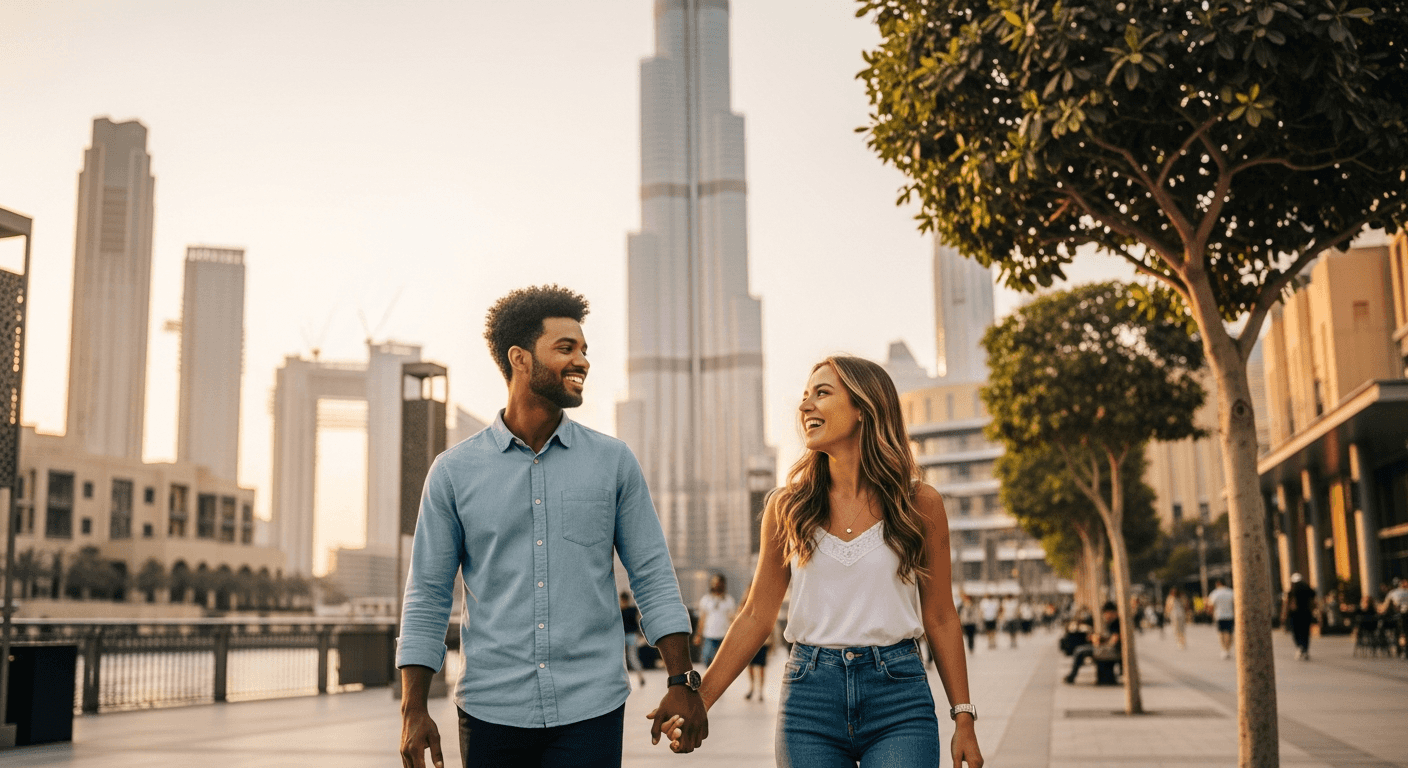
Dubai Without a Car: A Lifestyle Guide
Many assume Dubai is a city built for the car, but a few exceptional neighbourhoods offer a truly walkable, connected urban experience. I'll show you where to find them and what that lifestyle really costs.

For years, the global perception of Dubai has been tied to the image of supercars gliding down multi-lane highways. It’s a city, many believe, that you can only experience from behind the wheel. I’ll admit, when I first moved here, I bought into that narrative. But living and working in this city’s property market for over a decade has shown me a different reality, one that is becoming more desirable every year: a life in Dubai that is not just possible without a car, but in many ways, superior.
Here’s what we'll explore:
- The great myth of Dubai as a car-only city and the forces changing that.
- A deep dive into the "Walkability Trinity": Downtown, Marina/JBR, and DIFC.
- The next wave of connected hubs: Business Bay, City Walk, and Bluewaters.
- The real financial implications of choosing this lifestyle.
- A line-by-line cost breakdown of buying a connected apartment.
- My personal verdict on whether the convenience premium is truly worth it.
The Great Dubai Myth: Deconstructing the Car-Centric City
It’s an easy conclusion to draw. Dubai’s modern history is one of linear, rapid expansion outwards from the Creek, primarily along the spine of Sheikh Zayed Road. This explosive growth, fuelled by ambition and the automobile, naturally created a city that felt, on the surface, entirely dependent on cars. Neighbourhoods were separated by vast distances and formidable highways, and the climate made the idea of a long walk seem like an extreme sport for half the year. For a long time, your car wasn't just a vehicle; it was your private, air-conditioned bubble, your key to unlocking the city.
However, a quiet revolution has been underway for the better part of two decades. This shift wasn't accidental; it was a strategic pivot led by visionary master developers and the city’s own Roads and Transport Authority (RTA). The launch of the Dubai Metro in 2009 was the foundational move. It created a high-speed artery through the city's most populous and economically vital corridors. Suddenly, the distance between the old city and the new hubs of Dubai Marina and Jebel Ali shrank from a stressful, traffic-clogged drive to a predictable, climate-controlled journey.
Parallel to this, master developers like Emaar Properties and Meraas stopped thinking merely in terms of standalone towers and started designing entire ecosystems. They understood that the new currency of luxury wasn't just a marble lobby, but time. The ability to walk from your front door to a grocery store, a café, your child's nursery, or a park became the ultimate amenity. They began creating what I call "islands of walkability" — dense, mixed-use, self-sufficient enclaves where a car-optional life was not only feasible but actively encouraged. This focus on car-free living Dubai has reshaped the very definition of a prime address.
The Gold Standard: Downtown Dubai — The Epicentre of Urbanism
 Featured project
When clients ask me to show them the purest expression of this new urbanism, I take them to Downtown Dubai. I tell them to forget about property for a moment and just experience the place. We’ll start at a café in the shadow of the Burj Khalifa, walk through the lush Burj Park, stroll across the bridge to the vast expanse of the Dubai Mall, and later, watch the fountains before heading to a show at the Dubai Opera. The entire day can unfold on foot, in a beautifully designed, clean, and safe environment. This isn't a happy accident; it’s the result of one of the most ambitious and successful masterplans in modern city-building.
Emaar meticulously engineered Downtown for the pedestrian. The shaded boulevards, the constant presence of water features, the air-conditioned Metro Link bridge that connects the metro station directly to the mall — every element is designed to make walking the most pleasant and logical choice. The density is key; by concentrating world-class retail, dining, entertainment, and thousands of homes in a compact two-square-kilometre area, a genuine community fabric emerges. You see the same faces at the local Spinneys, you nod to your neighbours on their morning jog around the boulevard. It feels like a city within a city.
The property here reflects this philosophy. You have the ultimate trophy assets in the Burj Khalifa itself, the charming, lower-rise Arabic-style apartments of Old Town that feel like a hidden village, and the sleek, modern towers like South Ridge or The Address Residences. For those seeking the newest offerings, buildings like Opera Grand place you at the cultural heart of the district. This variety means different entry points, but they all share access to the same incredible walkability. Of course, this access comes at a significant premium. A one-bedroom apartment here might rent for AED 140,000 to AED 180,000 a year. In a car-dependent but popular community like JVC, a similar unit might be half that. Sales prices tell the same story, with Downtown properties often commanding AED 2,200 to over AED 3,500 per square foot, while many other areas are closer to the AED 1,000-1,500 mark. Even the service charges are higher, typically AED 20-30 per square foot annually, but this pays for the immaculate landscaping, 24/7 security, and world-class facilities that make the lifestyle possible.
The Waterfront Alternative: Dubai Marina & JBR
If Downtown is the polished, cosmopolitan heart of the city, then Dubai Marina offers a more relaxed, sun-drenched version of the walkable dream. The energy here is different — less about global landmarks and more about a vibrant, resort-style waterfront life. For many of my clients, especially those from Europe and the UK, the Marina feels instantly familiar, like a supercharged version of the Côte d'Azur. The seven-kilometre Marina Walk is the community's central plaza, a bustling promenade lined with restaurants, cafes, and yachts, where residents walk, jog, and cycle from dawn until late at night.
What makes the Marina and its neighbour, Jumeirah Beach Residence, so effective as a car-optional zone is the transport trifecta: the Dubai Metro, the Dubai Tram, and a network of pedestrian bridges. The two metro stations provide a direct link to the rest of the city, while the tram creates a smooth loop connecting the entire community. You can live at one end of the Marina, hop on the tram to do your shopping, meet friends at The Beach in JBR, and be home in minutes, all without thinking about traffic or parking. This level of integrated transit neighbourhoods Dubai is unmatched anywhere else in the city and is a core part of its value proposition.
The housing stock is incredibly diverse. You have the original six Emaar towers, which set the standard for the community, the "tallest block in the world" with its cluster of super-tall skyscrapers offering breathtaking views, and the sandy-hued apartment buildings of JBR that open directly onto one of Dubai’s most popular public beaches. Developers like Select Group have made a significant mark on the skyline with numerous high-quality towers. Within the community, pricing is nuanced. A premium is paid for a full marina or sea view, and proximity to a tram or metro station can add another 5-10% to a property's value. Generally, sales prices range from AED 1,800 to AED 2,800 per square foot, with rents for a two-bedroom apartment typically falling between AED 180,000 and AED 250,000 per year. Much like Downtown, the service charges are robust, covering the extensive amenities and the significant upkeep required for a waterfront community.
The Professional Hub: Live, Work, and Walk in DIFC
While Downtown and the Marina cater to a broad lifestyle appeal, the Dubai International Financial Centre (DIFC) offers the most concentrated and efficient example of a walkable community in Dubai. It is the ultimate expression of the "live-work-play" model, designed specifically for the high-flying professionals in finance, law, and consulting who populate its gleaming office towers. For residents here, the daily commute is measured in footsteps, not kilometres. The lifestyle is one of supreme convenience, a bubble of urban sophistication where everything you need is connected.
The masterstroke of DIFC's design is its multi-level, climate-controlled pedestrian network. The Gate Avenue, a retail and dining promenade, acts as a subterranean artery connecting the Gate building to residences, offices, and world-class restaurants. You can leave your apartment in Index Tower or Central Park Towers, walk indoors to a breakfast meeting, visit an art gallery at lunch, and meet colleagues for dinner at a Michelin-starred restaurant without ever stepping outside into the summer heat. It’s a 15-minute city in its most literal form, offering a level of smooth integration that is rare to find anywhere in the world.
This convenience fosters a unique culture. DIFC is not a family-focused suburb; it's an adult-oriented urban core. The atmosphere is polished and ambitious. The world-class art galleries, the fine dining establishments, and the exclusive social clubs create a dynamic environment for networking and leisure. It's a place designed for people who are time-poor and value efficiency above all else. This captive audience of high-earning professionals makes property in DIFC a compelling proposition. As a designated freehold zone, it allows for direct ownership, and the rental demand is consistently strong. Prices reflect this exclusivity, with sales per square foot often ranging from AED 1,900 to AED 3,000. Renting a one-bedroom apartment can cost anywhere from AED 130,000 to AED 170,000, a price tenants are willing to pay to eliminate a commute and live at the centre of their professional universe.
“The premium you pay for a Downtown address isn't just for the view; it's buying back hours of your life every week that would otherwise be spent in traffic.”
The Contenders: City Walk, Bluewaters, and Business Bay
Beyond the established trinity of Downtown, Marina, and DIFC, a new tier of highly walkable, design-led communities has emerged, each offering a distinct flavour of urban living. These areas are pushing the boundaries of Dubai urban convenience property and providing compelling alternatives for those seeking a car-optional life.
City Walk, a masterpiece by Meraas, feels like a piece of Europe dropped into the heart of Dubai. Instead of high-rise towers, it features low-rise, contemporary apartment buildings set along pedestrianised streets with a curated selection of boutiques, cafes, and entertainment venues. The vibe is creative, fashionable, and decidedly more intimate than the grand scale of Downtown, to which it sits adjacent. It’s a lifestyle choice for those who appreciate design and a ground-level, street-side culture. While it isn't directly on the metro, its proximity to the Downtown and DIFC stations makes it highly connected.
At the other end of the spectrum is Bluewaters Island, another Meraas creation. This is perhaps the ultimate "enclave" lifestyle. Once you are on the island, it is hyper-walkable, with a serene, resort-like atmosphere and stunning views back towards the JBR and Marina skyline. It offers an incredible sense of privacy and exclusivity. The trade-off is its relative isolation. While a pedestrian bridge connects it to JBR, getting further afield typically requires a car or taxi. It represents a choice: supreme walkability within your immediate community in exchange for a less direct connection to the wider city grid.
Then there's Business Bay, the sprawling district next to Downtown. I often describe Business Bay to clients as the "in-progress" contender. It has the density, the central location, and the stunning Dubai Water Canal, which has introduced a beautiful waterfront promenade for walking and cycling. However, the pedestrian experience can be inconsistent. Some pockets are brilliantly connected, while others are still fragmented by roads and construction. But its potential is enormous, and for buyers, it represents a more accessible entry point into the connected lifestyle. Prices per square foot are noticeably lower than in Downtown, offering a chance to invest in an area whose walkability is improving year by year. Developers like Damac Properties have a major presence here, shaping the future of this evolving urban core.
The True Cost of Convenience: A Financial Deep Dive
Embracing a walkable lifestyle in Dubai is an incredible quality-of-life upgrade, but it’s essential to approach it with a clear understanding of the financial commitment. The premium for convenience is real and is reflected in both purchase prices and ongoing costs. Let's break down the numbers for a hypothetical purchase of a one-bedroom apartment in a prime, walkable community like Dubai Marina, which is a popular choice for homes near Dubai Metro stations.
Let’s assume you find a great one-bedroom unit with good transport access for a purchase price of AED 1,800,000. If you're a UAE resident taking out a mortgage, here are the typical upfront costs you'll need to budget for, as regulated by entities like the Dubai Land Department (DLD) and the Central Bank of the UAE:
- Purchase Price: AED 1,800,000
- Mortgage Down Payment (20% for residents): AED 360,000
- DLD Transfer Fee (4% of purchase price): AED 72,000
- DLD Registration Fee (for properties over AED 500k): AED 4,200 (inclusive of VAT)
- Real Estate Agency Fee (2% of purchase price + 5% VAT): AED 37,800
- Mortgage Registration Fee (0.25% of loan amount): AED 3,600
- Bank Fees (Valuation & Processing): Approximately AED 8,000
- Trustee Office Fee for transfer: Approximately AED 4,200 (inclusive of VAT)
- Total Estimated Upfront Cost: AED 489,800
This upfront figure — nearly half a million dirhams, is substantial and is often the biggest hurdle for buyers. But the costs don't stop there. Ongoing ownership expenses are also higher in these premium communities. The most significant is the annual service charge, which covers the maintenance of the pool, gym, security, landscaping, and common areas. For an 800 sq ft apartment in the Marina, a service charge of AED 22 per square foot would be typical, amounting to AED 17,600 per year. This is a critical figure to factor into your annual budget, alongside your mortgage payments and utilities. While these numbers seem high, it’s crucial to weigh them against the savings from a car-free life: no car loan (often AED 2,000+/month), no insurance (AED 3,000+/year), no fuel (AED 1,000+/month), no Salik tolls, and minimal maintenance costs. The financial equation is a trade-off: you're shifting money from transport expenses into your property asset.
Future-Proofing Your Lifestyle: The Rise of Integrated Neighbourhoods
The momentum towards creating more human-scale, connected communities is not slowing down; it's accelerating and becoming official city policy. The Dubai 2040 Urban Master Plan is the government's roadmap for the city's future, and a core pillar of this plan is to enhance the quality of life by developing vibrant, healthy communities. One of its key objectives is to ensure that 55% of the population lives within just 800 metres of a main public transport station. This isn't just a lofty goal; it's a guiding principle for all future urban planning in the emirate.
This government-led vision provides a powerful tailwind for the investment case in walkable neighbourhoods. At Gaia Living, when we advise clients on long-term investments, we look for these fundamentals. We see a clear trend in the design of new master communities. Places like Dubai Hills Estate, while more suburban in feel, have been designed with a highly walkable core around the central park and Dubai Hills Mall. Emaar's ambitious Creek Harbour project is being built from the ground up with pedestrian life and future mass transit at its very heart. Even in more established areas, developers are retrofitting connectivity, building bridges and pathways to link previously isolated buildings to public transport and amenities.
Choosing a home in one of today's established walkable metro communities Dubai is, in my view, a form of future-proofing your investment and your lifestyle. As Dubai continues to grow and its roads become more congested, the premium for being able to bypass traffic will only increase. These connected nodes will become even more desirable, supporting rental demand and underpinning property values. You are not just buying an apartment; you are buying into a resilient urban model that aligns with the city's long-term strategic direction. It’s about recognizing that the ultimate luxury in a growing global city is not a faster car, but the freedom to not need one at all.
My Verdict: Is the Car-Optional Premium Worth Paying?
After walking these streets for years and guiding countless clients through this very decision, my conclusion is clear, though nuanced. This lifestyle is not for everyone. If you have a large family requiring constant school runs to different ends of the city, if your work is based in an industrial zone far from the metro line, or if you are a dedicated petrolhead who finds joy on the open road, then the premium for a walkable address might feel like a poor trade. The villa communities of Arabian Ranches or the sprawling space of Damac Hills and Damac Hills II would likely serve you far better, and we at Gaia Living have helped many happy families find their perfect home there.
However, for a significant and growing demographic — young professionals, couples, urban-minded singles, and even empty-nesters, my answer is an emphatic yes. The premium is absolutely worth paying. The financial cost is quantifiable, as we've discussed. But the benefits, while softer, are profound. It's the daily pleasure of a morning stroll to your favourite coffee shop. It's the spontaneity of deciding to see a movie or meet friends for dinner without a second thought about traffic or parking. It's the health benefit of walking thousands more steps each day without trying. It's the time and mental energy you save by not sitting in rush-hour gridlock. These are the daily dividends of your investment.
Ultimately, choosing a home is a deeply personal decision that must align with your priorities. My final piece of advice is always the same: experience it firsthand. Don't just look at floorplans and brochures. Spend a Tuesday evening walking through Business Bay. Spend a Friday afternoon at The Beach in JBR. Spend a morning exploring the quiet lanes of Old Town. Feel the energy of the community. See if it resonates with the life you want to live. A property is a collection of rooms, but a home is a part of a neighbourhood. Choosing a car-optional lifestyle is one of the most powerful decisions you can make to shape your daily experience of this dynamic city.
Choosing a car-optional lifestyle in Dubai is a conscious decision to trade a lower property price for unparalleled convenience and time. The financial premium is significant, but for many, the quality of life gained by living in a walkable, connected community like Downtown or the Marina is an investment that pays daily dividends.
Sources
- Dubai Land Department (DLD): https://dubailand.gov.ae/en/
- Roads and Transport Authority (RTA): https://www.rta.ae/
- Central Bank of the UAE: https://www.centralbank.ae/en/
- The UAE Government Portal (Dubai 2040 Urban Master Plan): https://u.ae/en/about-the-uae/strategies-initiatives-and-awards/local-governments-strategies-and-plans/dubai-2040-urban-master-plan
Questions, answered
- Can you really live in Dubai without a car?
- Yes, in specific, highly-connected neighbourhoods like Downtown Dubai, Dubai Marina, and DIFC, it's entirely possible to live a full life without owning a car, relying on the Metro, tram, and pedestrian-friendly layouts.
- What are the most walkable areas in Dubai?
- The top walkable areas are Downtown Dubai, City Walk, Bluewaters Island, JBR, and Dubai Marina. These areas combine residential buildings with retail, dining, and public transport in a dense, pedestrian-focused masterplan.
- How much more does it cost to live in a walkable Dubai neighbourhood?
- You can expect to pay a premium. A one-bedroom apartment in a prime walkable area like Downtown might rent for AED 140,000-180,000 annually, compared to AED 70,000-90,000 in a more car-dependent suburb. This premium reflects the high demand for convenience.
- Is property in walkable areas a good investment?
- Properties in well-connected, walkable communities often demonstrate strong rental demand and capital appreciation potential. Their enduring appeal to both tenants and end-users provides a degree of stability, though market conditions always apply.
- What public transport is available in these areas?
- Key transport options include the Dubai Metro, Dubai Tram (in the Marina/JBR area), extensive bus networks, and readily available taxis and ride-hailing services. Water taxis also operate in areas like the Marina and along the Creek.
- What are the hidden costs of living car-free?
- While you save on car payments, insurance, and fuel, you might spend more on taxis or ride-hailing for specific trips. The main "cost" is the higher property price or rent you pay for the prime location and convenience.

Yusuf writes about how Dubai actually lives — waterfront mornings, community dining, walkability, and the lifestyle premium built into an address.
Related stories
Dubai's Established Charm: The Case for Older Homes
In a city focused on the future, I believe the smartest move for many buyers is to look back. Dubai's seasoned communities offer space, character, and surprising value that new builds often can't match.
The True Cost of Owning a Dubai Property
Beyond the purchase price, your annual budget for a Dubai home must account for service charges, utilities, and maintenance. I'll break down every ongoing expense you need to plan for.
Calculating ROI on Dubai Rental Upgrades
As a landlord in Dubai, you can't just follow trends. I'll show you how to calculate the precise ROI of minor property upgrades to genuinely increase your rental yield.
Echoes, in your inbox
One thoughtful email a month. Market insight, new launches, no spam.