

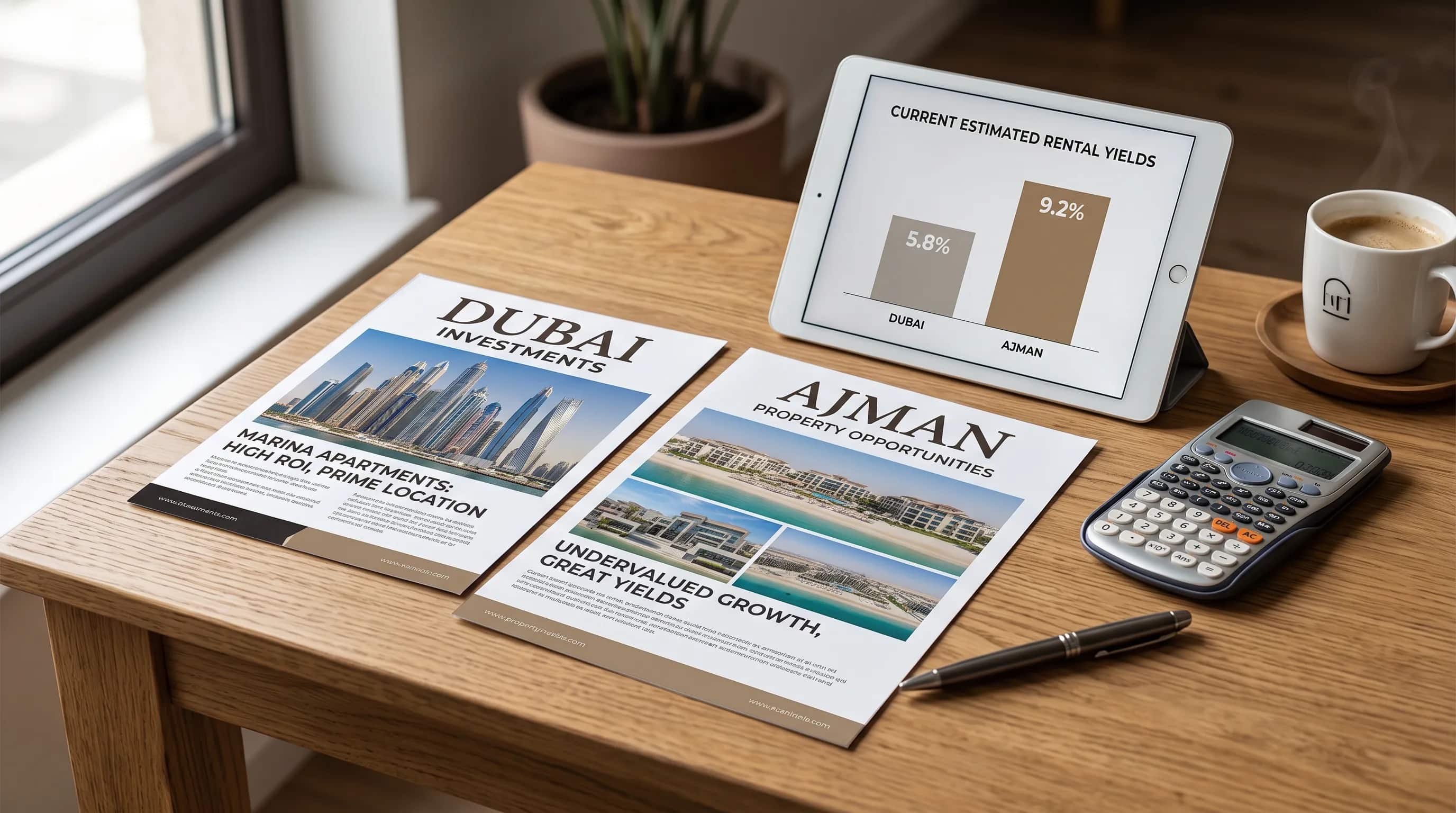
Dubai vs Ajman Rental Yields: The Numbers That Surprised Us
Dubai vs Ajman rental yields: why Ajman's numbers often look higher, what the headline yield hides, and why a bigger yield is not always the better buy.
The initial assumption going into this analysis was that Dubai would win out. Being the bigger, more sophisticated market, we assumed it would generate better rental returns. However, when we began comparing gross rental yields in Dubai vs Ajman, we found an interesting outcome where headline numbers indicated something that caught us off guard. On paper, Ajman often has higher yields than Dubai.
It is a surprising discovery that needs to be paid attention to by an investor and it is certainly true with respect to the headline yield number. It can easily be explained in the way that the higher yields in Ajman are caused by lower prices there. Once you begin looking past the headline number and consider net yields, appreciation, liquidity, and risks, things become much more complicated.
Here is the structure of our guide – a brief comparison; the reason why Ajman yields look so good; the difference between gross and net yields; the hidden aspects of the high yield; and how to understand the numbers right instead of just trying to go for the biggest percentage.
Before getting started – we are not financial advisors. The information provided below is general information, not financial advice, and all of the yields are only indicative. They vary depending on region, specific unit, and even time. Use them only as samples to check, not promises. Yields change, nothing in life is guaranteed, calculate your net yields yourself and consult professionals before making any investments. With that being said, here are our findings.
Dubai vs Ajman Rental Yields, in Short
Let's lay out the surprise and the catch together. Ajman often shows higher gross rental yields than Dubai, and the reason is simple, its prices are much lower while rents do not fall by as much, so the rent works out as a bigger percentage of the price. That is real, and it is why a yield-hunting investor's eye is drawn to the cheaper emirate.
The catch is that a higher yield is not the same as a better investment. Yield is only one part of the return, and a big gross yield in a cheaper, thinner market comes packaged with lower capital growth prospects, harder resale, more vacancy risk, and more restricted foreign ownership than Dubai. Dubai's lower headline yield comes with stronger appreciation potential, a deeper and more liquid market, and broad freehold. So the number that surprised us is genuine but incomplete. The general picture of property and investment across the country sits within the UAE government portal for the official side.
Here is the short version:
- Ajman's gross yield is often higher. Lower prices lift the percentage.
- That is real but partial. Yield is only one part of the return.
- Dubai grows more. Stronger capital appreciation prospects.
- Dubai is more liquid. Easier and quicker to sell or re-let.
- Ajman has more vacancy risk. A thinner market sits empty more.
- Ownership differs. Broad freehold in Dubai, more restricted in Ajman.
The honest framing is that the headline yield gap is real and tempting, but it largely reflects the price difference, not a free lunch. Ajman can be a fine income play for the right investor, and Dubai can be the better total-return choice for another, but reading the comparison as Ajman wins because the yield is higher misses everything the yield does not capture. The rest of this guide fills in what the headline number leaves out.
Why Ajman's Yields Look Higher
So why exactly does the number come out higher? It's arithmetic. Rental yield is just the annual rent divided by the price, so when the price is low and the rent does not drop proportionally, the yield rises. Ajman is much cheaper to buy in than Dubai, but its rents, while lower, do not fall by the same proportion, so the rent ends up being a bigger slice of the purchase price, and the yield looks higher.
A rough illustration shows it plainly. Imagine an Ajman apartment at around AED 500,000 renting at maybe AED 35,000 a year, that is a gross yield of about 7%. Now a Dubai apartment at around AED 1.5 million renting at maybe AED 90,000 a year, that is about 6%. The Dubai unit earns far more rent in dirhams, but as a percentage of its higher price, the yield is lower. These figures are illustrative, made up for the maths, and real yields vary by area and should be checked, but the principle holds, cheaper markets tend to show higher gross yields. Our Ajman area guide gives a sense of the emirate behind the numbers.
Here is why the yield looks higher:
- Yield is rent over price. A simple percentage.
- Ajman prices are low. The denominator is small.
- Rents fall less than prices. Rent stays a bigger slice.
- So the percentage rises. A high gross yield results.
- Dubai earns more in dirhams. But a lower percentage of a bigger price.
- It is the price gap talking. Not a sign of a better asset.
The honest summary is that Ajman's higher yield is mostly the price difference showing up as a percentage, not evidence that Ajman is a better investment than Dubai. The same rent looks like a bigger return simply because it sits on top of a smaller price. That is genuinely useful for an income-focused buyer, but it is arithmetic, not magic, and reading it as proof that Ajman beats Dubai would be the wrong lesson. The next question is what that headline yield turns into once real costs come out.
Gross vs Net: Where the Yield Goes
Here is the first thing the headline hides, the difference between gross and net yield. The yields people quote are almost always gross, the rent over the price, before any costs. What you actually keep is the net yield, after service charges, maintenance, management fees, and the cost of any time the property sits empty. Net yield is always lower than gross, sometimes a lot lower, and it is the only number that matters to your pocket.
This is where a thinner market quietly bites. In a cheaper, less active market, a unit can take longer to rent and sit empty between tenants, and every empty month drags the real yield down, since you are earning nothing while still paying the charges. So a headline 7% gross in a market with high vacancy risk can deliver a net return well below a steadier 6% gross in a market that stays rented. Keeping a property earning rather than empty is real work, which is where our property management team helps owners protect the yield they actually receive.
For market data on yields and how they vary across areas, reports from firms like Knight Frank are a useful reference, though they show gross figures and the past, not your net return or the future.
Here is where the yield goes:
- Quoted yields are gross. Before any costs come out.
- Net yield is what you keep. After charges and management.
- Service charges bite. They lower the real return.
- Vacancy is the big one. Empty months earn nothing.
- Thin markets sit empty more. Vacancy risk hits Ajman harder.
- Net is the only number. Gross is just the headline.
The honest summary is that gross yield is a headline and net yield is reality, and the gap between them is where a lot of the Ajman advantage can quietly disappear. A higher gross yield in a market with more vacancy and re-letting risk can turn into a lower net yield than a steadier market with a smaller headline number. Always compare net, not gross, and build in the cost of empty months, because that is the figure that actually lands in your account. A simple way to stay honest with yourself is to assume the property will sit empty for a stretch each year rather than rent the day the last tenant leaves, then see whether the yield still looks attractive. If it only works on the assumption of zero vacancy, it does not really work, because no real property stays full forever, least of all in a quieter market.
What the High Yield Hides
Beyond net yield, the headline number hides a few more things that matter just as much. The biggest is capital growth. Yield is the income side of the return, but total return also depends on what happens to the property's value, and Dubai's deeper, more active market has tended to offer stronger appreciation prospects than a smaller emirate, so a lower-yielding Dubai unit can out-total-return a higher-yielding Ajman one if it grows more in value. Dubai property data sits with the Dubai Land Department for the official record, though past growth is not a promise of future growth.
The high yield also hides liquidity and ownership. Dubai is easier and quicker to sell in, while a thinner Ajman market can take longer to exit, which matters if you might need your money back. And foreign ownership in Ajman is more restricted than Dubai's broad freehold, often tied to designated areas or leasehold arrangements rather than open freehold, so you must confirm what you, with your nationality, can actually own there before the yield even comes into play. These are real differences the percentage simply does not show.
Here is what the high yield hides:
- Capital growth. Dubai tends to have stronger appreciation prospects.
- Total return. Income plus growth beats income alone.
- Liquidity. Dubai is easier and faster to sell.
- Exit risk. A thin market can take longer to leave.
- Ownership limits. Ajman's foreign ownership is more restricted.
- Eligibility first. Confirm what you can own before chasing yield.
The honest summary is that a high yield can hide weaker capital growth, thinner liquidity, and tighter ownership rules, all of which shape your real return as much as the rent does. Yield is the part that is easy to quote, so it gets the attention, but appreciation, the ability to sell, and even your right to own are doing just as much work in the background. Judge the whole return, not the slice that happens to be largest on a cheaper property. The cleanest way to think about it is that yield pays you while you hold, and growth and liquidity pay you when you sell, and an investment that scores well on one but poorly on the others is not obviously better than one that balances them. A high income from an asset you struggle to sell or that barely grows is a narrower win than the headline percentage suggests.
How to Read the Numbers
So how should you actually read a Dubai-versus-Ajman yield comparison? We put the two against each other across what really matters, each on one line:
- Gross rental yield: Ajman often wins on paper, since lower prices lift the percentage.
- Net yield after costs: the gap narrows once voids and charges come out.
- Capital appreciation: Dubai tends to have stronger long-term growth prospects.
- Liquidity: Dubai wins, easier and quicker to sell or re-let.
- Vacancy risk: higher in a thinner market like Ajman, which dents real yield.
- Foreign ownership: broader in Dubai, more restricted in Ajman, so check eligibility.
The pattern is that Ajman wins the headline yield, Dubai wins most of the rest, and the gap on the thing everyone quotes, gross yield, shrinks once you account for the things they do not, net costs, vacancy, growth, and liquidity. That does not make Ajman a bad choice, it makes it a different one, a higher-income, lower-growth, less-liquid play versus Dubai's lower-income, higher-growth, more-liquid one. To compare real prices and rents as you weigh this, our property listings let you build the numbers from actual units rather than averages.
Which suits you depends on your goal. If you want maximum income now and can handle thinner liquidity and growth, Ajman's yield is genuinely attractive, as long as you use net, not gross, and budget for voids. If you want total return, easy resale, and broad ownership, Dubai's lower yield can still be the better deal. This is general information, not financial advice, so run your own net numbers and take professional advice.
The honest summary is that the way to read the numbers is to ignore the gross headline and build the real one, net yield after costs and realistic vacancy, then set it beside growth prospects, liquidity, and what you can actually own. Do that, and the surprise fades into a sensible trade, income versus total return, with no single winner, just the right fit for your goal.
What We Would Actually Do
All in all, the fact that Ajman’s gross yield is higher is true, however, it only stems from lower prices rather than implying a better investment choice. Transitioning to net yield, taking into account vacancy, capital gains, liquidity, and ownership considerations results in narrowing the gap to a reasonable deal: Ajman for income, Dubai for return with no clear winner among the two.
Should our friends ask for our opinion on the matter, we would advise them to put the gross yield aside and calculate the net one instead. It is important to consider realistic rents, deducting service charges, property management costs and adding an allowance for vacancy months to the actual price. One should focus on the net yield rather than on a more attractive headline yield rate. In addition, we would recommend them to take into consideration that which is not included in the yield: easy sellability, prospects of capital appreciation and possibility of foreign ownership in Ajman.
To be honest, both markets could potentially make for reasonable investments. Ajman's higher income would be suitable for someone seeking immediate rental income and able to tolerate thinner and slower market. Lower yield together with better growth, higher liquidity, and better ownership rights would work for those interested in total return and easy selling. Right conclusions would depend on the investor’s goals rather than on the highest percentage offered in listings.
The biggest mistake that we have seen investors make was rushing into cheaper market with a high gross yield while not calculating net numbers and considering other aspects of investment, and ending up losing money due to vacancies and slower sales process. It is necessary to use net numbers, allocate for vacancy periods, check the availability of ownership and assess the total return of the investment. Thus, a seemingly advantageous yield becomes a clear decision.
Should you require professional assistance in calculating the true net numbers and comparing two investments in Dubai and Ajman, we are here to help. Our property buying service can help you build the comparison from real figures. And if you want a straight conversation about which fits your goal, income or total return, we are glad to help. Get in touch and we will take it from there.
Related stories

Buying in Dubai By Selling Assets Abroad
A detailed guide on how to strategically sell your international property or investments to fund your home purchase in Dubai. I'll walk you through the entire process, from legal and tax considerations to transferring funds and proving their origin.

Exit Strategy: The Key to Total Return in Dubai Property
Many investors focus only on annual rental yield. I'll explain why your exit strategy and understanding total return are far more critical for a successful Dubai property investment.

The Professional's Retreat: Dubai Villas for Work & Family
For professionals balancing careers and family, finding the right Dubai villa is crucial. I explore the communities that masterfully blend dedicated home offices with exceptional family living.
Echoes, in your inbox
One thoughtful email a month. Market insight, new launches, no spam.