

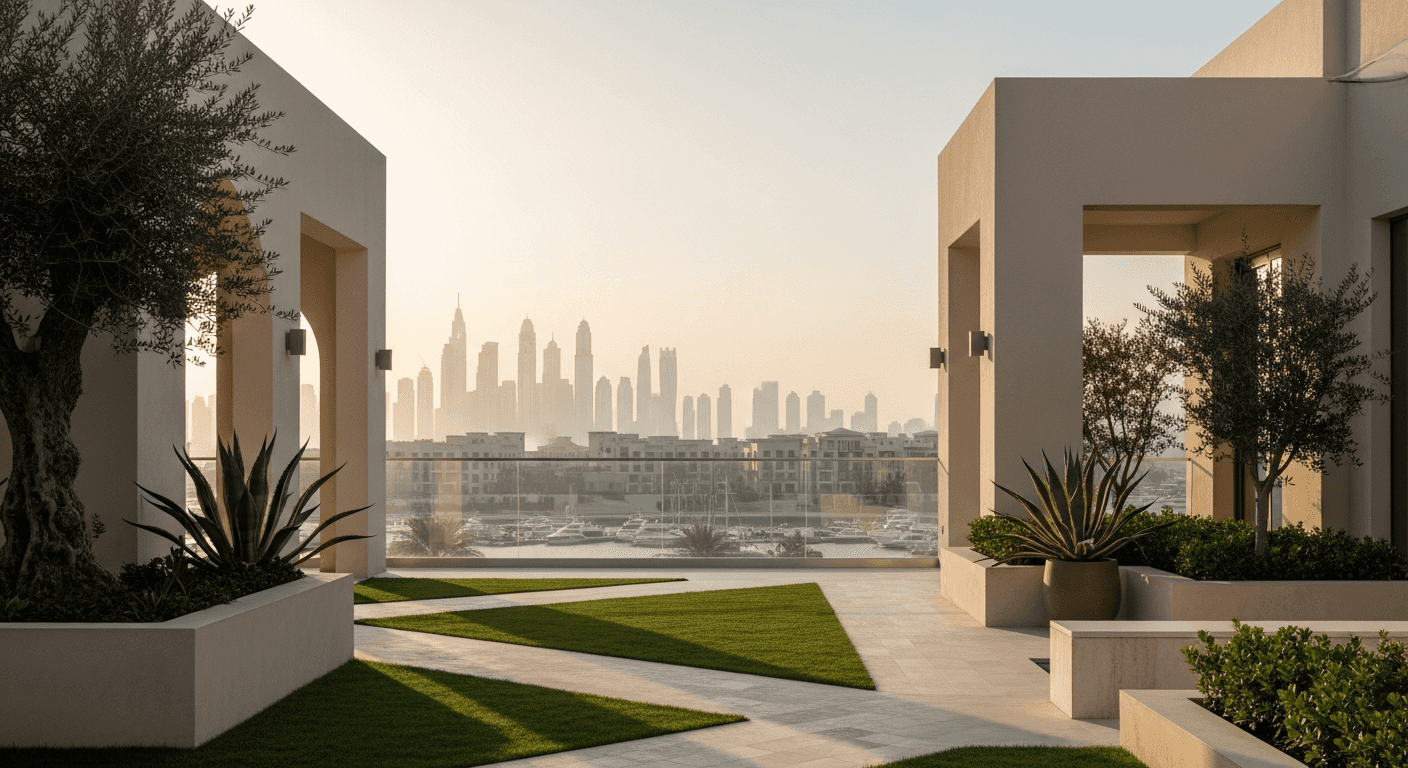
Dubai's Waterfront Premium: A Data-Led Analysis
As Head of Market Research, I analyze the real drivers of Dubai’s waterfront property premium, exploring why the value of a sea view is more complex than it appears.

The allure of water is one of the most powerful forces in real estate. In Dubai, a city defined by its ambitious coastline, the concept of the 'waterfront premium' is often taken as a given. Yet in my work analysing this market, I find the term is frequently oversimplified. The premium is not a uniform percentage applied to any property near the sea; it is a complex, multi-layered value proposition that varies dramatically with view typology, access, scarcity, and brand.
Here’s a look at how we'll deconstruct the Dubai waterfront property value:
- The true definition of the waterfront premium and its different tiers
- Scarcity as the ultimate, unshakeable driver of value
- A deep dive into the market dynamics of Palm Jumeirah, a global icon
- Analysing the urban coastal model of Dubai Marina and Jumeirah Beach Residence
- The new wave of projects like Emaar Beachfront redefining waterfront living
- Separating the tangible from the intangible value drivers
- A line-by-line breakdown of the real costs of owning a waterfront home
- How future coastal supply will shape the market and impact premiums
- My final verdict on whether this premium is a worthwhile investment
Defining the "Waterfront Premium"
At its core, the waterfront premium is the quantifiable price difference between a property with a water view or access and an otherwise identical property without it. However, the first mistake many investors make is to treat 'waterfront' as a single category. In Dubai, this label encompasses a wide spectrum of assets, each with its own distinct value hierarchy. Understanding these tiers is the first step towards making an informed investment. At the absolute top of this hierarchy is direct, private beach access. A villa on one of the fronds of Palm Jumeirah, where the garden ends in sand and private shoreline, represents the pinnacle of waterfront living. This is the rarest and most coveted form, and it commands the highest premium, often exceeding 100% compared to a non-beachfront villa in a comparable inland community.
One step down is a full, unobstructed sea view. This applies to apartments in frontline towers, such as those in Jumeirah Beach Residence or Bluewaters Island. The key words here are 'full' and 'unobstructed'. A high-floor apartment with a panoramic vista over the Arabian Gulf holds a significantly higher value than a low-floor unit in the same building with a view partially blocked by another structure. These premiums are substantial, often in the 30% to 50% range over a similar-sized apartment in the same building facing inland. The floor height plays a critical role; the premium increases with every level, as the view becomes more expansive and secure from future obstructions.
Next in the hierarchy are marina and canal views, exemplified by Dubai Marina and Business Bay. These views offer a different, more dynamic character — a vibrant cityscape of yachts, promenades, and architectural lights. While historically seen as secondary to a full sea view, a prime marina view from a well-positioned tower can now compete with, and sometimes exceed, the value of a partial sea view. The appeal is the integration of water with an active, urban lifestyle. Finally, we have partial sea views or community lake views, which offer a tangible but lower premium. These are often found in buildings set back from the primary coastline or in master-planned communities like Jumeirah Golf Estates. While pleasant, the premium is more modest, perhaps 15-25%, as the 'wow factor' and sense of exclusivity are diminished. The key for any investor is to not just buy the 'waterfront' label, but to critically assess which tier of the hierarchy their potential asset occupies.
Scarcity: The Bedrock of Dubai's Waterfront Value
 Featured project
The economic principle of scarcity is the fundamental force underpinning the entire structure of the waterfront living premium Dubai. While the UAE has a significant natural coastline, the amount of that coastline designated as 'freehold' — available for purchase by international investors, is a strictly limited resource. This manufactured scarcity, created through legal zoning and master planning, is the bedrock upon which the highest values are built. Master developers like Nakheel and Emaar Properties did not just build communities; they created new, sellable coastline where none existed before. The very creation of Palm Jumeirah, The World Islands, and Dubai Marina was a direct, capital-intensive response to the finite nature of Dubai's original coast.
Consider the geography. The prime stretch of coast from Jumeirah to the Dubai Marina is, for all intents and purposes, fully developed. There are no vast, empty beachfront plots waiting to be built upon in this established corridor. Any new project requires the demolition of an older structure or a land reclamation effort on a monumental scale, both of which are exceptionally expensive and complex undertakings. This effective cap on new supply in the most desirable, mature coastal zones provides a powerful long-term support for prices. It creates a defensive moat around properties in these areas. An owner of a frontline apartment in JBR or a villa on Palm Jumeirah knows that a competing project of similar quality cannot simply appear next door. This contrasts sharply with many inland areas, where vast land banks allow for continued expansion and the introduction of new supply, which can place downward pressure on the values of existing stock.
This principle of scarcity also operates on a micro level. Within a single waterfront project, the number of 'front-row' units is, by definition, limited. In a tower at Emaar Beachfront, for every apartment with a full, direct view of the Palm and the sea, there are several others with partial views, marina views, or views of the neighbouring building. This internal scarcity is what creates the steep price gradients within a single building. The developer prices these units according to this hierarchy from day one, and the resale market reinforces it over time. The highest premiums are paid for the assets that are hardest to replicate: the corner units, the penthouses with panoramic vistas, and the ground-floor homes with direct access to the water. A smart investor understands that they are not just buying square footage; they are buying a unique, finite position in a highly desirable, limited-supply landscape.
>The most enduring value in Dubai real estate is not found in proximity to water, but in the permanent, unshakeable scarcity of a front-row seat.
Case Study 1: Palm Jumeirah - The Global Icon
No discussion of Dubai's waterfront market is complete without a deep analysis of Palm Jumeirah. It is more than a real estate project; it is a global landmark and perhaps the single most powerful brand in Dubai's property landscape. The value drivers here are unique and demonstrate the highest echelons of the waterfront premium. The market on the Palm can be segmented into three distinct categories: the Frond Villas, the Shoreline and other trunk apartments, and the Crescent properties. Each commands its premium for different reasons, and understanding these is key to understanding the sustained *Palm Jumeirah appreciation*. The frond villas are the purest expression of waterfront luxury. Here, the premium is driven by absolute privacy and direct, personal beach access. The value of these homes, particularly post-2020, has seen a meteoric rise because the market of high-net-worth individuals prioritised space and seclusion. Owning a frond villa is not just about a sea view; it's about a lifestyle that cannot be replicated in an apartment tower.
Prices for these villas vary significantly based on their location (tip, mid-frond, or base), the villa type (Signature, Garden Home), and the level of customization. A villa at the tip of a frond, with its wider water frontage and more open view, will command a significant premium over one closer to the trunk. We have also seen the emergence of a new 'super-prime' category here, with custom-built villas by boutique developers like AHS Properties or private owners selling for figures that are multiples of the original Nakheel homes. This demonstrates that even within the most premium category, there is room for further stratification based on quality, design, and exclusivity. This continuous upward re-rating of the top end of the market has a positive knock-on effect for the entire frond ecosystem.
The apartment market on the Palm is more nuanced. The original Nakheel Shoreline Apartments offer a compelling proposition: high-quality construction, excellent amenities with private beach clubs, and a central location on the trunk. The value differential here is starkly illustrated by comparing apartments on the right side (beach access) versus the left side (no direct beach access). A right-side unit has consistently traded at a significant premium, proving that tangible access, not just a view, is a powerful and bankable value driver. More recent developments, particularly branded residences on the Palm trunk and West Beach, have introduced a new layer of luxury. Projects associated with five-star hotel brands command a further premium for their service, management, and brand prestige, attracting investors and end-users willing to pay more for a turnkey, hotel-like living experience.
The Crescent of the Palm presents yet another model. Dominated by world-famous hotels and ultra-luxury residences (like those at the Atlantis Royal), the properties here offer resort-style living with spectacular, elevated views of the Palm's fronds or the open sea and Dubai skyline. The premium is justified by the level of amenities, the security of being within a managed resort environment, and the sheer iconic status of the address. The sustained demand and price growth across all these segments on Palm Jumeirah validate a core thesis: in real estate, a powerful and globally recognised brand combined with genuine scarcity is an almost unbeatable formula for long-term value preservation and appreciation.
Case Study 2: Dubai Marina & JBR - The Urban Coastline
If Palm Jumeirah represents island-style resort living, Dubai Marina and its beachfront extension, Jumeirah Beach Residence, represent the world's largest man-made marina and a blueprint for urban coastal life. The value proposition here is a fusion of water views and walkability. It’s the ability to look out over the marina or the sea and then step out of your building directly into a vibrant ecosystem of cafes, restaurants, shops, and a public beach. This combination appeals to a different demographic than the Palm — young professionals, couples, and families who prioritise convenience and an active social environment. This is where we can closely examine *Dubai Marina property trends* to understand how value is created and sustained in a high-density environment.
The most valuable assets in this precinct are the frontline apartments in JBR. These towers, particularly in clusters like Shams and Amwaj, offer direct, and in many cases protected, views of the Arabian Gulf and Ain Dubai on Bluewaters Island. An apartment on a high floor facing the sea can trade for a 40-50% premium over an identical apartment on a low floor facing the community. This is a clear, measurable demonstration of the view's value. However, the age of the JBR stock (completed around 2007) means that the quality of renovation and upkeep now plays an almost equally important role. A fully upgraded, modernised apartment can command a 'renovation premium' on top of its 'view premium', making it highly sought after.
Within Dubai Marina itself, a different but equally clear value hierarchy exists. The most prized units are those with a full, wide view of the main marina channel, particularly in the original 'Emaar Six' towers or newer, high-spec buildings by developers like Select Group. These apartments offer a captivating, 24/7 view of yachts and the surrounding architectural landmarks. The premium for a full marina view over a partial view or a view of Sheikh Zayed Road can be as high as 25-35%. The location within the marina also matters immensely. Buildings closer to the beach, offering easy walking access to JBR and the sea, tend to hold a higher value than those located deeper into the marina, where access can be more convoluted. The success of the Marina has been its master plan, which, despite the high density, maintained public access via the Marina Walk, creating a sense of community and perpetual activity that supports rental demand and, consequently, investor confidence.
The enduring lesson from Dubai Marina is that a waterfront premium in a dense urban setting is not static. It is influenced by the age of the asset, the quality of its management, the evolution of the surrounding public realm, and the ever-present competition of new supply. While the best views will always be in demand, owners must continually invest in their properties to maintain their competitive edge. For investors, this means factoring in potential renovation costs over the long term. Unlike a new build, where the premium is clear from the outset, the value of an older waterfront asset is a dynamic interplay between its location, its view, and its condition.
The New Wave: Emerging Waterfront Communities
While Palm Jumeirah and Dubai Marina are the established benchmarks for coastal living, a new wave of master-planned communities is expanding and diversifying Dubai's waterfront offering. These projects provide a crucial insight into the future of *coastal real estate Dubai investment*, as they often present a different risk and reward profile compared to the mature markets. The most prominent of these is Emaar Beachfront, a project I find particularly interesting from a market analysis perspective. It is an intelligent hybrid, strategically positioned between Dubai Marina and Palm Jumeirah. It seeks to combine the best of both worlds: the high-rise, urban feel of the Marina with the private, exclusive beach access that was previously the sole domain of the Palm and a few five-star hotels.
This unique selling proposition — a 1.5km private beach for residents, has allowed Emaar to command significant premiums from the very first launch. Investors and end-users have been willing to pay upfront for the promise of this lifestyle, which did not exist in this format before. The project's value is further enhanced by its spectacular dual views: many apartments offer a view of the open sea and the sunset on one side, and the Dubai Marina skyline on the other. This thoughtful master-planning creates value on all sides of a building, not just the side facing the sea. As the community matures and the retail and F&B offerings come online, its value proposition will solidify further, likely creating a new, distinct price point in Dubai's coastal hierarchy.
Another critical development is Dubai Creek Harbour, a joint venture by Emaar and Dubai Holding. This project represents a different type of waterfront living. It is centered around the historic Dubai Creek, offering a creek/canal-front experience rather than an open sea one. The atmosphere is envisioned to be more tranquil and family-oriented, with vast parks, a marina, and a focus on culture and leisure. The investment proposition here is long-term. Buyers are investing in the future vision of a new 'city within a city'. While the immediate waterfront premium might be less pronounced than at Emaar Beachfront, the potential for long-term capital appreciation is tied to the successful delivery of the entire master plan, including the once-planned Dubai Creek Tower and its surrounding retail and entertainment districts. It's a bet on placemaking on a grand scale.
Beyond Dubai, we are also seeing the expansion of waterfront concepts in other Emirates, most notably in Ras Al Khaimah with projects on Al Marjan Island and Hayat Island by developers like Al Hamra. These areas offer a more resort-focused, leisure-driven lifestyle, often at a more accessible price point than their Dubai counterparts. The announcement of major entertainment and gaming resorts in Ras Al Khaimah has significantly accelerated interest and price growth in its coastal corridor. For investors, these emerging areas offer the potential for higher rental yields and earlier entry into a growth cycle, but this comes with the risk that the area may take longer to mature than a project in the heart of Dubai. Each of these new communities diversifies the market, providing more choice for buyers and testing the boundaries of what the *waterfront living premium Dubai* truly means.
Beyond the View: Tangible vs. Intangible Value
The premium for a waterfront property is derived from more than just the visual appeal of looking at the water. To accurately assess the *Dubai waterfront property value*, one must dissect the components of this premium into tangible, functional benefits and intangible, emotional ones. Both contribute to the final price, and their relative importance often depends on whether the buyer is an end-user or an investor. The tangible drivers are the physical amenities and conveniences that come with the property. These are measurable and have a direct impact on the quality of life and the property's rental potential.
Here are some of the key tangible drivers:
- Direct Beach Access: This is the most significant tangible benefit. The ability to walk directly from your property onto the sand without crossing a road is a powerful lifestyle and value driver.
- Private Moorings: For yacht owners, the availability of a private berth attached or adjacent to their property, as seen in some Dubai Marina and canal-front villas, adds immense functional and monetary value.
- Resort-Style Amenities: Waterfront properties, especially branded residences, often include access to superior facilities such as multiple swimming pools, lazy rivers, state-of-the-art gyms, spas, and residents' lounges.
- Integrated Retail and F&B: The proximity to high-quality restaurants, cafes, and shops, like those at The Walk at JBR or Nakheel Mall on the Palm, is a major convenience that residents pay a premium for.
- Enhanced Security: Gated waterfront communities and high-end towers typically offer a higher level of security, a factor that is highly valued by many residents, particularly HNWIs.
Intangible drivers, on the other hand, are emotional and psychological. They are harder to quantify but are just as powerful in driving purchasing decisions, particularly at the highest end of the market. These factors are about status, well-being, and the perception of an elevated lifestyle. The most obvious is the prestige associated with a prime waterfront address. Owning a property on Palm Jumeirah or in a landmark tower like Ciel in Dubai Marina is a statement. It confers a certain status that an inland property, however luxurious, may not.
Beyond that, there is a growing body of evidence about the wellness benefits of living near water, a concept known as 'Blue Health'. The calming effect of a sea view, the encouragement of an active outdoor lifestyle (swimming, walking, sailing), and the cleaner air quality are all intangible benefits that contribute to a resident's sense of well-being. This has become an increasingly important factor for discerning buyers post-2020. Finally, there's the 'scarcity' factor we discussed earlier, which has its own intangible appeal. The knowledge that you own something rare and difficult to replicate provides a sense of security and pride of ownership that is a core part of the luxury experience. For an investor, understanding these intangible drivers is crucial because they create sticky demand from end-users, which in turn leads to lower vacancy rates and more stable long-term capital growth.
Calculating the True Cost of Waterfront Living
While the allure of a sea view is undeniable, a prudent investor must look beyond the sticker price and calculate the total cost of ownership. The waterfront premium extends beyond the purchase price and into the recurring annual costs, which can be significantly higher than for an equivalent inland property. Failure to accurately budget for these expenses is one of the most common mistakes I see investors make, and it can seriously impact the viability of a coastal real estate investment. The most significant of these is the annual service charge. These fees, levied by the owners' association and managed by RERA-approved companies, cover the maintenance of all common areas, including lobbies, elevators, security, and amenities.
In premium waterfront buildings, the list of amenities is extensive: private beaches need cleaning and lifeguards, large resort-style pools require significant upkeep, lush landscaping needs irrigation, and building facades exposed to salty sea air require more frequent maintenance and cleaning. Consequently, service charges are higher. While a good quality inland apartment might have service charges in the range of AED 14-18 per square foot per year, a premium waterfront tower in Dubai Marina or on Palm Jumeirah can easily command charges of AED 20-30 per square foot, and sometimes more for ultra-luxury branded residences. On a 1,500 sq. Ft. two-bedroom apartment, that's a difference of up to AED 18,000 per year — a significant sum that directly eats into an investor's net rental yield.
Let's walk through a hypothetical cost breakdown for purchasing a two-bedroom apartment in a prime waterfront tower, to illustrate the full upfront investment required. Note that these are illustrative figures.
Hypothetical Purchase: 2-Bed Waterfront Apartment in Dubai
- Purchase Price: AED 4,000,000
- Dubai Land Department (DLD) Transfer Fee: 4% of Purchase Price = AED 160,000
- DLD Registration Fee: AED 4,200 (for properties over AED 500k)
- Real Estate Agency Fee: 2% of Purchase Price + 5% VAT = AED 84,000
- Mortgage Arrangement Fee (if applicable): Typically 1% of Loan Amount + 5% VAT
- Mortgage Registration Fee (DLD): 0.25% of Loan Amount
- Initial Upfront Cash Outlay (approximate, excluding mortgage fees): AED 4,248,200
Annual Recurring Costs:
- Service Charges: Assuming a 1,500 sq. Ft. apartment at AED 25/sqft = AED 37,500 per year
- Home Insurance: Approximately AED 2,000 per year
This breakdown, which relies on fee structures set by entities like the Dubai Land Department (DLD), shows that the initial costs are substantial. More importantly, the high annual service charge must be factored into any rental yield calculation. An investor achieving a 5% gross yield on the purchase price (AED 200,000 in annual rent) would see that figure reduced to a net yield of approximately 4% after accounting for service charges alone, before considering any other costs or potential void periods. This compression of yield is a critical trade-off for the potential long-term capital appreciation that scarce waterfront assets can offer.
Future Supply and Its Impact on Premiums
The final piece of the puzzle for any forward-looking analysis is supply. Dubai's real estate market is dynamic, and the pipeline of new projects is a constant factor influencing value. The question for investors in coastal property is whether the upcoming supply of waterfront homes will be enough to dilute the premium that current assets command. In my view, the impact will be highly segmented. We must differentiate between the introduction of new supply in ultra-prime, established areas versus the creation of entirely new waterfront destinations.
In mature, iconic locations like Palm Jumeirah or the main stretch of Dubai Marina, the potential for new supply is extremely limited. As discussed, there are very few remaining plots, and any new development is likely to be a single, ultra-luxury tower replacing an older building, rather than a massive new community. This means the scarcity factor for existing prime properties in these locations remains firmly intact. I do not foresee new supply having a significant negative impact on the premiums for A-grade assets in these zones. In fact, the launch of a new, record-breaking luxury project can often have a positive 're-rating' effect on the surrounding properties, pulling the entire local market's value ceiling higher.
Where the impact of new supply will be felt more keenly is in the creation of new, large-scale waterfront districts. Projects like the redevelopment of Dubai Islands (formerly Deira Islands) by Nakheel, the continued build-out of Dubai Maritime City, and other future coastal master plans will bring thousands of new waterfront units to the market over the next decade. This new supply will certainly compete with existing mid-tier and secondary waterfront properties. An apartment with a partial sea view in an older building may face increased competition from a brand-new apartment with a similar view in one of these emerging communities. This will likely put pressure on the premiums for non-prime assets and force owners to either lower their price expectations or invest in upgrades to compete.
This dynamic creates both a risk and an opportunity. The risk is for owners of secondary assets in established areas. The opportunity is for investors willing to enter these new communities at an early stage. By buying off-plan during the initial launches of these mega-projects, investors can potentially benefit from the long-term value uplift as the community matures and the infrastructure, retail, and amenities are delivered. The investment here is in the developer's ability to execute their vision and create a desirable place to live. The success of projects like Emaar Beachfront shows that a well-conceived new community can create its own market and command strong premiums from the outset. Therefore, the impact of future supply is not a simple case of dilution; it's a complex process of market segmentation and the creation of new value hierarchies.
The waterfront premium in Dubai is not a monolith. For investors, its justification hinges on asset quality and location. The premium for A-grade, scarce properties in iconic locations like Palm Jumeirah is a robust store of value. For mid-tier assets, the premium is more vulnerable to new supply and requires a sharp focus on rental yield and management quality.
My Verdict: Is the Premium Justified for Investors?
After analysing the multiple layers of value, the cost structures, and the supply dynamics, my verdict on the waterfront premium is nuanced. To ask if it's 'justified' is to ask the wrong question. The right question is: justified for whom, and for what purpose? The premium is not a speculative bubble; it is a rational market response to a combination of scarcity, tangible benefits, and powerful intangible desires. Its validity as an investment depends entirely on the investor's individual goals, time horizon, and risk appetite.
For the high-net-worth end-user or the long-term legacy investor focused on capital preservation, paying the premium for a prime waterfront asset in an iconic, supply-constrained location is, in my professional opinion, one of the most sound decisions they can make in the Dubai market. An asset like a frond villa on Palm Jumeirah or a full sea-view penthouse in a landmark tower is more than just a home; it is an investment in a globally recognised, finite asset class. The historical *Palm Jumeirah appreciation* demonstrates that these assets tend to hold their value strongly during downturns and lead the market during recoveries. For this buyer, the premium is the price of entry for scarcity, status, and long-term security.
For an investor whose primary goal is maximising annual rental yield, the calculation is different. The higher purchase price and, crucially, the higher annual service charges associated with premium waterfront properties can significantly compress net yields. This investor might find that a non-waterfront property in a high-demand community like Dubai Hills, or even an apartment with a less desirable view in a waterfront building, offers a better cash-on-cash return. The trade-off is clear: they sacrifice the potential for explosive capital growth tied to the waterfront premium in exchange for a more robust income stream today. There is no right or wrong answer here; it is a strategic choice.
Ultimately, success in this segment comes down to asset selection. The generic 'waterfront' label is meaningless. What matters is the specific view, the floor level, the quality of the building, the reputation of the developer, the tangible access to amenities, and the long-term plan for the surrounding area. At Gaia Living, our advice to clients is always to look past the marketing brochures and analyse these fundamentals. The waterfront premium is real and enduring, but it is not uniformly distributed. The greatest returns, both financial and in lifestyle, will go to those who understand the subtle but critical differences between a good waterfront property and a truly great one.
## Sources - Dubai Land Department (DLD): https://dubailand.gov.ae/ - Real Estate Regulatory Agency (RERA): https://dubailand.gov.ae/en/about-dld/dld-sectors/real-estate-regulatory-agency/ - UAE Government Portal (u.ae): https://u.ae/en/information-and-services/business/dubai-as-a-business-hub
Questions, answered
- How much more does a waterfront property cost in Dubai?
- The premium for a waterfront property in Dubai is not fixed. It can range from 20-30% for a partial sea or marina view compared to an identical inland-facing unit, to well over 100% for prime, front-row properties with direct, unobstructed sea views and private beach access, such as on Palm Jumeirah.
- Are service charges higher for waterfront properties?
- Yes, service charges for waterfront buildings are typically higher. This is due to the increased maintenance costs for amenities like private beaches, swimming pools, high-spec facades exposed to sea air, and extensive landscaping. Expect to pay anywhere from AED 18 to over AED 30 per square foot annually in premium coastal towers.
- Is Palm Jumeirah still a good investment?
- In my professional opinion, prime assets on Palm Jumeirah remain a strong long-term investment. Its global brand recognition, true scarcity, and consistent demand from high-net-worth individuals create a defensive moat around its value, driving significant Palm Jumeirah appreciation, particularly for well-located villas and branded residences.
- What are the main risks when investing in coastal real estate in Dubai?
- The primary risks include underestimating the high annual service charges which can compress net rental yields, and the potential for new supply in emerging areas to dilute the premium for non-prime assets. Also, a view that is marketed as 'unobstructed' could be impacted by future construction, so thorough due diligence on the master plan is essential.
- Which new areas offer waterfront investment potential?
- Emerging communities like Emaar Beachfront, which combines a marina lifestyle with private beach access, and the creek-front living at Dubai Creek Harbour present interesting opportunities. For a more resort-focused investment, areas like Al Marjan Island in Ras Al Khaimah are also expanding the UAE's coastal real estate market.
- What is the difference in value between a marina view and a sea view?
- A direct, high-floor sea view almost always commands the highest premium due to its expansive, natural appeal. A marina view is also highly valued for its dynamic, vibrant outlook of yachts and city lights, but the premium can vary more depending on the floor level and specific sightlines. In locations like Dubai Marina, a full marina view can be more desirable than a partial or low-floor sea view.

Amara translates DLD transaction data, supply pipelines, and macro signals into clear calls on where Dubai's market is heading. She writes the numbers most brokers only feel.
Related stories
Dubai's Established Charm: The Case for Older Homes
In a city focused on the future, I believe the smartest move for many buyers is to look back. Dubai's seasoned communities offer space, character, and surprising value that new builds often can't match.
The True Cost of Owning a Dubai Property
Beyond the purchase price, your annual budget for a Dubai home must account for service charges, utilities, and maintenance. I'll break down every ongoing expense you need to plan for.
Calculating ROI on Dubai Rental Upgrades
As a landlord in Dubai, you can't just follow trends. I'll show you how to calculate the precise ROI of minor property upgrades to genuinely increase your rental yield.
Echoes, in your inbox
One thoughtful email a month. Market insight, new launches, no spam.