

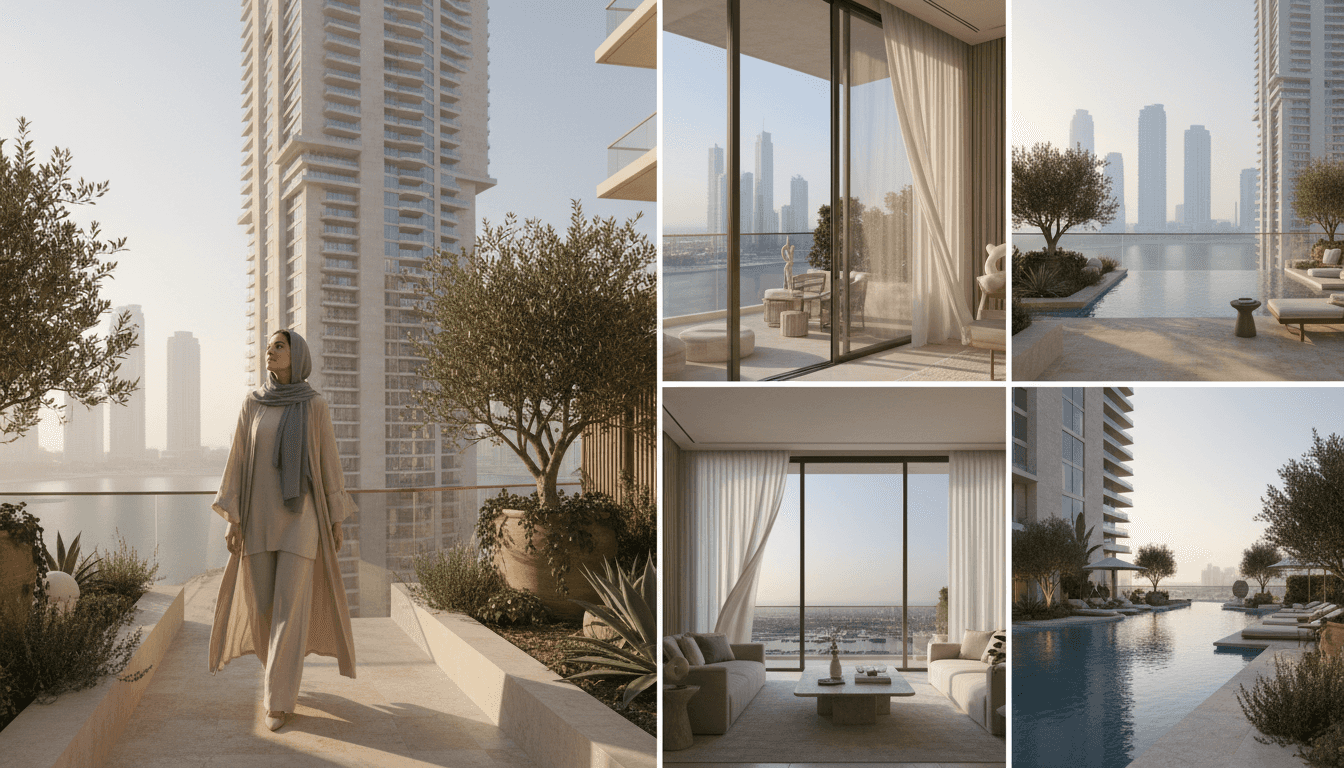
Dubai's Vertical Debate: The High vs. Low Floor Apartment
I explore the real value equation between high and low-floor apartments in Dubai, moving beyond just the view to analyse premiums, running costs, and lifestyle trade-offs.

It’s one of the first questions I get from clients looking to buy an apartment in Dubai: “Which floor should I choose?” The instinctive answer for many is 'as high as possible'. In a city defined by its skyline, the desire for a commanding view is a powerful driver. But the true value equation is far more complex than a simple trade-off between altitude and price.
Here's what we'll explore in this detailed guide:
- The real cost of the view: Quantifying the high-floor premium in Dubai's key districts.
- Living on the ground floor: Analysing the underrated benefits of podium and low-level units.
- The physics of high-rise living: Noise, wind, and energy efficiency at different heights.
- Service charges and running costs: Do you pay more to live on the 80th floor?
- The critical impact of view lines and future development on your investment.
- Access and convenience: The daily realities of elevator waits and amenity access.
- Resale value and rental appeal: Which floor level makes the most sense for investors?
- My verdict: Crafting a strategy to choose the right floor for your goals.
The High-Floor Premium: Pricing the Dubai Skyline
Let’s start with the most obvious factor: the price. The high-floor apartment premium in Dubai is not a myth; it's a tangible, and often substantial, cost. Developers price their inventory on a gradient, with each successive floor band commanding a higher price for the exact same layout. This isn't just about the view; it's a carefully calibrated strategy reflecting perceived exclusivity, status, and market demand. In my experience, this premium isn't a simple, flat percentage. It varies dramatically based on the neighbourhood, the specific view, and the overall quality of the tower. For instance, in a prime waterfront community like Dubai Marina, the jump in price from a low-floor unit with a partial marina view to a high-floor one with an unobstructed sea and Palm Jumeirah vista can be staggering — often 30-50% or more.
To make this concrete, consider a typical two-bedroom apartment of around 1,200 sq. Ft. in a new, premium tower. On a lower floor (say, 5-10), it might be priced at AED 3 million. The same layout on a mid-level floor (25-35) could be AED 3.4 million. Move up to a high floor (50+), and you could easily be looking at AED 3.9 million. Go to the sub-penthouse levels, and that figure could push towards AED 4.5 million or higher. That's a 50% premium for the same four walls, just positioned 200 metres higher in the sky. The most extreme examples are found in trophy towers in areas like Downtown Dubai or Palm Jumeirah, where the premium for a full Burj Khalifa or panoramic sea view can exceed 100% compared to a street-facing unit on a low floor.
This premium is established right from the launch of off-plan launches. Developers like Emaar Properties or Nakheel have sophisticated pricing models. A unit's price is a function of its size, layout, and crucially, its 'view score'. A property facing a major landmark will have a higher base price, and that price will then escalate more steeply per floor than a unit on the other side of the building facing a less desirable view. This is why, when we at Gaia Living advise clients on off-plan purchases, we insist on studying the masterplan in minute detail. Understanding not just your immediate view but the planned height of surrounding future buildings is critical. Paying a huge premium for a sea view that will be completely blocked in five years is a classic and costly mistake.
Low-Floor Living: The Case for Convenience
 Featured project
While the allure of the penthouse is strong, there's a compelling, often overlooked case for podium-level and low-floor apartments. The primary argument is, of course, value. By forgoing the panoramic view, you can often secure a larger apartment, a better layout, or simply a lower entry price in the same high-quality building. This immediately improves your potential rental yield if you're an investor. But the low-floor apartment benefits Dubai residents enjoy extend far beyond the initial purchase price. The most significant is convenience. Living on floors 2 through 10 means you are dramatically less dependent on elevators. During peak morning and evening hours in a 70-storey tower, the wait for an elevator can be a genuine daily frustration.
For families with young children or residents with pets, a lower floor is a game-changer. Imagine being able to quickly pop down to the community pool, the gym, or the children's play area, sometimes just by taking a short flight of stairs. Many modern buildings in communities like JVC or Arjan have extensive amenities located on the podium level (typically between floors 2 and 5). Living on one of these floors feels more connected to the life of the building. You're not just descending from a remote sky-home; you're part of the building's social fabric. This proximity often creates a stronger sense of community, something that can be lost in the anonymity of a super-tall tower.
Beyond that, many podium apartments come with exceptionally large terraces, far bigger than the balconies offered on higher floors. These spaces can function as genuine outdoor living rooms, gardens, or play areas — a rare luxury in apartment living. Developers often have to create setbacks at the podium level for architectural reasons, and the result is these unique, expansive outdoor spaces. For those who value a private garden-like feel but want the security and amenities of a modern apartment building, these units offer the best of both worlds. They provide a psychological buffer from the street while keeping you grounded and connected, avoiding the sometimes isolating feeling of living very high up.
Finally, the practicalities of moving in, receiving deliveries, or dealing with maintenance are all simplified on lower floors. It's a small but cumulative benefit that improves quality of life. The fear of being 'stuck' during a power outage or extensive elevator maintenance is also greatly diminished. While buildings in Dubai have excellent backup systems, the peace of mind that comes from knowing you can walk down a few flights of stairs if needed is a real, albeit psychological, advantage for many residents.
The Physics of a High-Rise: Noise, Wind, and Energy
Living in a skyscraper is an exercise in applied physics, and your experience changes with your altitude. Let's start with noise levels Dubai high-rise towers experience. It's a common assumption that higher is always quieter, and to an extent, that's true for ground-level noise. On the 50th floor, the hum of traffic, the chatter of pedestrians, and the sounds of ground-floor commercial activity fade into a distant murmur. This creates a serene, almost detached, living environment. However, height introduces new sources of noise. The most prominent is wind. Dubai's towers are engineered to sway slightly in high winds, and while structurally safe, the sound of wind whistling around the facade and across your balcony can be significant, especially during winter shamals (seasonal winds).
Another acoustic factor is ambient construction noise. In a developing city like Dubai, there's always a new tower going up nearby. Sound travels upwards. The noise from a construction site three blocks away might be barely audible on the 5th floor, but on the 60th floor, with a clear line of sound, it can be a constant presence. I've had clients in Business Bay who were surprised that their high-floor apartment was noisier than their previous low-floor one because of a new project starting a kilometre away. You're also closer to aviation paths on higher floors, and in some areas, the rooftop mechanical systems — chiller plants, HVAC units, and elevator motors, can create a low-frequency hum that is more noticeable on the floors directly beneath them.
Then there is the issue of Dubai apartment energy efficiency. Logic suggests a high-floor apartment, exposed on all sides, would be less efficient, and that is often the case. These units, particularly corner apartments, receive more direct sun exposure throughout the day. This 'solar gain' puts a heavier load on the air conditioning system, which can translate to higher DEWA (Dubai Electricity and Water Authority) bills, especially during the peak summer months from May to September. Conversely, a lower-floor apartment is often shaded by adjacent buildings for part of the day, reducing its cooling load. The difference may not be enormous on a monthly basis, perhaps a few hundred dirhams, but over the lifetime of the property, it adds up. Modern buildings with high-performance, solar-reflective glazing mitigate this effect, but the basic physics remains.
“The best view in the building isn't always from the highest floor. Sometimes it's from the mid-level, where you can see both the skyline and the life of the community below.”
Service Charges and Hidden Costs: A Level Playing Field?
This is one of the most persistent misconceptions I have to correct for buyers: the idea that service charges varying floors is a standard practice. In Dubai, it is not. Service charges are regulated by the Dubai Land Department (DLD) and its regulatory arm, RERA. The approved and legally mandated method for calculating these fees is based on the size of your unit in square feet as registered on your Title Deed. It has nothing to do with your floor number or the quality of your view.
This means that an owner of a 1,000 sq. Ft. one-bedroom apartment on the 8th floor pays the exact same annual service charge as the owner of an identical 1,000 sq. Ft. apartment on the 78th floor. Let's say the approved service charge for the building is AED 20 per square foot. Both owners will receive a bill for AED 20,000 per year from the owners' association management company. This is a critical point for investors to understand. While you might pay a 40% premium to purchase the high-floor unit, your proportional contribution to the building's upkeep (security, cleaning, pool maintenance, insurance, etc.) is identical to the low-floor owner's. This directly impacts your net rental yield.
Let's run a simplified scenario to illustrate the impact:
- Apartment A (Low Floor):
- Purchase Price: AED 2,000,000
- Annual Rent: AED 120,000
- Service Charge (1,000 sq. Ft. @ AED 20/sqft): AED 20,000
- Net Income: AED 100,000
- Gross Yield: 6.0%
- Net Yield: 5.0%
- Apartment B (High Floor, Same Layout):
- Purchase Price: AED 2,800,000 (40% premium)
- Annual Rent: AED 150,000 (Higher rent for the view)
- Service Charge (1,000 sq. Ft. @ AED 20/sqft): AED 20,000
- Net Income: AED 130,000
- Gross Yield: 5.36%
- Net Yield: 4.64%
As you can see, even though the high-floor unit commands a higher rent, the steep purchase premium means its net yield is actually lower. From a pure numbers perspective, the low-floor apartment often presents a stronger investment case. The only scenario where this calculation is different is in some ultra-luxury branded residences, where a developer might structure service levels differently for penthouse floors, but this is the exception, not the rule for the broader market. For 99% of apartments in Dubai, the service charge is floor-agnostic.
The Criticality of View Lines and Future-Proofing
When you buy a high-floor apartment, you are not just buying square footage; you are buying airspace. You are paying a premium for the view. Therefore, the single most important piece of due diligence you can undertake is to understand the long-term viability of that view. The apartment view lines impact on value is immense, and in a city that evolves as quickly as Dubai, what is an empty plot of land today could be a 90-storey skyscraper tomorrow. Losing a prime view of the Burj Khalifa or the Arabian Gulf can erase the premium you paid overnight.
At Gaia Living, a core part of our advisory process involves a deep dive into the Dubai Urban Master Plan 2040 and the specific zoning regulations for the plots surrounding a target building. We look at the designated land use, the maximum permissible height (Gross Floor Area or GFA ratios), and any publicly announced development plans. For example, if you are considering a high-floor apartment in a 60-storey tower in Creek Harbour with a stunning, open view, it's our job to check if the plot directly in front is zoned for a 75-storey tower. If it is, that view has an expiration date, and you should not pay a full premium for it.
This is where buying in a mature, fully-developed community like the core of Dubai Marina has an advantage. The risk of your view being obstructed is significantly lower because most of the surrounding plots are already built out. In contrast, in emerging areas like the new developments along Sheikh Zayed Road or in parts of Business Bay, the masterplan is still being realised. Here, the risk is higher, but so is the potential reward if you can secure a view that is protected by a low-rise zone, a park, a highway, or the sea. The front-row towers at Emaar Beachfront are a prime example; their direct sea-facing views towards the Palm are largely protected, which is a key reason for their sustained premium.
I always advise clients to think in three dimensions and across time. Obtain the masterplan. Stand on the proposed balcony location if it's off-plan. Use visualisation tools. But most importantly, work with an advisor who understands urban planning and isn't just selling you a brochure image. An obstructed view not only diminishes your personal enjoyment but can make the property significantly harder to sell or rent in the future, effectively trapping you with a high-cost asset that has lost its unique selling proposition.
The Daily Grind: Access, Elevators, and Amenities
Beyond the financial calculations and view analysis lies the simple reality of daily life. The practicality of getting from your car to your front door is a factor many buyers underestimate until they've lived in a high-rise for a few months. In a super-tall residential tower (60+ floors), the elevator system is the central artery. A well-designed building will have zoned elevators — local lifts serving lower floors and express elevators shooting up to the higher floors. This is crucial for managing traffic flow. However, even with the best systems, you are still subject to waiting times, especially during peak hours (7-9 am and 5-7 pm) or when one of the elevators is down for maintenance.
Living on the 75th floor of a building in a dense area like DIFC could mean your total commute time from apartment to car can be 5-10 minutes. This might seem trivial, but it adds up to over an hour a week spent just in vertical transit. Forgetting something in your car becomes a major expedition. This is a trade-off for the privacy and view, and it's one you must be comfortable with. In contrast, a resident on the 6th floor can often opt for the stairs if the lifts are busy, and their total door-to-kerb time is consistently minimal.
Access to amenities is another key consideration. If the gym, pool, and residents' lounge are on a podium level, a low-floor resident has near-instant access. A high-floor resident has to make a dedicated trip. This can subtly influence how often you use the facilities you are paying for through your service charges. If using the gym requires a 10-minute round trip in an elevator, it can become a psychological barrier. On the other hand, some ultra-luxury towers are now placing premium amenities, like an infinity pool or a sky lounge, on the highest floors, reserved exclusively for residents of the upper levels. In this case, the high-floor premium buys you not just a view but also exclusive access, changing the value equation entirely.
Below is a simple checklist I walk through with clients to assess the practicalities of a building's vertical living:
- Elevator System: How many elevators are there? Are they zoned for specific floor ranges? What is the reputation of the elevator manufacturer (e.g., Schindler, Otis, Kone)?
- Peak Hour Traffic: Visit the building during peak morning or evening hours. How long is the wait? Are the lifts crowded?
- Amenity Location: Where are the key amenities (pool, gym, kids' play area) located? Are they easily accessible from the floor you are considering?
- Parking Level: How many basement levels are there? Is your designated parking spot conveniently located near the elevator lobby?
- Emergency Egress: How comfortable are you with the idea of walking down from your potential floor in an emergency? This is a personal comfort question.
Resale and Rental: Decoding the Investment Angle
Ultimately, a property in Dubai is both a home and an asset. Its ability to hold value and generate income is paramount. So, which floor level performs better on the secondary market and the rental market? The answer depends entirely on the target demographic for that specific apartment type and location. For ultra-luxury, three-bedroom-plus apartments and penthouses, the high-floor premium is not just expected; it's essential. The target client for these properties is buying the view and the status that comes with it. A low-floor penthouse is a contradiction in terms. These trophy assets often see the highest capital appreciation in a rising market, as the pool of ultra-high-net-worth individuals competing for the 'best in building' is global and less price-sensitive.
However, for the bulk of the market — one and two-bedroom apartments, the investment case is more nuanced. These units are the workhorses of the Dubai rental market, sought by young professionals and couples. While they appreciate a good view, they are also highly budget-conscious. As my earlier yield calculation showed, the lower purchase price of a mid or low-floor unit often translates into a superior net rental yield. These apartments are easier to rent because they hit a more accessible price point. When a tenant is comparing two identical apartments in the same building, and one is 20% cheaper to rent, the majority will choose the more affordable option unless the view is truly spectacular.
From a resale perspective, the mid-floor apartment often represents the sweet spot. It offers a clear step-up in view and appeal from the low floors, justifying a higher price, but it avoids the hefty premium of the true high floors. This makes it attractive to a wider pool of end-users and investors on the secondary market. It's perceived as a 'good' unit without being prohibitively expensive. The lowest-floor units can sometimes be slower to sell, especially if they suffer from noise issues or have a particularly poor outlook (e.g., facing a service entrance or a wall). Therefore, my advice for most investors is to target the middle. You capture some of the aspirational value of a view without overpaying to a point where your yield is compromised.
The optimal floor is a strategic choice, not just an altitude. For pure investment yield on standard apartments, mid-to-low floors often win. For a trophy home or maximum capital appreciation potential in the ultra-luxury segment, a high floor with a protected, iconic view is the only choice.
My Verdict: Finding Your Place in the Vertical City
After years of analysing floor plans and walking clients through countless apartments from the podium to the penthouse, my conclusion is that there is no universally 'best' floor. The right choice is deeply personal and strategic. It requires an honest assessment of your priorities: Are you buying a financial asset or a lifestyle? A home for a young family or a statement for yourself?
If you are an investor focused squarely on maximising rental yield from a one or two-bedroom unit, my strong recommendation is to look away from the top floors. Your ideal target is likely between the 10th and 25th floors in a typical high-rise. This range is high enough to clear most ground-level obstructions and noise, offering a pleasant 'cityscape' view that appeals to tenants, but it avoids the significant premium attached to the upper levels. You get a rentable, desirable unit at a price that keeps your net yield healthy.
If you are an end-user, a family with children, and you value convenience and a connection to the community, do not dismiss the podium levels. The benefits of quick access to the pool, park, and your car, combined with the potential for a large terrace, can offer a quality of life that a sky-high apartment cannot match. You trade a panoramic view for practical, daily comfort. This is a trade that many of my happiest clients have made.
Finally, if you are buying a legacy asset, a place to truly live and enjoy the best of Dubai, and your budget allows, then yes, aim high. But do so with your eyes wide open. Pay the premium for a genuinely iconic and, crucially, a protected view. Work with us to vet the future development pipeline. Understand that you are paying for the emotion and the rarity, and ensure that rarity is not temporary. The joy of watching the sunset over the Arabian Gulf from your 70th-floor balcony is a real and powerful thing. Just be sure you've done the maths, understood the trade-offs, and are certain that this is the value you prize the most.
Sources
- Dubai Land Department (DLD): https://dubailand.gov.ae/
- Real Estate Regulatory Agency (RERA): Part of the DLD, sets rules for service charges and owners associations.
- Central Bank of the UAE: https://www.centralbank.ae/ - For information on mortgage regulations.
- UAE Government Portal: https://u.ae/en
Questions, answered
- How much more do high-floor apartments cost in Dubai?
- The high-floor premium in Dubai typically ranges from 15% to over 100% for trophy penthouses. In prime areas like Dubai Marina or Downtown, a unit on a high floor can be 20-40% more expensive than an identical layout on a low floor in the same building.
- Are service charges higher for apartments on upper floors in Dubai?
- Generally, no. Service charges in Dubai are calculated per square foot of your unit's title deed area, not by floor level. As an owner, you pay the same rate per square foot as your neighbours above and below you with identical layouts, as confirmed by the Dubai Land Department (DLD).
- Which floor is best for renting out an apartment in Dubai?
- For one and two-bedroom units, mid-range floors often provide the best balance of rental yield and appeal, offering good views without the highest purchase premium. For larger family apartments, lower floors with easier access to amenities like pools and parks can be more desirable for tenants.
- Are higher floors quieter in Dubai's high-rise buildings?
- Higher floors are generally quieter from street-level noise like traffic and pedestrians. However, they can be more exposed to wind noise, construction sounds from adjacent towers, and mechanical noise from rooftop equipment. Low floors may hear more ground-level activity but are shielded from high-altitude sounds.
- Is it better to live on a high floor or a low floor in Dubai?
- This is a personal choice. High floors offer superior views and more privacy but come at a significant cost premium and can have longer elevator waits. Low floors provide convenience, faster access to amenities and the outdoors, and are more budget-friendly, but may have obstructed views and more ground-level noise.
- Does floor level affect an apartment's energy efficiency in Dubai?
- Yes, it can. High-floor apartments, especially corner units, often have greater exposure to direct sunlight, potentially increasing air conditioning costs in summer. Lower floors may benefit from the shade cast by surrounding buildings, leading to slightly better Dubai apartment energy efficiency, though this depends heavily on the building's orientation and design.

Ravi lives and breathes apartment living — from studio yields in JVC to branded residences on the Palm. Floor plans, service charges, and view lines are his love language.
Related stories
Finding Your Tribe in Dubai's Villa Communities
I explore which of Dubai's renowned villa communities attract specific expat nationalities and lifestyle groups, offering insights to help you find a place that feels like home.
Post-Handover Quality: The Secret to Your Apartment's Value
Beyond the glossy brochures lies the real test of your property investment: how well a building ages. I'll break down why a developer's post-handover quality is the single most important factor for your apartment's long-term value.

Strategic Speed: An Urgent Dubai Property Sale Guide
Selling your Dubai property quickly requires more than just a low price. This guide outlines the essential strategies for a rapid, successful sale without leaving money on the table.
Echoes, in your inbox
One thoughtful email a month. Market insight, new launches, no spam.