

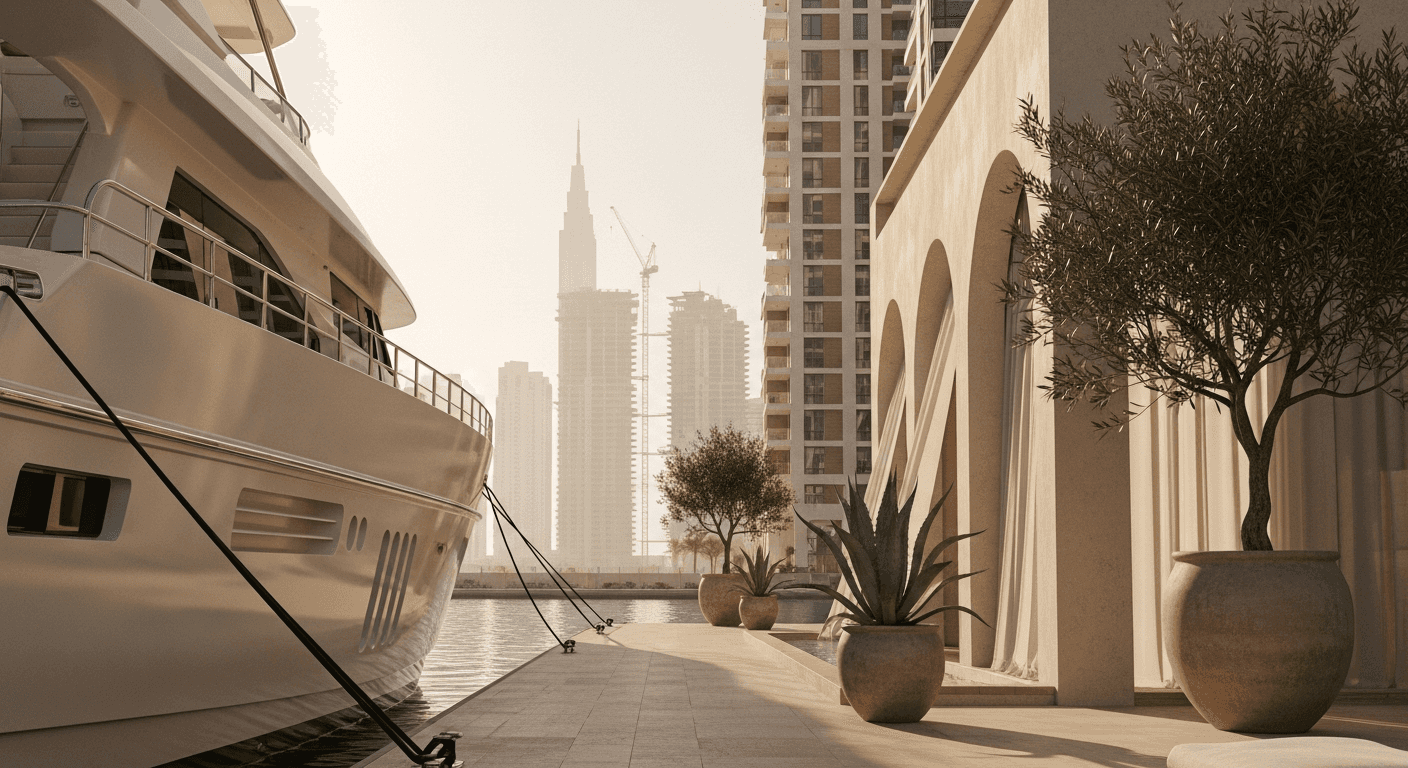
Dubai's Supply Boom: Absorption or Oversupply?
A deep dive into Dubai's residential supply pipeline, analysing whether record demand can absorb the wave of new launches or if parts of the market risk a glut.

The cranes are back on the skyline, a familiar sight for anyone who has watched Dubai’s story unfold. Every week, it seems, brings another glittering launch, another vast master plan, another promise of a new way to live. This relentless pace of development raises the perennial question for Dubai: is the market absorbing this flood of new homes, or are we building our way towards a painful oversupply? It’s a question I hear almost daily from clients, and the answer is more complex than a simple yes or no.
Here’s the ground we’ll cover in this analysis:
- The historical context of Dubai's boom-bust supply cycles.
- The powerful demand drivers currently fuelling absorption.
- How developers have fundamentally changed their strategies.
- Why we must segment the market to see the real picture.
- The critical role of infrastructure in making new communities viable.
- A health check of the off-plan market and its underlying mechanics.
- My outlook for future property prices in Dubai.
- A final verdict for homebuyers and investors.
Echoes of the Past: Dubai's History with Supply
To understand the present, we have to respect the past. I’ve been in this market long enough to remember the lessons of 2008 and the more recent slowdown of 2014-2016. Both periods were, at their core, stories of supply overwhelming demand. The pre-2008 era was characterized by a speculative frenzy and a “build it and they will come” philosophy. Developers launched entire cities with minimal upfront buyer commitment, fueled by cheap credit and global exuberance. When the global financial crisis hit, the music stopped, and the market was left with a vast inventory of empty, and often incomplete, properties. It was a harsh but necessary lesson in market fundamentals.
The 2014-2016 period was a different kind of correction. It was less a crash and more a slow deflation, driven again by a surge in handovers from projects launched in the optimistic years prior. Developers, particularly in the affordable and mid-market segments, were still using generous post-handover payment plans to attract buyers, which artificially inflated demand and encouraged flipping. When thousands of these units were completed, the rental market softened, and capital values followed. This experience taught the market a second lesson: the structure of demand matters just as much as the volume.
In response to the 2014-2016 cycle, the government took a more direct role. In 2019, the Higher Committee for Real Estate Planning was established, chaired by Sheikh Maktoum bin Mohammed. Its mandate was to create a better balance between supply and demand and ensure that new projects added strategic value. In my view, the committee’s influence has been more guiding than dictatorial. It hasn't stopped development, nor should it in a free market. What it has done is foster a greater sense of discipline among the major developers. The conversations shifted from pure volume to absorption rates, demographic targeting, and phased delivery. This institutional self-awareness is perhaps the most significant, albeit invisible, difference between today's market and previous cycles.
The Engine Room: Unpacking Today's Demand Drivers
 Featured project
Supply is only one side of the equation. The current construction boom is being met by a demand wave of historic proportions, and its sources are far more diverse and sustainable than in the past. This isn't a repeat of the purely speculative, credit-fueled demand of 2007. The demographic and economic shifts we're witnessing are profound and have created a fundamentally larger and more stable base of end-users and long-term investors.
The most significant driver is population growth. The Dubai 2040 Urban Master Plan outlines a vision for a city of 5.8 million residents by 2040. Current trends suggest we are well on our way to meeting, if not exceeding, these targets. This isn't just aspirational; it's happening on the ground. The UAE’s decisive handling of the pandemic, combined with its business-friendly environment and unmatched quality of life, has triggered a global relocation of talent and wealth to Dubai. This is supported by a raft of progressive visa reforms, chief among them the expanded Golden Visa program. This visa has been a game-changer, offering long-term residency to investors, entrepreneurs, and skilled professionals. It transforms a transient mindset into a resident mindset, turning renters into buyers and encouraging people to put down roots.
Secondly, Dubai's economy is demonstrating real diversification. While the city was once seen as a proxy for the oil price, its modern economy stands firmly on its own feet. We are seeing sustained growth in non-oil sectors like technology, international finance at the DIFC, trade, logistics, and tourism. Each new global tech firm opening an office in Dubai Media City or a hedge fund setting up in the financial district brings with it hundreds of well-paid professionals who need a place to live. This creates a steady, organic demand for housing that is tied to genuine economic activity, not just market sentiment. This structural shift provides a powerful counterbalance to the influx of new property supply.
Finally, Dubai’s status as a 'safe haven' cannot be overstated. In a world of increasing geopolitical and economic instability, the UAE's security, stability, and pro-business government are incredibly attractive. This has resulted in significant capital inflows from across the globe. While some of this is short-term 'safe-keeping' money, a large portion is being deployed into real estate by individuals and families looking for a long-term base. This has created a deeper, more committed buyer pool. We see this in the demand for family homes in established communities like Dubai Hills or Arabian Ranches, which points to a market with a stronger-than-ever end-user component. This isn't just about a quick flip; it's about building a life here.
A Smarter Playbook: How Developers Have Evolved
Responding to past lessons and present demand, Dubai's leading developers have significantly matured their approach. The speculative, high-risk strategies of the past have been replaced by a more cautious, data-driven, and segmented playbook. This evolution is a key reason why the current supply pipeline, while large, is being managed more effectively than ever before.
One of the most important shifts is the widespread adoption of phased launches. Master developers like Emaar Properties, Nakheel, and Meraas no longer launch an entire multi-thousand-unit master plan in one go. Instead, they release small clusters or phases of a few hundred units at a time. This allows them to test the market's appetite in real-time. If a launch sells out instantly, it gives them the confidence and the market data to proceed with the next phase. If demand is sluggish, they can pause, re-evaluate the product mix or pricing, and avoid flooding the market with unsold inventory. The successive launches within Emaar’s The Valley or Nakheel’s renewed push on Palm Jebel Ali are textbook examples of this disciplined, demand-led strategy.
Payment plans have also undergone a crucial transformation. The once-common post-handover payment plans (where a significant portion of the price was paid over years after moving in) are now a rarity. These were notorious for fueling speculation, as they allowed investors to control a property with very little capital and flip it before the heavy payments kicked in. Today, the industry standard is a construction-linked payment plan. A typical structure might be 10-20% as a down payment, followed by 50-70% paid in installments tied to construction milestones, with the final 10-30% due on handover. This model requires buyers to have significantly more 'skin in the game' from day one. It effectively filters out speculators who lack real capital and ensures the buyer pool consists of those with a genuine intention to either occupy the property or hold it as a long-term rental investment. This has been instrumental in improving the overall off-plan market health.
“The health of Dubai's off-plan market today is less about speculative frenzy and more about the structural integrity provided by escrow laws and stricter payment plans.”
Beyond that, developers are no longer just building generic towers. There is a concerted effort to create niche products that target specific, affluent buyer segments. The explosion in branded residences is a prime example, with developers like Binghatti and AHS Properties partnering with world-renowned luxury brands like Bugatti, Mercedes-Benz, and Jacob & Co. to create ultra-premium, highly differentiated assets. We also see a focus on wellness-centric communities, such as The Sanctuary by Aldar in Meydan, or projects with unique features like private boat berths or exceptional views, such as those found on Bluewaters Island. This strategy is about creating scarcity and a unique value proposition, moving the competition away from price alone and towards lifestyle and brand identity. It's a sign of a market that is segmenting and deepening, catering to a more sophisticated global clientele.
Segmenting the Glut: Not All Supply is Created Equal
This is the most critical point of my analysis: asking if Dubai has an oversupply problem is the wrong question. The right question is *where* and in *which segment* does the risk lie? The city's real estate market is no longer a monolith where a rising tide lifts all boats. It's a highly segmented collection of micro-markets, each with its own supply-demand dynamics. Ignoring this segmentation leads to dangerously simplistic conclusions.
First, let's look at the luxury versus affordable spectrum. The ultra-luxury segment — properties priced above AED 20 million, has been defined by scarcity. There are only so many prime beachfront plots or penthouses with panoramic views of the Burj Khalifa. Demand from the global ultra-high-net-worth community has far outstripped the limited new supply, leading to record-breaking prices in areas like Jumeirah Bay, Emirates Hills, and Palm Jumeirah. The new launch absorption rate for projects in this category is often 100% within hours of release. The supply risk here is negligible. The real risk is concentrated at the other end of the spectrum. The affordable and mid-market segments, particularly for apartments, are where the vast majority of new units are being delivered. This is where the market is most competitive and where a potential softening of demand could quickly lead to an inventory overhang.
Geography is the second critical lens. The bulk of new Dubai property supply is concentrated in developing master communities on the city's outskirts. Areas like Jumeirah Village Circle (JVC), Arjan, Dubai South, and Al Furjan are seeing a massive influx of new buildings from a wide range of private developers. While these locations offer attractive entry prices, they are also where the competition for tenants and buyers will be fiercest. In contrast, prime, established communities like Dubai Marina, Downtown, or Jumeirah Beach Residence (JBR) are largely built out. There is very little land available for new large-scale projects. Any new supply here, like the JBR Shoreline launch, is rare and commands a significant premium due to its irreplaceable location. The market inventory Dubai has is not evenly distributed, and the oversupply risk is therefore highly localized.
Finally, we must segment by property type. The post-pandemic era triggered a 'race for space', with immense demand for villas and townhouses with private gardens and more room for home offices. This demand surge met a relatively fixed supply, causing prices for this asset class to skyrocket, particularly in family-friendly communities. While developers like Nakheel and Emaar have launched new villa communities, the construction timeline is longer, and the overall volume remains lower than that of apartments. The overwhelming majority of units being handed over in the next 1-3 years are apartments. Consequently, the oversupply risk for a four-bedroom villa in Jumeirah Golf Estates is functionally zero, while the risk for a one-bedroom apartment in a secondary location with dozens of similar buildings is very real.
The Infrastructure Equation: Can the City Keep Pace?
Delivering tens of thousands of homes is one thing; delivering living, breathing communities is another entirely. The long-term absorption of new supply depends heavily on the timely delivery of supporting infrastructure. A property is not just four walls; it's its connection to roads, metro stations, schools, clinics, parks, and retail. When infrastructure lags behind residential handovers, it can severely impact a community's appeal, rental potential, and capital value.
The Dubai 2040 Urban Master Plan is the government's blueprint for ensuring development is sustainable. It rightly emphasizes creating '20-minute cities' where residents can access most of their daily needs via walking, cycling, or public transport. It also calls for a massive increase in green spaces and public parks. This top-level vision is excellent. The challenge, as always, lies in the execution on the ground, especially in master communities being built by multiple private developers rather than a single master developer.
In my experience, some of the newer, more affordable communities can feel isolated in their initial years. While the apartments themselves may be high quality and the pricing attractive, residents might face long commutes due to undeveloped road networks, a lack of on-site retail forcing them to drive for groceries, and a shortage of schools or healthcare facilities. Areas like Liwan or certain parts of Damac Hills and Damac Hills II have, at times, experienced these growing pains. Over time, as the RTA completes roadworks and retail centers open, these areas mature and become more desirable. However, early investors and residents need to be aware of this potential lag. The success of a massive undertaking like Dubai South is intrinsically linked to the government's colossal investment in expanding Al Maktoum International Airport and the RTA's planned Metro Blue Line, which will connect it to the rest of the city. Buying there is a bet on this infrastructure being delivered.
For any buyer considering an off-plan property in a new area, assessing the infrastructure plan is just as important as assessing the floor plan. At Gaia Living, we advise our clients to conduct thorough due diligence using this checklist:
- Transport & Access: Check the RTA's planned road upgrades and proximity to existing or future metro stations. Is there more than one entry/exit point?
- Social Infrastructure: Are schools, nurseries, and clinics part of the master plan, or just vaguely promised? Check the developer's track record for delivering these amenities in other communities.
- Retail & Leisure: Is there a planned community mall or at least ground-floor retail? Are parks and sports facilities being built concurrently with the residences or in a later phase?
- Developer Track Record: Has this developer successfully delivered and managed large-scale communities before? A developer like Emaar Properties has a proven history of creating fully integrated communities, which provides a degree of confidence.
Under the Hood: The Health of the Off-Plan Market
To truly gauge the sustainability of the current development cycle, we need to look at the mechanics of the off-plan market. A healthy off-plan market is one based on committed investment and end-use, protected by robust regulations. An unhealthy one is driven by short-term speculation and lax oversight. I can state with confidence that today’s market is structurally far healthier than in any previous cycle, thanks primarily to the regulatory framework put in place by the Dubai Land Department (DLD) and RERA.
The cornerstone of this stability is the mandatory use of escrow accounts. When a buyer purchases an off-plan property, their payments do not go directly to the developer. Instead, they are held in a separate, RERA-approved escrow account managed by a third-party bank. Funds are only released to the developer in stages, upon verification by an independent consultant that the corresponding construction milestones have been met. This system, governed by RERA, protects buyers' money from being diverted to other projects and ensures the funds are used specifically for the building they invested in. This simple mechanism prevents the kind of project stalls and developer defaults that plagued the market post-2008.
Buyers can and should verify every detail of their off-plan purchase. Using the DLD's official Dubai REST app, a buyer can scan a QR code on the title deed or Oqood (the initial off-plan sale contract) to verify the property's status, the escrow account details, and the project's completion percentage. This transparency empowers buyers and builds trust in the system. Let's break down the real costs involved in an off-plan purchase to illustrate the capital commitment now required. Here is a typical line-by-line breakdown for a hypothetical AED 2,000,000 apartment:
- Purchase Price: AED 2,000,000
- Down Payment (usually 10-20%): AED 200,000 (at 10%)
- Dubai Land Department (DLD) Fee: 4% of Purchase Price = AED 80,000
- Oqood (Off-plan Registration) Fee: Approximately AED 5,250
- Initial Upfront Cost: AED 285,250
The remaining balance of AED 1,800,000 is then paid in installments tied to construction progress as stipulated in the Sale and Purchase Agreement (SPA). This upfront cost, especially the non-refundable 4% DLD fee, acts as a significant deterrent to speculative flipping. In previous cycles, investors could flip a contract after paying only a small reservation fee. Today, a flipper has to pay the 4% DLD fee to register their ownership, and the new buyer also has to pay 4%, making short-term trades much less profitable and riskier.
Reading the Tea Leaves: The Outlook for Future Property Prices
Synthesizing all these factors — robust demand, disciplined supply, and a mature regulatory environment, what is the residential market outlook Dubai? My core prediction is a 'great divergence'. The era of the entire market moving up or down in unison is over. Future property prices Dubai will be highly dependent on the specific asset's location, quality, and segment.
For the prime and luxury segment, the outlook remains strong. Scarcity is the defining characteristic here. The global demand for trophy assets in Dubai continues to grow, while the supply of such properties is inherently limited. I expect continued, albeit more moderate, price appreciation in areas like Palm Jumeirah, Jumeirah Bay, Al Barari, and for unique, high-end branded residences. These assets are less sensitive to interest rate fluctuations as they are often purchased with cash by a global elite.
The mid-market in established, well-connected communities like JVT, The Springs, and older buildings in Dubai Marina will likely see price stability. Demand here is solid, driven by end-users and long-term investors focused on rental yields. While significant capital appreciation is less likely, these areas offer a stable investment with healthy returns. They are the workhorses of a mature property market.
The greatest uncertainty and risk lie in the affordable and mid-market segments in the developing growth corridors. This is where the supply is heaviest and the competition most intense. In these areas, we will see a clear flight to quality. Projects by top-tier developers with superior amenities and better locations *within* the master plan will hold their value and rental demand. However, projects by lesser-known developers, in less desirable locations, or with lagging infrastructure could face price stagnation or even declines. An investor buying an apartment in JVC must understand they are not just buying into JVC; they are competing with every other building in the area. The specific quality of their chosen project is paramount.
We must also factor in the macroeconomic environment. While Dubai's economy is strong, rising interest rates globally will have an effect. This will primarily impact the mortgage-dependent segment of the market. According to the Central Bank of the UAE regulations, first-time expat buyers need a minimum 20% down payment for properties under AED 5 million. As borrowing costs increase, the pool of eligible mortgage buyers may shrink, which could cool demand and soften prices in the very segments that rely most on bank financing. This will be another factor driving the divergence between the cash-driven luxury market and the credit-driven mid-market.
My Verdict: Navigating the Supply Wave
So, to return to the original question: is the market absorbing the new supply? For now, the answer is a qualified yes. The powerful tailwinds of population growth and economic strength are providing more than enough demand to meet the current pace of handovers. The market is not on the verge of a 2008-style collapse. However, the risk of localized, segment-specific oversupply is not just a possibility; it's a certainty in some areas. The buffer between demand and supply is getting thinner.
For end-users looking to buy a home, my advice is to tune out the macro noise about oversupply and focus on your own micro-reality. Prioritize quality of life. Don't be seduced by a low headline price in a community that won't be truly livable for another five years. Buy in a location with the infrastructure you need today — the schools, the parks, the road access. Pay a premium for a completed community and a quality developer. Your home is a long-term decision, and its value is ultimately tied to its livability.
For investors, the game has changed. This is no longer a market where you can buy anything off-plan and expect a quick, guaranteed profit. The strategy now must be surgical. You need to become an expert in micro-markets. You must analyze the developer's track record, scrutinize the service charges (which can range from AED 15 to over AED 35 per square foot and dramatically affect your net yield), and understand the specific competitive landscape of the building and the neighborhood. The best opportunities now lie in identifying quality assets in sub-markets with resilient demand and limited future supply.
The Dubai real estate market has matured from a speculative frontier into a complex, segmented global city. While the headline supply numbers are large, the story is one of divergence. The risk of oversupply is real but confined to specific sub-markets, while prime segments remain protected by scarcity and deep-rooted demand. Success for buyers and investors will depend not on timing the market, but on diligent, asset-level selection.
At Gaia Living, our role is to help our clients navigate this complexity. We believe in this market's long-term fundamentals, but we are also clear-eyed about the risks. The key is not to fear the supply, but to understand it.
Sources
- Dubai Land Department (DLD): https://dubailand.gov.ae/
- Dubai REST Official App: https://dubairest.gov.ae/
- Central Bank of the UAE (CBUAE): https://www.centralbank.ae/
- The UAE Government Portal (u.ae) for Visa Information
- Government of Dubai, Dubai 2040 Urban Master Plan
Questions, answered
- Is the Dubai property market heading for an oversupply crash?
- The market is not heading for a uniform crash. While strong demand is currently absorbing supply, the risk of oversupply is growing in specific segments, particularly for mid-market apartments in developing areas. Prime and luxury properties face much lower risk due to scarcity.
- Which areas in Dubai have the highest amount of new property supply?
- The highest concentration of new supply is found in developing master communities like Jumeirah Village Circle (JVC), Arjan, Dubai South, and Damac Hills 2. Established prime areas like Dubai Marina or Downtown have very limited new supply.
- How has buying off-plan property in Dubai changed?
- Buying off-plan is now more regulated. Developers must use RERA-approved escrow accounts, protecting buyer funds. Payment plans also require more upfront capital (typically 20-40% during construction) compared to the post-handover plans of the past, which filters out short-term speculation.
- What is driving the current demand for Dubai real estate?
- Current demand is fueled by strong population growth, economic diversification creating new jobs, and significant visa reforms like the Golden Visa. Dubai's reputation as a safe and stable global hub is also attracting a wave of international buyers and capital.
- What will happen to Dubai property prices in the near future?
- Future property prices in Dubai are expected to diverge. Prime and luxury properties will likely see moderate growth due to scarcity, while prices in areas with high supply may stabilize or face downward pressure. It's no longer a market where all properties rise together.
- Is it a good time to invest in Dubai property?
- It can be, but requires careful selection. The days of easy gains are over. A successful investment now depends on surgical analysis of location, developer quality, service charges, and potential rental yield, rather than betting on market-wide appreciation.
Omar tracks the announcements that move the market — new launches, regulation, mega-projects, and developer moves — and tells you what they actually mean for buyers.
Related stories
Dubai's Established Charm: The Case for Older Homes
In a city focused on the future, I believe the smartest move for many buyers is to look back. Dubai's seasoned communities offer space, character, and surprising value that new builds often can't match.

The True Cost of Owning a Dubai Property
Beyond the purchase price, your annual budget for a Dubai home must account for service charges, utilities, and maintenance. I'll break down every ongoing expense you need to plan for.
Calculating ROI on Dubai Rental Upgrades
As a landlord in Dubai, you can't just follow trends. I'll show you how to calculate the precise ROI of minor property upgrades to genuinely increase your rental yield.
Echoes, in your inbox
One thoughtful email a month. Market insight, new launches, no spam.