

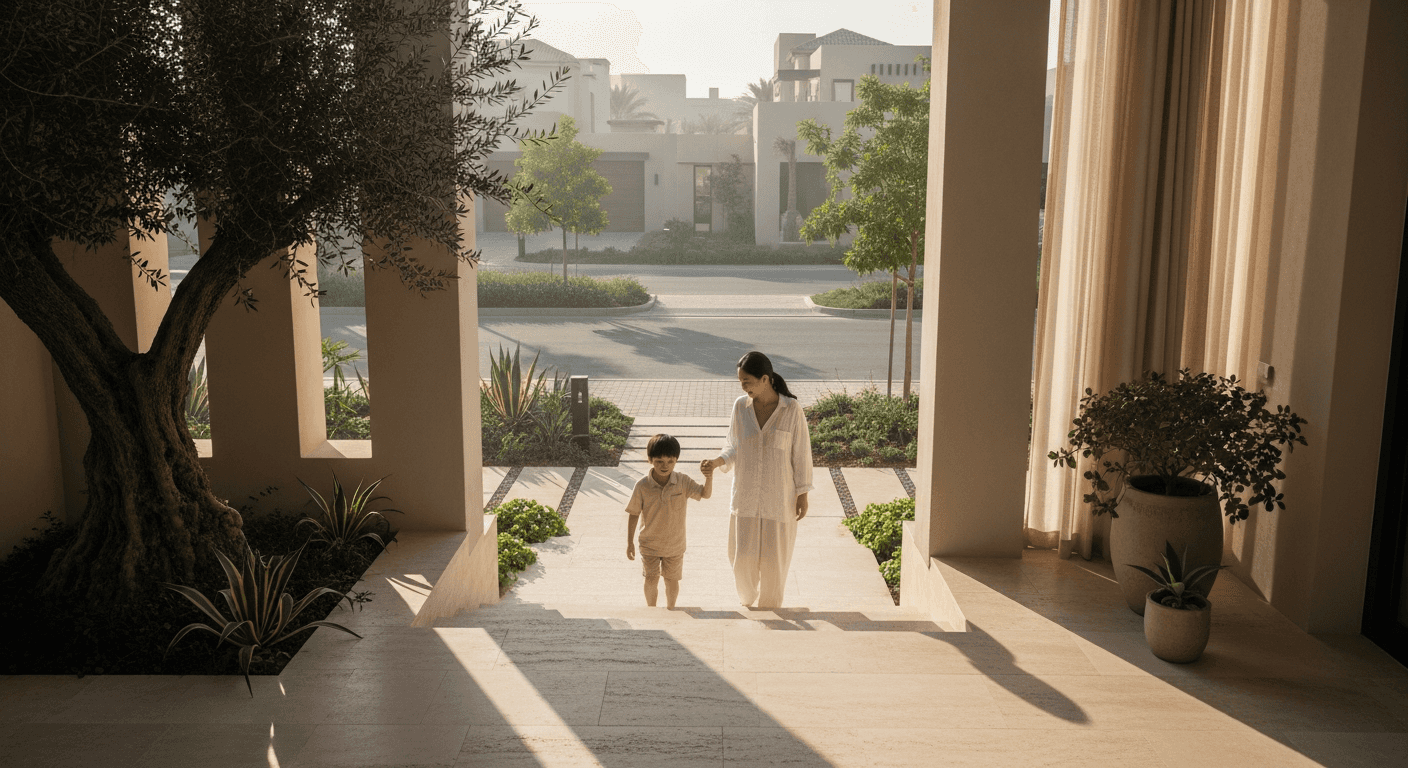
Dubai's Next Wave of Family Villa Communities
For years, the conversation around ideal family living in Dubai has been dominated by a few stellar names. Communities like [Dubai Hills](/areas/dubai-hills) set a formidable benchmark for…

For years, the conversation around ideal family living in Dubai has been dominated by a few stellar names. Communities like Dubai Hills set a formidable benchmark for what a modern, green, and connected suburb could be. But as these areas mature and prices reflect their success, I find my clients are increasingly asking the same question: what’s next? They are looking for the future family homes of Dubai, seeking the same magic of a thoughtfully designed master plan but with the potential for growth that comes from getting in early. The good news is, the next wave is already here, rising from the sands with ambitious new concepts for family life.
Here’s what we'll explore as we look at the emerging villa areas in Dubai:
- The key ingredients that define a 'next-generation' master plan.
- A spotlight on The Valley by Emaar Properties, a self-sufficient town in the making.
- A deep dive into the residential vision for Dubai South.
- The evolution of a classic with new launches in Arabian Ranches III.
- The bold, lifestyle-driven concepts of DAMAC Lagoons and Hills II.
- A practical breakdown of the total cost of buying an off plan villas Dubai family home.
- My personal verdict on where the best long-term value lies for different family priorities.
Beyond the Benchmark: What Defines the New Guard?
To understand where we're going, it helps to see where we've come from. The first generation of freehold villa communities, like the original Arabian Ranches and The Springs, were revolutionary for their time. They offered a safe, green, suburban lifestyle that simply didn't exist in Dubai before. The second wave, led by titans like Dubai Hills and Tilal Al Ghaf, refined the model. They integrated world-class golf courses, central parks, and high-quality schools and retail directly into the fabric of the community. They weren’t just places to live; they were complete lifestyles.
Now, I see the third wave, the new guard of master-planned communities Dubai, pushing the envelope once more. They are being built on a few core principles that differentiate them from their predecessors. The first is what I call 'hyper-amenitisation'. It's no longer enough to have a community pool and a small park. The new standard involves vast, swimmable crystal lagoons, urban beaches hundreds of metres from the desert, destination-worthy restaurants and cafes, dedicated sports villages with professional-grade facilities, and integrated co-working spaces that acknowledge the shift in how we work. These amenities are not afterthoughts; they are the central, organising features of the entire development.
Second is a strategic bet on infrastructure and connectivity. Most of these new communities are rising along Dubai’s southern growth axis, near major arteries like Sheikh Mohammed bin Zayed Road and Emirates Road. This isn't accidental. They are being planned in concert with the city's long-term expansion, particularly around Al Maktoum International Airport — set to become one of the world's largest, and the legacy infrastructure of Expo City. The vision is to build self-sustaining economic and residential hubs, reducing the reliance on the traditional city centre. For families, this means the promise of future convenience, with new Metro lines and road networks designed to serve these growing populations.
Finally, sustainability and wellness are now non-negotiable design pillars. This goes beyond simple greenwashing. Developers are competing to offer more genuine green spaces, extensive networks of shaded walking and cycling tracks, and architecture that prioritises natural light and energy efficiency. The entire community ethos is shifting towards promoting an active, outdoor, and balanced lifestyle. This is a direct response to a global shift in buyer priorities, a trend we at Gaia Living see reflected in our client conversations every day. Families don't just want a big house; they want a healthier, more connected environment for their children to grow up in.
Spotlight: Emaar's The Valley — A New Town Rises
 Featured project
When a developer with the track record of Emaar Properties announces a project of the scale of The Valley, the market takes notice. Located on the Dubai-Al Ain Road, this community is perhaps the most complete expression of the new 'town-building' philosophy. It’s not positioned as a mere suburb of Dubai but as a quaint, self-sufficient town of its own, aiming to recapture a sense of neighbourhood and community that can be lost in a sprawling metropolis. In my view, this is a direct appeal to families, especially those with young children, who are searching for that idyllic, close-knit environment.
The ambition is evident in its master plan. Instead of a single clubhouse, The Valley is structured around a series of large-scale amenity hubs. There's the 'Town Centre', planned to be a vibrant indoor and outdoor retail area with farmers' markets and gourmet dining. There’s the 'Sports Village', a 20,000 square metre facility with courts, fields, and a gym. But the centrepiece is arguably the 'Golden Beach', a 30,000 square metre urban beach concept with water features and play areas for children. The idea is to provide residents with so many high-quality leisure options within their community that they rarely feel the need to leave.
Over the past few years, Emaar has been steadily releasing clusters of townhouses and villas within The Valley, each with its own character. We've seen communities like Nara, Talia, and Orania, typically offering three and four-bedroom townhouses and semi-detached villas. More recent launches like Elora and Rivana have continued this trend, with contemporary architecture, open-plan layouts, and private garden spaces. At launch, these properties have often been positioned at a very compelling price point for Emaar, with three-bedroom townhouses starting in a range around AED 1.8 million to AED 2.2 million. This has made it a hotspot for first-time villa buyers and young families being priced out of more central locations but who still want the assurance of the Emaar brand.
The critical trade-off, of course, is the location. The Dubai-Al Ain Road corridor is still developing, and the commute to business hubs like DIFC or Dubai Marina can be significant. However, for the growing number of professionals with flexible working arrangements or those employed in the expanding southern business hubs, this becomes less of an issue. The value proposition is clear: you are trading a longer commute for a larger home, world-class amenities, and the potential for significant capital appreciation as the 'town' of The Valley and its surrounding infrastructure are fully realised over the next decade.
Dubai South: The City of the Future Takes Shape
For the truly long-term thinkers, no area in Dubai holds more transformative potential than Dubai South. This is not just another development; it's a 145-square-kilometre city-in-the-making, an integral part of the Dubai Urban Master Plan 2040. Anchored by Al Maktoum International Airport and the vibrant Expo City district, Dubai South is a monumental bet on the future of Dubai as a global hub for logistics, aviation, and commerce. And at its heart lies a rapidly growing residential district that is becoming one of the most talked-about destinations for families seeking value and growth.
For years, the residential component of Dubai South was dominated by Emaar South, which brought the developer's signature quality with clusters like Urbana townhouses and Golf Links villas overlooking a championship golf course. These projects were incredibly successful, proving the appetite for family homes in the area. Now, we are seeing the next phase of development, with new villa communities being launched by Emaar and other developers, building on this initial success. The vision is to create a complete ecosystem where people can live, work, and play, with schools, clinics, and retail all within the master plan.
Investing or choosing to live in Dubai South is a strategic decision. It's about buying into a government-backed vision for Dubai's future. The scale of investment pouring into this area is immense. The expansion of the airport, the extension of the Metro's Red Line, and the repurposing of the Expo 2020 site into a human-centric smart city are powerful catalysts for growth. Families moving here are pioneers of a sort. They benefit from brand new infrastructure and, most compellingly, a price point that is significantly more accessible than in established villa communities. You simply get more square footage for your money, allowing families to move from an apartment to a townhouse or from a townhouse to a villa.
Of course, being a pioneer comes with its own set of challenges. While the core infrastructure is excellent, the soft infrastructure — the wider array of schools, the diverse retail options, the community 'soul', takes time to develop. Early residents accept that they are living in a community that is still a work in progress. However, the quality of life on offer from day one is already high. The emphasis on green spaces, parks, jogging tracks, and the sheer sense of openness is a huge draw. For families with a parent who travels frequently, the proximity to the airport is a life-changing convenience. In my experience, Dubai South appeals most to those who are excited by the prospect of being part of building a new piece of the city from the ground up.
The Evolution of an Icon: Arabian Ranches III
Not all new villa communities are on uncharted territory. Sometimes, the most compelling new option is the next chapter of a beloved classic. That's precisely the case with Arabian Ranches III by Emaar. This community represents a different proposition entirely from the likes of The Valley or Dubai South. It isn't a pioneering move into a new part of the city; it's a confident expansion of one of Dubai’s most trusted and desirable family brands. For many families, this removes a huge element of uncertainty from the off-plan buying process.
When you buy into Arabian Ranches, you are buying more than just a property; you are buying into a two-decade legacy of exceptional community management, mature landscaping, and a well-established, family-centric lifestyle. People know what to expect from the brand: high-quality construction, beautifully maintained common areas, and a vibrant community life. Ranches III builds on this powerful foundation. Located adjacent to the original community, it leverages the existing infrastructure and reputation while introducing a more contemporary product and a new suite of amenities designed for today's families.
The master plan for Ranches III is distinct from its predecessors. While Ranches I is known for its desert-themed golf course and Ranches II for its tight-knit neighbourhood feel, Ranches III is designed around a massive central park that acts as the green heart of the community. Amenities are more modern and varied, including a lazy river, a dedicated cricket pitch, sports courts, and a direct connection to the Global Village. The architectural styles are also updated, moving away from the traditional Arabesque and Spanish themes towards cleaner, more contemporary designs with large windows and open-plan interiors.
Emaar has released a variety of sub-communities within Ranches III, catering to different family sizes and budgets. We’ve seen popular townhouse communities like Sun, Joy, Spring, and the minimalist-themed Bliss, which offered a unique pedestrian-friendly layout. For those seeking larger, standalone villas, clusters like Caya and June provided more spacious options. These properties offered a chance to own a brand-new home within the Ranches ecosystem, complete with a developer warranty and modern efficiencies, often at a price point that was competitive with older, secondary-market homes in Ranches I and II that might require renovation. In my opinion, Arabian Ranches III is the blue-chip choice for families who prioritise stability and proven quality over the higher-risk, higher-reward potential of the city's newer, more remote locations.
DAMAC's Twin Bets: Lagoons and The Hills Reimagined
If Emaar is known for its steady, master-planned excellence, then developer Damac is known for its bold, unapologetically ambitious concepts. This is perfectly illustrated by two of its most significant current projects: DAMAC Lagoons and the ongoing evolution of Damac Hills and Damac Hills II. These communities offer a distinct flavour of family living, one that heavily leans into a resort-style, amenity-rich experience.
DAMAC Lagoons, located adjacent to DAMAC Hills, is the ultimate example of hyper-amenitisation. It is perhaps the most audacious residential concept in Dubai right now. The entire community is themed around Mediterranean destinations, with a colossal, swimmable man-made lagoon forming its spine. Each cluster of townhouses and villas is named after a coastal city — Santorini, Costa Brava, Portofino, Venice, and designed to reflect its namesake's architectural style and atmosphere. The Santorini cluster features white-washed, blue-accented homes, while the Venice cluster is designed with canals and gondola rides. The lifestyle proposition is unequivocal: you are buying a home in a permanent holiday destination. It’s an immersive, thematic experience that appeals to buyers who want their home life to feel like an escape.
Meanwhile, DAMAC Hills and its younger sibling, DAMAC Hills 2, represent a more established but continually evolving vision. DAMAC Hills is anchored by the Trump International Golf Club Dubai, offering a premium lifestyle with villas and apartments overlooking the greens. It's a mature community now, with a school, supermarket, and a vibrant community centre. DAMAC Hills 2, located further out on the Al Qudra Road, doubles down on the amenity-rich model at a more accessible price point. It's divided into 'towns' — a Water Town with a wave pool and lazy river, a Sports Town with pitches and courts, and an Equestrian Town. It’s less about a single theme and more about providing an almost overwhelming array of activities for families. For many buyers, the value offered in DAMAC Hills 2, particularly for larger villas, is a major draw.
“The Valley is a bet on Emaar's world-building prowess, Dubai South is a bet on the city's inexorable southern expansion, and Arabian Ranches III is a bet on a trusted blue-chip brand.”
These communities cater to a specific mindset. The target audience is the family that values an active, social, and amenity-driven lifestyle above all else. Price points, particularly in DAMAC Hills 2 and the early phases of Lagoons, have been very competitive, making them a popular choice for those looking for new villa communities Dubai has to offer. The trade-off is a location that, like other emerging areas, requires a commute. But for the right buyer, the promise of living in a water park or a Mediterranean resort is a compelling reason to make that drive.
The Numbers: Deconstructing the Cost of an Off-Plan Villa
Exploring these exciting new visions for family life is inspiring, but for most people, the decision ultimately comes down to the numbers. As a communities specialist, I believe it's my responsibility to ground the dream in financial reality. The advertised price of an off-plan property is only the starting point, and understanding the full upfront and recurring costs is essential for sound financial planning. Many first-time buyers of off-plan villas in Dubai are caught off guard by the additional fees, so let's break them down transparently.
Let’s use a realistic example: a four-bedroom townhouse in a new master-planned community with a purchase price of AED 2,500,000. Here is a line-by-line breakdown of the upfront costs you would typically face as a cash buyer:
- Purchase Price: AED 2,500,000
- Dubai Land Department (DLD) Fee: 4% of Purchase Price = AED 100,000
- DLD Administration Fee: Approximately AED 4,200 (this is a fixed fee subject to change)
- Oqood (Off-Plan Registration) Fee: This is consolidated into the 4% DLD fee for initial sales from a developer.
- Agency Fee: Typically 2% of Purchase Price + 5% VAT = AED 50,000 + AED 2,500 = AED 52,500
- Developer Admin Fees/NOC: Varies, but budget around AED 5,250
- Total Upfront Cost: AED 2,500,000 + AED 100,000 + AED 4,200 + AED 52,500 + AED 5,250 = AED 2,661,950
For a mortgage buyer, the calculation changes. According to regulations from the Central Bank of the UAE, for a first property valued under AED 5 million, a resident can borrow a maximum of 80% of the property value. This means you need a minimum 20% down payment in cash. Crucially, the 4% DLD fee and other charges cannot be included in the mortgage and must also be paid upfront. A bank will also have its own fees. The scenario looks like this:
- Minimum Down Payment: 20% of AED 2,500,000 = AED 500,000
- DLD Fee + Admin: AED 104,200
- Agency Fee: AED 52,500
- Bank Arrangement Fee: ~1% of Loan Amount (1% of AED 2,000,000) = AED 20,000 + 5% VAT
- Bank Valuation Fee: ~AED 3,150
- Mortgage Registration Fee (paid to DLD): 0.25% of Loan Amount = AED 5,000
- Total Upfront Cash Required (Mortgage): AED 500,000 + AED 104,200 + AED 52,500 + AED 21,000 + AED 3,150 + AED 5,000 = AED 685,850
It's also vital to understand post-handover payment plans. If a developer offers a plan where 30% is due after handover, be aware that most banks will only finance the portion due up to handover. You may need to have the cash ready for the post-handover instalments or secure separate financing. Finally, don't forget the recurring costs. Annual service charges in new villa communities typically range from AED 2.50 to AED 4.50 per square foot. For a home with a 3,000 sq. Ft. built-up area, this translates to an annual bill of AED 7,500 to AED 13,500, which covers the upkeep of all those wonderful amenities.
The Investment Angle: Capital Growth vs. Rental Yield
While many of our clients are end-users looking for their forever home, the question of `investing new Dubai villas` is always part of the conversation. And rightly so — a family home is often the single largest investment one makes. In these emerging villa communities, the investment case has two distinct dimensions: capital appreciation and rental yield. It's important to understand which one is the primary driver in the early years.
For most off-plan purchases in new, large-scale master plans, the primary investment thesis is capital appreciation. The strategy involves buying into the developer's vision at an early stage, often at a lower entry price. As the community develops over several years, phases are completed, world-class amenities are delivered, schools and retail outlets open, and the area's reputation grows. This process of maturation typically drives property values upwards. An investor who bought a townhouse in Phase 1 of The Valley, for instance, hopes that by the time Phase 5 is launching and the Golden Beach is operational, their property will be worth significantly more. This is a medium to long-term strategy that requires patience and a belief in the developer's ability to execute their vision and the city's overall growth trajectory.
The flip side is rental yield, which is the annual rental income as a percentage of the property's cost. This becomes the focus after the property is handed over. In my experience, investors should have realistic expectations for rental yields in brand-new, emerging communities. Initially, yields might be more modest compared to established, central apartment districts. There are a few reasons for this. The initial tenant pool may be smaller as the area is still unknown. There is also a large amount of new stock being handed over simultaneously, creating competition among landlords which can temporarily suppress rents. An investor must be prepared for this initial phase.
Let’s run a quick calculation. If the AED 2.5 million villa we discussed earlier rents for AED 120,000 per year upon handover, the gross rental yield would be (120,000 / 2,500,000) * 100 = 4.8%. This is a respectable figure. However, to find the net yield, you must subtract annual costs like the AED 13,500 service charge and a provision for maintenance. This would bring the net income to AED 106,500, and the net yield down to around 4.26%. As the community matures, rents tend to rise, improving this yield over time. My advice to clients is generally to view these communities as an end-user or capital growth play first, with strong rental income being a benefit that solidifies later in the investment cycle.
My Verdict: Choosing Your Family's Future Home
After exploring these exciting new frontiers of family living, it's clear there is no single 'best' community. The right choice is deeply personal and depends entirely on your family's priorities, risk appetite, and vision for your life in Dubai. The thread that connects all these new projects is ambition — an ambition to offer families more space, more lifestyle, and more community than ever before. The decision lies in which brand of ambition best aligns with your own.
For the family I call the 'Pioneers' — those who are value-driven and have a long-term vision, the opportunities in Dubai South and the more accessibly priced clusters of The Valley are unmatched. Here, you will find the most space for your money and the highest potential for capital growth as these new cities take shape. This path requires patience and a tolerance for living in a community that is evolving, but the potential rewards are substantial.
For the 'Brand-Conscious' family that values security and predictability, my recommendation is often Arabian Ranches III. It is the quintessential blue-chip investment in family lifestyle. You are not taking a risk on a new concept or location; you are buying into a proven ecosystem with a guarantee of quality and community from a developer that has been defining the market for decades. It's a choice that prioritises peace of mind and immediate quality of life.
Finally, for the 'Lifestyle-Obsessed' family, for whom the home is an extension of their recreational life, DAMAC Lagoons stands in a category of its own. It is a bold, thematic choice. If your family’s dream is to live in a resort, with water sports and holiday vibes at your doorstep every single day, then no other community delivers on this promise so completely. It is a decision that puts a unique lifestyle experience at the forefront of every other consideration.
The next wave of Dubai's master-planned communities is defined by ambitious amenities and a bet on the city's future growth corridors. For families, the choice isn't just about the villa itself, but about which vision of Dubai's future you want to be a part of. The best value, in my opinion, lies with those who can balance a longer-term vision with their family's immediate needs for space and community.
Ultimately, these new communities offer a rich mix of choices for the future of family homes in Dubai. It’s an exciting time to be putting down roots in this dynamic city. If you're exploring these options, our team at Gaia Living has on-the-ground experience in every one of these areas, and we can help you navigate the nuances to find the perfect fit. Feel free to browse our properties for sale or reach out for a conversation.
## Sources - Dubai Land Department (DLD): dubailand.gov.ae - Central Bank of the UAE: centralbank.ae - UAE Government Portal (Property Purchase Information): u.ae
Questions, answered
- What are the most promising new villa communities in Dubai for families?
- Beyond established areas, communities like Emaar's The Valley, the residential district in Dubai South, Arabian Ranches III, and DAMAC Lagoons represent the next wave, each offering a different mix of lifestyle, value, and long-term potential.
- How much does it cost to buy an off-plan villa in Dubai?
- On top of the purchase price, you must budget for the 4% Dubai Land Department (DLD) transfer fee, associated admin fees, and a 2% agency fee. For a property of AED 2.5 million, your total upfront costs could exceed AED 150,000.
- Is investing in new Dubai villa communities a good idea?
- Investing in emerging master-planned communities is primarily a play on capital appreciation. Buying early can offer significant growth potential as the area matures and amenities are delivered, but rental yields may be modest in the initial years after handover.
- What is a 'master-planned community' in Dubai?
- A master-planned community is a large-scale residential development designed with a comprehensive vision. It includes not just homes but also integrated amenities like schools, retail centres, parks, and unique lifestyle features, creating a self-contained neighbourhood.
- What are typical service charges for a new villa in Dubai?
- For new villa communities, expect annual service charges to be in the range of AED 2.50 to AED 4.50 per square foot of your property's built-up area or plot area. These fees cover the maintenance of all common areas, security, and community amenities.
- Are new villa communities far from the city centre?
- Many new large-scale communities are located along Dubai's southern growth corridor, further from Downtown Dubai. This trade-off offers more space, modern amenities, and potentially lower entry prices, but requires a longer commute to the traditional city centre.

Sophia profiles Dubai's villa communities — schools, commute times, green space, and the intangible feel of a neighbourhood. She writes for families putting down roots.
Related stories
Dubai's Established Charm: The Case for Older Homes
In a city focused on the future, I believe the smartest move for many buyers is to look back. Dubai's seasoned communities offer space, character, and surprising value that new builds often can't match.
The True Cost of Owning a Dubai Property
Beyond the purchase price, your annual budget for a Dubai home must account for service charges, utilities, and maintenance. I'll break down every ongoing expense you need to plan for.
Calculating ROI on Dubai Rental Upgrades
As a landlord in Dubai, you can't just follow trends. I'll show you how to calculate the precise ROI of minor property upgrades to genuinely increase your rental yield.
Echoes, in your inbox
One thoughtful email a month. Market insight, new launches, no spam.