

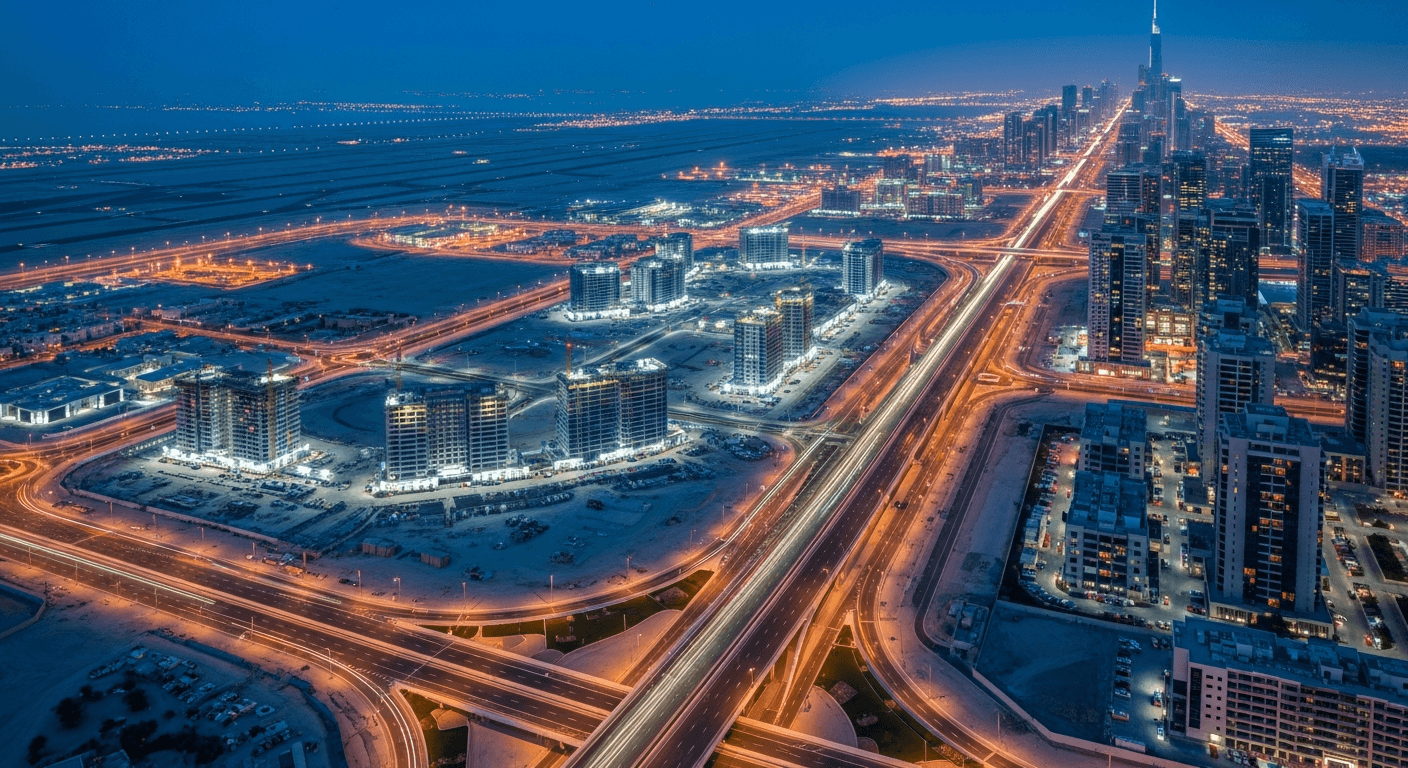
Dubai's Next Growth Corridors
To find Dubai's next property hotspots, you must look beyond the hype. My analysis focuses on tracking major infrastructure projects and demographic shifts to identify where real, sustainable value is being created.

In my role, I analyse numbers — transaction volumes, price indices, supply pipelines. But the most important numbers are often not in the past; they are embedded in the future, hidden in plain sight within urban master plans and demographic forecasts. Identifying Dubai's next investment hotspots is not about chasing last year's winners. It's about understanding where the city is physically going, and who is going with it.
Here's what we'll explore in this analysis:
- The macro-level vision driving Dubai's expansion beyond its prime core.
- The Southern Corridor: why the Al Maktoum Airport expansion is a generational catalyst.
- The Inland Corridors: tracking the migration towards space and value along the E311 and E611.
- The Northern Nexus: the quiet but steady economic integration with neighbouring emirates.
- Infrastructure as the Predictor: a deep dive into game-changing projects like the Metro Blue Line.
- The People Factor: how new visa rules and work cultures are reshaping demand.
- An investor's checklist for spotting a genuine growth zone before it becomes obvious.
- My personal verdict on where I see the most compelling opportunities taking shape.
The Macro Picture: A Mandate for Growth
To understand where Dubai's property market is headed, one must first appreciate the scale of its ambition. The Dubai Economic Agenda, or D33, isn't just a policy document; it's a strategic blueprint to double the size of the city's economy and establish it as one of the top three global cities. A cornerstone of this vision is a significant population increase, with a target of reaching 5.8 million residents by 2040. This isn't a passive hope; it's an active objective backed by massive government investment and pro-growth policies. This single fact is the primary driver of the need for new growth communities Dubai.
The current urban core, from Dubai Marina up through Downtown Dubai and Business Bay, is largely mature. While these areas will always command a premium and remain desirable, they cannot physically accommodate the millions of new residents and the economic activity that will accompany them. Simple maths dictates that the city must expand. This expansion is not random; it is meticulously planned along strategic corridors defined by transport infrastructure and economic anchors. For the savvy investor, the game is no longer about buying into the established prime markets and hoping for incremental gains. The real opportunity lies in identifying these corridors and positioning oneself ahead of the curve.
This outward push is a natural and healthy sign of a maturing global city. We saw similar patterns in London with the development of Canary Wharf and the Elizabeth Line's impact, or in Paris with the Grand Paris Express project. When a city's economic heart becomes too expensive and congested, growth inevitably follows the paths of new infrastructure. In Dubai's case, this infrastructure is being laid down with a speed and scale that is almost unparalleled. The government, through entities like the RTA and major master developers such as Emaar Properties and Nakheel, is not just responding to demand; it is actively creating the conditions for future growth. Understanding this top-down, vision-led approach is fundamental to identifying the most promising emerging property areas Dubai has to offer.
The Southern Corridor: The Al Maktoum Airport Effect
 Featured project
Of all the growth corridors, none is more significant or holds more long-term potential than the southern expansion towards Abu Dhabi, centred around the Al Maktoum International Airport (DWC) and the vast Dubai South master plan. The recent confirmation of a monumental AED 128 billion expansion of DWC, set to make it the world's largest airport with a capacity for 260 million passengers, is the single most important infrastructure announcement for the property market in a decade. This isn't just an airport expansion; it's the creation of an 'aerotropolis' — a city in its own right, with the airport as its economic engine.
The implications are profound. This new hub will consolidate all of Dubai's airline operations, including the flagship Emirates, creating an unprecedented centre for logistics, trade, aviation services, and commerce. The sheer number of jobs created — directly at the airport and in ancillary industries, will necessitate a massive residential population in the immediate vicinity. Dubai South is planned to house one million people. This is where demand will be organic and sustained. We are talking about pilots, logistics managers, tech professionals, and service staff all needing a place to live, shop, and educate their children, creating a vibrant, self-sufficient ecosystem.
Within this vast area, developers are already building the communities that will house this new population. Projects like Emaar South, with its golf course villas and townhouses, or The Pulse, with its focus on apartments and community living, are just the beginning. These are not speculative builds; they are the foundational bricks of a new city district. For investors, the entry points here are still remarkably accessible compared to the established city. A two-bedroom apartment in Dubai South can be acquired for a price that might only secure a studio in the prime core. The key is to look at the timeline. This is not a 'flip in six months' play. It's a strategic, 10-to-20-year investment in the future backbone of Dubai's economy. The value will be unlocked incrementally as each phase of the airport's expansion is completed and as the population moves in. To illustrate the costs, let's consider a hypothetical off-plan townhouse purchase in this corridor.
Sample Off-Plan Townhouse Cost Breakdown (Dubai South): - Property Purchase Price: AED 2,200,000 - Dubai Land Department (DLD) Transfer Fee (4% of price): AED 88,000 - DLD Registration Fees: ~AED 4,200 - Oqood (for off-plan) Registration Fee: AED 5,000 + 5% VAT = AED 5,250 - Agency Fee (if applicable on secondary market, typically 2%): N/A for direct from developer - Developer's Administration Fee (Varies): Typically AED 5,000 - AED 10,000 - Estimated Total Upfront Cost (excluding initial payment plan deposit): ~AED 97,450
This breakdown shows the ancillary costs involved, which are crucial for any investor to budget for. The real attraction, however, is the low capital entry point on the property price itself, combined with developer-led payment plans that often require only 10-20% down during construction. This is one of the most tangible investment hotspots Dubai 2025 will be known for.
The Inland Corridors: The E311 & E611 Axis
While the southern corridor represents the long-term future, a more immediate and observable growth trend is occurring along Dubai's two major inland arteries: Sheikh Mohammed bin Zayed Road (E311) and Emirates Road (E611). For years, these highways were seen simply as transit routes connecting Dubai to other emirates. Today, they are the spine of a burgeoning residential and suburban heartland. This shift is driven by a straightforward demographic and economic reality: families seeking more space and better value than the hyper-dense coastal strip can offer.
Communities like Arabian Ranches (and its newer phases), Dubai Hills, and Town Square by Nshama have proven the model. They offer villas, townhouses, and low-rise apartments set within green, amenity-rich master plans, complete with schools, parks, and retail centres. What was once considered 'far out' is now the new suburban centre for a significant portion of Dubai's professional class. The success of these areas has paved the way for the next wave of development further along these corridors. Areas like Damac Hills and Damac Hills II and the various communities within Dubailand are maturing rapidly, with infrastructure, retail, and social amenities catching up to the residential development.
This inland migration is a direct response to changing lifestyle priorities. The post-2020 work culture, with its acceptance of hybrid and remote models, has put a premium on home size and quality of life. A dedicated home office is no longer a luxury but a necessity for many. A garden or nearby park has become a key factor in choosing a home. These inland communities deliver on that promise at a price point that is often 30-50% lower per square foot than comparable properties in older, more central locations. An investor looking for undervalued neighborhoods Dubai should pay close attention to the less-developed plots along these highways. Where you see a major developer like Emaar, Damac, or Meraas acquiring large land banks, you can be sure a new master community is on the horizon.
“The value equation for families has fundamentally changed. The premium is no longer just on proximity to the central business district, but on space, community, and well-being.”
The key to successful investment here is to differentiate between isolated projects and true master-planned communities. An isolated tower in the middle of nowhere will likely struggle with occupancy and rental yields. A well-integrated community with a clear phasing plan for schools, clinics, and retail will create its own demand and see sustained capital appreciation. Look for the 'placemaking' developers — those who invest in the parks, the walkways, and the community centres before the last phase of residential is even sold. That is the hallmark of a future residential area Dubai families will actively choose to live in.
The Northern Emirate Nexus: The E11 Coastal Creep
While much of the headline-grabbing growth is focused south and inland, a quieter but equally important trend is the strengthening of the northern corridor along Sheikh Zayed Road (E11) towards Sharjah and Ras Al Khaimah. For a long time, the relationship was primarily one-way: a commuter flow from the northern emirates into Dubai for work. That dynamic is beginning to shift, creating interesting cross-emirate investment and residential opportunities.
Several factors are at play. First, the Sharjah-Dubai border is becoming increasingly porous in terms of lifestyle and development. Developers like Arada are creating high-quality master communities like Aljada in Sharjah that rival Dubai projects in terms of design and amenities, but at a more competitive price point. This creates a 'value-spillover' effect, making areas in Dubai that are close to the Sharjah border, like Mirdif and Al Khawaneej, more attractive as they benefit from the improved infrastructure and amenities on both sides.
Second, and more transformational, is the rise of Ras Al Khaimah (RAK) as a major tourism and investment destination in its own right. The announcement of the Wynn integrated resort, complete with a gaming component, on Al Marjan Island is a seismic event for the entire UAE. It will create a powerful new economic magnet, drawing international tourism and creating thousands of hospitality and service jobs. This makes the entire E11 corridor leading up to RAK more viable. The federal government's investment in the Etihad Rail network, which will eventually connect all the emirates, will further cement this northern nexus. For a property investor, this means looking at the northern coastal areas of Dubai not just in isolation, but as part of a larger, integrated economic zone. The potential for holiday homes and short-term rentals in areas with good access to both Dubai's attractions and RAK's upcoming resort is a niche that is currently underserved.
While I would still classify this as a more speculative play than the southern or inland corridors, the direction of travel is clear. As land in central Dubai becomes scarcer and more expensive, the economic logic of developing the northern fringe becomes more compelling. It represents a longer-term vision, but one that is underpinned by powerful economic forces. Investors with a higher risk appetite and a longer time horizon could find compelling opportunities by looking north, a direction that many others are currently overlooking.
Infrastructure as the Predictor: The Blue Line Metro
If you want to know where property prices will be higher in five to ten years, look at where the RTA is digging today. In Dubai, more than any other single factor, transport infrastructure is the primary catalyst for property value appreciation. The history of the Red and Green metro lines is a perfect case study: areas like JLT, Dubai Marina, and Bur Dubai saw significant price and rent increases once the connectivity was established. The next chapter in this story is the newly announced Dubai Metro Blue Line.
This 30-kilometre extension is a game-changer for a dozen residential and commercial districts that are currently underserved by public transport. The line will run from Creek Harbour to Academic City, with a branch to International City, creating a vital link. It will provide, for the first time, direct metro access to areas like Mirdif, Al Warqa, International City, Dubai Silicon Oasis, and importantly for the affordable housing sector, communities like Liwan and Arjan. These are areas that are already established and have significant resident populations but have been hampered by a reliance on cars.
My analysis indicates that Arjan, in particular, is poised for a significant re-rating. It has a central location, set between Al Khail Road and Sheikh Mohammed bin Zayed Road, and is home to popular attractions like the Dubai Miracle Garden and Butterfly Garden. The development there consists primarily of modern, affordable low-to-mid-rise apartment buildings, which attract a young professional and small family demographic. Its one major drawback has been the lack of public transport. The Blue Line removes that obstacle completely. Suddenly, a resident in Arjan will be able to connect to the entire city via the metro network. This fundamentally changes the value proposition of living there. We can expect to see increased rental demand, followed by a steady rise in capital values as the metro's completion date nears. This makes Arjan one of the most interesting undervalued neighborhoods Dubai currently offers.
To capitalise on this, an investor must act before the metro's impact is fully priced in. The time to investigate is now, while the project is in its early stages. By the time the first train runs, the biggest gains will have already been made by those who understood the predictive power of an RTA master plan. When evaluating properties in these zones, look for buildings within a 10-15 minute walk of a proposed station. That's the 'golden circle' where the impact on convenience, and therefore value, will be most pronounced.
The People Factor: Visas, Work, and Community
Infrastructure lays the tracks, but demographics drive the train. A critical, and perhaps less tangible, factor shaping Dubai's future growth corridors is the changing nature of its population. The UAE government's visionary reforms, particularly the expansion of the Golden Visa program, are having a profound effect on how people view their life in Dubai. The shift from a transient, short-term mindset to a long-term residency perspective is the most significant demographic trend I've seen in my career.
Golden Visa holders, who now include a wider range of professionals, entrepreneurs, and investors, are not just looking for a temporary base. They are putting down roots. They are planning for their children's education five years from now, considering their retirement plans ten years from now, and seeking a genuine sense of community. This has a direct impact on the property market. Demand is shifting away from small, transient-friendly apartments in the busiest tourist hubs and towards larger homes in stable, family-oriented communities. This is the 'software' that complements the 'hardware' of infrastructure. It explains the surging popularity of villa and townhouse communities in areas like Dubai Hills and Arabian Ranches, and it will drive the success of the new communities being built in Dubai South and along the E311/E611 corridors.
Another key driver is the global evolution of work. The acceptance of hybrid and remote work models means the daily commute is no longer the sole determinant of where someone chooses to live. This decouples residential choice from office location. People are now willing to trade a slightly longer commute on the two or three days they go to the office for a larger home, a garden, better amenities, and a quieter environment. This trend directly benefits the growth corridors I've outlined. A three-bedroom townhouse in Town Square or DAMAC Hills II, which might have seemed too far for a five-day-a-week commuter, becomes perfectly logical for a professional who only needs to be in a Downtown office twice a week. This shift is permanent and is fundamentally reshaping the geography of demand across the city.
This creates a clear checklist for developers and investors: does the community have good schools? Are there parks and green spaces? Is there a community centre? Is the internet connectivity reliable for home offices? These were once secondary considerations; they are now primary drivers of choice. The future residential areas Dubai's new long-term population will flock to are the ones that answer these questions affirmatively.
The Investor's Checklist: Spotting a Growth Zone
Synthesizing this analysis into an actionable framework, how does an investor practically identify these growth corridors before they become common knowledge? It requires a specific, research-led approach that goes beyond reading property portals. At Gaia Living, this is the methodology we apply. It involves looking for a convergence of leading indicators.
Here is my personal checklist for evaluating a potential growth zone. A truly promising area will tick most, if not all, of these boxes:
- Announced Master Plan: Is there a public, detailed master plan from a top-tier developer (Emaar, Nakheel, Aldar, etc.) or a government entity? A clear vision is non-negotiable.
- Major Infrastructure Confirmed: Look for official announcements from authorities like the RTA, Etihad Rail, or Dubai Airports. A line on a map in a consultant's report is speculation; a government tender or budget allocation is a confirmation. Check the official Dubai Land Department (DLD) and government portals regularly.
- Economic Anchor Present: Is the area anchored by a significant economic driver other than just housing? This could be an airport, a university hub (like Academic City), a major industrial zone, or a tourism magnet.
- Initial 'Pioneer' Development: Are the first phases of development underway or completed? This shows the master plan is moving from paper to reality. The first movers often secure the best plots and set the quality standard.
- Price Differential: Is there a significant (e.g., 30%+) price per square foot discount compared to the nearest established and comparable community? This gap represents your potential for capital appreciation.
- New Support Infrastructure: Are you seeing the construction of 'soft' infrastructure alongside the buildings? Look for new school campuses, clinic and hospital announcements, and the development of community retail centres.
- Improving Connectivity: Even before a new metro, are road networks being upgraded? Are new interchanges or access roads being built? This is often the first sign of a future focus area.
Applying this checklist to the areas discussed, Dubai South ticks every single box. The Blue Line corridor around Arjan and Liwan ticks most of them, with the 'Economic Anchor' being the existing population and commercial base that is now being unlocked. The inland E311/E611 corridor is a more mature example of this checklist in action. By using this structured approach, you move from speculation to strategic analysis.
My Verdict: Where to Focus Now
Having laid out the evidence, my professional conclusion is that Dubai's growth over the next decade will be overwhelmingly defined by two main axes: the southern corridor towards Dubai South and the ongoing maturation of the inland family communities. These are not mutually exclusive; they represent different timelines and investor profiles.
For the long-term, strategic investor with a 10-20 year horizon, the evidence for the Dubai South corridor is, in my view, undeniable. The sheer scale of the government's commitment to Al Maktoum International Airport creates a gravitational pull that is too large to ignore. Investing here is a direct investment in the core strategic vision of Dubai's future. The initial phases of residential communities like those by Emaar and in the Dubai South Residential District offer an entry point that will look incredibly astute in a decade's time. This is a patient investor's play, focused on fundamental, long-term economic and demographic growth.
For the investor with a more medium-term outlook of three to seven years, my attention is firmly on the areas impacted by the Metro Blue Line, specifically Arjan. This is a textbook case of a good area becoming a great one through a single, transformative infrastructure project. The area already has a critical mass of quality, affordable housing and a growing population. The metro provides the final missing piece of the puzzle, unlocking its potential and connecting it smoothly to the rest of the city. The window to benefit from this is now, before the project's completion makes the subsequent price uplift an established fact. It represents one of the clearest and most immediate opportunities to benefit from infrastructure-led value creation.
The most sophisticated property investment strategy in Dubai today is to follow the infrastructure map, not the hype map. By focusing on the tangible, government-backed development in the southern and inland corridors, and using catalytic projects like the Blue Line, investors can position themselves for the next wave of sustainable growth, well away from the crowded and mature prime markets.
## Sources - Dubai Land Department (DLD): https://dubailand.gov.ae/ - UAE Government Portal (u.ae): https://u.ae/ - Roads & Transport Authority (RTA): https://www.rta.ae/
Questions, answered
- Which areas are considered the next big growth corridors in Dubai?
- The primary growth corridors are the southern belt towards Al Maktoum International Airport (Dubai South), the inland axis along the E311 and E611 highways, and areas set to be connected by the new Dubai Metro Blue Line, such as Arjan and Liwan.
- How does infrastructure affect property value in Dubai?
- Major infrastructure like new metro lines, airport expansions, and highway upgrades are the strongest predictors of future property value growth. They improve connectivity, reduce commute times, and unlock land for new residential and commercial development, driving demand and prices up over the long term.
- Is Dubai South a good investment for 2025 and beyond?
- In my professional opinion, Dubai South represents one of the most significant long-term investment opportunities in the city. Its growth is directly tied to the expansion of Al Maktoum International Airport and the Dubai government's strategic vision, creating a self-sustaining economic and residential hub.
- What are the main demographic shifts impacting Dubai's property market?
- The key demographic shifts are a growing population of long-term residents, driven by initiatives like the Golden Visa, and a change in work culture favouring larger homes with office space. This is increasing demand for family-oriented communities with robust amenities beyond the traditional city centre.
- How can I identify an undervalued neighborhood in Dubai?
- Look for a combination of factors: a clear master plan from a reputable developer, upcoming transport infrastructure, the construction of schools and retail, and property prices that are still significantly lower than in established, comparable communities. The gap between current price and future potential is where you'll find value.
- What is the Dubai Metro Blue Line and which areas will it serve?
- The Blue Line is a planned 30km extension to the Dubai Metro, connecting Creek Harbour to Academic City. It will provide metro access for the first time to around a dozen areas including Mirdif, Ras Al Khor, International City, Dubai Silicon Oasis, and Arjan, significantly impacting their appeal and property values.

Amara translates DLD transaction data, supply pipelines, and macro signals into clear calls on where Dubai's market is heading. She writes the numbers most brokers only feel.
Related stories
Dubai's Big Squeeze: Smaller Plots, Denser Living
Dubai real estate is undergoing a fundamental shift towards smaller plot sizes and higher density. We analyse the economic drivers, the impact on property values, and what this new era of compact urban living means for both homebuyers and investors.
Resort Living as Your Dubai Reality
Explore how to trade temporary staycations for a permanent home with five-star amenities in Dubai. I'll break down the real costs, best communities, and lifestyle trade-offs of embracing high-end resort living every day.
Finding Your Tribe in Dubai's Villa Communities
I explore which of Dubai's renowned villa communities attract specific expat nationalities and lifestyle groups, offering insights to help you find a place that feels like home.
Echoes, in your inbox
One thoughtful email a month. Market insight, new launches, no spam.