

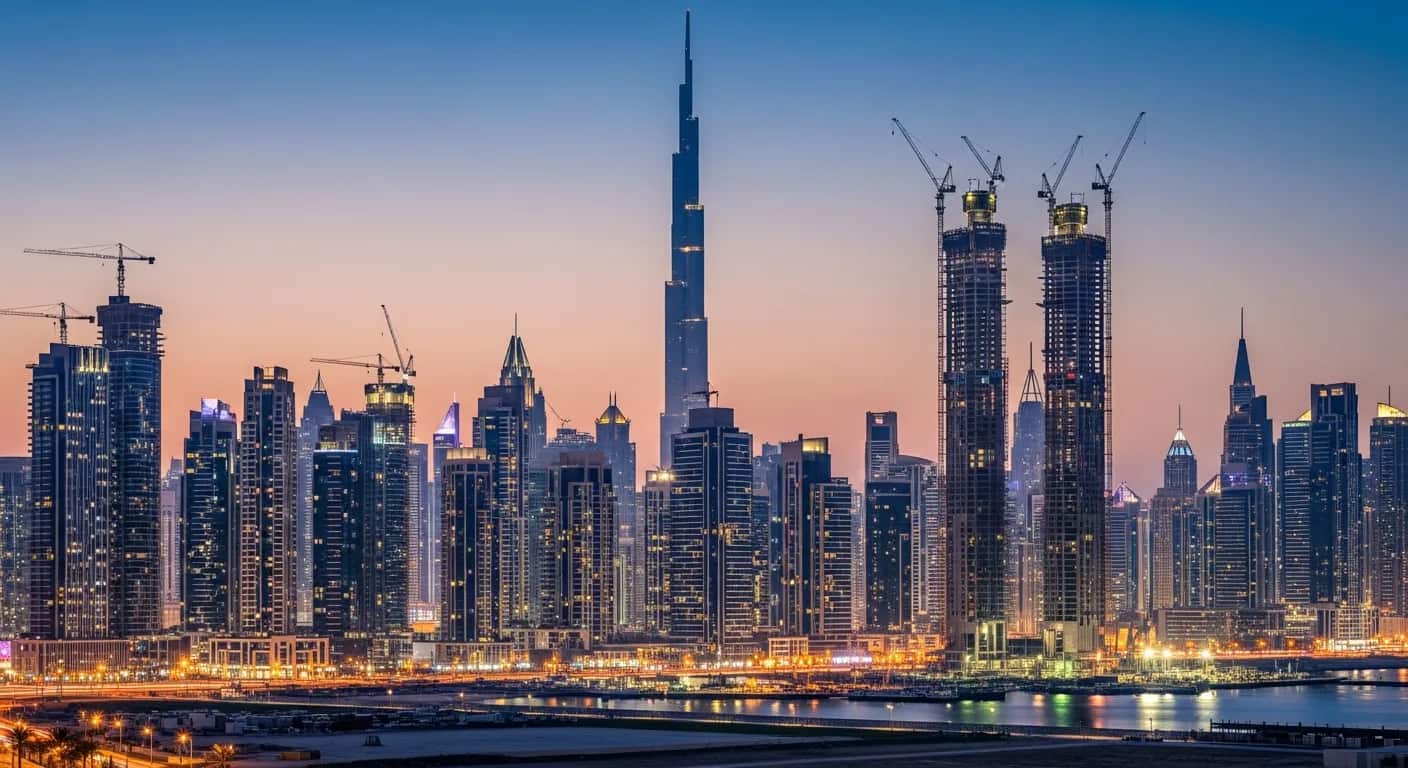
Dubai's New Titans: The Mega-Projects Defining This Decade
I explore the next generation of mega-projects reshaping Dubai's skyline and investment landscape, moving beyond hype to analyse the real opportunities for buyers and investors.

Dubai's story has always been written in concrete and glass, each chapter more ambitious than the last. But the new narrative taking shape this decade is about more than just height and scale; it's a fundamental reimagining of urban life. As I see it, we are witnessing a pivot from building iconic, standalone structures to engineering vast, integrated economic ecosystems that will redefine how we live, work, and invest in this city for generations to come.
Here's what we'll explore:
- The new urban doctrine driving Dubai's growth
- Dubai Creek Harbour: the vision for a new downtown
- The monumental return of Palm Jebel Ali
- Dubai South: the rise of the aerotropolis
- The 'Wynn Effect' on Al Marjan Island
- The trend of branded, ultra-luxury supertalls
- The detailed financial calculus for investing in these projects
- My final verdict on where the smart money is heading
Beyond the Blueprint: Dubai's New Urban Doctrine
For years, the world watched as Dubai erected superlative after superlative: the tallest building, the largest mall, the most luxurious hotel. These were statements of intent, markers of a city arriving on the global stage. Now, the intent has evolved. The Dubai 2040 Urban Master Plan is the clearest articulation of this new doctrine. It’s less about singular icons and more about holistic, human-centric communities. The plan explicitly calls for developing integrated service centers, concentrating development in existing urban areas, and ensuring that 55% of the population will live within 800 metres of a main public transport station. This is the blueprint that underpins the mega-projects of this decade.
What I find most compelling is the shift in economic logic. The previous generation of projects often relied on the 'build it and they will come' philosophy, using spectacular architecture to draw in tourism and investment. The new titans are different; they are being built around pre-existing or co-developing economic engines. The expansion of Al Maktoum International Airport (DWC) is not just an airport project; it is the heart of an 'aerotropolis' in Dubai South that will drive demand for logistics, commerce, and housing. The Wynn Resort on Al Marjan Island is not just a hotel; it's an integrated entertainment destination designed to create a new, resilient tourism economy in Ras Al Khaimah. This is a more mature, more sustainable model of growth.
At Gaia Living, when we advise our clients, we stress this point: you are no longer just buying a property; you are buying into a micro-economy. The long-term value of your asset is intrinsically linked to the success of the master plan's commercial, logistical, and social infrastructure. This requires a different kind of analysis from investors. It demands a look beyond the glossy brochures and 3D renderings to the underlying business case of the entire district. Is the transport connectivity credible? Is there a clear jobs pipeline to attract residents? Is the retail and leisure offering compelling enough to create a genuine community?
The projects we are seeing emerge—from the revived Palm Jebel Ali to the sprawling districts around the Creek—are not just expanding the map of Dubai. They are creating new centres of gravity. For decades, the city's prime real estate axis ran along Sheikh Zayed Road, from the old city through Downtown and the Marina. These new projects are creating multiple, competing, and complementary centres. This polycentric model is a sign of a maturing global city, and for investors, it presents a complex but potentially rewarding landscape. The key is to understand which of these new 'cities-within-a-city' has the most robust and believable plan for a vibrant future.
Dubai Creek Harbour: A Future Metropolis Takes Shape
 Featured project
When you stand on the waterfront at Dubai Creek Harbour, looking across the water at the Downtown skyline, you feel a sense of scale and ambition that is quintessentially Dubai. This project by Emaar Properties is, in my opinion, the heir apparent to Downtown Dubai. Spanning six square kilometres, it's twice the size of its famous predecessor and is designed to be a fully-fledged city, not just a central district. The original, spectacular plans for the Dubai Creek Tower, envisioned to be taller than the Burj Khalifa, may have been paused and are reportedly undergoing a redesign, but I would argue that focusing solely on the tower misses the point. The tower was the marketing hook; the real value is in the meticulously planned community taking shape at its base.
The investment thesis for Creek Harbour is long-term. Emaar is methodically building a community with a diverse mix of properties, from high-rise luxury apartments in the Island District with stunning waterfront views to more family-oriented mid-rise communities and villas. The infrastructure is being laid with purpose: a dedicated metro extension is planned, a major new mall is part of the master plan, and the entire development is wrapped around the Ras Al Khor Wildlife Sanctuary, offering a unique blend of urban living and nature. This is a key differentiator. While Downtown is dense and electric, Creek Harbour aims for a more balanced, waterfront-centric lifestyle.
From an investor's perspective, the opportunity here has been in phases. Early investors who bought into the first launches have already seen significant capital appreciation as the community has begun to mature and take on a life of its own. For new investors, the question is about the next stage of growth. At Gaia Living, we see continued strong demand, particularly for units with unobstructed views of the water and the skyline. Current prices for a one-bedroom apartment can range from AED 1.6 million to over AED 2.5 million, depending on the building, view, and size. What we're telling our clients is that the full potential of Creek Harbour will likely be unlocked once key infrastructural anchors, like the new mall and the metro link, become fully operational. That is the point at which it will transition from a promising development to a prime, established Dubai address.
One must also consider the rental market. Yields in Creek Harbour are solid, typically in the 6-7% gross range, which is attractive in the current market. The tenant profile is strong, attracting professionals and families who want modern amenities and a slightly more relaxed pace than the Marina or Downtown, but with easy access to the city's core. The key risk, as with any mega-project, is the delivery timeline. Emaar has a peerless track record in this regard, but the sheer scale of the project means its final completion is still many years away. This is not a short-term flip; it is a strategic investment in what is being positioned as the future heart of Dubai.
The Second Wave: Palm Jebel Ali's Monumental Return
After more than a decade of dormancy, the revival of Palm Jebel Ali by master developer Nakheel is arguably the most significant real estate announcement of the 2020s. To understand its impact, one must appreciate the scale. Palm Jebel Ali is roughly double the size of its iconic sibling, Palm Jumeirah. It will add approximately 110 kilometres of new coastline to Dubai and is designed to eventually be home to over 35,000 families. This isn't just another luxury project; it's a statement of profound confidence in the long-term future of Dubai's ultra-prime market.
What I find fascinating about the new vision for Palm Jebel Ali is how it reflects the evolution of Dubai's development philosophy. While Palm Jumeirah was a triumph of engineering and luxury for its time, the new Palm is being built with the lessons of the past two decades firmly in mind. The master plan places a heavy emphasis on sustainability, with plans for extensive green spaces, renewable energy sources, and smart city technology. It's being marketed not just as a collection of villas and hotels, but as a complete, futuristic city on the water. The initial launches of villas have seen unprecedented demand, with properties selling out within hours, often at prices starting north of AED 18 million for a five-bedroom villa.
The implications for the broader Dubai property market are immense. Firstly, it provides a new focal point for ultra-high-net-worth individuals who may have felt the best opportunities on Palm Jumeirah were already taken. It essentially resets the clock on prime waterfront real estate. Secondly, it will create a powerful new gravitational pull on the southern axis of Dubai, complementing the growth of Dubai South and the Expo City area. The project's sheer size means it will require and support a massive ecosystem of retail, hospitality, education, and healthcare, creating a self-sustaining community on a scale we haven't seen before.
For investors considering this project, the strategy is clear: this is a long-haul play on capital appreciation. The initial buyers are betting that as the island's infrastructure is built out—the bridges, the marinas, the 80 planned hotels and resorts—the value of their early positions will multiply. The risks are tied to the very long delivery timeline and the immense capital required to bring the vision to life. However, Nakheel's status as a government-backed master developer provides a significant degree of assurance. When we speak with clients about Palm Jebel Ali, we frame it as a legacy investment. It is an opportunity to acquire a piece of what will likely become one of the world's most recognizable and desirable addresses over the next 10 to 15 years.
The Aerotropolis Rises: Dubai South and the DWC Engine
While waterfront projects capture the imagination, I believe the most fundamentally important mega-project for Dubai's economic future is the development of Dubai South. This 145-square-kilometre master-planned city, which includes the legacy site of Expo City, is anchored by one colossal piece of infrastructure: the expansion of Al Maktoum International Airport (DWC). The recent government confirmation of a new AED 128 billion passenger terminal, designed to scale up to a capacity of 260 million passengers annually, is the starting gun for the transformation of this entire district into a global logistics and aviation hub.
This is a classic example of infrastructure-led real estate development. The airport is the economic engine that will drive demand across all other sectors. Think of the tens of thousands of jobs that will be created directly and indirectly in aviation, logistics, hospitality, and support services. All those people will need somewhere to live. This is the core investment thesis for the residential districts within Dubai South, such as the family-friendly communities with their villas and townhouses, and the apartment complexes in 'The Pulse'. These are not being built on speculative hope but to serve a clear, projected demographic and economic need.
At Gaia Living, we are seeing a marked increase in investor inquiries for Dubai South. The appeal lies in its relative affordability compared to the city's more central hubs, combined with a powerful long-term growth story. You can still acquire a townhouse or a spacious apartment for a price that would be unthinkable in Dubai Marina or Downtown. For example, a two-bedroom apartment might be in the range of AED 900,000 to AED 1.4 million. The rental yields are already attractive, often exceeding 7-8% gross, because the existing communities serve the staff of the current DWC operations and the nearby Dubai Parks and Resorts.
What investors need to understand is that they are buying into an emerging city. The amenities are growing, but it does not yet have the density of retail, dining, and entertainment options of an established community. The metro connectivity to the main Red Line, built for Expo 2020, is a crucial asset, but further internal transit solutions will be needed as the city grows. My analysis is that the risk-reward profile here is compelling for those with a five-to-ten-year horizon. As DWC's expansion progresses and more businesses relocate to the district's free zones, the demand for housing will inevitably surge. Early investors are positioned to benefit from both strong rental income and significant capital appreciation as the aerotropolis matures.
The 'Wynn' Effect: How Al Marjan Island is Changing the Game
While technically in the emirate of Ras Al Khaimah, the development of Al Marjan Island is having such a profound impact that it must be considered part of the broader UAE mega-project landscape influencing Dubai-based investors. The catalyst is the monumental $3.9 billion Wynn Resort. The announcement that this integrated resort will feature the UAE's first confirmed gaming facility has acted like a lightning rod, attracting a torrent of global attention and capital to an area that was, until recently, a relatively quiet leisure destination.
I call this the 'Wynn Effect'. We've seen it in other global cities like Las Vegas and Macau, where the arrival of a world-class integrated resort acts as an anchor that lifts the entire real estate ecosystem around it. The Wynn Al Marjan Island is not just a hotel; it's a destination with over 1,500 rooms, a massive theatre, an exclusive spa, high-end retail, and more than 20 dining options, all anchored by the gaming area. This single project is projected to be a massive driver of tourism and employment for Ras Al Khaimah, and the property market is reacting accordingly. Land values on Al Marjan Island have soared, and major Dubai-based developers like Emaar Properties and Aldar have announced luxury residential projects on or near the island to capitalize on the demand.
For investors, this presents a unique ground-floor opportunity. The price point for luxury beachfront property in Ras Al Khaimah is still significantly lower than in prime Dubai locations like Palm Jumeirah or Emaar Beachfront. A luxury one-bedroom apartment on Al Marjan Island from a top-tier developer might launch in the AED 1.8 to 2.5 million range, whereas a comparable unit in Dubai could be 50-100% higher. The bet is that as the Wynn Resort approaches its opening, and the island transforms into a premier entertainment hub, these values will converge with those in established Dubai hotspots.
Our team at Gaia Living has been actively guiding clients who are looking to diversify their UAE property portfolio. The key considerations for Al Marjan are twofold. First, the rental market is expected to be exceptionally strong, driven by both tourism (short-term lets) and the thousands of staff who will work at the resort and its supporting businesses. Second, the potential for capital appreciation is immense, but it is heavily correlated with the successful delivery and operation of the Wynn Resort. This makes it a higher-risk, higher-reward play compared to a mature community in Dubai. My advice is to focus on projects by reputable developers with a proven track record, and to see this as a strategic allocation within a broader portfolio, capturing the growth of a new and exciting UAE destination.
Vertical Realms: The Ascendancy of Branded Supertalls
Beyond the sprawling master communities, another, more vertical, mega-project trend is reshaping Dubai's skyline: the rise of the branded, ultra-luxury residential supertall. This isn't just about building tall; it's about partnering with globally recognized luxury brands—from jewelers and automotive giants to high-fashion houses—to create trophy assets that command staggering premiums. Developers like Binghatti with their Jacob & Co. branded 'Burj Binghatti' and other bespoke towers in Business Bay are at the forefront of this movement.
This trend is a direct response to a specific and growing segment of the market: the global ultra-high-net-worth individual (UHNWI). For this buyer, a property is not just a home; it's a statement, a collector's item, and a diversification of their global asset portfolio. The brand association provides an immediate stamp of quality, exclusivity, and design pedigree. These towers offer not just exquisite apartments but a complete, curated lifestyle with five-star-hotel-level services: dedicated concierges, private chefs, exclusive wellness clubs, and chauffeurs. This is the vertical equivalent of a gated community in Emirates Hills.
From a market analysis perspective, these projects are pushing the upper limits of Dubai's property values, with prices per square foot entering territory previously unseen outside of global hubs like New York, London, or Hong Kong. A penthouse in one of these branded towers can be listed for hundreds of millions of dirhams. What fascinates me is the value proposition. The developer is selling a unique lifestyle and a piece of a brand's legacy, and buyers are willing to pay a significant premium for that exclusivity. The key to the success of these projects is the authenticity of the brand partnership and the quality of execution. It has to feel genuine, not like a marketing gimmick.
For an investor who is not in the UHNWI category, these projects still have an impact. They create a powerful 'halo effect', raising the perceived value and aspiration of the entire district they are in. The presence of a Bugatti or Jacob & Co. residence in Business Bay elevates the entire neighbourhood's profile, which can trickle down to benefit other premium, non-branded properties in the vicinity. However, I would caution investors against assuming that these price points will become the new normal across the board. This is a niche, top-of-the-pyramid market. The real opportunity for most investors is not necessarily in buying into the branded tower itself, but in identifying well-built, premium properties nearby that will benefit from the district's enhanced prestige.
“The real story of Dubai's new mega-projects isn't just their scale, but their shift from standalone icons to integrated economic ecosystems. The smart money is following the infrastructure, not just the architecture.”
The Investor's Calculus: Analysing the Mega-Project Play
Investing in an off-plan mega-project is one of the most exciting, and potentially lucrative, strategies in Dubai real estate. It offers the chance to get in at the ground floor and benefit from significant capital appreciation as the project matures. However, it requires a clear head and a deep understanding of the associated costs and processes, which are governed by entities like the Dubai Land Department (DLD) and the Real Estate Regulatory Agency (RERA).
First, let's talk about the payment structure. Unlike buying a completed property with a mortgage, off-plan purchases are dictated by the developer's payment plan. A typical plan might be 60/40, meaning 60% of the property value is paid in instalments during construction, and the final 40% is due upon handover. Some developers offer more aggressive post-handover payment plans (e.g., 20% during construction, 80% over several years after you get the keys), which can be attractive for managing cash flow. It is critical to ensure your payments are made to a RERA-approved escrow account for the specific project, which protects your funds.
Let's walk through a tangible cost breakdown for a hypothetical off-plan purchase. Imagine you are buying a one-bedroom apartment in a new tower in Dubai Creek Harbour for AED 2,000,000, with a 70/30 payment plan and a 20% down payment.
- Purchase Price: AED 2,000,000
- Initial Payment to Developer (20% of Price): AED 400,000
- Dubai Land Department (DLD) Fee (4% of Price): AED 80,000
- Oqood Registration Fee (for pre-title deed): approx. AED 5,250
- Total Upfront Cost at Booking: AED 485,250
The remaining payments (50% of the property price) would be due in instalments over the construction period, with the final 30% payable at handover. At that point, you can either pay cash or secure a mortgage, subject to the regulations set by the Central Bank of the UAE. Another crucial long-term cost to factor in is service charges. These are annual fees, paid per square foot, for the maintenance of common areas, security, and amenities. In new, premium towers, these can range from AED 18 to AED 25 per sq. ft. annually. For a 1,000 sq. ft. apartment, that's an additional AED 18,000 to AED 25,000 per year that must be factored into your net yield calculation.
To make a sound investment decision, I always advise our clients at Gaia Living to follow a strict due diligence process. Here is a checklist we use:
- Developer Track Record: Have they delivered projects of similar scale before? Are they known for quality and timely handover?
- Master Plan Viability: Does the project have a credible economic engine (e.g., proximity to jobs, tourism drivers, transport links)?
- Escrow Account Verification: Use the Dubai REST app or the DLD website to confirm the project has a valid, RERA-approved escrow account.
- Sale and Purchase Agreement (SPA): Review the SPA carefully. Pay attention to the completion date, penalty clauses for delays, and the specifications of the unit and finishes.
- Service Charge Estimates: Ask for the estimated service charges and compare them to similar completed projects. Unusually low estimates can be a red flag.
Ultimately, the mega-project play is a bet on the future vision of Dubai. The potential rewards are high, but they are balanced against the risks of construction delays and the multi-year wait for the community to fully mature. A well-researched decision, based on facts and sound financial planning, is the only way to proceed.
My Verdict: Navigating the New Map of Dubai
Having watched Dubai's skyline evolve for decades, I can say with confidence that the current wave of development is the most strategic and ambitious in the city's history. We are moving past the era of singular wonders and into an age of integrated, purpose-built cities. The mega-projects of this decade—Palm Jebel Ali, Dubai Creek Harbour, Dubai South—are not just additions to the map; they are creating entirely new maps, with new centres of economic and social gravity.
For the discerning buyer or investor, this presents a landscape of profound opportunity, but one that demands more sophisticated analysis than ever before. The core question is no longer simply 'what am I buying?' but 'what am I buying into?'. The answer must be a convincing narrative of long-term economic sustainability. My conviction is that the projects most likely to deliver exceptional value are those with the strongest, most tangible links to a non-speculative economic engine. Dubai South is the clearest example, tethered to the undeniable growth of the world's future largest airport. Its success is a matter of logistical certainty.
Palm Jebel Ali represents a different kind of bet—a wager on the enduring global demand for ultra-exclusive waterfront living, scaled up to an unprecedented degree. Its success hinges on Nakheel's ability to deliver a lifestyle that is not just luxurious but also futuristic and sustainable, differentiating it from its celebrated predecessor. Dubai Creek Harbour is the patient play, a bet on Emaar's proven ability to craft a world-class community that will, in time, rival and perhaps even eclipse Downtown. And the branded supertalls are a hyper-niche play on the apex of global wealth, a testament to Dubai's status as a safe harbour for capital and a premier luxury destination.
Investing in Dubai's next-generation mega-projects requires a long-term vision. Success lies not in chasing renderings, but in understanding the underlying economic drivers—be it logistics, tourism, or community infrastructure—that will sustain value long after the launch hype fades. My advice is to diversify. A balanced portfolio might include a yield-focused apartment in the path of progress at Dubai South, alongside a strategic position in a waterfront community like Creek Harbour or even Al Marjan Island, capturing different facets of the UAE's incredible growth story. The skyline is changing, and for those who can look past the cranes and see the cities to come, the rewards will be substantial.
Sources
- Dubai Land Department (DLD) - dubailand.gov.ae
- Real Estate Regulatory Agency (RERA) - rera.gov.ae
- UAE Government Portal (Dubai 2040 Urban Master Plan) - u.ae
- Central Bank of the UAE - centralbank.ae
Questions, answered
- What are the most significant new mega-projects in Dubai?
- The most significant projects include the revived Palm Jebel Ali by Nakheel, Emaar's Dubai Creek Harbour, the massive expansion of Dubai South around Al Maktoum International Airport, and the development of ultra-luxury branded residences across the city.
- Is investing in an off-plan mega-project a good idea?
- It can be, but it requires careful due diligence. The potential for capital appreciation is high, but investors must assess the master developer's track record, the project's long-term economic drivers, and be prepared for a multi-year investment horizon. Always verify the project's escrow account registration with the Dubai Land Department (DLD).
- How is Palm Jebel Ali different from Palm Jumeirah?
- Palm Jebel Ali is approximately twice the size of Palm Jumeirah and is being developed with a stronger emphasis on sustainability and futuristic urban planning. It will feature a more diverse mix of properties, extensive green spaces, and aims to house a larger population, positioning it as a complete city on the water.
- What fees are involved in buying an off-plan property in Dubai?
- Typically, you will pay a 4% Dubai Land Department (DLD) fee and an Oqood (pre-title registration) fee of approximately AED 5,250. You will also make the first instalment of your payment plan to the developer. Agency fees of 2% are more common on the secondary market but can apply in some primary sales.
- What is the 'Wynn Effect' on Al Marjan Island?
- The 'Wynn Effect' refers to the surge in property values and investor interest in Ras Al Khaimah's Al Marjan Island following the announcement of the multi-billion dollar Wynn Resort. This integrated resort, featuring the UAE's first confirmed gaming facility, is acting as a powerful anchor, attracting global attention and capital to the emirate.
- How does the DWC airport expansion impact real estate in Dubai South?
- The expansion of Al Maktoum International Airport (DWC) into the world's largest aviation hub is the primary economic engine for Dubai South. It drives demand for residential property from aviation and logistics professionals, fuels commercial development, and positions the entire district as a globally significant 'aerotropolis', underpinning long-term property values.
Omar tracks the announcements that move the market — new launches, regulation, mega-projects, and developer moves — and tells you what they actually mean for buyers.
Related stories
Dubai 2040: A Land Use and Investment Blueprint
A deep dive into the Dubai 2040 Urban Master Plan, analysing specific zoning changes and land use designations to reveal the next generation of property investment hotspots.
Beyond the Blueprint: The Retail Value Multiplier
It's a simple truth of Dubai real estate: proximity to quality retail and leisure isn't just a perk, it's a powerful driver of property value. I'll explain how operational hubs are creating measurable premiums for investors and residents.
Your Dubai Home Setup Guide
A step-by-step guide for new Dubai homeowners on connecting utilities, setting up essential services, and integrating into your new community.
Echoes, in your inbox
One thoughtful email a month. Market insight, new launches, no spam.