

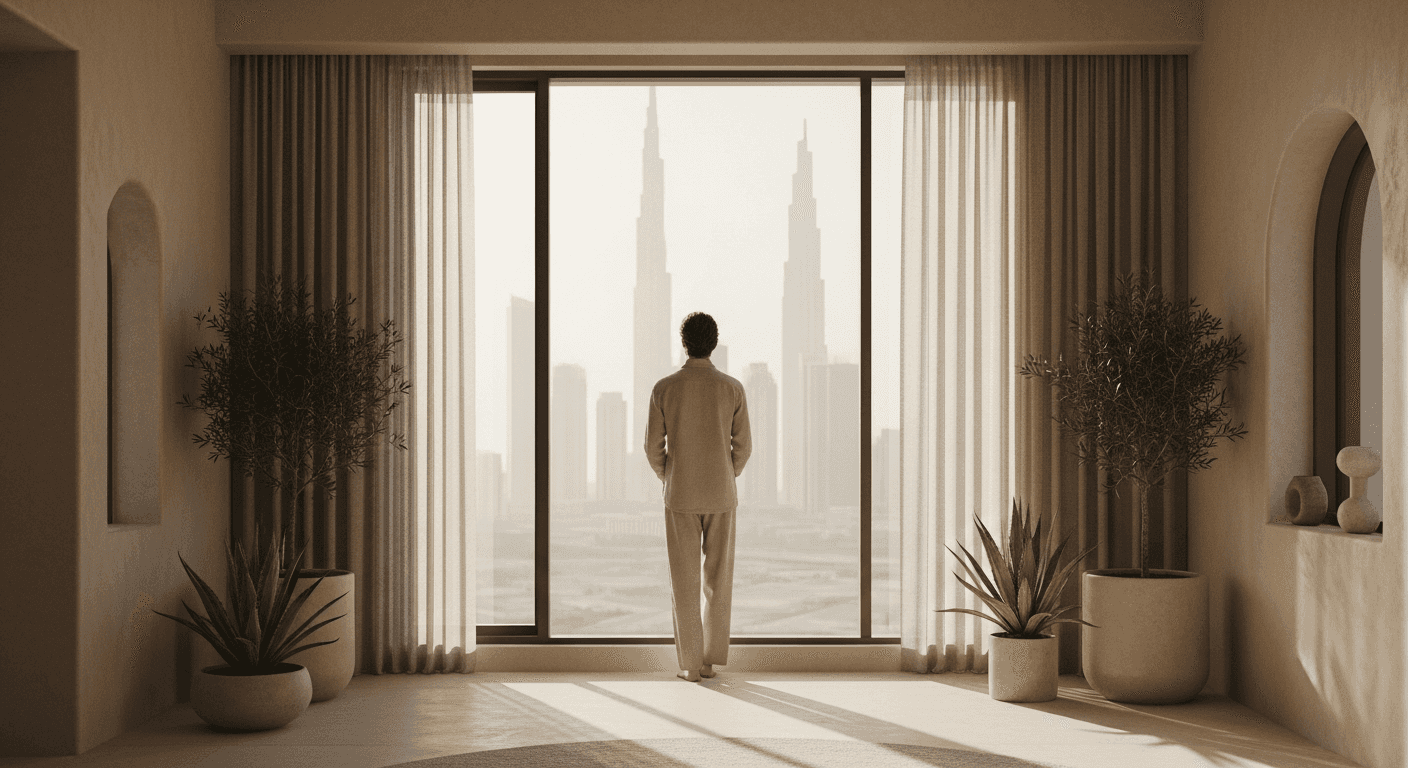
Dubai's New Gravity: The Wealth Migration Effect
A structural shift in global wealth is reshaping Dubai's property market. I analyse the deep-seated drivers behind this migration and its profound, lasting impact on residential demand across all price points.

The narrative of Dubai's property market is often told in cycles of boom and bust. But the current era is different. This is not just another cycle; it's a fundamental realignment of global capital flows, and I believe its impact on our residential market is more structural and permanent than anything we have seen before.
Here's what I will analyse in this report:
- The deep 'push' and 'pull' factors driving the global wealth migration to Dubai.
- How this influx of high-net-worth individuals is creating demand signatures in specific prime communities.
- The cascade effect: how ultra-prime demand stimulates the entire market, down to starter homes.
- A transparent, line-by-line cost breakdown for anyone considering entering the market.
- My view on the sustainability of this trend and the key risks and opportunities ahead.
The Thesis: Beyond a Boom, A Structural Realignment
As a market analyst who has tracked Dubai real estate for over a decade, I've learned to be sceptical of hyperbole. Every surge in prices brings with it pronouncements of a 'new paradigm'. Yet, the data and the qualitative drivers I observe today convince me that we are witnessing something more profound than a simple cyclical upswing. The `global wealth migration Dubai property` trend is not a fleeting headline; it is the primary engine of a market that is maturing in real time. This isn't the speculative, debt-fuelled frenzy of 2008, nor is it the slow, tentative recovery of 2014. This is a demand-led expansion, anchored by a significant and sustained transfer of people, capital, and enterprise to the Emirate.
Previous cycles were heavily influenced by global economic tides — the flow of oil money or the availability of cheap international credit. The current market, while not immune to those forces, is responding to a different set of stimuli. The primary driver is a global search for stability, security, and a pro-business environment in a world where these qualities are becoming increasingly scarce. High-net-worth individuals and successful entrepreneurs are not just buying holiday homes; they are moving their families, their headquarters, and their futures to Dubai. This 'stickiness' of demand is a critical differentiator. A holiday home can be sold on a whim; a primary residence and a relocated business represent a much deeper, long-term commitment to the city.
This structural shift is evident in the nature of the transactions we at Gaia Living are seeing and in the broader market data from the Dubai Land Department (DLD). The growth in the AED 10 million+ segment is not just in volume but in the profile of the buyer — increasingly an end-user, albeit a very wealthy one. They are concerned with school catchments, proximity to business hubs like DIFC, and lifestyle amenities, not just short-term capital appreciation. This shift in buyer motivation creates a more resilient demand floor for the market, one less susceptible to short-term sentiment swings. My thesis is simple: to understand Dubai's property market today, you must first understand its new role as a global haven for both capital and talent.
The Global 'Push' Factors: Why Wealth is on the Move
The decision to relocate wealth and family is rarely made lightly. It is often the result of powerful 'push' factors from an individual's home country or region. In recent years, a confluence of these factors has created an unprecedented migration of capital away from traditional hubs in Europe, Asia, and North America. The `geopolitical impact Dubai property` market is direct and measurable, seen in the nationality of buyers and the sheer volume of capital inflows. These are not uniquely Dubai's triumphs, but rather global shifts from which the UAE has been a primary beneficiary due to its contrasting stability.
First, geopolitical instability and conflict in various parts of the world have shattered the sense of security that many wealthy families took for granted. When your primary concern shifts from optimising tax to ensuring personal safety and preserving generational wealth from unpredictable regimes, your investment criteria change dramatically. We have seen this play out with influxes of capital from regions experiencing conflict and uncertainty. These buyers are not seeking a 10% annual return; they are seeking a 100% chance of asset preservation and personal security. Dubai, with its steadfast focus on safety and rule of law, offers a powerful antidote to this anxiety.
Second, the economic and fiscal landscape in many Western countries is becoming more challenging. Rising tax burdens, inheritance taxes, and a political narrative that is often hostile to wealth creation are pushing entrepreneurs and investors to look elsewhere. They see environments where their success is penalised, and they are seeking jurisdictions that are actively pro-business. The introduction of a modest 9% corporate tax in the UAE was done with such extensive consultation and with so many exemptions for free zones and small businesses that, paradoxically, it only served to highlight how much more favourable the environment is compared to the 30-50% rates common elsewhere. This economic push is a slow-burning but powerful catalyst for relocation.
Finally, there's the less tangible, but equally important, factor of social and political friction in many established wealth centres. Debates over social policies, concerns about crime rates, and a general sense of declining quality of life have led many to question the long-term viability of raising a family in these locations. Dubai's ability to offer a high-quality, cosmopolitan lifestyle in a clean, safe, and functional environment is a compelling alternative. When families can live in a secure villa community like Dubai Hills or enjoy the beachfront lifestyle of Palm Jumeirah without the social and political anxieties of their home countries, the decision to move becomes an emotional and logical one.
The Dubai 'Pull' Factors: A Perfected Safe Haven
While global push factors explain why wealth is mobile, Dubai's unique 'pull' factors explain why it is choosing this city as its destination. The Emirate has spent decades meticulously building a platform for global talent and capital, and that platform is now operating at peak efficiency. It's a multi-layered value proposition that goes far beyond sunshine and skyscrapers. It is, in my view, the most comprehensive and deliberately engineered safe haven in the world today.
At the forefront is the UAE's visionary visa framework, particularly the Golden Visa program. As detailed on the official UAE Government Portal, the ability to secure a 10-year renewable residency by investing AED 2 million in property is a game-changer. This transforms a property purchase from a mere asset acquisition into a key that unlocks long-term residency for the entire family, without the need for a local sponsor. It provides certainty and a sense of permanence that was previously lacking. This single policy has been instrumental in converting transient investors into committed residents, anchoring `high net worth individuals Dubai real estate` demand in a way we've never seen before.
Beneath the visa structure lies a robust legal and business framework. The UAE's commitment to 100% foreign ownership of mainland companies, the absence of personal income tax, and the currency peg to the US dollar create an exceptionally predictable and attractive environment for entrepreneurs and businesses. For a family office looking to relocate its headquarters, this trinity of benefits is almost impossible to find elsewhere. Add to this the common law jurisdictions of the DIFC and ADGM, which provide a legal system familiar to international investors, and you have a framework that breeds confidence. This is not by accident; it is the result of deliberate, long-term government strategy to make Dubai the easiest place in the world to do business and manage wealth.
Finally, there's the lifestyle component — a factor often dismissed as 'soft' but which I believe is a critical economic advantage. Dubai's world-class infrastructure, from its airport and airline to its roads and public transport, simply works. The city offers a remarkable concentration of premium schools, advanced healthcare facilities, and unparalleled leisure and hospitality options. A family can move here and instantly access a lifestyle that would be unattainable in most other global cities. This quality of life is the 'glue' that makes the relocation decision stick. It ensures that once families and businesses arrive, they are highly motivated to stay, creating a stable, long-term population of residents who buy, rent, and participate in the economy.
This is not just another property cycle; it’s the cartographic realignment of global wealth, and Dubai is emerging as a new capital.
The HNW Footprint: Where Capital is Landing
When a significant influx of high-net-worth individuals arrives in a city, their impact on the property market is not uniform. They are drawn to specific enclaves that meet their exacting standards for privacy, exclusivity, and lifestyle. In Dubai, this has supercharged a handful of ultra-prime communities, creating record-breaking sales and setting new benchmarks for luxury living. Understanding where this capital is landing provides a clear map of the `high net worth individuals Dubai real estate` segment.
The most iconic of these destinations is, without question, Palm Jumeirah. The demand for Signature and Garden Homes on the fronds has been immense, with buyers paying a premium for direct beach access and skyline views. We've seen a surge in major renovation projects, with older villas being completely rebuilt into contemporary masterpieces, often trading for prices north of AED 100 million. The 'Palm' has also become a hotspot for branded residences, with developers like Nakheel and others partnering with legendary hospitality brands to offer serviced living, which is incredibly appealing to this demographic. They are buying into a fully managed, secure, five-star lifestyle.
Equally important, though catering to a different taste, is the established luxury of Emirates Hills. This is Dubai's answer to Beverly Hills — a gated community of sprawling, custom-built mansions set around a championship golf course. Here, privacy and plot size are the ultimate currencies. The appeal is the ability to create a truly unique family estate. The demand has pushed land values to new highs and has seen a number of high-profile sales that underscore its status as the city's most exclusive address. It attracts 'old money' and those seeking a more traditional, suburban form of luxury, away from the buzz of the waterfront.
Beyond these two titans, a new generation of ultra-luxe micro-communities is emerging. Jumeirah Bay Island, often dubbed 'Billionaire's Island', has seen land values and villa prices reach stratospheric levels, driven by its limited supply and the presence of the Bvlgari resort. Similarly, Bluewaters Island by Meraas offers a unique proposition: luxury apartment living with stunning sea views and a walkable, vibrant retail and dining scene, all while being a stone's throw from the mainland. What unites these disparate locations is a focus on scarcity, world-class amenities, and a powerful sense of place. HNWIs are not just buying a property; they are buying into a curated and exclusive community.
The Ripple Effect: How Ultra-Prime Lifts the Entire Market
It's a common misconception that the surge in the ultra-luxury market exists in a vacuum, a phenomenon relevant only to the handful of billionaires buying trophy assets. In my analysis, this couldn't be further from the truth. The influx of wealth at the top of the pyramid creates a powerful cascade effect that lifts the entire residential market. Every AED 100 million villa sale on Palm Jumeirah has downstream consequences that create demand for apartments in Dubai Marina and townhouses in Town Square.
This mechanism works in several ways. First, the HNWIs and entrepreneurs relocating to Dubai are not coming alone. They bring their businesses, their management teams, and their families' support staff. The CEO who buys the villa in Emirates Hills employs a CFO who then seeks a family home in a premium community like Arabian Ranches or Jumeirah Golf Estates. The managers and senior professionals in their newly established companies look for apartments in well-connected, amenity-rich areas like Downtown Dubai or Business Bay. This creates a distinct layer of demand for mid-to-high-end properties, directly driven by the initial ultra-prime investment. This is a core feature of current `expat property investment trends Dubai`.
This cascade continues down the chain. The new companies created by this wealth influx hire marketers, accountants, software developers, and administrative staff. These professionals, often young expats, become the lifeblood of the rental market in popular and more affordable communities like JVC, Arjan, or Al Furjan. Their demand for one and two-bedroom apartments creates attractive rental yields, which in turn draws in buy-to-let investors. This is why we've seen rents rise significantly across the board, not just in prime areas. The strength at the top creates a solid foundation of rental demand across the entire ecosystem, making Dubai an attractive proposition for a wide spectrum of property investors.
Beyond that, this broad-based demand gives major developers like Emaar Properties, Damac, and Aldar the confidence to launch new master-planned communities and towers, knowing there is a deep and diverse pool of buyers. The launch of a new luxury project is often followed by launches targeting the mid-market segment, as developers understand the need to cater to the entire ecosystem created by this wealth migration. So, while the headlines focus on the record-breaking prices at the top, the real story is the robust, organic demand being generated across every single price point in the city.
The Practicalities: A Cost Breakdown for New Entrants
Understanding the macro trends is essential, but for any potential buyer, the decision ultimately comes down to concrete numbers. The Dubai market is transparent, but it has specific protocols and costs that newcomers must understand. A frequent question we get at Gaia Living is, "What is the total upfront cost beyond the sticker price?" To provide clarity, let's walk through a realistic, line-by-line breakdown for purchasing a secondary market property. This is one of the most critical parts of the `buyer & investor guides` we provide.
Let’s use the example of buying a two-bedroom apartment in a sought-after community like Dubai Hills for a purchase price of AED 3,500,000. Here are the typical upfront costs you would need to budget for, payable at the time of transfer:
- Purchase Price: AED 3,500,000
- Dubai Land Department (DLD) Transfer Fee: 4% of Purchase Price = AED 140,000. This is the single largest ancillary cost, mandated by the DLD for registering the title deed in your name.
- DLD Administration Fee: AED 4,200 (including VAT). This is a fixed fee for properties over AED 500,000.
- Property Registration (Trustee) Fee: Approximately AED 4,200 (including VAT). This is paid to a DLD-approved Trustee Office for handling the transfer process.
- Real Estate Agency Fee: Typically 2% of Purchase Price + 5% VAT = AED 73,500. This is the commission for the brokerage that facilitated the deal.
- Developer No-Objection Certificate (NOC) Fee: This can range from AED 500 to AED 5,000. It is a fee paid to the master developer to confirm the seller has no outstanding service charges. Let's budget AED 1,500 for this example.
Total Upfront Cost Calculation: * Purchase Price: AED 3,500,000 * Total Fees: AED 140,000 + AED 4,200 + AED 4,200 + AED 73,500 + AED 1,500 = AED 223,400 * Total Outlay: AED 3,723,400
It is crucial to note these fees are not typically included in a mortgage. If you are financing the purchase, a bank in the UAE will generally lend up to 80% of the property value for a first-time resident buyer. This means you would need to have the 20% down payment (AED 700,000) plus the entire AED 223,400 in fees available in cash. Beyond these initial costs, owners must also factor in annual service charges. These vary by building and community but a reasonable range for a premium building in Dubai Hills would be AED 18-24 per square foot per year. For a 1,500 sq.ft. Apartment, this would equate to AED 27,000 - AED 36,000 annually, covering maintenance, security, and use of communal facilities.
Navigating the Market: Supply, Protection, and Due Diligence
With such strong demand, a natural question arises about the supply side of the equation. The enduring image of Dubai for some is one of constant construction, leading to concerns about oversupply. While the pace of development is indeed brisk, my analysis suggests the market is showing far greater discipline and sophistication than in previous cycles. The key is not just the quantity of supply, but the quality and the alignment with what the market actually wants.
Today's leading developers are not just building standalone towers; they are creating fully integrated master communities. Projects by developers like Meraas and Emaar are case studies in this approach. Think of communities like City Walk, Bluewaters, or Dubai Hills. These are not just collections of buildings; they are curated living environments with parks, schools, retail, and entertainment. This focus on place-making creates desirability and helps maintain value over the long term. Crucially, the government and the DLD have become more strategic in managing the pipeline, ensuring that the pace of off-plan launches is better calibrated to absorb market demand, preventing the kind of large-scale glut we may have seen in the past.
For buyers, particularly in the off-plan space, a robust set of protections has been put in place by Dubai's Real Estate Regulatory Agency (RERA). Any money paid towards an off-plan property must be deposited into a regulated escrow account, which is tied to the project's construction progress. The developer can only withdraw funds upon reaching specific construction milestones certified by an independent consultant. This system, along with the Oqood registration process that provides a preliminary title deed, provides a significant layer of security for off-plan investors. It ensures your capital is being used for its intended purpose and provides a clear legal claim to the property.
Despite these safeguards, due diligence remains paramount. My advice to any prospective buyer is always the same: work with a reputable, RERA-certified agent and brokerage. A good agent will provide more than just listings; they will offer insights on developer reputations, realistic service charge estimates, comparative market analysis, and potential red flags. Here is a basic due diligence checklist I recommend:
- Verify the Developer: Research their track record. Have they delivered past projects on time and to the promised quality?
- Check the Title Deed: For a secondary property, ensure the seller has a valid Title Deed and there are no liens or mortgages on it.
- Confirm Escrow Account Details: For off-plan, verify the project's RERA registration and its approved escrow account number.
- Understand Service Charges: Request the service charge history for the building or community. High or rapidly increasing charges can significantly impact your net rental yield or overall cost of ownership.
- Review the Sale and Purchase Agreement (SPA): Have a lawyer review this critical document before signing, especially for off-plan purchases.
The Future Trajectory: Risks and Opportunities
No market moves in a straight line forever, and as we look toward the future of Dubai real estate, a balanced view that acknowledges both risks and opportunities is essential. The current momentum is undeniably strong, but its continuation is contingent on several internal and external factors. In my view, the foundations are more solid than in any previous cycle, but complacency is the enemy of sound investment.
The primary risks are largely external. A severe global recession could curb the flow of wealth and reduce the appetite for luxury assets worldwide. Similarly, a significant de-escalation of geopolitical tensions could lessen Dubai's 'safe haven' appeal, though I believe the city has now established itself as a premier business and lifestyle hub on its own merits. Internally, the biggest risk remains undisciplined supply. If developers, spurred by the current demand, revert to launching projects without sufficient market research and infrastructure planning, we could see pockets of oversupply emerge, putting pressure on prices and rents in specific sub-markets. Vigilant regulation from the DLD and RERA will be critical to mitigate this.
However, I believe the opportunities far outweigh the risks. The Dubai Economic Agenda (D33), which aims to double the size of the city's economy by 2033, provides a powerful roadmap for sustained growth. This isn't just a slogan; it's a detailed plan involving attracting international companies, fostering new sectors like AI and green technology, and further growing the population. Every one of these goals translates into direct, long-term demand for residential and commercial real estate. The government is not resting on its laurels; it is actively building the next phase of Dubai's growth story.
Beyond that, the network effect of the current wealth migration is a powerful engine for future opportunity. Dubai is rapidly reaching a critical mass of talent, capital, and innovation. The world's brightest entrepreneurs, investors, and professionals are now meeting, collaborating, and creating new ventures here. This creates a self-reinforcing cycle of growth and prosperity that will continue to attract more talent and capital. The city's infrastructure and lifestyle offerings continue to evolve, with new cultural institutions, luxury resorts, and public spaces constantly enhancing the quality of life. This continuous improvement is a key part of the value proposition for residents and investors.
Key takeaway: The global migration of wealth and talent to Dubai is not a temporary trend but a structural shift that has fundamentally strengthened the residential real estate market. This demand, anchored in the city's role as a safe haven and global business hub, is creating a cascade of opportunity across all property segments. While investors must remain discerning and perform their due diligence, the market's fundamentals are robust, and its long-term trajectory, in my opinion, remains firmly positive.
Sources
- Dubai Land Department (DLD): https://dubailand.gov.ae
- UAE Government Portal (Golden Visa & Business Rules): https://u.ae
- Central Bank of the UAE (Mortgage Regulations): https://www.centralbank.ae
Questions, answered
- What is the minimum property investment for a Dubai Golden Visa?
- To qualify for a 10-year Golden Visa through real estate, you must own a property worth at least AED 2 million. This can be a single property or a portfolio, and it can be off-plan or ready, with or without a mortgage from specific local banks.
- What are the main upfront costs when buying a property in Dubai?
- The primary costs are the Dubai Land Department (DLD) transfer fee, which is 4% of the property value, and the real estate agency fee, typically 2% of the value. You should also budget for smaller fees like DLD admin fees, a Trustee Office fee, and a No-Objection Certificate (NOC) fee from the developer.
- Is the Dubai property market in a bubble?
- While prices have risen significantly, the current market shows greater maturity than previous cycles. Stronger regulations, a more diversified economy, and demand driven by genuine migration and end-users provide more stable fundamentals than the speculative peaks of the past.
- Which Dubai areas are most popular with high-net-worth individuals?
- High-net-worth individuals (HNWIs) gravitate towards ultra-prime communities offering exclusivity and premium amenities. Key areas include Palm Jumeirah, Emirates Hills, Jumeirah Bay Island, Bluewaters Island, and increasingly, luxury branded residences in locations like Downtown Dubai.
- How does global instability affect the Dubai property market?
- Geopolitical and economic instability elsewhere tends to increase demand for Dubai property. The UAE's reputation as a safe, stable, and pro-business hub attracts capital and talent from regions facing uncertainty, reinforcing its 'safe haven' status.
- Can foreigners get a mortgage in Dubai?
- Yes, non-resident foreigners can obtain mortgages from UAE banks. However, regulations set by the Central Bank of the UAE typically require a larger down payment, usually 20-25% of the property value plus associated fees, compared to UAE nationals.

Amara translates DLD transaction data, supply pipelines, and macro signals into clear calls on where Dubai's market is heading. She writes the numbers most brokers only feel.
Related stories
Dubai's Established Charm: The Case for Older Homes
In a city focused on the future, I believe the smartest move for many buyers is to look back. Dubai's seasoned communities offer space, character, and surprising value that new builds often can't match.
The True Cost of Owning a Dubai Property
Beyond the purchase price, your annual budget for a Dubai home must account for service charges, utilities, and maintenance. I'll break down every ongoing expense you need to plan for.
Calculating ROI on Dubai Rental Upgrades
As a landlord in Dubai, you can't just follow trends. I'll show you how to calculate the precise ROI of minor property upgrades to genuinely increase your rental yield.
Echoes, in your inbox
One thoughtful email a month. Market insight, new launches, no spam.