

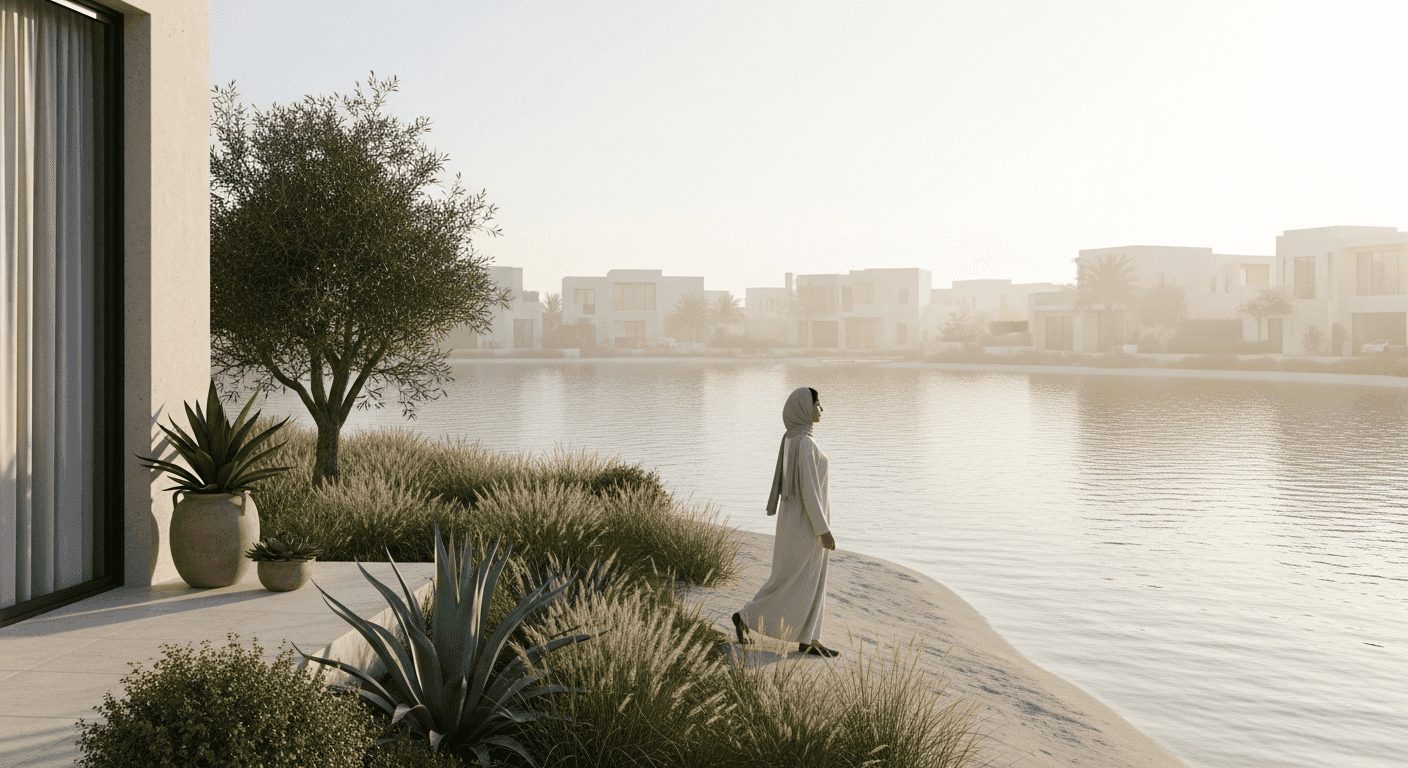
Dubai's Lagoon Living: A Deep Dive into Tilal Al Ghaf
Majid Al Futtaim’s Tilal Al Ghaf has set a new benchmark for master-planned living in Dubai. I explore what makes these lagoon communities so compelling and what you need to know before buying into the dream.

As a communities specialist, I’ve walked through hundreds of master plans, from the initial renders to the lived-in reality. For years, the template for a successful Dubai villa community was clear: golf course, green parks, good road access. But in the last few years, a powerful new element has entered the equation, and it’s completely reshaping the landscape of premium family living. That element is water — not just a decorative fountain, but vast, crystalline, swimmable lagoons that form the heart of entire communities. Majid Al Futtaim’s Tilal Al Ghaf is the project that crystallized this trend, transforming it from a novelty into a new gold standard.
Here’s what I'll explore in this deep dive:
- The defining features of a modern lagoon community
- A detailed case study of Tilal Al Ghaf, its successes and its blueprint
- The complete financial breakdown of buying into this lifestyle
- The new wave of competitors, from DAMAC Lagoons to projects in other Emirates
- A comparison of the developer DNA behind these ambitious plans
- The reality of livability: schools, commutes, and community feel
- My long-term verdict on the risks and rewards
The Rise of the Lagoon Community
For decades, waterfront living in Dubai meant being on the coast, with a view of the Arabian Gulf. Think Palm Jumeirah or Jumeirah Beach Residence. This was, and remains, the pinnacle of the market. But what if you could replicate that beachside feeling deep within the city, in a family-friendly villa suburb? This is the powerful proposition of the lagoon community. The concept isn't entirely new, but its modern incarnation is a world away from the decorative water features of the past. We're talking about massive bodies of water, often using technology from specialists like Crystal Lagoons, that are clean enough to swim in, lined with sandy beaches, and designed for recreation like kayaking and paddleboarding.
The timing of this trend is no accident. The global pandemic fundamentally shifted what people want from their homes. A private garden became non-negotiable for many families. Proximity to amenities that support a healthy, active lifestyle moved from a 'nice-to-have' to a primary decision driver. Suddenly, the idea of a community where you could walk from your front door to a sandy beach, go for a swim, and meet neighbours at a waterfront café without ever getting in your car became incredibly compelling. It’s resort living, but integrated into your daily life. It offers a permanent escape, a sense of tranquility that is hard to find in a bustling metropolis.
These master plans are far more than just houses arranged around a large pool. They are holistic ecosystems. The lagoon is the anchor, but it's supported by an intricate network of parks, jogging and cycling trails, community town centres with curated retail, and, crucially, high-quality schools. It represents a move towards self-contained, walkable neighbourhoods where the majority of a family's daily needs can be met within a short radius. In my view, Tilal Al Ghaf wasn't just another project; it was the first to execute this vision in Dubai at such a high level of quality and coherence. It provided a powerful proof of concept, demonstrating the immense market demand for this lifestyle and creating a template that has since been emulated, adapted, and scaled by nearly every major developer in the region.
Case Study: Tilal Al Ghaf by Majid Al Futtaim
When Majid Al Futtaim (MAF) announced Tilal Al Ghaf, there was a healthy dose of skepticism in the market. MAF is a regional powerhouse in retail and entertainment — the name behind Mall of the Emirates and City Centre malls, but they were not known as a large-scale residential community developer in the same vein as Emaar Properties or Nakheel. What we’ve seen since, however, is that their expertise in creating world-class 'destinations' was precisely the skill set needed. They didn't just build houses; they curated an experience. From the moment you enter, the quality of the landscaping, the maturity of the trees, and the thoughtful urban planning are immediately apparent. It feels different.
The heart of the community is, of course, the Lagoon Al Ghaf. At over 70,000 square meters with 400 meters of open beachfront, it's a stunning centerpiece. But what makes it work is everything around it. The 18 kilometers of walking trails and 11 kilometers of cycling tracks that weave through the neighbourhoods are not an afterthought; they are wide, well-lit, and genuinely pleasant to use. The distribution of green spaces and parks means that no home is more than a few minutes' walk from a place for children to play. This thoughtful integration is what elevates the community beyond its headline amenity.
The residential offerings are clustered into distinct neighbourhoods, each with its own character. It began with Elan, the townhouse community that saw phenomenal demand at launch. This was followed by Aura, Harmony, and Aura Gardens, offering a mix of townhouses and semi-detached villas. As the community matured, MAF launched more premium clusters like Elysian, the ultra-luxe Serenity, and the breathtaking signature villas of Alaya and Lanai Islands. This phased approach allowed them to build a diverse community and respond to market demand, layering in more luxurious products as the location's reputation grew. The architecture is contemporary and clean, with a focus on natural light and indoor-outdoor living, which perfectly complements the community's ethos.
For me, as someone who advises families, the single most significant differentiator for Tilal Al Ghaf was the inclusion of the Royal Grammar School Guildford Dubai right within the master plan. This isn't just a nearby school; it's a top-tier British curriculum school that is part of the community fabric. For parents, the ability to have their children walk or cycle to one of the city’s best schools is an invaluable advantage. It anchors the community for the long term and solidifies its identity as a premier family destination. This level of integrated planning is what we at Gaia Living point to when explaining the premium that Tilal Al Ghaf commands.
The Financial Reality: Buying into the Lagoon Lifestyle
This lifestyle comes at a price, and it's essential for any potential buyer to understand the full financial picture. The capital appreciation story in Tilal Al Ghaf has been remarkable. Early buyers in the Elan townhouses, for instance, secured properties starting around AED 1.2 million. On the secondary market today, those same units trade for significantly more, reflecting the established quality and high demand. While we never guarantee returns, this history demonstrates the value creation that occurs when a developer delivers on its promises. For those looking to buy today, it’s a mature market with premium pricing, but one that is underpinned by tangible quality and rental demand.
Let’s break down the actual upfront costs for a resale property, as this is often where buyers underestimate the total budget required. These figures are based on the standard fee structure in Dubai and are crucial for financial planning. Remember that according to UAE Central Bank rules, expatriate residents typically need a minimum 20% down payment for a first property valued under AED 5 million, and 25% for properties above that.
Here is a worked example for a hypothetical resale 4-bedroom villa in Tilal Al Ghaf:
- Purchase Price: AED 5,500,000
- Mortgage Down Payment (25%): AED 1,375,000
- Dubai Land Department (DLD) Fee (4% of price): AED 220,000
- DLD Admin Fee: approx. AED 4,200
- Property Trustee Registration Fee: AED 4,200
- Real Estate Agency Fee (2% of price + 5% VAT): AED 115,500
- Mortgage Registration Fee (0.25% of loan amount): AED 10,313
- Bank Mortgage Arrangement Fee (up to 1% + VAT): approx. AED 5,250
- Bank Property Valuation Fee: approx. AED 3,150
- Total Upfront Cash Required:AED 1,737,613
As you can see, the initial cash outlay is substantially more than just the down payment. On a 5.5 million dirham property, you need over 1.7 million in cash to complete the transaction. This is a critical calculation we guide every buyer through at Gaia Living. Beyond the purchase, owners need to factor in annual service charges. In Tilal Al Ghaf, these are in the range of AED 3.50 to AED 5.00 per square foot, calculated on the plot area. For a villa on a 5,000 sqft plot, this could mean an annual fee of AED 17,500 to AED 25,000. While this may seem high compared to older communities, it’s the price for maintaining pristine lagoons, lush parks, 24/7 security, and extensive amenities. In my experience, communities with well-managed, adequately funded service charges hold their value far better over the long term.
From a rental perspective, the demand remains robust. A 4-bedroom villa similar to our example could currently achieve a rent of AED 300,000 to AED 350,000 per year, depending on its specific location and condition. Based on the purchase price of AED 5.5 million, this translates to a gross rental yield of approximately 5.4% to 6.3%. For a premium, high-quality villa in Dubai, this is a very healthy return, balancing strong rental income with the potential for long-term capital growth.
The Ripple Effect: The New Wave of Lagoon Projects
The resounding success of Tilal Al Ghaf sent a clear signal to the market, and the response was swift. The lagoon concept is now being deployed across the UAE by various developers, each putting their own spin on the formula. The most direct and ambitious competitor in Dubai is undoubtedly DAMAC Lagoons. Situated near DAMAC's existing Hills community, it is a project of enormous scale, with a master plan featuring multiple man-made lagoons and a series of themed residential clusters named after Mediterranean destinations like Santorini, Costa Brava, and Malta.
DAMAC Lagoons is targeting a broader segment of the market than Tilal Al Ghaf. The entry price points for their townhouses and villas have generally been lower, opening up the lagoon lifestyle to a wider audience. The marketing is vibrant, colourful, and focuses on a high-energy, resort-style experience. It's a different proposition — less about understated wellness and more about themed entertainment and amenities. This creates a clear choice for buyers: the curated, premium feel of Tilal Al Ghaf versus the accessible, sprawling, and theme-park-like ambition of DAMAC Lagoons.
The trend extends beyond Dubai's borders. In the neighbouring emirate of Sharjah, developer Arada has been a trailblazer. Their master-planned community, Aljada, features a large entertainment complex designed by Zaha Hadid Architects at its heart, complemented by green spaces and residential districts. More directly comparable is their newer project, Masaar, which is designed as a 'forested' community with thousands of trees, but its third phase introduced homes with direct access to a swimmable lagoon, showing that even developers with a different primary theme recognize the powerful draw of water.
We're also seeing this concept influence projects in Ras Al Khaimah and Abu Dhabi. It has become a key feature in the playbook for any new large-scale community launch. Even Emaar, the master of the golf course community with projects like Dubai Hills and Arabian Ranches, has its own version of waterfront living at Emaar Beachfront and Creek Harbour, although these are integrated with the sea and the natural creek rather than an artificial lagoon. The principle remains the same: water is the ultimate luxury amenity, and proximity to it commands a premium. The key question for buyers now is not *whether* to consider a community with a water feature, but to understand the vast differences in quality, scale, and execution among the many options now available.
The central lagoon has become the must-have amenity for any new master plan aiming for the premium family segment; it's the 2020s equivalent of the community golf course.
Developer DNA: Comparing the Master Planners
When you're buying into a master plan that will take years, or even decades, to fully complete, you are not just buying a property; you are investing in the developer. Their track record, financial stability, and philosophy — their 'DNA', are the most critical factors in determining the long-term success and value of your home. The differences between the key players in the lagoon community space are stark and worth examining closely.
Majid Al Futtaim, as I’ve mentioned, came to Tilal Al Ghaf from a background of creating holistic, high-end consumer experiences. Their approach is meticulous and quality-controlled. They are not a high-volume developer. Their focus is on creating a flagship brand and asset that will hold value for decades, much like their landmark malls. This translates into higher-quality materials, more mature landscaping from day one, and a relentless focus on the resident experience. They understand that a community's reputation is built on details — the cleanliness of the paths, the quality of the retail tenants, the efficiency of the community management. In my opinion, they are building for the long term, and the premium price reflects this commitment.
DAMAC Properties: (/developers/damac) has a very different DNA. They are masters of marketing, scale, and speed. They have a huge portfolio of completed projects across Dubai and are known for their bold concepts and high-profile brand collaborations. With DAMAC Lagoons, they are applying their model of mass-market luxury to the lagoon concept. The advantage for a buyer is often a more attractive entry price and a wider variety of options. The trade-off is that projects of this sheer scale can feel less intimate and can experience teething issues as infrastructure struggles to keep pace with the rapid pace of construction. Prospective buyers should do their due diligence by visiting some of DAMAC's earlier large-scale communities, like DAMAC Hills 1 and 2, to get a feel for their style of delivery and community management.
In Sharjah, Arada has carved out a reputation that sits somewhere between the two. Formed as a partnership between KBW Investments and Basma Group, Arada has strong backing and has focused on delivering on its promises in its home emirate. Projects like Nasma Residences and Aljada have been handed over successfully, building trust in the market. Their approach is similar to MAF's in its focus on creating integrated communities with a full suite of amenities, including schools, entertainment hubs, and commercial spaces. They are methodically building a reputation for quality and delivery, making them a developer to watch as they expand their footprint.
Finally, there is the benchmark against which all are measured: Emaar Properties. While they have not launched a direct 'crystal lagoon' competitor, communities like Dubai Hills Estate are the gold standard for suburban master planning. Emaar's track record is unparalleled in creating long-term, appreciating assets. They excel at building not just homes, but stable, desirable, and exceptionally well-managed communities that mature beautifully over time. When we at Gaia Living evaluate a new master plan from any developer, our internal benchmark is always the standard set by Emaar. The most successful new communities will be those that learn from this long-term approach to value creation.
Livability and Lifestyle: Beyond the Water's Edge
As beautiful as a lagoon is, you don't live *in* the water. The day-to-day livability of a community is determined by a host of other, more practical factors. This is where my focus as a communities specialist always lands when I'm advising clients. It's about the morning school run, the weekend grocery shop, and the commute to the office.
On the education front, Tilal Al Ghaf has a clear and significant advantage with the Royal Grammar School Guildford Dubai located within the community gates. This isn't just a convenience; it's a powerful anchor for a family-oriented community. It removes a major logistical headache for parents and ensures a steady stream of demand from families who prioritize top-tier education. For DAMAC Lagoons, the school proposition is different. While there are no confirmed schools inside the master plan itself yet, it benefits from proximity to established schools in neighbouring communities like Motor City, Sports City, and DAMAC Hills, such as the Jebel Ali School. This is a workable solution, but it doesn't offer the same smooth, integrated experience of having a world-class school a short walk or bike ride from your home.
Location and connectivity are another critical piece of the puzzle. Both Tilal Al Ghaf and DAMAC Lagoons are located in Dubai's key growth corridor along Hessa Street. This area offers good access to both Sheikh Mohammed Bin Zayed Road (E311) and Al Khail Road (E44), making commutes to major hubs like Dubai Marina, Mall of the Emirates, and Downtown Dubai manageable, typically within 25-35 minutes outside of peak hours. However, Hessa Street itself is already experiencing significant traffic congestion, a situation that will only intensify as these massive communities, along with others in the area, are fully delivered. Buyers must be realistic about this. While the Roads & Transport Authority (RTA) is continually upgrading Dubai's road network, infrastructure development can sometimes lag behind real estate delivery. This is a key risk factor to consider for any community in this corridor.
Finally, there's the intangible but crucial element of community feel. In my experience, this is where the developer's approach to phasing and landscaping makes a huge difference. Tilal Al Ghaf's strategy of delivering neighbourhoods in contained phases, with extensive, mature planting from the outset, has allowed a sense of place to develop quickly. Early residents of Elan were not living on a vast construction site; they were living in a beautifully landscaped, albeit new, neighbourhood. Larger, more sprawling projects can take much longer to shake the feeling of being a work-in-progress. The quality of the post-handover community management, responsible for everything from security and maintenance to organizing community events, is also paramount in turning a collection of houses into a genuine community. This is an area where established developers with long track records often excel.
The Long-Term View: Risks, Rewards, and My Verdict
Investing in an off-plan or new-build community is an exercise in calculated risk and forward-thinking. The rewards, as demonstrated by early buyers in Tilal Al Ghaf, can be substantial capital appreciation and the enjoyment of a lifestyle that is second to none. The rental demand for these well-designed, amenity-rich communities is consistently strong, particularly from the family segment of the market, providing a solid underpinning for investment values. There's also the unquantifiable, but very real, 'lifestyle return' — the daily pleasure of living in a beautiful, safe, and engaging environment. These are powerful motivators for both end-users and investors.
However, it's essential to go in with your eyes open to the potential risks. The most significant is execution risk. A developer's glossy brochure and 3D renders are promises, not guarantees. Will the lagoon be as pristine as advertised? Will the retail centre be populated with high-quality tenants? Will the build quality of the villas and townhouses stand the test of time? This is why, as I've stressed, due diligence on the developer's track record is paramount. Another risk is market saturation. The lagoon community is the defining trend of the moment, but how many can the market realistically absorb? If too many similar projects are delivered at the same time, it could dilute the uniqueness and potentially lead to price stagnation or increased competition in the rental market.
Infrastructure is another major consideration. The rapid development in areas like the Hessa Street corridor puts immense pressure on existing road networks. While Dubai's government and the RTA have an excellent track record of ambitious infrastructure projects, the sheer pace of development can create short- to medium-term challenges with traffic and access. Lastly, buyers need to be prepared for the long-term costs. Service charges are necessary to maintain the high-quality amenities that make these communities attractive, and these fees can increase over time. It's crucial to budget for this ongoing expense, which is approved and monitored by the Dubai Land Department and RERA to ensure fairness.
Key takeaway: Tilal Al Ghaf has successfully proven the market's deep appetite for thoughtfully designed, amenity-rich family communities. While many developers are now replicating the lagoon formula, the long-term value will be determined not by the water feature itself, but by the developer's commitment to build quality, supporting infrastructure, and professional community management.
My final verdict is this: Tilal Al Ghaf has established itself as the blue-chip asset in the lagoon community category. It commands a premium for a reason — the proven quality of execution, the MAF pedigree, and the holistic, well-integrated master plan. For buyers for whom budget is a secondary concern to quality and long-term stability, it remains the top choice. For those seeking a more accessible entry point into this lifestyle, projects like DAMAC Lagoons present a compelling and vibrant alternative, provided the buyer understands the different developer philosophy and the implications of its massive scale. Whichever path a buyer considers, the fundamental advice we give at Gaia Living is the same: look beyond the lagoon. Look at the developer's completed projects. Scrutinize the master plan for schools, retail, and green space. And plan your finances for the total cost of ownership, not just the sticker price. This is how you make a smart, sustainable investment in not just a property, but a home.
Sources
- Dubai Land Department (DLD): dubailand.gov.ae
- Real Estate Regulatory Agency (RERA): dubailand.gov.ae
- UAE Central Bank (CBUAE): centralbank.ae
- Roads & Transport Authority (RTA): rta.ae
Questions, answered
- What makes Tilal Al Ghaf different from other Dubai communities?
- Tilal Al Ghaf, developed by Majid Al Futtaim, stands out for its high-quality execution, mature landscaping, and the integration of top-tier amenities like the Royal Grammar School Guildford. Its central swimmable lagoon is paired with a strong focus on community wellness, setting a premium standard that others aim to follow.
- How much does it truly cost to buy a villa in Tilal Al Ghaf?
- Beyond the property price, you must budget for upfront costs of around 7-8%. This includes a 4% DLD transfer fee, 2% agency fee, plus various registration and admin fees. For a villa priced at AED 5.5 million, the total initial outlay would be approximately AED 6.9 million including a 20% mortgage down payment.
- Is DAMAC Lagoons a good alternative to Tilal Al Ghaf?
- DAMAC Lagoons is a valid alternative, offering a similar lagoon lifestyle at a more accessible price point. However, it's a much larger-scale project with a different developer ethos. Buyers should weigh Tilal Al Ghaf's premium, curated feel against DAMAC's mass-market, theme-driven approach.
- What are the service charges like in a lagoon community?
- Service charges in premium lagoon communities like Tilal Al Ghaf typically range from AED 3.5 to AED 5 per square foot on the plot area annually. These fees cover the maintenance of the extensive amenities, including the lagoon, parks, and security, and are regulated by Dubai's Real Estate Regulatory Agency (RERA).
- Can foreigners buy property in Tilal Al Ghaf?
- Yes, Tilal Al Ghaf is a designated freehold area in Dubai. This means non-GCC nationals can purchase property there with full ownership rights, making it a popular choice for international buyers and investors.
- What are the main risks of buying in a new lagoon community?
- The primary risks include execution risk (will the developer deliver the promised quality?), market saturation as more similar projects launch, and potential strain on local infrastructure like roads. It is crucial to assess the developer's track record for quality and delivery before committing.

Sophia profiles Dubai's villa communities — schools, commute times, green space, and the intangible feel of a neighbourhood. She writes for families putting down roots.
Related stories
Dubai's Established Charm: The Case for Older Homes
In a city focused on the future, I believe the smartest move for many buyers is to look back. Dubai's seasoned communities offer space, character, and surprising value that new builds often can't match.
The True Cost of Owning a Dubai Property
Beyond the purchase price, your annual budget for a Dubai home must account for service charges, utilities, and maintenance. I'll break down every ongoing expense you need to plan for.
Calculating ROI on Dubai Rental Upgrades
As a landlord in Dubai, you can't just follow trends. I'll show you how to calculate the precise ROI of minor property upgrades to genuinely increase your rental yield.
Echoes, in your inbox
One thoughtful email a month. Market insight, new launches, no spam.