

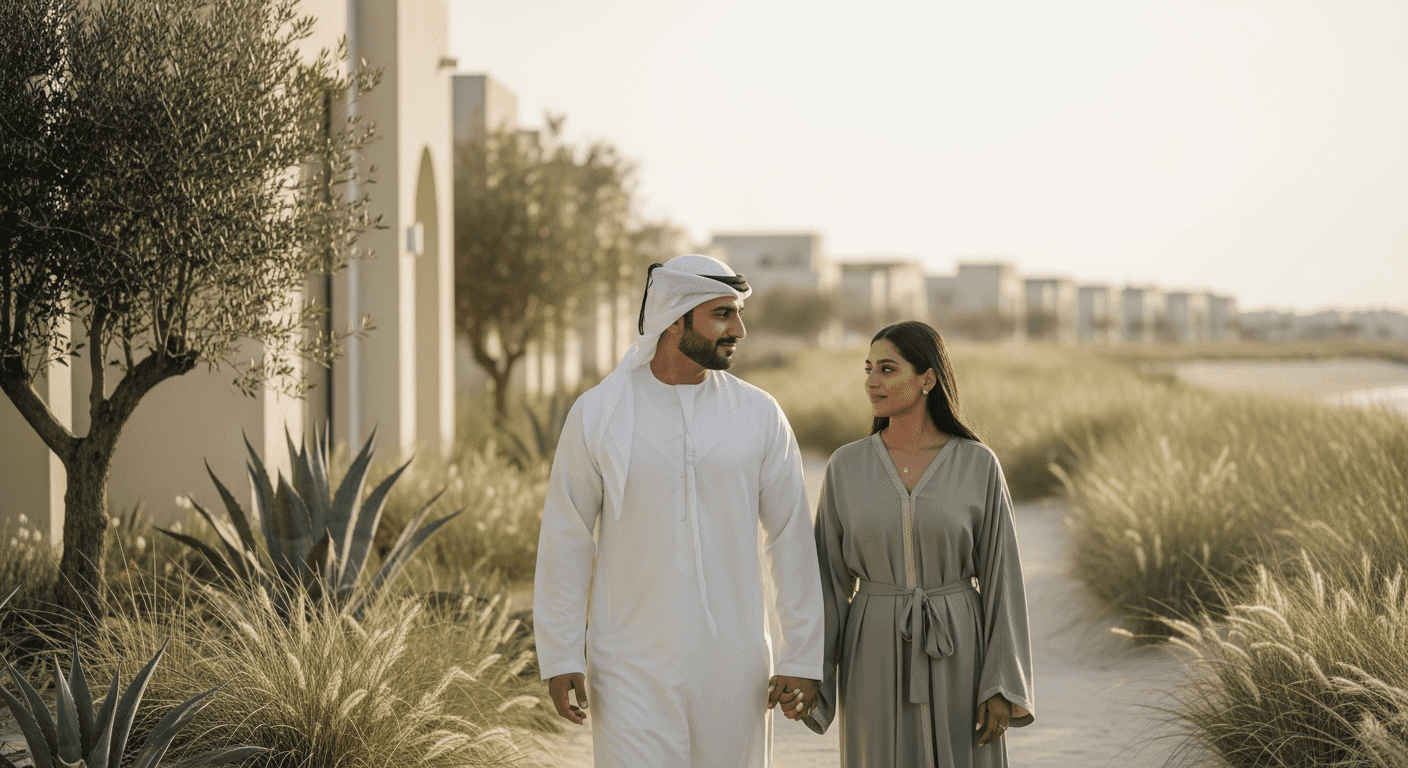
Dubai's Greenest Havens for Family Life
Forget the desert stereotypes. I'm exploring the Dubai villa communities where lush parks, cycling paths, and genuine outdoor living are the main attractions for families.

Forget the desert stereotypes. I'm exploring the Dubai villa communities where lush parks, cycling paths, and genuine outdoor living are the main attractions for families.
Here’s what I'll be exploring from my perspective as a communities specialist at Gaia Living:
- The evolution from basic landscaping to community-defining green spaces.
- A deep dive into the gold standard: Dubai Hills Estate.
- The original green escape and its enduring appeal: Arabian Ranches.
- The botanical masterpiece for ultimate luxury: Al Barari.
- Newer communities offering incredible green value.
- The real costs and practicalities of this lifestyle, from service charges to school runs.
- A full, line-by-line breakdown of the costs to buy into your green dream.
- My final verdict on which community is right for your family.
The Shift to Green: More Than Just Landscaping
When I first started in Dubai real estate over a decade ago, 'green space' in a new development often meant a few token palm trees and a patch of immaculately manicured, rarely used lawn. It was decorative, something to look nice on a brochure, but it wasn't truly integrated into the life of the community. The focus was on the villa itself — the square footage, the marble, the private pool. The space between the homes was secondary. Today, that philosophy has been completely inverted. For the best master developers, the landscape *is* the plan. The parks, the trails, the streams, and the public squares are the skeleton, and the homes are built around them. This represents a fundamental shift in how developers understand what families are looking for when they choose a place to live in Dubai.
This change wasn't accidental. It was driven by pioneering developers like Emaar Properties and Nakheel, who saw that creating a genuine neighbourhood feel was the key to long-term value. They learned from classic suburban models in the US and Europe and adapted them for Dubai's climate and culture. They understood that parents don't just want a big back garden; they want a safe place for their kids to ride their bikes to a friend's house. They want a park where they can meet other families on a Saturday morning, a jogging track for a pre-work run, and a community pool that feels like a resort. The success of communities built on this principle proved there was huge demand for an outdoor lifestyle Dubai communities could offer.
Now, this approach is the industry standard. A new villa launch that doesn't lead with its 'central park', its 'green corridors', or its network of cycling paths villa communities Dubai residents now expect is seen as behind the times. The competition is fierce, which is fantastic news for buyers. Developers are constantly trying to outdo each other with bigger parks, more creative playgrounds, and more unique outdoor amenities. We've seen everything from lazy rivers and wave pools to skate parks and outdoor cinemas become defining features. This focus on the public realm creates 'stickiness' — it makes people want to stay, put down roots, and invest in their community for the long haul. It transforms a collection of houses into a home.
The Gold Standard: Dubai Hills Estate
When clients ask me to name the single best example of a modern, green, family-centric community in Dubai, my answer is almost always the same: Dubai Hills. It’s a joint venture between Emaar and Meraas, and it feels like they took every lesson learned from their previous successes and perfected the formula here. It’s centrally located, sprawling, and meticulously planned around its green spaces. It isn't just a neighbourhood; it’s a self-contained ecosystem for family living, and in my view, it sets the benchmark against which all other new communities are measured.
The heart of the community is, without a doubt, Dubai Hills Park. This isn't just a small neighbourhood park; it's a vast, 180,000 square metre lung for the entire area. On any given weekend, it's absolutely buzzing with life. You’ll see families having picnics, kids at the splash park and adventure playground, teenagers at the skate park, and dog owners at the dedicated dog park. It's an incredibly well-designed space that caters to every age group. But what truly makes Dubai Hills special is that the green experience doesn't stop at the park's edge. A network of green ribbons and jogging trails weaves through the entire development, connecting the various sub-communities. This means you can genuinely walk or cycle from your villa in, say, Maple or Sidra, through shaded pathways all the way to the park, the mall, or the golf club. This level of connectivity is what elevates it from a development with a park to a true park-based community.
Of course, this lifestyle comes with a price tag. Dubai Hills offers a wide range of properties, from one-bedroom apartments to palatial mansions in Hills Grove Villas. For a family-sized home, you're looking at a significant investment. A three-bedroom townhouse in Maple might trade for around AED 4 million to AED 4.5 million, while a five-bedroom independent villa in a community like Sidra or Parkways could range from AED 9 million to over AED 20 million. The rental market is just as strong. The community's appeal is bolstered by world-class amenities right on the doorstep: Dubai Hills Mall offers a complete retail and entertainment experience, King's College Hospital provides top-tier medical care, and several GEMS international schools are within the community itself or a very short drive away. It is the complete package.
The Original Green Escape: Arabian Ranches
If Dubai Hills is the modern standard, then Arabian Ranches is the beloved classic. Launched by Emaar in 2004, it was one of the very first master-planned communities to truly sell the dream of suburban, green living in Dubai. For many long-term residents, 'The Ranches' is synonymous with family life. What sets it apart today, especially Arabian Ranches I, is its maturity. The landscaping here isn't new; the trees are tall, the bougainvillea is lush and overgrown, and the neighbourhood has a settled, established feel that you just can't replicate in a new development. Driving through it feels less like a project and more like a proper, lived-in suburb.
The layout of the original Ranches is centered around the Arabian Ranches Golf Club and a series of smaller, interconnected community parks and pools. Each sub-community, like Saheel, Mirador, or Alvorada, has its own distinct architectural style and its own local park and swimming pool. This creates a series of smaller villages within the larger community. It’s incredibly common to see kids’ bikes left on front lawns and neighbours chatting over garden walls. The sense of community is palpable, reinforced by the Ranches Souk for local shopping, the Jumeirah English Speaking School (JESS) located right inside the gates, and the nearby Arabian Ranches Polo & Equestrian Club. It’s a place where families put down deep roots.
Over the years, the brand has expanded. Arabian Ranches II, located nearby, offers newer homes with more contemporary layouts and its own community hub, The Ranches Souk 2. Then there's the much newer Arabian Ranches III, which is a massive expansion that leans heavily into modern amenities like a central park, a lazy river, and a vast array of sports facilities. While Ranches I is known for its spacious plots and mature greenery, Ranches III offers more modern home designs and a focus on programmed activities. The choice between them comes down to personal preference: do you value the charm and space of an older home, or the modern finishes and resort-style amenities of a new one? Prices reflect this. A villa in Arabian Ranches I can range from AED 5 million to over AED 15 million, often depending on the level of upgrades, while newer townhouses in Ranches III can be found in the AED 2.5 million to AED 4 million range. It remains one of the most sought-after addresses for families seeking Dubai villa communities green space.
The Botanical Masterpiece: Al Barari
While Dubai Hills and Arabian Ranches execute the green suburban model to perfection, Al Barari is something else entirely. It's less of a suburb and more of a private botanical sanctuary. I remember visiting the site years ago when it was just a vision, and even then, the ambition was staggering. The developer, also named Al Barari, wasn't just planning a green community; they were creating an ecosystem. A staggering 60% of the 18.42-million-square-foot development is dedicated to green space, including stunning themed gardens, naturally landscaped lakes, and freshwater streams. The name itself means 'the wilderness' in Arabic, and it truly lives up to it.
Living in Al Barari is an experience. The density is incredibly low. You drive through lush forests to get to your home. The air feels cleaner and cooler. The sound of birdsong replaces the hum of traffic. The community is famous for its world-class wellness facilities, including the Body Language health club and the Heart & Soul spa. Its destination restaurant, The Farm, set amidst the gardens and waterways, has been one of Dubai's most popular spots for years. This is not a place you choose for its proximity to a metro station. You choose Al Barari because you want to be surrounded by nature in a way that is simply not possible anywhere else in Dubai. It offers perhaps the most authentic outdoor lifestyle Dubai communities can provide, but in a highly curated, luxurious package.
This level of exclusivity and botanical splendor comes at a significant cost, both in terms of property price and ongoing upkeep. The villas, like The Nest and The Residences, are magnificent, contemporary homes with huge plot sizes, with prices starting from around AED 12 million and soaring upwards. Even the apartments, in buildings like Seventh Heaven and Ashjar, are positioned at the top end of the market. The service charges here are also among the highest in Dubai, which is to be expected. Maintaining these extensive gardens, waterways, and forests is a huge operational undertaking. For the residents who choose Al Barari, it’s a price they are more than willing to pay for a lifestyle that prioritizes tranquility, privacy, and an unparalleled connection to nature. It is, without question, home to some of the best parks in Dubai villas, because the entire community is essentially one giant park.
The Value Proposition: Newer Communities on the Rise
While the big three — Dubai Hills, Arabian Ranches, and Al Barari, often dominate the conversation, a new wave of communities has emerged that offers a fantastic green lifestyle at a more accessible price point. For many young families I work with, these areas represent the sweet spot between affordability, amenities, and space. A prime example is Town Square by Nshama. The entire development is master-planned around Town Square Park, a huge central hub that gives the community its heart and soul. It’s packed with amenities: a carousel, a kids' train, a splash pad, a wave rider pool, and an excellent skate park. The park is surrounded by cafes and restaurants, creating a vibrant, pedestrian-friendly core that is always busy.
Nshama's strategy with Town Square was brilliant. They built the central park and the core amenities first, so from the moment the first residents moved in, the lifestyle was already there. The community offers a mix of apartments and townhouses, with three- and four-bedroom townhouses often available in the AED 2 million to AED 2.8 million range, making it a very popular entry point into the villa/townhouse market. The trade-off is the location; it’s further out along Al Qudra Road, but for the residents, the self-contained nature of the community and the sheer volume of amenities make it worthwhile. It has its own spinneys, a cinema, and numerous gyms and pools, so you rarely need to leave.
Another major player in this space is Damac, with its two huge communities, Damac Hills and Damac Hills II. DAMAC Hills is planned around the Trump International Golf Club Dubai, providing a green backdrop for thousands of villas and apartments. Beyond the golf course, it has its own version of a central park at Malibu Bay, featuring a man-made wave pool and beach area that is a huge draw for families. DAMAC Hills 2, formerly known as Akoya, is even further out but doubles down on the amenity-rich model. It is divided into 'clusters' with different themes — a water park, a sports complex, an equestrian area, and a motor town. While the location requires a commitment to a longer commute, the value on offer is compelling, with townhouses and smaller villas frequently trading at prices that are very competitive compared to more central locations.
Finally, for those who love a manicured, resort-like environment, Jumeirah Golf Estates is a stunning option. Home to the DP World Tour Championship, the entire community is woven through the magnificent Fire and Earth golf courses. The landscaping is immaculate. Even if you're not a golfer, living here means being surrounded by rolling green hills, mature trees, and serene lakes. It has a country club feel and offers a range of properties from townhouses in communities like Alandalus to opulent custom-built mansions overlooking the fairways. While it’s certainly a premium community, it offers a different, more tranquil and established kind of green living compared to the bustling energy of Town Square or the themed attractions of DAMAC Hills 2.
The best master-planned communities are defined not by the homes themselves, but by the quality of the spaces between them.
Beyond the Parks: The Practicalities of Green Living
Falling in love with the images of lush parks and sparkling pools is easy. However, living in these communities involves practical considerations that every family needs to weigh. The most significant of these is the annual service charge. Those beautiful parks, endless jogging tracks, 24/7 security, and multiple community pools all need to be maintained, and that cost is passed on to homeowners. Service charges are levied by the community management company and are calculated in AED per square foot of your property's built-up area (BUA). It's a fee you must be prepared for, as it's a recurring annual expense on top of your mortgage and utility bills.
The fees can vary dramatically. For a standard Emaar or Nshama community like Arabian Ranches or Town Square, you might expect to pay between AED 4 and AED 6 per sqft. For a 3,000 sqft villa, that's AED 12,000 to AED 18,000 per year. In a more premium, amenity-rich community like Dubai Hills Estate, the fees might be slightly higher, perhaps AED 6 to AED 8 per sqft. In an ultra-luxury, botanically dense community like Al Barari, the charges can be north of AED 10-12 per sqft, reflecting the immense cost of maintaining its unique environment. Before you buy, it is absolutely critical to ask for the exact service charge for the specific property you are considering. You can verify this information on the Dubai REST app provided by the Dubai Land Department (DLD).
Here’s a quick example of how to estimate this cost:
- Property: 4-Bedroom Townhouse in Town Square
- Built-Up Area (BUA): 2,400 sqft
- Stated Service Charge: AED 5.50 per sqft
- Annual Service Charge Calculation: 2,400 sqft x AED 5.50/sqft = AED 13,200 per year
Connectivity is the other major factor. The trade-off for space and greenery is often a longer commute. Communities like DAMAC Hills 2 or the outer reaches of Arabian Ranches III are fantastic, but you are looking at a 30-40 minute drive to hubs like Downtown Dubai or Dubai Marina without traffic. You need to be honest with yourself about your tolerance for time spent in the car. Finally, for families, the school run is a major part of the daily routine. While many of these large communities have excellent schools within them (like JESS at the Ranches or the GEMS schools in Dubai Hills), places in these schools can be highly sought-after. It's wise to research school availability and admissions processes at the same time as you are house-hunting.
The True Cost of Buying into the Green Dream
Understanding the full, upfront cost of purchasing a property is one of the most important services we provide for our clients at Gaia Living. The sticker price of the villa is just one part of the equation. There are several government fees and third-party costs that you must budget for. These fees are non-negotiable and are typically paid on the day of the transfer. Using a hypothetical purchase of a 4-bedroom villa in Dubai Hills as an example, let's break down what you would actually need to have ready.
Let's assume a purchase price of AED 6,000,000. Here is a realistic, line-by-line breakdown of the upfront costs involved in a secondary market transaction. Please note that some administrative fees are subject to change by the authorities, but this provides a very clear picture.
- Purchase Price: AED 6,000,000
- Dubai Land Department (DLD) Transfer Fee: 4% of Purchase Price = AED 240,000. This is the largest single fee.
- DLD Administrative Fees: Approximately AED 4,200 (this is a fixed fee for properties over AED 500k).
- Property Registration (Trustee) Fee: AED 4,000 + 5% VAT = AED 4,200. This is paid to the trustee office that facilitates the transfer.
- Real Estate Agency Fee: 2% of Purchase Price + 5% VAT = (AED 120,000 + AED 6,000) = AED 126,000.
- Developer No-Objection Certificate (NOC) Fee: This varies by developer but typically ranges from AED 500 to AED 5,000. Let's budget AED 1,500.
Total Upfront Cost (without a mortgage): AED 240,000 (DLD Fee) + AED 4,200 (DLD Admin) + AED 4,200 (Trustee) + AED 126,000 (Agency) + AED 1,500 (NOC) = AED 375,900
This means that to purchase a property for AED 6 million, you need to have almost AED 6.4 million available. If you are taking a mortgage, there are additional costs. According to Central Bank of the UAE regulations, expats can typically borrow up to 75-80% of the property value for their first property, meaning a 20-25% down payment is required. There will also be a Mortgage Registration Fee paid to the DLD, which is 0.25% of the loan amount, plus a small admin fee. Banks will also charge arrangement fees and a valuation fee. It’s crucial to factor all these elements into your budget before you begin your property search to avoid any surprises.
My Verdict: How to Choose Your Green Haven
Having spent years walking through every one of these communities, meeting families, and seeing how they live, it's clear there is no single 'best' green community. The right choice is deeply personal and depends entirely on your family's priorities, budget, and lifestyle. The key is to understand the distinct personality of each place and the trade-offs involved. Are you willing to commute further for more space and newer amenities? Or is the charm of an established neighbourhood with mature trees closer to the city's core more your style? Is a high-octane park with a wave pool the right fit for your kids, or would they prefer quiet, shaded streets for bike riding?
In my experience, I find myself recommending communities based on a family's life stage. For young families just starting out and looking for value and energy, the model of Town Square is incredibly compelling. The focus on the central park creates an instant social hub. If budget is less of a concern and you want the absolute best of everything — new construction, a central location, and unparalleled amenities, then Dubai Hills remains the undisputed champion. It's the complete, modern vision of family life in Dubai. For those who value a quieter, more established suburban feel and don't mind living in a slightly older (but often more spacious) home, the original Arabian Ranches has a soul and a sense of community that is hard to replicate.
And for the true connoisseur of luxury and nature, the family for whom tranquility and privacy are the ultimate luxuries, Al Barari exists in a category of its own. It's a commitment, but the reward is a lifestyle you simply cannot find anywhere else. My advice is always to spend time in these places. Don't just do a drive-by viewing of a villa. Go on a Saturday morning. Visit the community park, have a coffee at the local cafe, and watch how people use the space. That is how you will find the green haven that feels like home. At Gaia Living, this is what our team specialises in — helping you look beyond the floorplan to find the community that truly fits your life.
Key takeaway: Dubai's best villa communities are no longer just collections of homes, but ecosystems designed around green spaces. The right choice depends on balancing budget, commute, and lifestyle, with standout options like Dubai Hills for modern luxury, Arabian Ranches for established charm, and Town Square for energetic value.
Sources
- Dubai Land Department (DLD): https://dubailand.gov.ae/
- Central Bank of the UAE: https://www.centralbank.ae/en/
- UAE Government Portal (u.ae): https://u.ae/en/
Questions, answered
- Which Dubai community has the best parks for families?
- Dubai Hills Estate is widely considered the benchmark for family parks, with its huge central park featuring a skate park, splash pad, and sports courts. Arabian Ranches and Town Square are also excellent choices with mature greenery and central community parks, respectively.
- Are villas in green communities in Dubai more expensive?
- Yes, properties in communities with extensive, well-maintained green spaces often command a premium. This is reflected in both the purchase price and the annual service charges, which cover the upkeep of parks, pools, and landscaping.
- What are service charges like in these green villa communities?
- Service charges vary significantly but expect to pay between AED 4 to AED 8 per square foot annually for most master-planned villa communities. Ultra-luxurious and botanically dense communities like Al Barari can have charges upwards of AED 10-12 per square foot to maintain their unique environments.
- Do these communities have good cycling paths?
- Yes, modern communities like Dubai Hills Estate and Arabian Ranches III are designed with extensive cycling paths villa communities Dubai residents use daily. These networks often connect different sub-communities, parks, and retail areas, promoting a safe, active lifestyle.
- Are these communities far from central Dubai?
- Many of Dubai's greenest villa communities are located in suburban areas like Dubailand. A commute to Downtown Dubai or Dubai Marina can take 20-35 minutes depending on the specific community and traffic, a trade-off many families happily make for more space and a better lifestyle.
- What is the total upfront cost to buy a villa in Dubai?
- Beyond the property price, you should budget for approximately 7-8% of the purchase price in upfront costs. This covers the 4% DLD transfer fee, trustee fees, agency fees, and other administrative charges.

Sophia profiles Dubai's villa communities — schools, commute times, green space, and the intangible feel of a neighbourhood. She writes for families putting down roots.
Related stories
Dubai's Established Charm: The Case for Older Homes
In a city focused on the future, I believe the smartest move for many buyers is to look back. Dubai's seasoned communities offer space, character, and surprising value that new builds often can't match.
The True Cost of Owning a Dubai Property
Beyond the purchase price, your annual budget for a Dubai home must account for service charges, utilities, and maintenance. I'll break down every ongoing expense you need to plan for.
Calculating ROI on Dubai Rental Upgrades
As a landlord in Dubai, you can't just follow trends. I'll show you how to calculate the precise ROI of minor property upgrades to genuinely increase your rental yield.
Echoes, in your inbox
One thoughtful email a month. Market insight, new launches, no spam.