

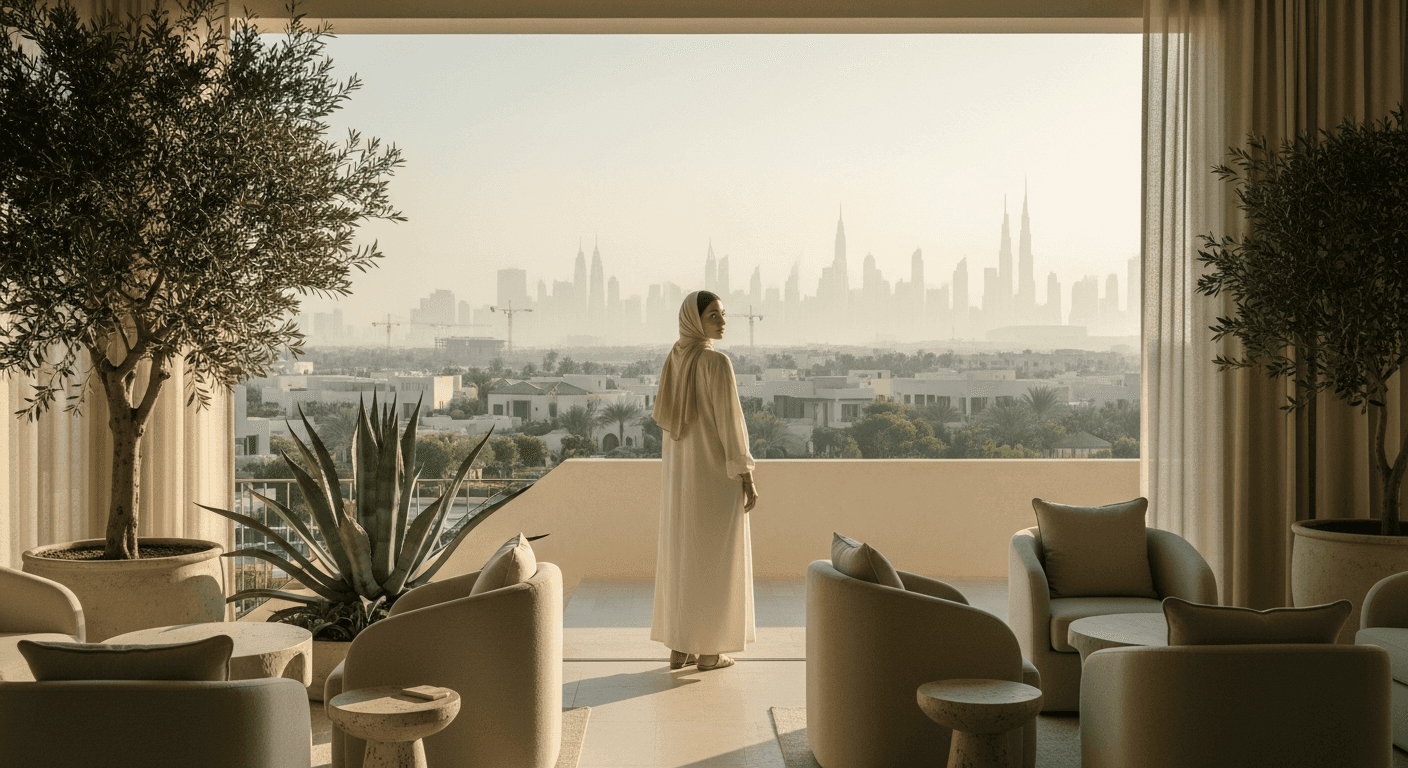
Dubai's Green Mandates: Cost vs. Value
New Dubai green building mandates are coming. I break down how they will impact developer costs, off-plan prices, and the long-term value of your property investment.

The UAE's Net Zero 2050 commitment is no longer a distant ambition; it's a force actively reshaping the foundations of our built environment. For years, 'sustainability' in Dubai real estate was often a marketing buzzword, but now, the framework of mandatory regulations is solidifying. These new building regulations in Dubai are set to fundamentally alter the cost-to-value equation for every new property built in the emirate.
Here’s what I'll analyse for you:
- The existing Al Sa'fat green building code that sets the current baseline.
- What the upcoming, stricter mandates are likely to entail.
- A detailed breakdown of the real sustainable construction costs UAE developers will face.
- The direct impact these costs will have on off-plan and new-build property prices.
- The long-term financial benefits for owners, from lower bills to higher resale value.
- My final verdict on whether this 'green premium' is a cost worth paying.
Al Sa'fat: The Rulebook for Greener Buildings
Before we can understand where we're going, we need to be clear on where we are. The primary instrument for enforcing sustainability in Dubai's construction sector is the Al Sa'fat Green Building Rating System. Launched by the Dubai Municipality, this is not a voluntary program; it is the law. It's a comprehensive framework that evaluates a building's performance across several critical categories: energy efficiency, water efficiency, materials and resources, and environmental quality. Its goal is to create buildings that are more efficient, use fewer resources, and provide healthier living and working environments for their occupants.
The system is tiered, offering four levels of certification: Bronze, Silver, Gold, and Platinum. Each level represents a progressively higher standard of sustainable performance. Since 2014, all new buildings in Dubai have been required to achieve, at a minimum, the 'Bronze Sa'fat' rating. This initial step was crucial in establishing a market-wide baseline. Bronze certification focuses on the fundamentals — ensuring a basic level of efficiency in cooling systems, mandating the use of solar water heaters, and setting standards for insulation and water-conserving fixtures. It was designed to be achievable without imposing an overwhelming financial burden on developers, effectively ending the era of building with no regard for operational efficiency.
While every private developer must meet the Bronze standard, the government has led by example, mandating that all its own new buildings must achieve a 'Silver Sa'fat' rating. This has served as a large-scale pilot program, demonstrating the feasibility and benefits of a higher standard. The Silver rating demands more significant improvements, such as greater energy and water savings compared to a standard baseline building, more rigorous waste management during construction, and the use of more sustainable materials. This two-speed approach has allowed the market to adapt gradually, building local expertise and supply chains for green materials and technologies before making higher standards a universal requirement. The Al Sa'fat system is publicly detailed and forms the core of the new building regulations Dubai is enforcing.
What's Changing? The Push Beyond Bronze
 Featured project
The conversation in Dubai's planning and development circles is no longer about *if* the mandatory baseline will be raised, but *when* and by how much. While no official date has been legislated for a universal upgrade, all signs from government strategy documents and the direction of the Dubai 2040 Urban Master Plan point towards an inevitable raising of the bar. In my professional opinion, the most logical next step is mandating 'Silver Sa'fat' for all new private developments within the next few years. This move would represent a significant step-change in the market, moving sustainability from a basic compliance issue to a core design principle.
What would a shift to a mandatory Silver rating mean in practice? It requires a much more integrated and scientific approach to building design. It’s not about just bolting on a few solar panels. A Silver-rated building must demonstrate tangible, measurable performance improvements over the baseline. This often involves:
- Enhanced Energy Performance: Achieving a significant percentage reduction in energy consumption compared to a standard ASHRAE (American Society of Heating, Refrigerating and Air-Conditioning Engineers) baseline model. This is typically achieved through a combination of passive design (building orientation, shading) and active measures (high-efficiency glazing, superior insulation, and advanced HVAC systems).
- On-Site Renewables: While Bronze encourages solar water heaters, Silver often requires a greater commitment, potentially including a certain percentage of the building's total energy load to be met by on-site renewable sources like photovoltaic (PV) solar panels.
- Water Conservation: The requirements become much stricter. This includes mandating ultra-low-flow fixtures and faucets throughout the building and, for larger projects, often requiring systems for treating and reusing greywater for irrigation and toilet flushing.
- Indoor Environmental Quality: Greater emphasis is placed on the health and wellbeing of occupants. This translates into requirements for low-VOC (Volatile Organic Compound) paints, adhesives, and flooring, as well as ventilation systems that provide superior air quality.
This impending shift is the central driver behind the current focus on `Dubai green building mandates`. Developers are acutely aware that the goalposts are moving. Those who are already building to a Silver standard or higher — like Emaar Properties in many of its newer projects in Creek Harbour or Aldar in Abu Dhabi, are positioning themselves ahead of the curve. Those who have been content to simply meet the bare-minimum Bronze requirement will soon face a steep learning curve and a significant adjustment to their construction models and cost structures. This is a deliberate policy choice by the government to elevate the overall quality of the city's building stock.
The Upfront Cost: A Developer's Perspective
For developers, achieving higher levels of green certification is not a cost-free exercise. The transition from a Bronze to a Silver or Gold Sa'fat rating involves tangible upfront capital expenditures. It’s critical to understand that these are not arbitrary costs; they are investments in higher-quality components, more sophisticated technology, and specialised expertise. My analysis of `sustainable construction costs UAE` shows the premium is typically spread across several key areas, representing a 3-8% uplift in total construction costs for a Silver rating, and potentially 10-15% or more for Gold and Platinum.
First are the 'hard costs' related to materials and technology. A significant portion of a building's energy efficiency comes from its envelope — the roof, walls, and windows. Upgrading to high-performance, double-glazed windows with low-emissivity coatings is more expensive than standard single glazing. Using thicker, higher-quality thermal insulation like mineral wool instead of basic polystyrene adds to material costs. The HVAC system, which accounts for up to 70% of a building's electricity consumption in Dubai, is another major area of investment. Upgrading from standard units to a high-efficiency Variable Refrigerant Flow (VRF) system can add a substantial amount to the budget, but it is one of the most effective ways to slash operational energy use. Other hard costs include the installation of solar PV panels, greywater treatment systems, LED lighting throughout, and the selection of certified sustainable materials like FSC-certified wood or recycled steel.
Second are the 'soft costs' associated with design and certification. Building green requires a more collaborative and technical design process from day one. Developers must hire specialised sustainability consultants, often accredited professionals (like Estidama PQPs or LEED APs), to guide the design team, conduct energy modeling simulations, and manage the certification process with the Dubai Municipality. This expertise comes at a price. There are also direct fees for the certification itself. The process involves detailed documentation, on-site audits, and commissioning tests to ensure the building performs as designed. This adds a layer of administrative complexity and cost that a 'build-and-sell' developer focused only on speed and minimum standards might try to avoid. It’s a key part of ensuring `developer compliance green` standards are actually met.
To put this in perspective, here is an illustrative cost uplift for a hypothetical 1,500 sq.ft. Apartment moving from a minimum-code build to a 'Silver Sa'fat' standard:
- Base Construction Cost (Bronze equivalent): AED 900,000 (at AED 600/sq.ft.)
- Green Premium Uplift (Illustrative):
- High-Performance Glazing Upgrade: + AED 20,000
- Enhanced Wall & Roof Insulation: + AED 15,000
- Upgrade to High-Efficiency VRF AC System: + AED 25,000
- Solar Water Heater System (if not already baseline): + AED 8,000
- Water-Saving Fixtures & Fittings Upgrade: + AED 5,000
- Sustainability Consultant & Energy Modeling Fees: + AED 12,000
- Certification & Documentation Fees: + AED 5,000
- Total 'Green' Uplift: AED 90,000
- Total Construction Cost (Silver): AED 990,000
- Percentage Uplift: 10%
This is a simplified model, but it demonstrates how the costs add up. A 5-10% increase in construction cost is a significant figure that no developer will simply absorb. This cost will, inevitably, be passed on to the buyer.
The New Price Tag: Impact on Off-Plan Sales
The multi-billion-dirham question is how this increase in construction cost will translate to the prices you see for off-plan launches. The answer is straightforward: prices will go up. Developers operate on margins, and any systemic increase in their cost base will be reflected in the final sale price. My view is that we will not see a separate 'green fee' on the sales contract. Instead, this premium will be baked into the overall price per square foot. The initial market reaction may be a slight sticker shock, as buyers compare new, greener launches with older, less efficient inventory on the secondary market.
However, savvy developers will not present this as a simple price hike. They will market it as a value proposition. The narrative will shift from "this apartment costs more" to "this home offers more." The marketing language will focus on the tangible benefits for the owner: lower DEWA bills, healthier indoor air, superior comfort, and the prestige of living in a technologically advanced, environmentally responsible building. We are already seeing this from premium developers. A builder like Meraas, known for lifestyle destinations like City Walk and Bluewaters Island, frames sustainability as part of the luxury experience. Similarly, the marketing for villas in Dubai Hills by Emaar often highlights the green spaces and eco-friendly design as key selling points that justify the premium price point.
“The most successful developers won't sell 'green buildings'; they will sell smarter, healthier, and more economical homes. The sustainability aspect will be an intrinsic part of the quality promise, not an optional extra.”
The ability of the market to absorb these higher prices will likely vary by segment. In the luxury and ultra-luxury markets, where buyers are less price-sensitive and more focused on quality and features, a 5-10% premium for a certified green home is an easy sell. Buyers of villas in Jumeirah Golf Estates or penthouses in Dubai Marina are already paying for the best, and a certified sustainable design is increasingly seen as part of that package. The real test will be in the affordable and mid-market segments. For developers like Damac in their sprawling Damac Hills and Damac Hills II communities or Binghatti in their numerous JVC projects, balancing the mandatory green costs with an affordable price point will be a major strategic challenge. It will force them to innovate, seeking efficiencies in their supply chains and construction processes to deliver compliance without alienating their target demographic.
The Total Cost of Ownership: An Investor's View
While the purchase price is the most visible number, sophisticated investors know it's only one part of the financial picture. The real measure of an asset's performance is its total cost of ownership (TCO). This is where green buildings pivot from being more expensive to actually being more profitable. The higher initial capital expenditure (CapEx) is a strategic investment to reduce the long-term operational expenditure (OpEx). This is the core of the argument for `property value energy efficiency`.
The most direct and easily quantifiable saving comes from reduced utility bills. A building constructed to Silver Sa'fat standards can realistically achieve energy and water savings of 20-30% or more compared to a non-certified or barely-compliant building. Let's translate that into actual dirhams. The average DEWA bill for a two-bedroom apartment can easily be AED 1,500-2,000 per month during the peak summer months. A 25% reduction translates to a saving of AED 375-500 every month. Annually, that’s a saving of AED 4,500-6,000 straight back into your pocket or your tenant's, making your property more attractive to rent.
Service charges are the second area of significant savings. These annual fees, which cover the maintenance and operation of the building's common areas, are a major consideration for any property owner. A building with an efficient HVAC system for its lobby, LED lighting in its corridors and parking garage, and solar panels to heat the swimming pool will have a dramatically lower common area electricity bill. Beyond that, green building standards often encourage the use of more durable, higher-quality materials that require less frequent maintenance and replacement. A 10% reduction in service charges may not sound like much, but on a 2,000 sq.ft. Apartment with charges of AED 18 per sq.ft., that's a saving of AED 3,600 per year, every year.
Let's compare the annual operational costs for two similar apartments, one standard and one green-certified:
Annual OpEx Comparison: 1,500 sq.ft. Apartment
- Standard (Bronze-level) Property:
- Average Annual DEWA Bill: AED 18,000
- Annual Service Charges (at AED 20/sq.ft.): AED 30,000
- Total Annual OpEx: AED 48,000
- Green (Silver-level) Property:
- Average Annual DEWA Bill (25% saving): AED 13,500
- Annual Service Charges (10% saving, at AED 18/sq.ft.): AED 27,000
- Total Annual OpEx: AED 40,500
In this scenario, the green property saves its owner AED 7,500 per year. Over a five-year holding period, that's a saving of AED 37,500. This saving directly offsets the initial higher purchase price and, from an investment perspective, results in a higher net rental yield. When you run the numbers, the higher upfront cost starts to look like one of the shrewdest investments you can make.
The 'Green Premium': Will Your Property Be Worth More?
Lower running costs are a clear benefit, but the ultimate question for any property investor is about capital appreciation. Will a certified green building command a higher resale price in the secondary market? My unequivocal answer is yes. While the 'green premium' in Dubai's resale market is still emerging, I am convinced it will become a significant and quantifiable factor in property valuations over the next five to ten years.
Firstly, buying a green-certified building today is an act of future-proofing your investment. As regulations inevitably tighten further, older, less efficient buildings will become comparatively less attractive. They may even be subject to future mandates requiring costly retrofits to improve their energy performance. A property that already meets or exceeds the foreseeable standards will hold its value far better and will appeal to a wider pool of buyers. It's a classic case of skating to where the puck is going, not where it has been. This is a topic we cover extensively in our buyer & investor guides.
Secondly, buyer awareness is on a steep upward curve. A growing cohort of purchasers, particularly expatriates from Europe and other markets where energy ratings have been standard for years, are now actively seeking out efficient and healthy homes. They understand the benefits of lower utility bills and better indoor air quality. As this demographic becomes more influential in the Dubai market, they will vote with their wallets, creating a clear demand-driven premium for certified properties. At Gaia Living, we are increasingly fielding specific questions from clients about insulation quality, AC efficiency, and sustainability certifications — questions that were rare just a few years ago.
Finally, the financial and valuation ecosystem will adapt. I anticipate that banks and mortgage lenders will soon begin formally incorporating Al Sa'fat ratings into their property valuation reports. A property with a Gold Sa'fat rating might be appraised at a higher value than an identical, non-certified neighbor, potentially allowing a buyer to secure a larger loan. This will formalize the green premium. Beyond that, the rental market will drive value. If a green apartment in Jumeirah Beach Residence can command a 5% higher rent than a non-green one because of its lower DEWA bills and superior comfort, its investment value and sale price will rise accordingly.
More Than a Certificate: The Community-Wide Impact
The impact of these green mandates extends far beyond the technical specifications of a single building. When embraced at the master plan level, sustainability becomes a powerful force for creating more desirable, resilient, and valuable communities. It creates a 'halo effect' that elevates the brand of the developer and the lifestyle of the residents. The focus shifts from simply building and selling units to creating a holistic, high-quality environment.
A prime example of this philosophy is Al Barari, a developer whose entire brand identity is synonymous with lush landscaping and sustainable living. The premium commanded by properties in Al Barari is not just due to the quality of the villas themselves, but to the unique, green environment that cannot be replicated elsewhere. Buyers are investing in the clean air, the shaded walkways, and the sense of tranquility that comes from living in a green oasis. This has created a fiercely loyal community and some of the most stable and sought-after property in Dubai.
We are seeing this ethos being adopted by the new generation of master planners. Expo City is being developed as a model for sustainable urban living, integrating smart mobility, green spaces, and buildings designed to the highest environmental standards. Major new urban districts like Dubai South, which will be home to hundreds of thousands of residents, are incorporating sustainability principles into their core infrastructure and planning. This community-wide approach provides benefits that no single building can offer on its own — reduced urban heat island effect, better walkability, and shared amenities that promote a healthier lifestyle. These factors create 'sticky' communities where people want to live for the long term, leading to lower resident turnover, higher rental yields, and more stable capital growth.
This trend is not just for sprawling new suburbs. Even in dense urban areas, developers are using green credentials to differentiate themselves. In a competitive market for high-end apartments, a developer who can promise a LEED-certified or Gold Sa'fat building with landscaped sky gardens, EV charging stations, and community recycling programs has a powerful competitive advantage. It signals a commitment to quality and a forward-thinking vision that resonates with today's discerning global buyer. This is about building a legacy, not just a ledger.
My Verdict: An Essential Evolution for a Maturing Market
After analyzing the costs, benefits, and market dynamics, my conclusion is clear: the push for stricter green building mandates is not a burden on the Dubai real estate market, but an essential and highly positive evolution. It marks the transition of our city from a phase of rapid, spectacular growth to a new era of mature, sustainable quality.
For developers, the increased upfront costs are a necessary investment in staying relevant. The days of value-engineering quality out of a project to hit a low price point are numbered. The developers who will thrive in the coming decade are those who embrace these standards, innovate in their construction methods, and build a brand based on long-term quality, not short-term profit. The compliance costs will serve as a barrier to entry, filtering out less capable players and rewarding those with the vision and capital to build properly.
For buyers and investors, the message is to look beyond the headline price. The slightly higher initial cost of a certified green property is one of the most intelligent investments you can make. You are buying a home that will be cheaper to run, healthier to live in, and more desirable to future buyers or tenants. You are acquiring an asset that is insulated from the risks of regulatory change and aligned with global trends. The `property value energy efficiency` provides is no longer a theoretical benefit; it is a measurable financial return.
When you are looking to buy property in Dubai, the Al Sa'fat rating should be a key part of your due diligence, as important as the floor plan or the view. Ask the developer for the certification. Ask us at Gaia Living to help you understand what it means. A green building is, quite simply, a better building. It's an investment in a superior asset and a vote of confidence in Dubai's future as a world-class, sustainable city.
## Sources - Dubai 2040 Urban Master Plan: Government of Dubai - Al Sa'fat Green Building Rating System: Dubai Land Department - UAE Net Zero by 2050 Strategic Initiative: UAE Government Portal
Questions, answered
- Are all new buildings in Dubai required to be 'green'?
- Yes, all new construction in Dubai must comply with the Al Sa'fat Green Building Rating System. Currently, the minimum requirement is the 'Bronze Sa'fat' certification, but regulations are expected to become more stringent over time.
- How much more does a green-certified apartment in Dubai cost?
- The 'green premium' varies. Achieving a higher rating like 'Silver Sa'fat' can add an estimated 3-8% to the initial construction cost, which is often reflected in the final sale price. This cost covers higher-quality materials, technology, and design.
- Will a green building really lower my DEWA bills?
- Yes. A key goal of the Dubai green building mandates is energy and water efficiency. A certified property with better insulation, efficient AC, and water-saving fixtures can reduce your monthly DEWA consumption by 20-30% or more compared to an older, less efficient building.
- How do green building mandates affect my property's resale value?
- Green-certified properties are expected to have a higher resale value. They offer lower running costs, a higher quality of living, and are 'future-proof' against stricter future regulations. As market awareness grows, this 'green premium' on the secondary market is likely to increase.
- How can I verify a building's Al Sa'fat green rating?
- The developer should provide documentation of the building's Al Sa'fat certification. You can also ask your real estate agent to verify this information, and it is sometimes recorded in property documents accessible via the Dubai Land Department's platforms like the Dubai REST app.
- Do green buildings have lower service charges?
- They often do. Energy savings in common areas and the use of more durable, low-maintenance materials can lead to lower operational costs for the building management. These savings are then passed on to homeowners through reduced annual service charges.
Omar tracks the announcements that move the market — new launches, regulation, mega-projects, and developer moves — and tells you what they actually mean for buyers.
Related stories
Dubai's Established Charm: The Case for Older Homes
In a city focused on the future, I believe the smartest move for many buyers is to look back. Dubai's seasoned communities offer space, character, and surprising value that new builds often can't match.
The True Cost of Owning a Dubai Property
Beyond the purchase price, your annual budget for a Dubai home must account for service charges, utilities, and maintenance. I'll break down every ongoing expense you need to plan for.
Calculating ROI on Dubai Rental Upgrades
As a landlord in Dubai, you can't just follow trends. I'll show you how to calculate the precise ROI of minor property upgrades to genuinely increase your rental yield.
Echoes, in your inbox
One thoughtful email a month. Market insight, new launches, no spam.