

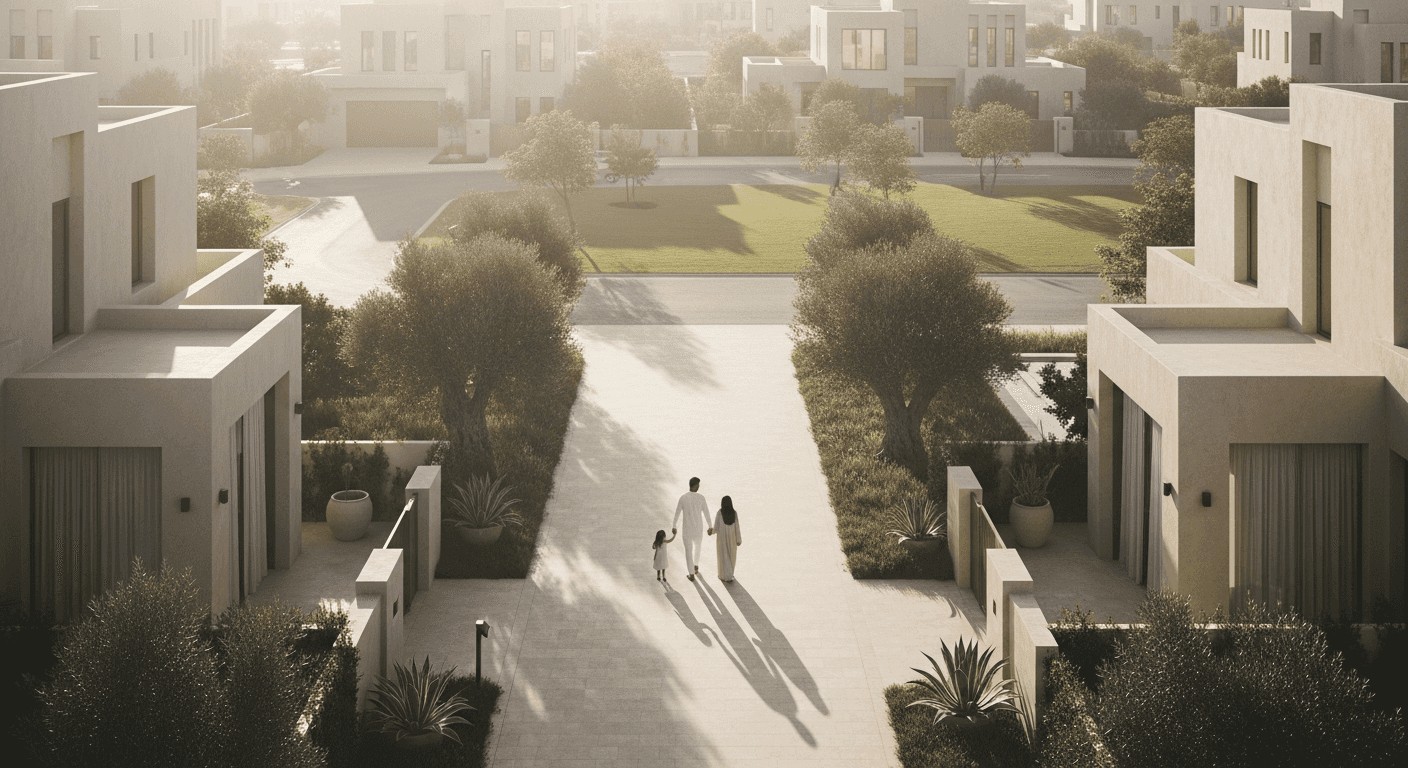
Dubai's Forever Homes: Villas for Family Growth
I explore what truly defines a 'forever home' in Dubai, moving beyond size to focus on communities designed for long-term family growth, adaptability, and enduring value.

The concept of a 'forever home' in a city as dynamic as Dubai can feel like a contradiction. Yet, for a growing number of us who have put down deep roots here, it's the ultimate goal. It's about finding a place that doesn't just fit your family today, but has the space, flexibility, and community fabric to evolve with you for decades to come.
Here's what we'll explore in this guide to finding your family's forever home:
- The true definition of a 'forever home' in the Dubai context
- A deep dive into Emaar's foundational family communities
- The specific villa layouts and features that enable long-term living
- Why the surrounding community ecosystem is as important as the house itself
- A detailed, line-by-line breakdown of the financials involved
- A look at niche and boutique communities with lasting appeal
- The pros and cons of buying your forever home off-plan
- My final verdict on how to choose the right community for your family
What Truly Makes a 'Forever Home' in Dubai?
When clients talk to us at Gaia Living about finding `long-term family homes Dubai`, the conversation often starts with square footage and number of bedrooms. While space is certainly a prerequisite, I find the essence of a 'forever home' lies in something less tangible: its capacity for adaptation. This isn't just a house; it's a foundation for your family's changing narrative. It’s a home that makes sense when you have toddlers running around the garden, just as it does when those toddlers become teenagers needing their own space, and even later when you might have grandparents coming for extended stays.
The search for `forever homes Dubai` is a search for permanence in a place known for its rapid pace. This means looking past the initial 'wow' factor of a brand-new villa. You have to project forward. Will this layout work in ten years? A ground-floor bedroom that serves as a playroom today could become an essential guest suite for an elderly parent tomorrow. An open-plan living area is wonderful for young families, but a separate formal lounge or a study can be a sanctuary when children get older and have friends over. True long-term design anticipates these shifts.
Beyond the four walls, the community itself must be built to last. A thriving 'forever' community has a mature ecosystem. This includes top-tier schools that children can progress through, accessible and high-quality healthcare facilities, and retail and dining options that aren't just trendy, but genuinely useful. The most successful communities are those that foster a real sense of belonging, where neighbours become friends and children grow up together on the same quiet streets and in the same parks. This social infrastructure is what transforms a collection of houses into a genuine neighbourhood, and it’s a critical component of enduring value. When you invest in a home in a community with these fundamentals, you’re not just buying property; you're securing a lifestyle and a stable environment for your family's future.
The Titans of Family Living: Emaar's Enduring Masterpieces
 Featured project
When you talk about master-planned family communities in Dubai, one name consistently sets the benchmark: Emaar Properties. For decades, they have perfected the formula for creating large-scale neighbourhoods that are not only beautifully designed but are also holistically conceived to support family life from infancy to adulthood. Two communities, in my view, perfectly encapsulate this ethos: the established classic, Arabian Ranches, and its modern evolution, Dubai Hills Estate. They represent two different eras of Dubai's growth but share a common DNA focused on creating lasting residential value.
Arabian Ranches is, for many, the original blueprint for the Dubai suburban dream. Launched in the early 2000s, it has had twenty years to mature into a truly settled community. The trees are tall, the gardens are lush, and there’s a palpable sense of permanence. This is where you find `villas for growing families Dubai` that have already stood the test of time. The community is anchored by outstanding amenities like the Arabian Ranches Golf Club and the Jumeirah English Speaking School (JESS), one of the city's most sought-after not-for-profit schools. This educational anchor is a powerful draw, creating a sticky ecosystem where families are reluctant to leave. A three-bedroom townhouse here might start around AED 3.5 million, while larger five or six-bedroom independent villas can range from AED 7 million to over AED 15 million, depending on their location, view, and level of upgrades.
If Arabian Ranches is the established patriarch, Dubai Hills Estate is the ambitious, modern heir. It takes all the lessons learned from the Ranches and elevates them with contemporary design and a more central location. What I find so compelling about Dubai Hills is its internal scalability. A young family can start with a three-bedroom townhouse in a sub-community like Maple or Sidra, and as their needs and finances grow, they can upgrade to a larger villa in Parkways or a sprawling mansion in Hills Grove Villas without ever leaving the master community. This ability to 'grow in place' is a key feature of a forever community. Anchored by the vast Dubai Hills Park, the championship golf course, Dubai Hills Mall, and King's College Hospital, the infrastructure is second to none. A four-bedroom villa here might trade in the AED 8-12 million range, with larger, more premium properties commanding prices well north of AED 25 million.
The Anatomy of a Long-Term Villa: Layouts and Features
The search for a 'forever home' demands a forensic examination of the property's layout. A beautiful finish is lovely, but a functional, flexible floor plan is what delivers enduring livability. One of the most significant trends we see at Gaia Living is the growing demand for layouts that support `multi-generational living Dubai`. As families choose to live together for longer, or as grandparents play a more active role, the need for specific architectural features has become paramount. A ground-floor bedroom with an en-suite bathroom is no longer a 'nice-to-have'; for many, it's a necessity. It provides accessibility for older relatives and privacy for guests, and in a pinch, it can serve as a home office or a playroom.
Beyond that key feature, I always advise clients to look for homes with multiple living areas. A single, vast open-plan space can feel cavernous and impractical as children get older. A layout with a primary family room connected to the kitchen, but also a separate, more formal living room or a smaller upstairs family area, provides crucial separation. It allows for simultaneous activities — homework in one corner, TV in another, and quiet conversation in a third. Similarly, think about the transition from indoors to outdoors. A covered terrace or a loggia that can be used for dining and relaxing for much of the year effectively extends your living space and is a hallmark of the best-designed villas in Dubai.
When assessing a property, don't just look at the built-up area; consider the plot itself. The size, shape, and orientation of the land are fundamental. A corner plot often affords more privacy and natural light. A plot that backs directly onto a park or a green belt offers a beautiful, protected view and a sense of expanded space for your children to play. I also encourage a critical look at the home's 'bones'. Is there potential to extend in the future? Is the garden large enough to add a swimming pool if it doesn't already have one? These considerations of future potential are what distinguish a simple house purchase from a true `family investment villas Dubai` strategy. Here are some of the key features I believe are essential in a future-proof family villa:
- A ground-floor bedroom with an en-suite bathroom: The ultimate feature for flexibility, catering to guests, elderly relatives, or even serving as a private home office.
- Multiple, distinct living zones: Look for a combination of open-plan family areas and separate formal or casual lounges to accommodate a growing family's diverse needs.
- Generous and well-oriented plot: A large, private plot, especially one backing onto a park, provides space for recreation, landscaping, and future extensions.
- Dedicated service areas: Well-designed maid's and/or driver's rooms, along with a functional utility and storage space, are critical for the smooth running of a large family home.
- Robust and high-quality construction: Look beyond the cosmetic finishes to the quality of the build, the MEP (mechanical, electrical, plumbing) systems, and the potential for future upgrades.
“A true 'forever home' isn't a static asset; it's a platform for your family's life, designed to adapt as your needs change.”
Beyond the Gates: The Community Ecosystem
A magnificent villa is only half the story. The long-term happiness of your family and the enduring value of your property are intrinsically linked to the quality of the surrounding community. When I walk clients through areas like Dubai Hills or Arabian Ranches, I spend as much time talking about the parks, schools, and clinics as I do about the houses themselves. This is the ecosystem that will support your daily life. A 30-minute drive to the school run twice a day can erode the joy of even the most beautiful home. A lack of safe, green spaces for children to play can leave a community feeling sterile and isolating.
For families, schools are the single most important piece of community infrastructure. The presence of a top-tier, internationally recognised school within the community gates, or a short drive away, is a powerful anchor. It not only simplifies daily logistics but also fosters a strong neighborhood bond as parents and children interact at drop-off, school events, and after-school activities. In my experience, properties in the catchment areas of schools like JESS at Arabian Ranches, or the GEMS schools and Foremarke School near Al Barari, consistently hold their value better and command higher rental yields precisely because of this educational advantage. It creates a non-negotiable demand driver for a specific type of tenant and buyer.
Equally important are healthcare and wellness facilities. The peace of mind that comes from having a reputable clinic or hospital nearby is immeasurable. The inclusion of King's College Hospital directly within Dubai Hills Estate was a masterstroke by Emaar, instantly elevating its appeal for families and older residents. Finally, look at the lifestyle on offer. Are there well-maintained parks? Shaded jogging and cycling tracks? A vibrant community centre with a good gym, a supermarket, and a few casual cafes? These are the 'third spaces' where life is lived, where you bump into neighbours, and where a sense of community is forged. A long commute to Business Bay or DIFC is more palatable when you know you're returning to a neighborhood that provides a complete, enriching lifestyle right on your doorstep.
The Financials of Forever: Budgeting for Your Long-Term Home
Securing your forever home is one of the most significant financial commitments you will ever make. It's crucial to go into it with a clear and comprehensive understanding of all the costs involved, both upfront and ongoing. Many first-time villa buyers in Dubai focus solely on the headline purchase price and their mortgage down payment, but the transaction costs can be substantial. As a buyer, you need to budget for approximately 7-8% of the property's value in fees on top of your down payment. Understanding these numbers is the first step in making a sound, sustainable investment.
Let's walk through a realistic example. Imagine you've found a wonderful five-bedroom villa in a community like Dubai Hills Estate with a purchase price of AED 12,000,000. If you are an expatriate resident financing the purchase, the Central Bank of the UAE's regulations will apply. For a first property over AED 5 million, you are required to have a minimum down payment of 25%, which in this case would be AED 3,000,000. The remaining AED 9,000,000 would be financed through a mortgage. The upfront costs, however, don't stop there. The largest fee is the Dubai Land Department (DLD) transfer fee, which is a mandatory 4% of the purchase price.
Here’s a line-by-line breakdown of the estimated upfront costs for this hypothetical AED 12 million villa purchase. It's essential to get precise quotes from your agent and mortgage provider, but this checklist provides a reliable guide:
- Purchase Price: AED 12,000,000
- Down Payment (25%): AED 3,000,000
- Dubai Land Department (DLD) Fee (4%): AED 480,000
- DLD Admin Fees: Approximately AED 4,200 (for properties over AED 500k)
- Real Estate Agency Fee (2% + 5% VAT): AED 240,000 + AED 12,000 = AED 252,000
- Property Registration (Trustee) Fee: Approximately AED 4,200
- Mortgage Registration Fee (0.25% of loan amount): 0.25% of AED 9,000,000 = AED 22,500
- Bank Mortgage Fees (Valuation, Processing): Typically ranges from AED 5,000 to AED 10,000
- Developer's No Objection Certificate (NOC) Fee: Can range from AED 500 to AED 5,000, payable to the master developer.
- Total Estimated Upfront Cash Required: Approximately AED 3,775,900 (Down Payment + All Fees)
Beyond these initial costs, you must factor in the recurring annual expenses. The most significant of these is the community service charge, which covers the maintenance of all common areas, security, landscaping, and amenities. For villa communities, this typically ranges from AED 3 to AED 6 per square foot of your plot area, per year. For a 6,000 sq. Ft. plot, this could mean an annual bill of AED 18,000 to AED 36,000. Adding DEWA (water and electricity) and any home maintenance contracts creates a complete picture of your annual running costs, which is vital for long-term financial planning.
The Boutique & The Bold: Niche Communities with Enduring Appeal
While the large master-planned communities by developers like Emaar offer a proven and popular model, some of the most compelling `forever homes Dubai` can be found in more specialized, boutique developments. These communities cater to specific lifestyle preferences and, in doing so, create a powerful sense of identity and a very loyal resident base. They might not have the sheer scale of a Dubai Hills, but their unique selling proposition gives them a strong defensive 'moat', which is a key attribute of a great `family investment villas Dubai`.
My personal favorite in this category is Al Barari. Driving into Al Barari feels like leaving Dubai and entering another world. With over 60% of the development dedicated to green space, landscaped gardens, and waterways, it is an undisputed sanctuary for those who prioritize nature, wellness, and privacy. The villas here are known for their generous plots and high-end finishes, and the community is anchored by unique amenities like The Farm restaurant, the Body Language health club, and a destination spa. It's a choice for a discerning buyer who wants a tranquil, resort-like atmosphere every single day. The community, originally brought to life by developer Zaya, has an almost cult-like following, and properties here have shown remarkable value resilience because there is simply nothing else like it in the city.
Another outstanding example is Jumeirah Golf Estates. This is a community built, quite literally, around a passion for sport. Home to two Greg Norman-designed championship courses, Fire and Earth (host of the DP World Tour Championship), JGE is an obvious choice for the golf-loving family. But its appeal goes broader than that. The European Tour Performance Institute and the impressive clubhouse act as a central hub for the entire community, offering dining, fitness, and social events. The villas themselves are often arranged in distinct Mediterranean-inspired clusters, creating intimate neighborhoods within the larger development. For families who value an active, outdoor lifestyle, JGE offers a complete and compelling world, making it a very strong contender for a long-term family base.
The Off-Plan 'Forever Home': Designing for the Future
A significant portion of the villa market in Dubai involves buying directly from a developer before or during construction. The idea of securing one of the `villas for growing families Dubai` off-plan can be incredibly appealing. You get a brand-new property, often with the latest smart home technology and contemporary finishes, and you benefit from a structured payment plan that spreads the cost over several years. This can make a larger home more financially accessible than buying on the secondary market where the full down payment and associated fees are due at once. Beyond that, buying early in a new phase of a community like Arabian Ranches III or a new launch in Dubai South allows you to lock in a price before the community fully matures and values potentially appreciate.
However, this path requires careful consideration and due diligence. The primary risk is, of course, the construction timeline. While Dubai's real estate market is strictly regulated by authorities like RERA, with protections like mandatory escrow accounts for buyer funds, delays can still happen. The other consideration is the community's maturity. When you move into a new off-plan villa, the surrounding parks might still be saplings, the retail centre might not be fully leased, and the 'community feel' will take time to develop. You are buying into a vision, and you must be comfortable with the journey of seeing that vision come to life around you over the first few years.
My advice to clients considering an off-plan forever home is to prioritise the developer's track record above all else. A master developer like Emaar Properties, Nakheel, or Aldar in Abu Dhabi, has a long history of not just delivering high-quality homes, but of building and managing the entire community ecosystem for years after handover. They are not just builders; they are placemakers. When you buy from a developer with a proven track record of delivering on their promises — from the quality of the landscaping to the operational excellence of the community centre, you are significantly mitigating your risk. You are investing in a promise made by an entity that has kept that same promise to thousands of other families before you.
Finding a forever home in Dubai is a process of matching the physical asset — the villa, with the intangible but critical elements of community and lifestyle. It requires looking beyond the present and imagining your family's future, then finding the community built with the foresight and quality to meet you there.
My Verdict: Choosing the Right Path for Your Family
After years of walking families through Dubai's diverse villa communities, my core belief is that the 'perfect' forever home doesn't exist in a brochure. It's found at the intersection of your family's unique priorities, your financial reality, and a community's proven ability to deliver on its promises. The journey is deeply personal. For some, the established, leafy streets and undeniable sense of community in a place like Arabian Ranches will always be the gold standard. It represents a known quantity — a safe, stable, and deeply satisfying environment that has proven its worth over two decades. There is a profound comfort in that level of maturity.
For others, the allure of the new is irresistible. A community like Dubai Hills Estate offers a more modern vision of family life, with state-of-the-art amenities, contemporary architecture, and the excitement of being part of Dubai's 'next classic' neighborhood. The opportunity to buy a brand-new home, and potentially upgrade within the same community as your family grows, is a powerful proposition. Then there are the niche communities like Al Barari or Jumeirah Golf Estates, which offer a specialised lifestyle that, for the right family, is simply without parallel. They prove that a forever home can be defined by a shared passion, be it for nature or for sport.
Ultimately, my advice is to think in layers. Start with the practicalities: your budget (including all fees), your required commute, and your non-negotiable school requirements. Once you have that framework, you can begin to explore the communities that fit. Spend time there. Visit on a weekend. Walk through the parks, have a coffee at the community centre, and talk to us. At Gaia Living, we see our role not just as brokers, but as community consultants. We live in these areas, our children go to these schools, and we understand the subtle differences that don't appear on a floor plan. A forever home is the biggest investment most of us will ever make, not just financially, but emotionally. It's worth the time to get it right.
Sources
- Dubai Land Department (DLD): dubailand.gov.ae
- Central Bank of the UAE: centralbank.ae
- UAE Government Portal: u.ae
Questions, answered
- What are the typical service charges for a family villa in Dubai?
- Service charges for villas in prime family communities generally range from AED 3 to AED 6 per square foot annually. This covers landscaping, security, and maintenance of community amenities like pools and parks. Always verify the exact rate for a specific property as it can vary.
- What is the minimum down payment for a villa in Dubai?
- For expatriate residents buying their first property valued over AED 5 million, the Central Bank of the UAE mandates a minimum down payment of 25% of the purchase price. For properties under AED 5 million, the minimum is 20%. These figures don't include additional closing costs like DLD fees and agency commissions.
- Which Dubai communities are best for multi-generational living?
- Communities like Dubai Hills Estate and Arabian Ranches are excellent for multi-generational living as they offer a variety of villa types, including those with ground-floor master suites. Newer developments often explicitly design layouts with separate living spaces or annexes to accommodate extended family.
- Is it better to buy a ready or off-plan forever home in Dubai?
- This depends on your priorities. A ready home offers a mature community and immediate occupancy, while an off-plan property allows for modern designs, customised finishes, and phased payment plans. Buying off-plan from a reputable master developer like Emaar mitigates much of the delivery risk.
- What are the main upfront costs when buying a villa in Dubai?
- The main upfront costs, aside from your down payment, include the 4% Dubai Land Department (DLD) transfer fee, a 2% real estate agency fee (+5% VAT), mortgage registration fees if applicable (0.25% of the loan), and various smaller administrative and trustee fees. Budget for approximately 7-8% of the property's value in total closing costs.
- How important are schools when choosing a family villa in Dubai?
- Proximity to top-tier schools is one of the most critical factors for families choosing a forever home in Dubai. Communities with reputable schools like JESS in Arabian Ranches or GEMS schools near Dubai Hills not only offer convenience but also tend to have more stable property values and a strong sense of community.

Sophia profiles Dubai's villa communities — schools, commute times, green space, and the intangible feel of a neighbourhood. She writes for families putting down roots.
Related stories
Dubai's Established Charm: The Case for Older Homes
In a city focused on the future, I believe the smartest move for many buyers is to look back. Dubai's seasoned communities offer space, character, and surprising value that new builds often can't match.
The True Cost of Owning a Dubai Property
Beyond the purchase price, your annual budget for a Dubai home must account for service charges, utilities, and maintenance. I'll break down every ongoing expense you need to plan for.
Calculating ROI on Dubai Rental Upgrades
As a landlord in Dubai, you can't just follow trends. I'll show you how to calculate the precise ROI of minor property upgrades to genuinely increase your rental yield.
Echoes, in your inbox
One thoughtful email a month. Market insight, new launches, no spam.