

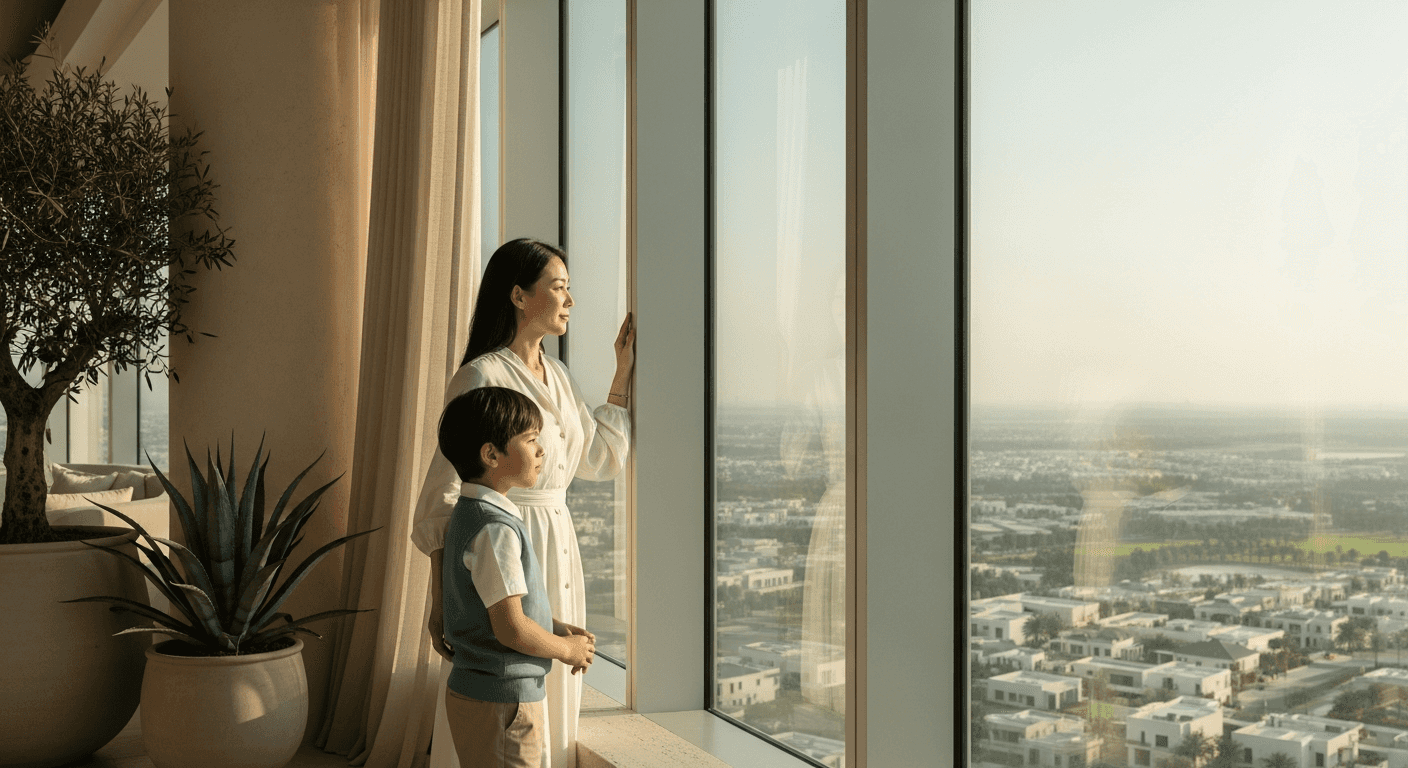
Dubai's Eco-Conscious Family Homes
As a communities correspondent, I've seen firsthand how Dubai's concept of luxury is evolving. This is my guide to finding a truly sustainable family home in a city that’s getting serious about going green.

For years, the image of a Dubai family home was a sprawling villa with a manicured lawn and the air conditioning on full blast. But as a communities correspondent for Gaia Living, I’ve watched a quiet and powerful shift take place. The new aspiration isn't just luxury — it's intelligent luxury. It’s about finding a home that is kinder to the planet, lighter on the wallet, and ultimately, offers a richer quality of life. This is my guide to navigating the world of eco-friendly villas Dubai has to offer, from the truly pioneering to the practically achievable.
Here’s what we will explore:
- What 'sustainable' truly means in a Dubai context, beyond the marketing jargon.
- A deep dive into the communities leading the charge, like The Sustainable City and Al Barari.
- The specific technologies and designs that make a villa genuinely green.
- A frank breakdown of the costs and long-term financial benefits.
- Practical steps for retrofitting an existing villa to be more sustainable.
- The key community sustainability features your family should look for.
- My final verdict on the future of this growing movement.
Redefining 'Green' in the Desert
Let’s start by addressing the elephant in the room: can a modern city in the middle of a desert truly be 'green'? It’s a fair question, and one I hear often. For a long time, 'green' in Dubai real estate simply meant having a lot of landscaped greenery — often water-intensive grass lawns that required constant irrigation. But that definition is now thankfully outdated. The conversation has matured, driven by both a government-led vision and a growing awareness among residents. The UAE’s Net Zero by 2050 Strategic Initiative is not just a policy document; it's a framework that is actively shaping the way we build and live. This has created a fertile ground for a more authentic and measurable approach to sustainability in our homes and communities.
So, what does genuine sustainability look like here? It’s a multi-layered concept that goes far beyond landscaping. It involves a holistic approach to resource management. We're talking about reducing energy consumption for cooling through intelligent design and materials, generating clean energy through rooftop solar, conserving and recycling precious water, managing waste effectively, and creating communities that are walkable and connected. Developers are no longer able to simply 'greenwash' their projects with vague claims of being eco-friendly. Buyers are more sophisticated, and the regulations are more stringent. The key is to look for proof, which often comes in the form of certifications and clearly defined standards.
The most important local framework is the 'Al Sa'fat' green building rating system, made mandatory by the Dubai Municipality. Every new building in Dubai must meet at least the 'Bronze' standard, which covers a range of criteria from energy and water efficiency to the use of sustainable materials and waste management. The levels go up to Silver, Gold, and Platinum, with each tier demanding a higher level of performance. When we at Gaia Living assess a new project, Al Sa'fat certification is one of the first things we look for. Internationally recognized standards like LEED (Leadership in Energy and Environmental Design) and BREEAM (Building Research Establishment Environmental Assessment Method) are also used for high-end or specialized projects, providing another layer of third-party verification. For a family looking for an environmentally conscious villa, asking about its Al Sa'fat rating is a crucial first step in separating the truly green from the merely green-painted.
Spotlight on Pioneer Green Communities
 Featured project
While regulations set a baseline, some communities have gone far beyond the minimum requirements, becoming global case studies in sustainable urban development. When clients ask me where to find the best green living villa lifestyle, a few key names always come to mind, each offering a different flavour of eco-conscious living. My personal favourite, and perhaps the most famous, is The Sustainable City. Developed by Diamond Developers, this community isn't just a collection of green homes; it's a living laboratory for a new model of urbanism. It operates on a 'net zero' energy basis, meaning it produces as much energy on-site from solar panels as it consumes. Every single villa and all the community parking structures are topped with solar panels, and the savings on DEWA bills are genuinely transformative for residents.
The community is built around a philosophy of three pillars: social, environmental, and economic sustainability. Environmentally, beyond the solar power, it features on-site water treatment and recycling for irrigation, a huge biodome with urban farms that supply residents with fresh produce, and a car-free central spine where children can play safely. Residents primarily use electric buggies to get around the residential cluster, drastically reducing noise and pollution. Socially, it fosters a powerful sense of community through shared spaces and activities. Economically, the low running costs make it a sound long-term investment. It's a radical concept, and living there requires a certain buy-in to the lifestyle, but for families committed to a deep green life, it is, in my opinion, the gold standard in Dubai.
On the other end of the spectrum is a community like Al Barari, which translates to 'the wilderness'. Its approach to sustainability is less about technology and more about biology and a deep connection to nature. While The Sustainable City is an engineer's masterpiece of efficiency, Al Barari is a botanist's dream. It's famous for having dedicated over 60% of its area to landscaped gardens, freshwater streams, and verdant public spaces. The density is incredibly low. Sceptics point to the amount of water required, but the developers have invested heavily in a sophisticated, sustainable irrigation system and have cultivated a microclimate that supports an astonishing level of biodiversity. It is one of the few places in Dubai where you can walk through a genuine forest. The villas themselves are designed for a smooth indoor-outdoor flow, with huge windows and natural materials, encouraging residents to engage with their surroundings. This focus on biophilia — the innate human tendency to connect with nature, has profound benefits for mental and physical well-being. For high-net-worth families seeking a sanctuary and a nature-infused upbringing for their children, Al Barari offers a unique and powerful interpretation of the green living villa lifestyle.
Between these two pioneers, you have the mainstream innovators like Emaar Properties at Dubai Hills Estate. This isn't a niche eco-community but a massive, master-planned city-within-a-city that has successfully woven sustainable principles into its very fabric. The sheer scale of Dubai Hills Park — an 18-hole championship golf course surrounded by 1.45 million square metres of parks and open spaces, acts as a 'green lung' for the entire area. The extensive network of cycling tracks and shaded walkways encourages an active, outdoor lifestyle. While the individual villas might not all have the radical features of The Sustainable City, the newer phases are built to high Al Sa'fat standards, ensuring good insulation and energy efficiency. For many families, Dubai Hills represents the sweet spot: a large, vibrant community with top-tier schools and amenities, that also offers a healthier, greener environment than older parts of the city. It demonstrates how sustainable design is no longer a niche but is becoming a standard feature of any new, premium development.
Inside the Eco-Friendly Villa: Technology & Design
Moving from the community to the home itself, what are the tangible features that make up an eco-friendly villa? It’s a combination of smart design, modern technology, and considered material choices, all working together to reduce the home's environmental footprint — and its running costs. The single biggest consumer of energy in any Dubai home is air conditioning. Therefore, the most impactful green features are those that reduce the 'cooling load'. This starts with the building envelope. Superior wall and roof insulation is non-negotiable. It prevents the brutal summer heat from penetrating the home, meaning the AC doesn't have to work as hard. Equally important is the glazing. High-performance, double-glazed windows with a low-emissivity (Low-E) coating can block a significant amount of solar heat gain while still allowing visible light to pass through. Walking into a villa with this technology, you can literally feel the difference; the ambient temperature is more stable, and the rooms feel more comfortable even before the AC is switched on.
Next is energy generation. The most visible and impactful technology here is rooftop solar. Thanks to the Dubai Electricity and Water Authority (DEWA)'s Shams Dubai initiative, homeowners can install solar photovoltaic (PV) systems on their roofs and connect them to the grid. Under a net metering system, any surplus electricity you generate is sent back to the DEWA grid, and you are credited for it against your consumption. On a sunny day, it's possible for your meter to literally spin backwards. This has been a game-changer. For a typical four or five-bedroom villa, a well-sized solar system can slash the electricity portion of your DEWA bill by 50% or more, which can amount to thousands of dirhams in savings each month during the summer peak. The initial investment is not insignificant, but the payback period has shortened dramatically in recent years, making it one of the smartest long-term investments a homeowner can make.
Water conservation is the other critical pillar. A sustainable home will feature low-flow taps, showerheads, and toilets that reduce water consumption without compromising performance. But the real innovation is in water recycling. Greywater recycling systems are becoming more common in high-end eco-friendly villas Dubai offers. These systems capture the relatively clean water from showers, baths, and washing machines, treat it on-site, and then reuse it for landscape irrigation. This drastically reduces the demand for precious desalinated water for watering gardens. Some advanced communities even have blackwater treatment plants that recycle all wastewater for non-potable uses. Coupled with smart irrigation systems that use moisture sensors and weather data to water plants only when necessary, these technologies can cut a villa's external water usage by more than half. It’s this kind of intelligent, closed-loop thinking that defines a truly sustainable home.
“The smartest homes in Dubai aren't the ones with the most tech; they're the ones that quietly reduce your bills and reconnect your family with the world outside your door.”
The Financials of Green Living: A Cost-Benefit Analysis
This all sounds wonderful, but what is the cost? It's the question every practical-minded buyer asks me. The honest answer is that there is typically an upfront premium for a home with superior green credentials. Based on our transactions at Gaia Living and my market observations, a new, certified green villa can cost anywhere from 5% to 15% more than a comparable conventional villa in the same area. This premium accounts for the higher cost of better insulation, high-performance windows, solar panels, water recycling systems, and the rigorous certification process itself. However, viewing this premium as just a 'cost' is a mistake. It is an investment, and one that pays dividends in multiple ways.
The most direct return is through lower running costs. The savings on your monthly DEWA bill are real, measurable, and significant. Let's create a simplified, illustrative breakdown for a hypothetical 5,000 sq. Ft. villa to demonstrate the point. This is not a guarantee, but a realistic model based on current market conditions.
Hypothetical Upfront Cost Comparison (5-Bed Villa)
| Item | Conventional Villa | Eco-Friendly Villa | |:--- |:--- |:--- | | Purchase Price | AED 7,000,000 | AED 7,900,000 (approx. +13%) | | DLD Transfer Fee (4%) | AED 280,000 | AED 316,000 | | Agency Fee (2% + VAT) | AED 147,000 | AED 165,900 | | Trustee Office Fee | AED 4,200 | AED 4,200 | | Total Upfront Investment | AED 7,431,200 | AED 8,386,100 |
Now, let's look at the running costs. The average DEWA bill is a combination of electricity, water, housing fees (5% of the average rent for the area), and a fuel surcharge. For this example, let's focus on the variable consumption part.
Hypothetical Annual DEWA Savings
- Conventional Villa: Average monthly DEWA (consumption part) might be AED 4,500 in summer and AED 2,000 in winter. Annual average ~AED 3,250/month. Annual Cost: AED 39,000.
- Eco-Friendly Villa (with solar & efficiency): Average monthly DEWA might be AED 2,200 in summer and AED 800 in winter. Annual average ~AED 1,500/month. Annual Cost: AED 18,000.
In this scenario, the annual saving is AED 21,000. The initial premium for the green features was roughly AED 900,000. Just looking at the DEWA savings, the simple payback period on that investment is long. However, this calculation is too simplistic. The real value comes from a combination of factors: the DEWA savings, potentially lower service charges if the community uses solar for common areas, and importantly, higher resale value. As energy and water costs inevitably rise over time, these savings will become even more significant. On top of that, we are seeing a clear trend where buyers are willing to pay a premium for homes with lower running costs and sustainable features. The 'green premium' you pay upfront is increasingly something you can expect to recoup, and then some, when it's time to sell.
The Retrofit Route: Greening Your Existing Dubai Villa
Of course, not everyone is in the market to buy a brand new villa. The good news is that you don't have to move to reap the benefits of a greener lifestyle. Retrofitting an existing property is an incredibly effective way to improve comfort, reduce bills, and increase your home's value. I've worked with many families who have transformed their older villas in communities like Arabian Ranches or The Meadows into models of efficiency. You can approach this in stages, depending on your budget and ambition. Here is a checklist of potential upgrades, from easy wins to major projects:
Eco-Retrofit Checklist for Your Villa:
- Phase 1: Quick & Easy Wins (Low Cost, High Impact)
- Switch to LED Lighting: Replace all old incandescent or CFL bulbs with LEDs. This can reduce lighting energy consumption by up to 80%.
- Install a Smart Thermostat: Devices like Nest or Ecobee learn your habits and optimize your AC usage, saving 10-15% on cooling costs.
- Install Water Aerators: These inexpensive devices screw onto your taps and showerheads and can reduce water flow by 30-50% without a noticeable difference in pressure.
- Apply Solar Reflective Film: A professionally installed film on your windows can reject a surprising amount of solar heat for a relatively low cost.
- Seal Air Leaks: Check for drafts around doors and windows and use weatherstripping to seal them. It's a small detail that makes a big difference.
- Phase 2: Medium-Term Investments
- Upgrade Your AC Units: If your AC units are over 10 years old, replacing them with new, high-efficiency models (look for a high EER or SEER rating) will pay for itself in energy savings.
- Improve Roof Insulation: Many older villas have inadequate roof insulation. Adding a layer of modern insulation is one of the most cost-effective ways to reduce heat gain.
- Plant Shading Trees: Strategically planting deciduous trees on the south and west sides of your villa can provide natural shade in the summer while letting in sun during the winter.
- Phase 3: Major Green Projects
- Install a Solar PV System: This is the biggest investment but offers the biggest reward. A typical 5-10 kWp system for a villa can cost between AED 40,000 and AED 80,000, with a payback period of 6-9 years at current DEWA rates.
- Replace Windows: Upgrading from old single-pane to modern double-glazed, low-E windows is expensive but will permanently improve your home's thermal performance and acoustics.
- Install a Greywater Recycling System: A more complex project, but one that can virtually eliminate the need for municipal water for your garden.
Starting with Phase 1 can make an immediate and noticeable difference to your bills and your home's comfort. Then, as and when your budget allows, you can progress to the more significant upgrades. Each step not only contributes to a more sustainable lifestyle but also adds demonstrable value to your property.
Community Sustainability Features to Look For
While an individual villa's features are important, a truly sustainable family community is more than the sum of its parts. The infrastructure and ethos of the entire neighborhood play a huge role in enabling a greener lifestyle. When you're exploring potential communities, I encourage you to look beyond the show villa and assess the wider environment. This is something I always focus on when advising families. What does the community *itself* do to promote sustainability? Here are some key features to look for and ask about:
- Effective Waste Management: Does the community offer a comprehensive recycling program with separate bins for paper, plastic, glass, and metal? Are there facilities for composting green waste? This simple service makes a huge difference to the amount of waste sent to landfill.
- Intelligent Water Management: Look for evidence of water conservation beyond individual homes. Do you see drought-resistant, native plants like Ghaf and Sidr trees in the landscaping, or is it all thirsty, imported grass? Ask if the community uses treated sewage effluent (TSE) or recycled greywater for irrigating common areas.
- Walkability and Connectivity: Can you walk to a local shop, a park, or a cafe comfortably? Are there shaded footpaths and dedicated cycle lanes that are safe for children? A well-designed community reduces dependency on cars for every small trip.
- Proximity to Essentials: Consider the community's location relative to your children's school and your workplace. A shorter commute is not just a lifestyle benefit; it's a significant environmental one, reducing your family's daily carbon footprint.
- Shared Mobility: Some forward-thinking communities are incorporating shared resources like a fleet of electric buggies (like in The Sustainable City), community e-bikes, or dedicated EV charging stations in visitor parking areas.
- Promotion of Biodiversity: Does the community feel like a concrete island, or does it actively encourage nature? Look for green corridors, lakes that attract birdlife, and landscaping that supports local insects and pollinators.
When a developer gets these community sustainability features right, the result is a neighborhood that is not only more environmentally friendly but also healthier, safer, and more socially connected for the families who live there.
My Verdict: The Future of Family Living in Dubai
After years of walking through Dubai's many villa communities, from the established to the brand new, I can say with confidence that the shift towards sustainability is real and accelerating. It's no longer a niche concern for a handful of enthusiasts; it's a mainstream demand from a generation of homebuyers who are more informed and conscientious than ever before. They understand that a home's value is not just measured in square feet, but in its long-term running costs, its impact on the planet, and the quality of life it offers their family.
The most successful sustainable family communities are those that grasp this holistic vision. They combine verifiable, data-driven efficiency in the homes with a community-wide design that fosters well-being and connection. They deliver not only financial savings through lower bills but also the priceless benefit of a healthier environment for children to grow up in — with cleaner air, more green space, and a stronger sense of belonging.
Is there an upfront cost? Yes. Does it require a shift in mindset? Absolutely. But in my professional opinion, the investment is unequivocally worth it. The demand for well-designed, environmentally conscious villas is only going to grow, underpinning their long-term value. This is not a fleeting trend; it is the new benchmark for premium family living in Dubai.
For families looking for a home in Dubai, seeking out sustainable features is no longer just an ethical choice, but a financially savvy one. The combination of lower monthly bills, a healthier living environment, and stronger long-term asset value makes a compelling case. The future of luxury living is not about excess, but about intelligent, sustainable design that enhances both your life and the world around you.
Sources
- UAE Net Zero by 2050 Strategic Initiative - UAE Government Portal
- Al Sa'fat Dubai Green Building Evaluation System - Dubai Land Department
- Shams Dubai Net Metering - Dubai Electricity and Water Authority (DEWA)
Questions, answered
- What are the most genuinely sustainable villa communities in Dubai?
- The Sustainable City is a global benchmark for its closed-loop system with solar panels on every home and urban farming. Al Barari focuses on incredible biodiversity and water conservation through landscaping, while communities like Dubai Hills Estate integrate large green spaces and sustainability standards at scale.
- How much more do eco-friendly villas in Dubai cost?
- You can expect a price premium of 5-15% for a villa with certified green credentials and advanced features. However, this upfront cost is often offset over time by significant savings on your DEWA bills, sometimes by as much as 50%.
- Can I make my current Dubai villa more eco-friendly?
- Yes, absolutely. Retrofitting is a great option. Simple changes include switching to LED lights and a smart thermostat, while larger projects like installing DEWA-approved solar panels or upgrading your windows can have a major impact on your energy consumption.
- What is 'Al Sa'fat' certification in Dubai?
- Al Sa'fat is Dubai Municipality's green building rating system, mandatory for all new constructions. It has Bronze, Silver, Gold, and Platinum levels, ensuring new buildings meet specific standards for energy efficiency, water use, and sustainable materials.
- How much can I really save on my DEWA bill with a sustainable villa?
- Savings vary, but it's not uncommon for a highly efficient villa with solar panels to see a 40-50% reduction in electricity and water bills compared to a conventional home of the same size. In summer, this can translate to thousands of dirhams saved each month.
- Are sustainable communities better for families?
- In my experience, yes. Beyond bill savings, these communities often prioritize walkability, parks, and community activities like gardening. This creates a safer, healthier, and more connected environment for children to grow up in.

Sophia profiles Dubai's villa communities — schools, commute times, green space, and the intangible feel of a neighbourhood. She writes for families putting down roots.
Related stories
Dubai's Established Charm: The Case for Older Homes
In a city focused on the future, I believe the smartest move for many buyers is to look back. Dubai's seasoned communities offer space, character, and surprising value that new builds often can't match.
The True Cost of Owning a Dubai Property
Beyond the purchase price, your annual budget for a Dubai home must account for service charges, utilities, and maintenance. I'll break down every ongoing expense you need to plan for.
Calculating ROI on Dubai Rental Upgrades
As a landlord in Dubai, you can't just follow trends. I'll show you how to calculate the precise ROI of minor property upgrades to genuinely increase your rental yield.
Echoes, in your inbox
One thoughtful email a month. Market insight, new launches, no spam.