

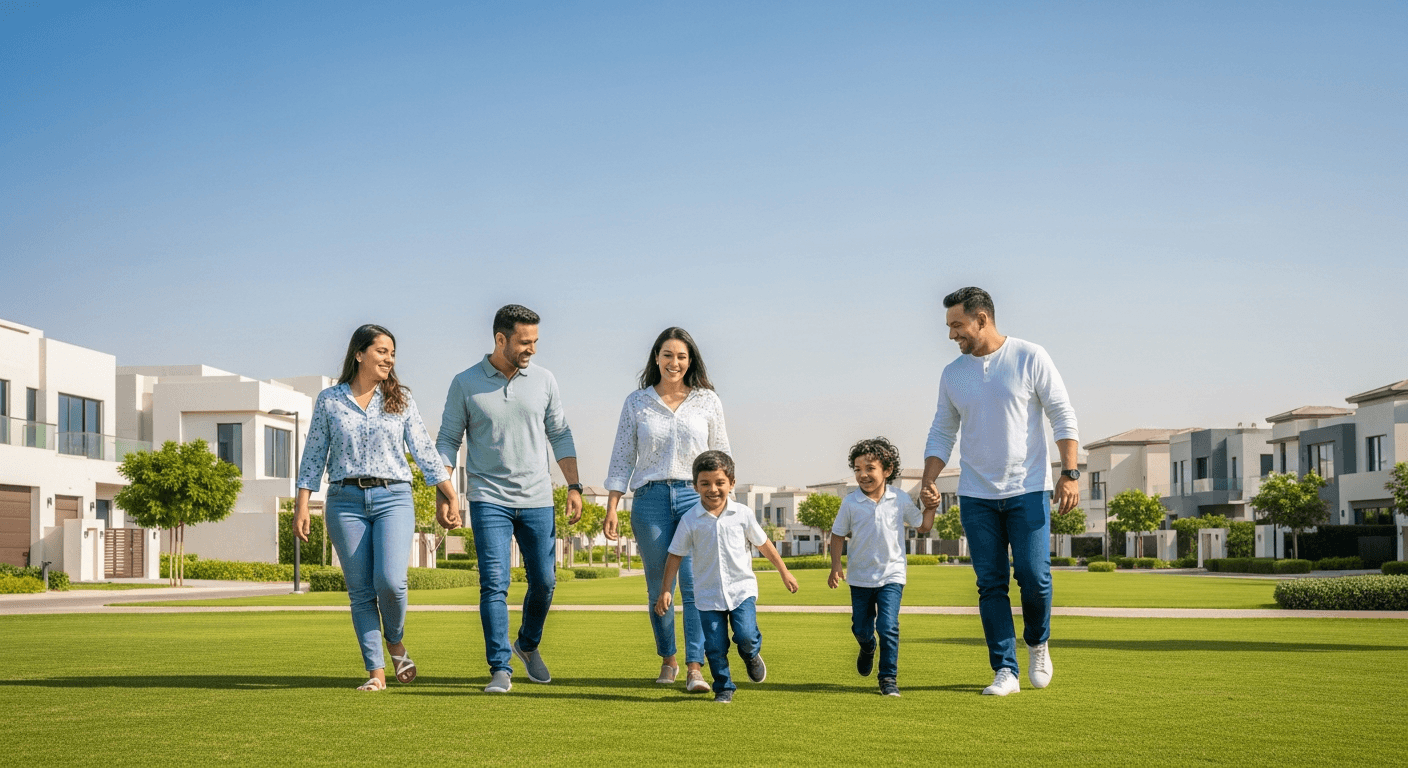
Dubai's Desert Edge: The New Family Dream
For families in Dubai, the new definition of luxury isn't a downtown penthouse, but a spacious villa where the city gives way to the serene beauty of the desert. I explore the allure of these nature-rich communities.

For years, the story of Dubai was one of vertical ambition, of skyline-defining towers in Downtown Dubai and waterfront living in Dubai Marina. But a significant shift has been taking place, a quiet migration outwards. Families are increasingly trading the urban hustle for a different kind of life, one defined by space, community, and a direct connection to the landscape. They are seeking out Dubai’s desert-edge villa communities, and finding a quality of life they thought was out of reach.
Here's what we'll explore in this guide:
- The fundamental shift driving families towards Dubai's suburban fringe.
- The key characteristics that define a 'desert-edge' community.
- A detailed look at the leading communities, from pioneers like Arabian Ranches to modern marvels like Dubai Hills.
- The rise of sustainability and how eco-friendly features are becoming standard.
- The lifestyle on offer, packed with outdoor activities and a strong community spirit.
- A practical, line-by-line breakdown of the real costs of buying and living here.
- The trade-offs involved and who this lifestyle is truly suited for.
- The future trajectory for these rapidly maturing suburbs.
The Great Re-Evaluation: Why Families Are Moving to the Fringes
I’ve been working with families in Dubai’s property market for over a decade, and I’ve never witnessed a collective re-evaluation of priorities quite like the one we've seen in recent years. The global pandemic was a catalyst, forcing everyone to spend more time at home and fundamentally reconsider what 'home' should provide. The apartment with a great view suddenly felt restrictive. The lack of a private garden became a daily frustration. For families with children, the need for safe, open spaces to play became paramount. This wasn't just a fleeting trend; it was a deep, lasting change in the psychology of the Dubai homebuyer.
This shift has directly fuelled the demand for desert edge villa communities Dubai. These areas, once considered remote, are now seen as destinations. The primary driver is space — not just the internal square footage of a home, but the space between homes, the green expanses of parks, and the psychological breathing room that comes from seeing an open horizon instead of another tower. A client of mine recently sold their three-bedroom apartment in JBR to buy a four-bedroom townhouse in Town Square. They told me the decision wasn't financial; it was for their children’s well-being. They wanted their kids to be able to ride their bikes on the street, meet friends in the park, and have a backyard for a trampoline. That, to them, was the new luxury.
At Gaia Living, we see this story play out daily. The conversation has moved from “how close can I be to the action?” to “how much life can I fit into my home and my community?” It’s a move from prioritizing consumption and convenience to prioritizing connection — to family, to neighbours, and to nature. The appeal isn't just about escaping the density of the city core. It's about running towards a lifestyle that feels more balanced, healthier, and more aligned with long-term family aspirations. These communities offer a promise of rootedness in a city often perceived as transient, and for many, that promise is proving irresistible.
Defining the Desert Edge: What Makes These Communities Unique?
 Featured project
It’s easy to think of 'desert-edge' as just a geographical descriptor, but in Dubai's real estate context, it represents a specific and deliberate master-planning philosophy. These are not simply collections of houses built on the sand. They are holistic ecosystems designed to integrate with, rather than dominate, the surrounding landscape. What truly sets them apart is an intentional focus on low-density living and abundant greenery. Where urban developers measure success in floor-area ratio, the architects of these communities measure it in acres of parkland and kilometres of jogging tracks.
Architecturally, these communities offer a diverse palette, but the common thread is a design that complements the environment. You’ll find everything from the classic, earthy tones of Arabian and Mediterranean styles in the original Arabian Ranches to the clean, minimalist lines of the contemporary villas in Tilal Al Ghaf or the newer phases of Dubai Hills Estate. The design language speaks to a more relaxed way of life. Large windows and glass sliding doors don’t just open onto private gardens; they frame views of meticulously landscaped green corridors, community lakes, or the starkly beautiful dunes beyond. This is the core appeal of nature villas Dubai family living: the lines between indoor and outdoor living are intentionally blurred.
Beyond aesthetics, the uniqueness lies in the very layout of the land. The road networks are designed to calm traffic, with cul-de-sacs and gentle curves creating safer streets for children and pedestrians. The amenities are not an afterthought but the heart of the community — central parks, swimming pools strategically placed in each sub-community, and retail centres with cafes and grocery stores that residents can often walk or cycle to. This is a stark contrast to the vertical model of living, where amenities might be confined to a podium level and the 'community' is the elevator lobby. Here, the community is the entire neighbourhood, and the master plan is the blueprint for social interaction.
A Tour of Dubai's Premier Desert-Edge Communities
When clients ask me where to start their search for a family villa, I always begin with a tour of the archetypes. Each of the major desert-edge communities has its own distinct personality and caters to a slightly different vision of family life. Understanding these nuances is key to finding the right fit.
Arabian Ranches by Emaar: This is the original, the blueprint for all that followed. Launched by Emaar Properties in 2004, Arabian Ranches pioneered the concept of a fully integrated, gated villa community in Dubai. It’s now a sprawling, mature development with a palpable sense of established community. We often divide it into Ranches I, II, and III. Ranches I has a timeless charm with its sandy-hued villas, lush landscaping that has had two decades to grow, and the prestigious Arabian Ranches Golf Club at its heart. It feels settled and deeply rooted. Ranches II is its slightly more modern sibling, with larger, more contemporary homes. Ranches III is the newest chapter, offering townhouses and villas with a focus on modern family amenities like a lazy river and a central park. For many, the appeal of the Ranches is its reputation, excellent schools like Jumeirah English Speaking School (JESS), and a community centre that genuinely feels like a village square. Prices here reflect its premium status, with three-bedroom townhouses in Ranches III starting around AED 2.5 million, while larger villas in Ranches I can easily command upwards of AED 6 to 10 million.
DAMAC Hills and DAMAC Hills 2: If the Ranches is old-world charm, the communities by Damac represent a bolder, more amenity-driven approach. Damac Hills and Damac Hills II are vast developments along Al Qudra Road. DAMAC Hills (the original) is anchored by the Trump International Golf Club Dubai. The properties here range from apartments to sprawling mansions, many offering direct golf course views. It has a polished, resort-like feel. DAMAC Hills 2, further down the road, takes the amenity concept even further. It's famously themed into 'clusters' like a Water Town, Sports Town, and Equestrian Town. This is a community that wears its lifestyle proposition on its sleeve. While some might find the theming a bit overt, for families with active children, the sheer volume of things to do — from the wave pool and fishing lake to the paintball park, is a massive draw. DAMAC has often been aggressive on price, making it a relatively more accessible entry point for larger villas, though you are trading proximity for these features.
Dubai Hills Estate by Emaar: In my view, Dubai Hills is the perfect hybrid. It masterfully blends the lush, green, and spacious feel of a desert-edge community with a more central location. It’s a vast ‘city within a city,’ co-developed by Emaar and Meraas, wrapping around the magnificent Dubai Hills Golf Club. The community offers everything from low-rise apartments to some of Dubai's most exclusive ultra-luxury villas in areas like Hills Grove. What I love about Dubai Hills is the balance. You have the 1.8 million square metre Dubai Hills Park, endless cycling tracks, and a sense of suburban tranquility, yet you're only a 15-minute drive from Downtown. It also offers the superb Dubai Hills Mall, King's College Hospital, and top-tier schools within the community itself. This convenience, combined with its beautiful design, makes it arguably the most sought-after family community in Dubai today. A three-bedroom townhouse might start near AED 4 million, with five-bedroom villas quickly rising to AED 10 million and beyond.
The 'Eco' Factor: Sustainability and Green Living
More than ever, the families I speak with are conscious of their environmental footprint. The desire for a connection with nature extends to a desire to protect it. This has made sustainability a key selling point, moving from a niche interest to a mainstream requirement. Developers have responded, and the concepts of sustainable city living Dubai and eco-friendly villas Dubai are now central to the marketing of new projects. While no community is perfect, the progress in this area is significant and adds another layer of appeal to living on the fringe.
The benchmark for this movement is, of course, The Sustainable City. Located near Arabian Ranches on Al Qudra Road, it’s a living laboratory for green urbanism. Every home is fitted with rooftop solar panels, resulting in dramatically lower electricity bills. The community features urban farms in biodomes where residents can get fresh produce, a 'no cars' policy in the residential clusters (people use electric buggies), and a sophisticated water recycling system for irrigation. It’s a radical and inspiring model that has proven the concept can work at scale in Dubai's climate. While it remains a unique project, its success has had a ripple effect across the entire industry.
Newer communities are now integrating many of these principles as standard. For example, in the latest phases of projects from major developers like Emaar Properties and Arada, you'll find a strong emphasis on passive design. This means orienting villas to minimize sun exposure, using high-performance glass, and installing better insulation to reduce the reliance on air conditioning. LED lighting is now ubiquitous. Solar panels are increasingly offered as an option for water heating, if not for full power generation. Landscaping has also become smarter, with a move towards native, drought-resistant plants like Ghaf trees and desert grasses, which require far less water than traditional lawns. These features not only contribute to a healthier planet but also offer a direct financial benefit to residents through lower DEWA bills.
“The conversation has shifted. 'Value for money' no longer just means the price per square foot; it now includes lower running costs and a healthier, more sustainable lifestyle for your family.”
This focus on sustainability resonates deeply with the ethos of desert-edge living. It's a holistic approach. Choosing to live in a community that respects its natural surroundings feels more authentic and responsible. It's about building a home that is not just in nature, but in harmony with it. As building codes become stricter and buyer awareness grows, I expect these eco-friendly features to become a non-negotiable standard for all new villa developments in Dubai.
The Lifestyle: Outdoor Activities and Community Life
When you buy a home in one of these communities, you’re investing in a lifestyle as much as in bricks and mortar. The promise of abundant outdoor activities Dubai communities offer is a primary reason families make the move, and in my experience, the reality lives up to the brochure. The daily rhythm of life here is simply different from that in the city’s more vertical neighbourhoods. It's a life lived more outdoors, more actively, and more connected to your neighbours.
Weekends, in particular, take on a new character. Instead of planning an excursion to a mall or a public park, your amenities are on your doorstep. Mornings might start with a family cycle along the dedicated tracks that weave through the community. For the more serious cyclists, the proximity of areas like DAMAC Hills and Arabian Ranches to the famous Al Qudra Cycle Track is a huge bonus. Afternoons are often spent at the community pool, which becomes a social hub for both children and parents. Evenings bring residents out for walks, with parks and playgrounds buzzing with activity until well after sunset. This is what I hear most from residents: a feeling of reclaiming their leisure time.
Community life is actively fostered by the developers and residents' associations. The calendar is dotted with events that bring people together. You'll find everything from outdoor movie nights in the park and festive markets during holidays to community-wide garage sales and fitness challenges. These organized events are the scaffolding upon which a genuine social fabric is built. Neighbours get to know each other not just by nodding in a hallway but by participating in shared activities. This creates an old-fashioned sense of neighbourhood watchfulness and camaraderie, which is incredibly reassuring for parents. Children form friendships that extend from the school bus to the skate park, fostering a sense of belonging and freedom that is hard to replicate in a high-rise.
Here’s a glimpse of the kind of amenities that are now considered standard in these master communities:
- Extensive Park Systems: Not just a single park, but a network of green spaces, from small pocket parks to large central commons.
- Sports Facilities: Tennis courts, basketball courts, football pitches, and state-of-the-art gymnasiums.
- Swimming Pools: Multiple pools, often including a main resort-style pool and smaller, quieter pools for each sub-community.
- Tracks and Trails: Dedicated, safe pathways for jogging, walking, and cycling, often stretching for several kilometres.
- Retail and Dining: A community centre with a supermarket, clinic, pharmacy, and a selection of casual cafes and restaurants.
- For Kids: Modern playgrounds, skate parks, and often unique features like splash pads or climbing walls.
This infrastructure is the hardware for a better quality of life. It encourages an active, healthy lifestyle and provides the setting for a vibrant community to flourish.
The Practicalities: Cost of Living on the Edge
While the lifestyle is aspirational, the decision to buy must be grounded in financial reality. Moving to a desert-edge villa community involves a different cost structure than buying an apartment downtown. It’s crucial for my clients to understand the full picture, from the initial purchase costs to the long-term running expenses. Let's break it down with a realistic example.
Imagine you're an expatriate family looking to buy your first home in Dubai: a four-bedroom villa in a community like Arabian Ranches III or DAMAC Hills, with a purchase price of AED 4,000,000. Here are the typical upfront costs you would need to budget for, on top of the property price itself:
- Purchase Price: AED 4,000,000
- Down Payment (20% for first property under AED 5M): AED 800,000. As per Central Bank of the UAE mortgage regulations for expats.
- Dubai Land Department (DLD) Transfer Fee (4%): AED 160,000. This is the largest ancillary cost, mandated by the Dubai Land Department.
- DLD Administrative Fees: Approximately AED 4,200 (this is a fixed fee including VAT).
- Property Registration Fee: AED 4,000 (+ 5% VAT) for properties over AED 500,000.
- Real Estate Agency Fee (2% + 5% VAT): AED 80,000 + AED 4,000 VAT = AED 84,000.
- Mortgage Registration Fee (0.25% of loan value): If your loan is AED 3,200,000, this would be AED 8,000.
- Bank Mortgage Arrangement Fee (up to 1% + VAT): Can often be negotiated, but budget up to AED 32,000 + VAT.
In this scenario, your total immediate cash outlay would be around AED 1,092,200 (Down Payment + DLD Fees + Agency Fees, etc.). This is a substantial figure and underscores the importance of being fully prepared financially before starting your property search. Our team at Gaia Living always provides clients with a detailed cost sheet like this to ensure there are no surprises. You can also explore our buyer & investor guides for more detailed information.
Beyond the purchase, you have the annual running costs. The most significant of these are the service charges. These fees are paid to the community management company to cover the maintenance of all common areas: security, landscaping, pools, parks, street lighting, and waste management. In most desert-edge villa communities, you can expect service charges to range from AED 3 to AED 6 per square foot of your property's built-up area (BUA) per year. So, for a 3,500 sq. Ft. villa, you could be looking at an annual bill of AED 10,500 to AED 21,000. While this may seem high, it's what pays for the pristine environment and extensive amenities that define the lifestyle. You must also budget for DEWA (electricity and water), which will naturally be higher for a larger villa with a garden than for an apartment, and home insurance. The trade-off for more space is higher consumption and maintenance responsibility.
The Trade-Offs: Is Desert-Edge Living Right for You?
As much as I am a champion of these communities, my role is to provide balanced advice. This lifestyle, idyllic as it sounds, is not for everyone. It involves clear trade-offs, and being honest about them is the first step in making a successful move. The primary consideration is almost always the commute. While Dubai's road network is excellent, living in areas like Dubailand or Dubai South means you are, by definition, further from the core business and entertainment hubs like Business Bay or the DIFC. For a family where both partners work in different parts of the city, this can mean a significant amount of time spent in the car each day.
This leads to the second major trade-off: car dependency. While communities are becoming more walkable internally, you absolutely need a car — and likely two for a family, to function effectively. Trips to other parts of the city, major shopping malls (outside of your community's own), or specialized appointments all require driving. This is a significant lifestyle and budget adjustment for those accustomed to the pedestrian and public transport-friendly environments of Marina or Downtown. Spontaneity changes; you can't just step out of your building and be in the heart of a bustling dining district.
To help you weigh the decision, here’s a straightforward summary of the pros and cons I discuss with my clients:
Pros: - More Space for Your Money: Larger homes, private gardens, and bigger plots compared to central Dubai. - Family-Centric Lifestyle: An environment designed around children's safety, freedom, and activity. - Strong Community Feel: A sense of neighbourhood and belonging fostered by shared amenities and events. - Connection to Nature: Direct access to parks, green spaces, and a quieter, healthier environment. - Excellent Amenities: Resort-style facilities like pools, gyms, and sports courts on your doorstep.
Cons: - Longer Commute Times: Potentially significant daily travel to work and other key areas. - Car Dependency: Owning at least one car is non-negotiable, and often two are needed. - Less Urban Spontaneity: Fewer walk-to options for high-end dining, entertainment, and cultural venues. - Ongoing Development: Newer communities can experience construction noise and disruption as they build out. - Higher Running Costs: Larger homes and gardens mean higher utility bills and maintenance responsibilities.
My verdict is that desert-edge living is a deliberate lifestyle choice. It’s for families who have reached a stage where a private garden is more valuable than a walk to a nightclub, and where the sound of children playing in a park is more desirable than the buzz of the city. It’s for those who are willing to trade a bit of convenience for a lot more well-being.
The Future of the Fringe: What's Next for These Communities?
The move towards the desert edge is not a temporary trend; it’s a core component of Dubai's long-term vision. The Dubai 2040 Urban Master Plan explicitly calls for developing vibrant, healthy communities, with a focus on increasing green spaces and ensuring that a high percentage of the population lives near parks and recreational areas. The growth of the suburban fringe is in perfect alignment with this government-led strategy, which gives buyers and investors confidence in the long-term sustainability and appreciation of these areas.
We are already seeing the next evolution of this model in the pipeline. Developers are learning from past successes and refining their offerings. The latest off-plan launches show a clear trend towards even greater integration of lifestyle amenities and sustainable technology. There's a stronger focus on creating '20-minute communities,' where residents can access most of their daily needs — shops, schools, clinics, and recreation, within a short walk or bike ride from their homes. This addresses one of the key historical drawbacks of suburban living and makes the lifestyle even more compelling.
Infrastructure is also racing to catch up with the population growth. New access roads are being built, and existing ones like Sheikh Mohammed Bin Zayed Road and Emirates Road are being expanded to improve traffic flow. We're seeing more schools, hospitals, and large-scale retail destinations opening to serve these maturing communities. The eventual extension of the Dubai Metro and other public transport networks will be the final piece of the puzzle, fully connecting the fringe to the urban core. What feels like 'the edge' today will, in five to ten years, feel like a fully established and integrated part of the city. For families buying now, this trajectory represents not just a great lifestyle but also a sound investment in Dubai’s future.
The migration to Dubai's desert-edge communities represents a fundamental shift in values, where the new luxury is defined by space, nature, and a strong sense of community. For families willing to embrace the trade-offs, these neighbourhoods offer an unparalleled quality of life that is becoming the new benchmark for family living in the emirate.
Choosing a community is one of the most important decisions a family can make. It's about finding a place where your life can flourish. If the vision of a home connected to nature resonates with you, I encourage you to explore these incredible communities for yourself. At Gaia Living, we have specialists on the ground in every one of these areas, and we'd be delighted to help you find your perfect fit. You can start by browsing our curated list of properties for sale.
## Sources - Dubai Land Department (DLD): https://dubailand.gov.ae/ - Central Bank of the UAE: https://www.centralbank.ae/ - UAE Government Portal: https://u.ae/
Questions, answered
- What are desert-edge communities in Dubai?
- Desert-edge communities are master-planned residential developments located on the outskirts of Dubai's urban core, bordering the natural desert landscape. They prioritize spacious villas, townhouses, green spaces, and outdoor amenities, offering a lifestyle that's more connected to nature.
- Are desert-edge communities a good choice for families?
- In my experience, they are an excellent choice. These communities are designed with families in mind, offering larger homes, private gardens, safe environments for children, top-tier schools, and a wide array of parks and recreational facilities.
- What are the most popular desert-edge villa communities in Dubai?
- Some of the most sought-after communities include Arabian Ranches (I, II, and III), Dubai Hills Estate, Damac Hills and Damac Hills II, and Town Square. Each offers a slightly different lifestyle and price point.
- Is living on the edge of Dubai expensive?
- While property prices can be more accessible per square foot compared to central areas, you must factor in other costs. These include higher service charges for extensive amenities, potential reliance on two cars for a family, and commute times. However, many families find the value for money in terms of space and lifestyle is well worth it.
- How sustainable are these new villa communities?
- Sustainability is a growing focus. While The Sustainable City is a benchmark, many new eco-friendly villas in Dubai incorporate features like superior insulation, solar water heaters, and water-wise landscaping to reduce utility consumption. Developers are increasingly aligning with Dubai's green initiatives.

Sophia profiles Dubai's villa communities — schools, commute times, green space, and the intangible feel of a neighbourhood. She writes for families putting down roots.
Related stories
Dubai's Established Charm: The Case for Older Homes
In a city focused on the future, I believe the smartest move for many buyers is to look back. Dubai's seasoned communities offer space, character, and surprising value that new builds often can't match.
The True Cost of Owning a Dubai Property
Beyond the purchase price, your annual budget for a Dubai home must account for service charges, utilities, and maintenance. I'll break down every ongoing expense you need to plan for.
Calculating ROI on Dubai Rental Upgrades
As a landlord in Dubai, you can't just follow trends. I'll show you how to calculate the precise ROI of minor property upgrades to genuinely increase your rental yield.
Echoes, in your inbox
One thoughtful email a month. Market insight, new launches, no spam.