

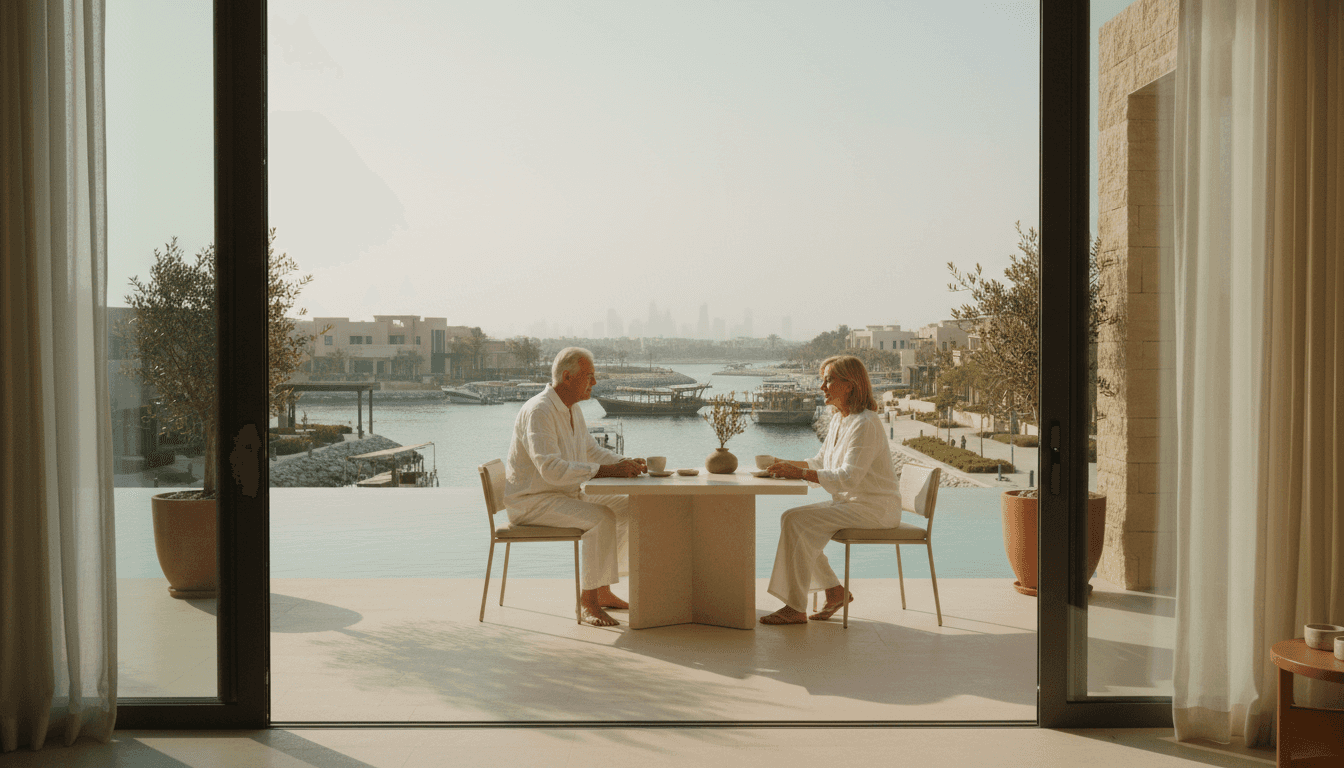
Dubai's Best Villas for Babies & Toddlers
I explore the Dubai villa communities best suited for families with young children, focusing on safety, amenities, and practical layouts that make life with little ones easier.

Bringing a new baby home is a profound shift. Suddenly, your two-bedroom apartment with the great city view feels less like a home and more like an obstacle course. This is the moment I see many of our clients at Gaia Living begin their search for one of the classic Dubai villas for young families, a home with a garden, more space, and a community built with little ones in mind.
Here’s what we'll explore in this guide:
- The essential checklist for a baby- and toddler-friendly villa.
- A deep dive into my top community picks: Arabian Ranches, DAMAC Hills, and Sobha Hartland II.
- The crucial role of nurseries and healthcare facilities in your decision.
- A realistic look at the costs involved, from purchase price to running costs.
- The lifestyle trade-offs you make when moving to a suburban villa community.
- My final verdict on which community offers the best all-round package for a young family.
The Toddler-Friendly Villa Checklist
When you start your property search with a baby or toddler, your priorities change entirely. The sleek, minimalist villa that appealed to your pre-parent self now looks like a collection of sharp corners and open staircases. As a communities specialist, I've walked through hundreds of homes with young parents, and I've developed a practical checklist of non-negotiables. It’s not just about the number of bedrooms; it’s about the flow of daily life. For me, the single most important feature is a ground-floor room that can serve as a playroom or a nanny's room. This creates a safe, contained space for toys and play, keeping the main living areas clearer and meaning you aren’t constantly running up and down stairs.
Layout is king. Open-plan living spaces are a huge advantage, allowing you to keep an eye on a crawling baby or roaming toddler while you’re in the kitchen. I also advise clients to look for villas with a direct line of sight from the main living area to the garden. You want to be able to see them the moment they wander outside. Speaking of the garden, its size is less important than its potential for security. Can it be easily and fully fenced? Is there a good mix of patio for ride-on toys and grass for soft landings? A villa backing directly onto a park is a dream, but one backing onto a busy road is a definite drawback, even with a high wall. Consider the noise and the simple peace of mind that comes with being set deeper within the community.
Beyond the four walls of the villa, the immediate vicinity is just as critical. I always walk the street with my clients. Is the villa on a quiet cul-de-sac or a busy thoroughfare connecting different parts of the community? A quiet street is a godsend for naps and for those first tentative bike rides. How far is the nearest park? A five-minute walk is ideal; anything over ten minutes in the Dubai heat means you'll end up driving, which defeats the purpose. These small details of daily logistics are what separate a good community from a great one. These are the details that define the best toddler-friendly communities in Dubai.
Finally, a practical but often overlooked point: storage. The amount of equipment that comes with a small child is astonishing. Prams, car seats, travel cots, and a mountain of toys all need a home. Villas with generous built-in storage, a proper garage (not just a car port), and a separate laundry/utility room are infinitely more practical. Many older villas in Dubai offer more spacious layouts and better storage than some of the newer, more compact designs. It's a trade-off between modern finishes and practical living space, and for a young family, I believe practicality should always win.
The Classic Choice: Arabian Ranches
 Featured project
When people think of family villa living in Dubai, they often think of Arabian Ranches. Developed by Emaar Properties, it set the benchmark for master-planned suburban communities and remains, in my opinion, one of the very best choices for families with young children. Its enduring appeal lies in its maturity. The landscaping is lush and established, providing beautiful green vistas and, crucially, shade. The community feels settled, with a genuine neighbourhood spirit that can be harder to find in newer developments. It’s a place where you see children playing in the street and neighbours stopping to chat — a rare and valuable quality.
The community is divided into several sub-communities, each with its own character. For families with toddlers, I particularly like Saheel and Alvorada. The villas here often have larger plots than in some of the newer phases, offering generous private gardens. More importantly, the layout of these sub-communities is fantastic, with numerous small parks and swimming pools dotted throughout. You are never more than a few minutes' walk from a safe, enclosed play area. The main Arabian Ranches Community Centre is a hub of activity, with a Mediclinic, a Carrefour supermarket, and numerous cafes and restaurants. There’s also the excellent Jumeirah English Speaking School (JESS), one of Dubai’s top schools, right on the doorstep, which makes it a long-term choice for many families.
Of course, this established quality comes at a price. Arabian Ranches is a premium community. A standard three-bedroom villa (Type 3M or 3E) will typically cost between AED 3.5 million and AED 5 million to purchase, with annual rents starting around AED 220,000. Service charges are also a consideration, though they are reasonable for the quality of the amenities. Calculated on the plot area, they generally fall in the range of AED 2.50 to AED 3.50 per square foot per year. For a villa on a 6,000 sqft plot, this would equate to AED 15,000 to AED 21,000 annually. It’s an investment, but the lifestyle, convenience, and strong community feel provide a compelling return for many young families looking for a safe family neighbourhood in Dubai.
The Modern Contender: DAMAC Hills
If Arabian Ranches is the established classic, then DAMAC Hills and DAMAC Hills II represent the new generation of family-centric communities. Located further out along Al Qudra Road, what you trade in commute time, you gain in modern amenities and, often, value for money. My first impression of DAMAC Hills was the sheer scale of its ambition. The community is vast and anchored by the Trump International Golf Club Dubai, but the real draw for families is the incredible array of recreational facilities. The Park at DAMAC Hills is a particular highlight, with its skate park, horse stables, fishing lake, and petting farm. It feels less like a residential park and more like a destination in its own right.
For families with toddlers, the sheer number of playgrounds and pools is a massive plus. The community is designed so that these facilities are always close at hand. The villas themselves are more contemporary in design than those in Arabian Ranches, with clean lines and large windows. While the plots are generally smaller, the homes are well-designed with the open-plan layouts that modern families prefer. One of the key advantages of DAMAC Hills is the variety of properties available, from smaller three-bedroom townhouses to sprawling six-bedroom villas, catering to a wider range of budgets.
Price-wise, DAMAC Hills offers a more accessible entry point into the villa market. A three-bedroom townhouse or villa can be found starting from around AED 2.8 million, with rentals from approximately AED 180,000 per year. This value proposition has attracted a vibrant, young, and very international community. The Jebel Ali School, a highly-regarded British curriculum school, has its campus here, and there are several nurseries within the community. The main drawback has historically been its distance from the city's main business hubs like Downtown Dubai or Dubai Marina. However, as road networks improve and more retail and dining options open within the community itself — like the DAMAC Mall, it is becoming increasingly self-sufficient. For families who don't need to commute to the city centre daily, it presents a very compelling lifestyle package.
The Luxury Newcomer: Sobha Hartland II
For those seeking a more premium, centrally located option, Sobha Hartland and Sobha Hartland II have quickly become one of my top recommendations. Situated in Mohammed Bin Rashid City, just a stone's throw from Downtown Dubai, it combines the convenience of city living with the space and tranquillity of a villa community. The developer, Sobha Realty, is renowned for its exceptional build quality, and you can feel it the moment you enter one of their homes. The attention to detail, from the fittings to the finishes, is superb. This is a crucial factor for peace of mind when buying a new home.
The master plan for Sobha Hartland II is particularly impressive from a family perspective. A huge portion of the community is dedicated to green space, including two blue lagoons for swimming and kayaking. The idea is to create a resort-like atmosphere. For parents of toddlers, this means wide open, car-free green areas for children to run around in safely. The community is also planned to have two international schools on-site, making the school run a walk in the park rather than a battle with traffic. This forward-planning for educational needs is a huge plus and something I always highlight to clients.
These are high-end properties, and the pricing reflects that. Villas in Sobha Hartland II are aimed at the luxury end of the market, with five and six-bedroom homes being the standard. Prices for these off-plan villas typically start north of AED 10 million. While this positions it in a different bracket to Arabian Ranches or DAMAC Hills, for those with the budget, it offers an unparalleled combination of location, quality, and family-focused amenities. It represents a new standard for luxury family living in Dubai, proving that you don't have to move to the suburbs to find space and greenery. It’s one of the most exciting new [Dubai villas for young families] I’ve seen in recent years.
“For families with babies and toddlers, the five-minute walk is the gold standard. If you can't get to a park, a pool, or a coffee shop on foot in that time, the convenience of the community is fundamentally compromised.”
Nurseries, Schools, and Healthcare
Beyond the parks and pools, the practical infrastructure of a community is what makes it truly work for a family. Access to high-quality nurseries and healthcare is paramount when you have little ones. One of the key reasons I rate established communities like Arabian Ranches so highly is the ecosystem that has grown around them. The Ranches is home to Raffles Nursery and Blossom Nursery, both highly respected early years providers. Having these facilities within the community gates is a game-changer for parents, simplifying drop-offs and allowing for a real sense of community among families.
Newer communities are catching up fast. DAMAC Hills has a branch of the popular CreaKids Nursery, and Sobha Hartland has a Hartland International School that includes an early years foundation stage. When we at Gaia Living advise clients on off-plan communities, we always scrutinise the master plan for committed educational facilities. A plot designated 'for school' is not the same as a signed agreement with a reputable operator. This is where a developer's track record, like Emaar's or Sobha's, provides confidence. They understand that a community isn't complete without these essential services.
Healthcare is the other critical piece of the puzzle. You want a good clinic nearby for those inevitable toddler tumbles and fevers. Mediclinic has a facility within Arabian Ranches, and Aster Clinic is in the DAMAC Hills community centre. For major emergencies, you’ll want to know your proximity to one of Dubai's main hospitals. From Arabian Ranches or DAMAC Hills, Mediclinic Parkview Hospital on Umm Suqeim Street is a 15-20 minute drive, while from Sobha Hartland, you are very close to the major hospitals in Dubai Healthcare City. Before settling on a community, I always recommend clients do a trial run of the drive to their preferred paediatrician or hospital. It's a practical test that provides invaluable peace of mind.
The Real Cost of Villa Living
When clients start their search for a family villa, the sticker price is just the beginning of the conversation. It's my job to help them understand the total cost of ownership, which goes far beyond the purchase price. We need to factor in transaction costs, running costs, and the potential for capital expenditure down the line. Let's break down the upfront costs for a hypothetical AED 4,000,000 villa, a typical price for a good three-bedroom home in a desirable community.
First, there are the government fees. The single biggest cost is the Dubai Land Department (DLD) transfer fee, which is 4% of the property value. On our AED 4M villa, that's a straightforward AED 160,000. You'll also need to pay registration fees, which are around AED 4,200 for properties over AED 500,000. So, we're already at AED 164,200 in mandatory government charges. These fees are non-negotiable and are paid by the buyer at the DLD transfer appointment. You'll also need a Manager's Cheque for the full property price made out to the seller.
Next are the professional and financing costs. Our agency fee at Gaia Living, like most brokerages, is 2% of the purchase price, which would be AED 80,000 + 5% VAT (AED 4,000), totalling AED 84,000. If you are taking a mortgage, you need to account for the down payment. For a non-national resident buying a property under AED 5 million, the Central Bank of the UAE mandates a minimum down payment of 20% of the purchase price. For our example, that's AED 800,000. Your bank will also charge a valuation fee (around AED 3,000) and a mortgage arrangement fee, typically 0.5% to 1% of the loan amount. Let's assume 0.5% on a AED 3.2M loan, which is AED 16,000. Finally, you need a No Objection Certificate (NOC) from the developer to confirm there are no outstanding service charges. The fee for this varies but is usually between AED 500 and AED 5,000. Let's budget AED 1,500.
Here's a line-by-line breakdown of the upfront cash you would need:
- Down Payment (20%): AED 800,000
- DLD Transfer Fee (4%): AED 160,000
- Real Estate Agency Fee (2% + VAT): AED 84,000
- Mortgage Arrangement Fee (0.5% of loan): AED 16,000
- DLD Registration Fee: AED 4,200
- Bank Valuation Fee: AED 3,000
- Developer NOC Fee (estimate): AED 1,500
- Total Upfront Cash Required: AED 1,068,700
This demonstrates that for a AED 4 million villa, you need over AED 1 million in cash ready to complete the transaction. Beyond this, you have annual running costs like service charges (e.g., AED 18,000), DEWA bills, and general maintenance. Understanding this full financial picture is essential before committing to a purchase. It ensures there are no surprises and that the dream of a family villa remains a joy, not a burden.
Lifestyle and Trade-Offs
Choosing to move to a villa community is as much a lifestyle decision as it is a property one. It involves a series of trade-offs, and it’s important to be honest about what you are gaining and what you are giving up. The most obvious gain is space, both inside and out. The luxury of a private garden where your toddler can play safely while you have a coffee is something you can't put a price on. It changes the rhythm of your weekends. Instead of planning excursions to crowded public parks, your backyard becomes your sanctuary. Community living also brings shared amenities — pools, tennis courts, and gyms, that are maintained for you. For many families, this combination of private space and shared luxury is the ideal balance.
The biggest trade-off is almost always the commute. Most of the spacious villa communities, especially the newer ones, are located in Dubai's suburban belt, a good 20-40 minute drive from the main business and entertainment hubs like DIFC or Downtown. This means more time in the car and a greater reliance on it. While the communities themselves are becoming more self-contained with their own retail centres, you will still need to drive for most things. This is a significant shift from the convenience of living in a more central apartment building where you might walk to the metro, the supermarket, and a dozen restaurants.
Another subtle trade-off is spontaneity. Living in a gated community can sometimes feel like living in a bubble — a very safe, green, and pleasant bubble, but a bubble nonetheless. You lose the vibrant, sometimes chaotic energy of being in the heart of the city. A quick pop-out for a specific ingredient or a last-minute decision to see a film becomes a more planned event. For some, this is a welcome change, a move towards a quieter, more structured family life. For others, particularly those who thrive on the buzz of urban living, it can be a difficult adjustment. My advice is always to spend time in the community you're considering. Visit on a weekday evening and a weekend morning. Go to the local supermarket, have a coffee in the community centre, and get a real feel for the pace of life before you make the commitment.
Ultimately, the best Dubai villas for young families are found in communities that master the art of the 'five-minute bubble'. Your daily life with a toddler is lived in very small radiuses. The best communities understand this, placing parks, pools, and nurseries within an easy, pram-friendly walk from your front door. Everything else — the big school, the office, the fancy mall, can be a drive away, but your immediate world needs to be on foot. Communities like Arabian Ranches perfected this model, and the best new developments like Sobha Hartland II and DAMAC Hills are innovating on it with even more ambitious amenities. The physical villa is important, but it is the thoughtful design of the space between the villas that truly creates a perfect home for a young family.
Sources
- Dubai Land Department (DLD): dubailand.gov.ae
- Central Bank of the UAE - Mortgage Regulations: centralbank.ae
- UAE Government Portal - Living in the UAE: u.ae
Questions, answered
- Which Dubai community is best for a family with a baby?
- For families with babies, I often recommend established communities like Arabian Ranches or Meadows for their mature greenery, large parks, and abundance of nurseries. Newer communities like Damac Hills and Sobha Hartland II also offer excellent, modern amenities designed for young families.
- What is the average price for a 3-bedroom family villa in Dubai?
- Prices vary significantly by area. A 3-bedroom villa in a community like Arabian Ranches or Damac Hills might range from AED 3 million to AED 6 million, while areas like Al Furjan could be slightly more accessible. Rents typically start from AED 200,000 per year for a standard 3-bed villa.
- Are Dubai's villa communities safe for toddlers?
- Yes, most master-planned villa communities in Dubai are exceptionally safe. They are typically gated with 24/7 security, have speed limits, and feature enclosed parks and play areas, making them very secure environments for toddlers to play.
- What should I look for in a toddler-friendly villa?
- Look for a ground-floor bedroom or playroom, a garden that can be safely enclosed, proximity to a community park, and an open-plan layout for easy supervision. It's also wise to check for villas away from main community roads to minimise traffic noise and risk.
- Do I need a car if I live in a Dubai villa community?
- Yes, for all practical purposes, living in a villa community in Dubai requires a car. While some have small retail centres, major supermarkets, schools, and workplaces are almost always a drive away. Public transport links to these communities are limited.
- How much are the service charges in Dubai's villa communities?
- Service charges for villas are calculated on the plot area, not the built-up area. They typically range from AED 2 to AED 6 per square foot per year, covering security, landscaping, and maintenance of communal facilities like pools and parks.

Sophia profiles Dubai's villa communities — schools, commute times, green space, and the intangible feel of a neighbourhood. She writes for families putting down roots.
Related stories
Refinancing for Rental Cash Flow in Dubai
As Gaia Living's yield analyst, I'll walk you through the numbers on how to use refinancing to extract equity, reduce monthly costs, and boost your net rental income in Dubai's property market.
How to Read a Developer Payment Plan
A developer's payment plan is more than a schedule of dates and percentages; it's a strategic document that reveals their confidence, cash flow, and the true cost of your investment. Here’s how to decode it and avoid the traps.
Developer Due Diligence: The Critical Check for Dubai Buyers
In Dubai's dynamic property market, the glossy brochure is just the start. I'll explain why a developer's track record and financial health are now the most critical factors for any smart buyer or investor.
Echoes, in your inbox
One thoughtful email a month. Market insight, new launches, no spam.