

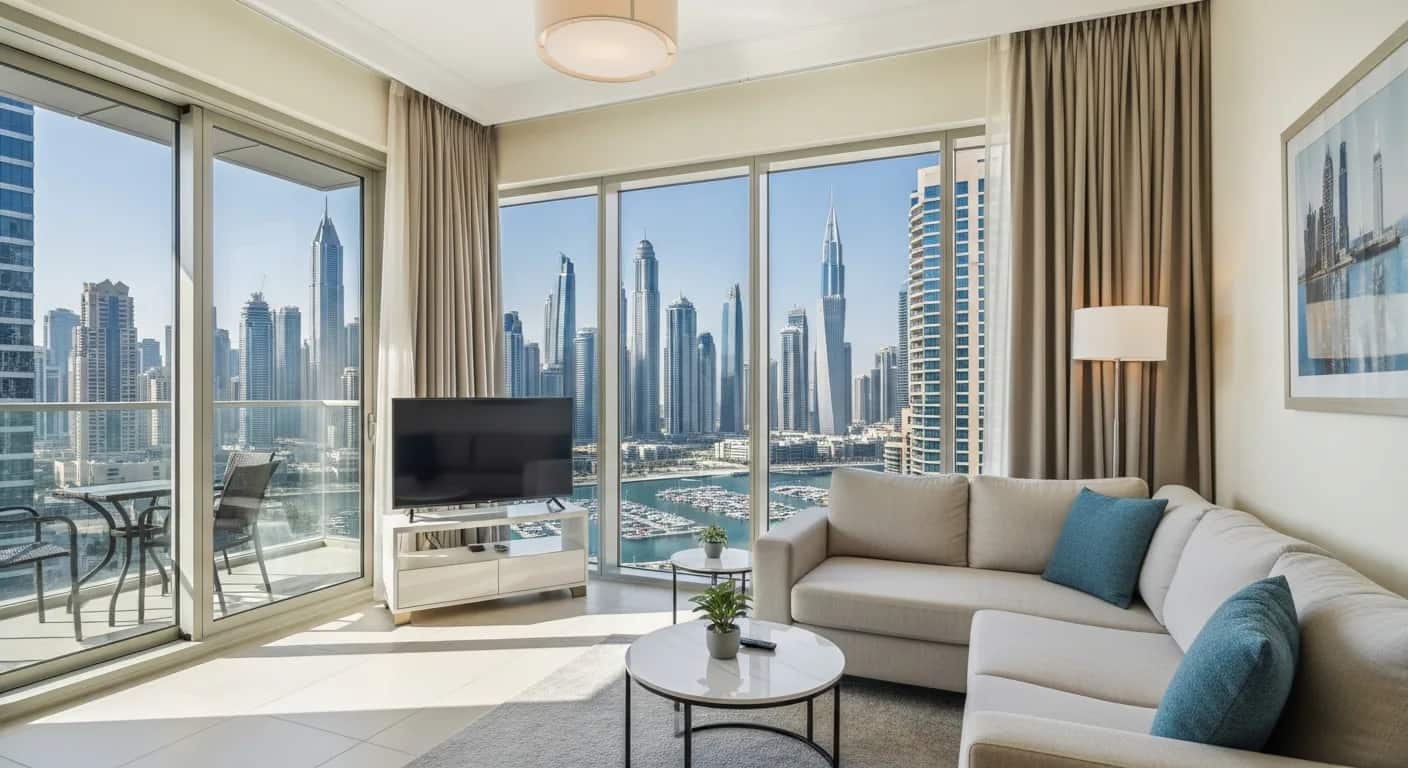
Dubai's Best 1-Bed Investor Units for 2026
As Gaia Living's apartment specialist, I'm cutting through the noise to reveal the best one-bedroom apartments for investors in Dubai for 2026, focusing on the metrics that truly matter: yield, growth, and quality.

As an apartment specialist, I've walked through hundreds of buildings, scrutinised thousands of floor plans, and analysed countless service charge statements. For investors eyeing Dubai in 2026, the one-bedroom apartment remains the undisputed workhorse of a successful portfolio, but choosing the right one has become a science. This isn't about chasing the latest fad; it's about a calculated decision that balances income, growth, and long-term viability.
Here's the framework we'll use to identify the top investment-grade one-bedrooms for 2026:
- Why the one-bedroom is Dubai's undisputed investment sweet spot
- The investor's core calculation: balancing rental yield, capital growth, and asset quality
- A deep dive into the prime and proven markets of Dubai Marina and Business Bay
- Uncovering the growth engines in high-yield areas like JVC and Arjan
- The strategic decision: analysing off-plan launches versus the secondary market
- A complete, line-by-line cost breakdown of a typical one-bedroom purchase
- Navigating the mortgage maze and financing your investment property
- My final verdict on the best one-bedroom strategies for different investor profiles
The One-Bedroom: Dubai’s Investment Workhorse
In the diverse landscape of Dubai real estate, the one-bedroom apartment holds a special status for investors. It is, in my opinion, the most liquid, resilient, and versatile asset class you can own. Why? It comes down to the fundamental demographic and economic drivers of the city. Dubai is a magnet for ambitious, talented individuals and young couples from across the globe. These are the engineers, the marketing managers, the tech entrepreneurs, and the finance professionals who form the backbone of the city's economy. For this vast and ever-renewing demographic, the one-bedroom apartment is the default housing choice—offering privacy, independence, and a manageable footprint.
This consistent, high-volume tenant pool makes the one-bedroom unit incredibly easy to rent out. At Gaia Living, our leasing data consistently shows that well-priced, well-located one-bedrooms have the lowest vacancy rates and the shortest time-on-market compared to larger, more expensive units. While a sprawling four-bedroom penthouse might sit vacant for months waiting for the perfect high-net-worth tenant, a sharp one-bedroom in a desirable building often has multiple applications before the previous tenant has even moved out. This liquidity is an investor's best friend, ensuring a steady and predictable income stream.
From a financial perspective, the one-bedroom hits a strategic sweet spot. The entry price is significantly lower than for two-bedroom units or villas, making it an accessible entry point for first-time investors or a scalable asset for portfolio builders. You could acquire two or even three high-yielding one-bedrooms for the price of a single villa in some communities, diversifying your risk and multiplying your income streams. Furthermore, service charges, which I'll dissect in detail later, are calculated per square foot. The smaller footprint of a one-bedroom (typically 650 to 900 sq. ft.) means the absolute annual cost is more manageable, protecting your net yield from the erosion that can affect larger properties with hefty five-figure service charge bills.
The Investor's Matrix: Yield, Growth, and Quality
 Featured project
When our clients at Gaia Living ask me to identify the 'best' investment, my first step is to dismantle the word 'best' into its three core components: Rental Yield, Capital Growth, and Asset Quality. An astute investor never focuses on one at the expense of the others; true value lies at the intersection of all three. A high initial yield means nothing if the building is deteriorating and the property's value stagnates. Conversely, the promise of future capital growth is a poor substitute for positive cash flow today.
Let's start with Rental Yield. It’s crucial to distinguish between Gross Yield and Net Yield. Gross Yield is the simple calculation of annual rent divided by the property price. It’s the headline figure agents often quote, but it's largely a vanity metric. What truly matters is Net Yield: the annual rent minus all your annual expenses (service charges, maintenance, property management fees), divided by your total investment cost (purchase price plus all acquisition fees). As an apartments analyst, I'm obsessed with service charges. A difference of just AED 5 per square foot in annual charges on an 800 sq. ft. apartment is AED 4,000 straight off your bottom line. I've seen two buildings side-by-side in Business Bay, one charging AED 16/sqft and the other AED 24/sqft. That AED 8 difference is a massive 1% of the property's value disappearing from your net yield each year.
Next is Capital Growth, the increase in the property's market value over time. This is driven by macro factors like city-wide economic growth and micro factors specific to the property's location. Is it near a new metro station? Is the master developer, like Emaar Properties or Meraas, investing heavily in upgrading the surrounding public realm? Is a new business hub or university opening nearby? These are the catalysts for appreciation. For 2026, I’m paying close attention to areas that will benefit from the RTA's Metro Blue Line expansion and communities where the developer is still actively curating the 'last mile' of retail and lifestyle amenities, as this is where the next wave of value uplift will come from.
Finally, and perhaps most importantly, is Asset Quality. This is the intangible but critical element that underpins both yield and growth. It's the reputation of the developer—a building by a top-tier name like Select Group or Nakheel simply commands more confidence and higher resale value than one by an unknown entity. It's the quality of the building management, the efficiency of the elevators, the cleanliness of the pool, the security staff who know residents by name. A low-quality building will be plagued by high tenant turnover, maintenance issues that eat into your returns, and a declining reputation that ultimately caps its rental and sale value. A quality asset, even if it has a slightly lower gross yield on paper, will almost always deliver a better, more reliable total return over the long term.
Prime & Proven: Dubai Marina and Business Bay
For investors who prioritise location, prestige, and proven rental demand, the blue-chip communities of Dubai Marina and Business Bay remain top contenders for 2026. These areas represent the bedrock of Dubai's modern apartment market. They are not the places to find bargain-basement prices, but they offer a level of stability and tenant appeal that is hard to replicate. When you buy here, you are investing in a globally recognised address with a deep and liquid rental market.
Dubai Marina is the quintessential Dubai lifestyle destination. Its appeal is timeless: the stunning waterway, the vibrant walk, the proximity to the beach, and the sheer concentration of cafes, restaurants, and retail. For a tenant, living in the Marina means having a world-class social infrastructure on your doorstep. For an investor, this translates into consistent demand from a demographic of well-paid professionals who are willing to pay a premium for this lifestyle. In my analysis, the key to a successful Marina investment is to look beyond the headline 'full marina view'. While these units command the highest prices, their yields can sometimes be compressed. I often guide investors towards units with partial marina or sea views, or even skyline views, in high-quality towers. The rental difference is often marginal, but the purchase price can be significantly lower, boosting your net yield.
Within the Marina, I advise focusing on towers with a strong reputation for quality management and well-maintained amenities. The original Emaar 6 towers remain a benchmark for quality. Newer developments by Select Group, such as the Marina Gate complex, have set a new standard for finishes and facilities and are highly sought after by tenants. For a good quality one-bedroom of around 800 sq. ft. in a desirable tower, an investor should budget between AED 1.7 million and AED 2.5 million. Gross yields typically hover in the 6-7.5% range. It’s critical to scrutinise the service charges, which in prime Marina towers can range from AED 18 to AED 25 per square foot. Anything higher than this needs serious justification in terms of amenity provision (e.g., an exceptional gym or multiple pools).
Slightly inland, Business Bay offers a different but equally compelling investment case. It's the functional heart of the city's commercial life, located adjacent to Downtown Dubai and the DIFC. This makes it the number one choice for professionals who value a short commute. The expansion of the Dubai Canal has transformed the area, adding a crucial lifestyle element with its waterfront promenades and dining outlets. The quality in Business Bay can be more variable than in the Marina. My advice is to stick with towers from A-list developers. Emaar's projects, such as those in their South Ridge or Boulevard Point clusters on the border of Downtown, are excellent. I also have a high regard for some of the signature towers built by Damac, particularly those with superior finishes and canal views. One-bedroom prices here generally range from AED 1.4 million to AED 2.2 million, offering gross yields that can often touch 7-8%, slightly higher than the Marina due to more competitive entry prices. Service charges are also often a touch more reasonable, averaging between AED 16 and AED 22 per square foot for a quality building.
“For an investor, a boring, predictable 7% net yield in a high-demand area beats a spectacular sea view with a 4% yield every single time.”
The Growth Engines: JVC and Arjan
While prime areas offer stability, the highest rental yields and strongest potential for near-term capital growth are often found in Dubai's emerging, well-connected communities. For 2026, my focus for yield-hungry investors is squarely on two areas that have matured from 'up-and-coming' to 'arrived': Jumeirah Village Circle (JVC) and Arjan.
Jumeirah Village Circle (JVC) has become a powerhouse in the affordable luxury segment. Its circular design, abundance of parks, and central location—equidistant from the Marina, Downtown, and both airports—make it exceptionally popular with a broad tenant base of mid-income professionals, families, and educators. The key to investing in JVC is to be incredibly selective. The area features a vast mix of developers, and the quality can vary dramatically from one building to the next. At Gaia Living, we maintain a curated list of preferred developers and buildings in JVC known for better construction, reliable management, and superior layouts. I personally look for projects by developers like Binghatti, known for their distinctive designs and timely delivery, or other established private developers who have a track record of multiple successful projects in the area. AVOID anonymous, single-project developers with no history.
A good quality one-bedroom in JVC, perhaps in a newer building with a decent pool and gym, can be acquired for between AED 850,000 and AED 1.3 million. This accessible price point is the engine of its high yields. It's realistic to expect gross rental yields of 8-9% here, and sometimes even higher. Service charges are a major advantage, typically ranging from a very competitive AED 12 to AED 16 per square foot. This lower overhead means more of the gross rent translates into net profit for the investor. The community's infrastructure is constantly improving, with new Circle Malls, schools, and connecting roads enhancing its appeal and supporting capital values.
Neighbouring JVC is Arjan, an area I believe is poised for significant growth. For years, Arjan was known primarily for the Dubai Miracle Garden and Butterfly Garden. Now, it's rapidly evolving into a vibrant residential community. Its strategic location, sandwiched between the affluent Dubai Hills and the employment hub of Dubai Science Park, is a core part of its investment thesis. Arjan benefits from excellent connectivity via Umm Suqeim Road and Sheikh Mohammed bin Zayed Road. What excites me most is the quality of the new projects launching here. Developers are bringing higher-spec buildings to Arjan than the early JVC stock, learning from the successes and failures of its neighbour. Prices for one-bedroom units are currently very attractive, generally falling between AED 900,000 and AED 1.4 million, closely tracking JVC but often for a newer, higher-quality product. The yields are similarly robust, comfortably sitting in the 7.5-8.5% gross range. As the community's retail and social infrastructure continues to be built out, I foresee strong potential for capital appreciation, potentially outpacing JVC in the medium term.
The Off-Plan Play: Securing Future Value
The decision between buying a property on the secondary market versus investing in an off-plan launch direct from a developer is one of the most significant strategic choices an investor will make. Each path has distinct advantages and risks, and the right choice for 2026 depends entirely on your capital, risk appetite, and investment timeline.
The allure of off-plan is powerful. Firstly, there's the potential for built-in capital appreciation. By buying at the launch price, you are often getting in at a lower base than the property's expected value upon completion. As construction progresses and the surrounding community matures, the value of your asset can rise, leading to a significant capital gain by the time you receive the keys. Secondly, developers offer highly attractive payment plans. A typical plan might be 60/40 or 70/30, where you pay 60-70% of the price in installments during the construction period (which can be 3-4 years) and the remaining 30-40% upon handover. This allows you to secure an asset with less initial capital and can significantly leverage your returns. Finally, you receive a brand-new, pristine property with a warranty, meaning minimal initial maintenance costs and high appeal for the first tenant.
However, these benefits come with inherent risks. The primary risk is project delay or, in a worst-case scenario, cancellation. While Dubai's real estate regulations, enforced by RERA and the Dubai Land Department (DLD), have become incredibly robust, delays can still happen. The system of mandatory escrow accounts, where developer funds are held and only released based on construction progress, provides a strong safety net for buyers. You must ensure your Sales and Purchase Agreement (SPA) is registered with the DLD and you have an 'Oqood' certificate as proof. The other major risk is market fluctuation. If the property market softens during the construction period, your unit may be worth less at handover than what you paid. This is why it's crucial to invest in projects in resilient locations from top-tier developers who create destinations, not just buildings. Areas I am watching for strong off-plan potential include the new phases at Creek Harbour by Emaar and select projects in Dubai South which will benefit massively from the long-term expansion of Al Maktoum International Airport.
Here’s a simple checklist for any off-plan investment:
- Developer Track Record: Have they delivered multiple projects on time in Dubai?
- Escrow Account: Is there a RERA-approved escrow account for the project? This is non-negotiable.
- DLD Registration: Is the project and your unit registered on the DLD's official systems?
- Location & Master Plan: Is the project part of a well-designed master community with future infrastructure plans?
- Payment Plan vs. Handover Date: Does the cash flow of the payment plan align with your financial capacity? A post-handover payment plan can be a huge advantage for managing cash flow.
The Numbers Don't Lie: A Complete Cost Breakdown
To make an informed investment decision, you must understand every single cost involved. Vague estimates are not enough. As an analyst, I insist on building a line-by-line budget. Let’s walk through a realistic example of purchasing a one-bedroom apartment on the secondary market in Business Bay. This detailed breakdown will help you see the full picture beyond the sticker price.
Let’s assume our target property is listed for AED 1,600,000.
Here is a line-by-line breakdown of the upfront costs you must budget for, based on regulations and standard market practice:
- Property Purchase Price: AED 1,600,000
- Dubai Land Department (DLD) Transfer Fee: 4% of Purchase Price
- `AED 1,600,000 * 4% = AED 64,000`
- DLD Admin Fee: A fixed fee payable to the DLD.
- `~AED 4,200`
- Property Registration Fee (to Trustee Office): This is for properties valued over AED 500,000.
- `~AED 4,200`
- Real Estate Agency Fee: Standard market rate is 2% of the purchase price, plus 5% VAT on the fee.
- `Fee: AED 1,600,000 * 2% = AED 32,000`
- `VAT on Fee: AED 32,000 * 5% = AED 1,600`
- `Total Agency Fee = AED 33,600`
- Developer No Objection Certificate (NOC) Fee: The developer must issue an NOC to confirm there are no outstanding dues on the property before transfer. This fee varies.
- `Range: AED 525 to AED 5,000 (Let's budget conservatively at AED 2,000)`
Total Upfront Cost (Cash Buyer): `AED 1,600,000 + 64,000 + 4,200 + 4,200 + 33,600 + 2,000 = AED 1,708,000`
As you can see, the total cash required is over AED 100,000 more than the property's price. Now, let's add the costs if you are financing the purchase with a mortgage:
- Mortgage Arrangement Fee: Most banks charge a fee, often 1% of the loan amount (or a fixed fee).
- `Assuming an 80% loan (AED 1,280,000), this is ~AED 12,800. Some banks waive this.`
- Mortgage Registration Fee (to DLD): 0.25% of the total loan amount.
- `AED 1,280,000 * 0.25% = AED 3,200`
- Property Valuation Fee: The bank will mandate a valuation from an approved firm.
- `~AED 3,150`
In a mortgage scenario, your initial cash outlay would be the 20% down payment (AED 320,000) plus all the fees listed above. Total cash needed would be approximately `AED 320,000 + 64,000 + 4,200 + 4,200 + 33,600 + 2,000 + 12,800 + 3,200 + 3,150 = AED 447,150`. This is the true number you need in your bank account to complete the transaction.
Navigating the Mortgage Maze: Financing Your Investment
For many investors, leveraging bank finance is a key strategy to enhance returns and acquire assets with less upfront capital. However, navigating the UAE's mortgage landscape requires a clear understanding of the rules, which are set by the Central Bank of the UAE. The regulations differ significantly for UAE residents versus non-residents, and for a first property versus subsequent investment properties.
For a UAE resident purchasing their first property (whether for personal use or investment) with a value under AED 5 million, the maximum loan-to-value (LTV) ratio is 80%. This means you are required to provide a minimum down payment of 20% of the purchase price, plus all the associated fees we just calculated. For any subsequent property purchase, the maximum LTV for a resident drops to 65%, requiring a larger 35% down payment. For non-residents looking to invest in Dubai, the rules are tighter. The maximum LTV is typically capped at 50%, though some banks may offer up to 60% under specific circumstances. This means a non-resident investor must be prepared for a substantial down payment of 40-50% of the property's value.
Beyond the LTV caps, banks will conduct a rigorous assessment of your financial health. The most important metric is your Debt-to-Burden Ratio (DBR), which is the percentage of your monthly income that goes towards servicing all your existing debts (car loans, credit cards, personal loans) plus the new proposed mortgage payment. The Central Bank caps this at 50%. Banks will also apply a 'stress test' to your application. They will calculate your affordability not at the current interest rate, but at a higher, 'stressed' rate (e.g., current rate + 2%) to ensure you can still make payments if interest rates rise. In my experience, it's prudent for investors to do their own stress testing. I always advise our clients to model their rental income and expenses based on an interest rate at least 1.5-2% higher than what the bank offers, to ensure their investment remains cash-flow positive even in a less favorable rate environment.
Interest rates in the UAE are typically variable and linked to the EIBOR (Emirates Interbank Offered Rate), with the bank adding their own margin on top. While rates fluctuate, for planning purposes in 2026, it would be sensible to budget for a rate in the range of 4.5% to 5.5%. Some banks offer introductory fixed-rate periods of 1 to 5 years, which can provide valuable payment certainty in the initial phase of your investment. When approaching banks, it's essential to have your documentation in perfect order. This typically includes passport/visa copies, Emirates ID, salary certificates, 6 months of bank statements, and details of any existing liabilities. Working with a reputable mortgage broker can be invaluable in navigating this process, as they have established relationships with multiple lenders and can help position your application for the best possible outcome.
My Verdict: The Top 1-Bedroom Investment for 2026
After analysing the market dynamics, cost structures, and community trajectories, it's clear there is no single 'best' one-bedroom apartment for every investor. The optimal choice depends entirely on your personal financial goals, risk tolerance, and investment horizon. Therefore, instead of a single recommendation, my verdict for 2026 is tailored to three distinct investor profiles that we frequently encounter at Gaia Living.
1. The Yield-Focused Investor: For the investor whose primary goal is to maximise monthly cash flow and achieve the highest possible net rental yield, my recommendation is a newly completed or nearly-complete one-bedroom apartment in JVC or Arjan. The key is to be fanatically selective about the developer and the specific building. Target a property from a developer with a proven track record of quality construction and community management, such as Binghatti or a select few reputable private firms. Look for a unit of around 700-800 sq. ft. in a building with practical, well-maintained amenities—a good gym and a clean pool are more important than extravagant lobbies. The entry price, likely between AED 900,000 and AED 1.3 million, combined with strong rental demand and low service charges (AED 13-16/sqft), creates the perfect equation for net yields that can realistically exceed 7%. This is the workhorse investment that generates consistent, reliable income.
2. The Balanced Growth & Yield Investor: For the investor seeking a blend of steady income and long-term, stable capital appreciation, my focus shifts to Business Bay. Specifically, I would target a one-bedroom apartment in a 5-10 year old tower built by a premium developer like Emaar. These buildings have a proven track record, established communities, and are located in a strategic economic corridor. While the gross yield might be slightly lower than in JVC (expect 6.5-7.5%), the quality of the tenant profile is exceptionally high, and the potential for long-term capital preservation and growth is stronger due to its proximity to the Downtown core. Budget for an investment between AED 1.5 million and AED 2 million. This is a 'set and forget' style investment in a blue-chip location that offers peace of mind and a robust total return.
3. The Capital Gains Maximiser: For the investor with a higher risk tolerance and a primary focus on capital gains over a 3-5 year horizon, the strategy is to look at off-plan launches in master communities with a clear, funded infrastructure pipeline. My top pick in this category for 2026 would be a one-bedroom apartment in a new launch within Emaar's Creek Harbour or a well-positioned project in Dubai South. These areas are set to be transformed by massive government and private sector investment—from the Dubai Metro expansion to the new tower and the continued growth of the airport city. By entering at the developer's launch price with a favourable payment plan, you are positioned to capture the value uplift as these grand visions become reality. This is a higher-risk, higher-reward play that requires patience and faith in Dubai's long-term growth story.
The best investment isn't always the cheapest property or the one with the highest advertised yield. For 2026, the smartest money will be on high-quality, well-located one-bedroom apartments where the numbers—from service charges to net yield—have been scrutinised and validated. Whether you prioritise immediate cash flow in JVC, balanced returns in Business Bay, or future growth in an off-plan community, a data-driven, quality-focused approach will always be the winning strategy.
Sources
- Dubai Land Department (DLD): dubailand.gov.ae
- Real Estate Regulatory Agency (RERA): Part of the DLD website.
- Central Bank of the UAE: centralbank.ae
- The UAE Government Portal (Property Purchase Information): u.ae
Questions, answered
- What is a good rental yield for a 1-bedroom in Dubai?
- A gross rental yield of 6-7% is considered good in established Dubai communities, while emerging areas can offer 8% or higher. However, investors should focus on the net yield after deducting service charges and other costs, which is the true measure of profitability.
- Are service charges high for apartments in Dubai?
- Service charges vary significantly by building quality and location, typically ranging from AED 12-16 per square foot in affordable communities to AED 20-30 per square foot in premium towers with extensive amenities. These fees are a critical factor in calculating your net investment return.
- Is it better for an investor to buy an off-plan or a ready property?
- It depends on your strategy. Off-plan properties offer the potential for higher capital gains and attractive payment plans but come with construction and market risks. A ready property provides immediate rental income and proven performance, making it a more conservative choice.
- What are the main upfront costs when buying an apartment in Dubai?
- Buyers should budget approximately 6-8% of the property's purchase price for fees. This includes the mandatory 4% Dubai Land Department (DLD) transfer fee, agency fees (typically 2%), and various administrative and registration fees.
- Can a foreigner get a mortgage to invest in Dubai property?
- Yes, non-resident foreigners can obtain mortgages in Dubai. However, the loan-to-value (LTV) ratio is typically capped at 50-60% by the UAE Central Bank, meaning a larger down payment of 40-50% plus fees is required compared to residents.
- What is the minimum investment for a 1-bedroom apartment in Dubai?
- In developing, high-yield communities like JVC or Arjan, entry prices for one-bedroom apartments can start around AED 800,000. In prime, central locations like Dubai Marina or Downtown Dubai, prices typically begin at AED 1.5 million or more.

Ravi lives and breathes apartment living — from studio yields in JVC to branded residences on the Palm. Floor plans, service charges, and view lines are his love language.
Related stories
Right-Sizing Your Dubai Villa for a New Chapter
As an empty nester or active retiree, your idea of the perfect Dubai home shifts. I explore the best villa communities that prioritise lifestyle and low-maintenance living over sheer size.
Dubai's AC Dilemma: The Real Cost of Cooling
Your apartment's air conditioning is more than just a utility—it's a major factor in your monthly budget and comfort. I'll break down the real costs and benefits of Dubai's two main cooling systems, helping you choose your next home wisely.
Managing Multiple Offers: A Dubai Seller's Playbook
Receiving multiple offers on your Dubai property is an excellent problem to have, but handling it incorrectly can cost you time and money. Here’s my strategic playbook for managing competitive bids to secure the best possible outcome.
Echoes, in your inbox
One thoughtful email a month. Market insight, new launches, no spam.