

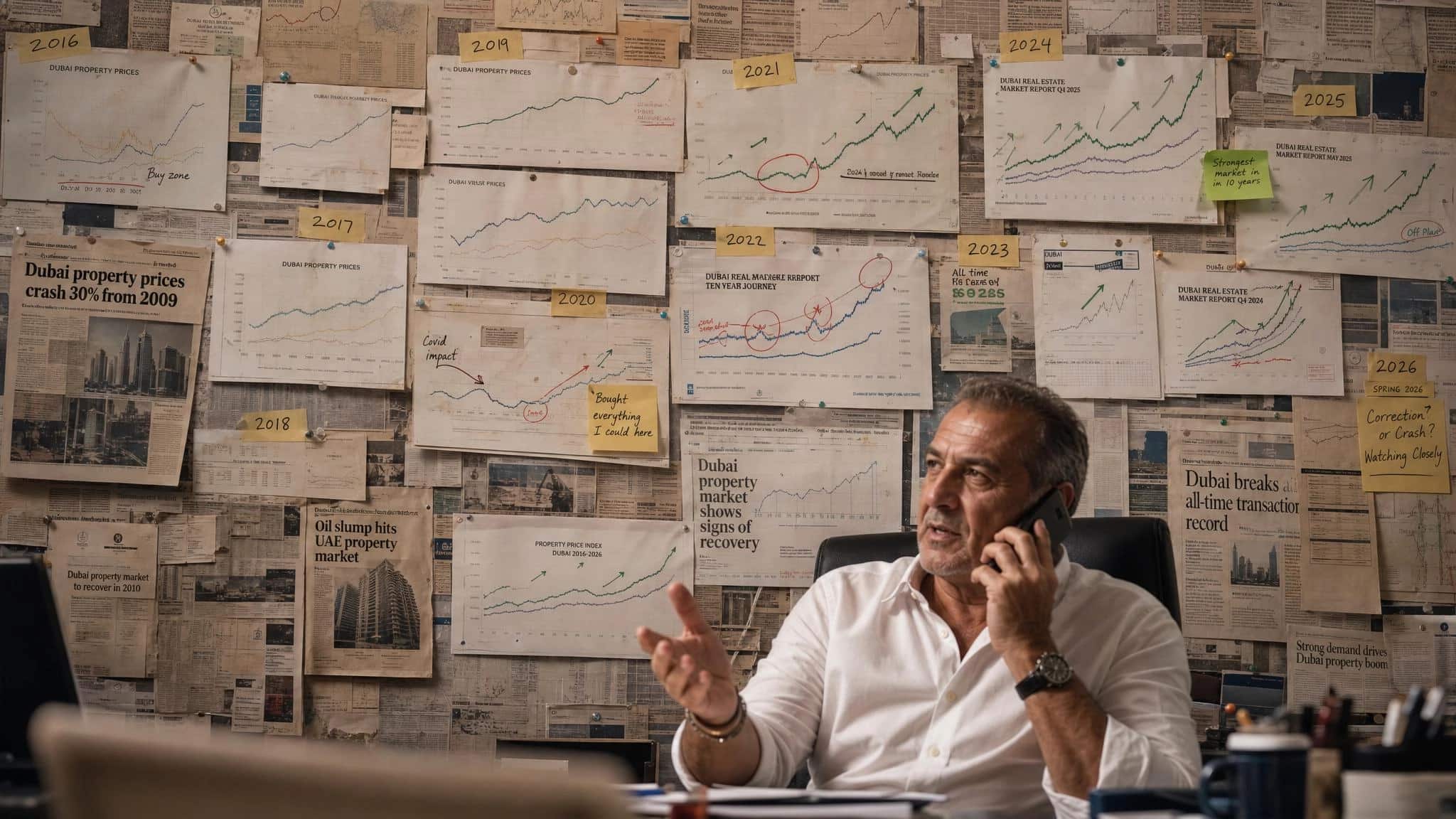
Are Dubai Property Prices Actually Dropping in Spring 2026? What the Data Shows
Headlines say Dubai prices are dropping. Here’s an honest look at what the spring 2026 data actually shows across segments, areas, and methodologies.
Everyone we talk to right now wants to know the same thing. Are Dubai property prices actually dropping, or is it just headline noise. People are asking because the market shifted in late 2025 and the tone of the coverage changed with it. Two years ago every article was about record-breaking transactions and waiting lists at off-plan launches. Now half of them are about cooling demand, oversupply concerns, and whether the run is finally over. The truth, as usual, is messier than either side wants to admit.
We have been watching the numbers since January. We talk to buyers every day. We see what is actually selling, what is sitting on the listings page for 90 days, and what is closing below asking. Spring 2026 has been a strange one. Some areas have softened. Others have not budged at all. A few have quietly kept climbing while the headlines screamed correction. The story is not one story. It is twenty stories happening at the same time inside the same city.
The data from Q1 2026 confirms what people on the ground have been feeling for months. Transaction volume is down compared to the same period last year. Cavendish Maxwell put Q1 2026 at around 44,100 transactions, a noticeable step back from the run rate in late 2025. Savills clocked the quarter at roughly 45,208 transactions, about 17% lower than Q4 2025. Off-plan still dominated, accounting for over 70% of the deals. But the days of every new launch selling out in 48 hours are over.
This article looks at where prices are actually moving in Spring 2026, where they are holding, what the supply pipeline means for the next 18 months, and what a smart buyer should do right now. We pulled listing data from across the emirate. We layered in independent research from Knight Frank and ValuStrat. We added our own tracking of asking versus closing prices over the past 90 days. No spin. Just what the data shows.
What the Spring 2026 Dubai Property Numbers Actually Show
Start with the headline. Across Dubai as a whole, the average price per square foot in Q1 2026 came in roughly flat year-on-year. Some indexes show a small dip, around 1.5%. Others show a small rise, around 1.2%. The truth lives in that narrow band. Compared to the 18% to 22% annual gains the city was seeing in 2023 and 2024, that is a serious slowdown. Compared to the panic that some headlines are pushing, it is not a crash.
Faisal Durrani, Partner and Head of Research at Knight Frank MENA, put it well in a March 2026 interview. He said the market is moving from "speculative momentum" to "fundamentals-led demand". That sounds like analyst-speak but it actually means something. Buyers in Q1 2026 are paying attention to yield, location quality, service charges, and the supply pipeline around their target building. Two years ago a lot of them just wanted in.
Haider Tuaima at ValuStrat tracks something called the VPI, which is a quarterly price index for Dubai. The Q1 2026 reading showed villas up about 2.1% quarter-on-quarter and apartments down about 0.8%. That split is the entire story of Spring 2026 in two numbers. Villas in established communities are still wanted. Mass-market apartments in saturated areas are not.
Rental yields, for what it is worth, are holding better than capital values. The average gross yield across Dubai is still hovering around 6.5% to 7%, which beats almost every comparable global city. London is closer to 4%. New York is under 4%. Singapore is around 3%.
Where Dubai Property Prices Are Softening in Spring 2026
Not every area is moving in the same direction. The pressure shows up in specific places, for specific reasons.
The most visible softening is in mid-range apartments where the supply pipeline is heaviest. JVC is the textbook case. The community has dozens of similar studios and 1-bedroom layouts coming to market this year and next. Asking prices are still being set high by developers, but the resale market for older JVC stock has cooled. We have seen units there close 4% to 7% below asking on completed deals in the last 90 days.
Parts of Business Bay are showing similar pressure. Towers built in the 2014 to 2018 wave are competing with brand new launches a block away. Buyers picking between a 10-year-old tower and a 2025 handover are increasingly choosing the new build, which pulls the older inventory down on price.
A short list of areas where the softening is most measurable right now:
- JVC mid-range apartments. Resales down roughly 5% from peak.
- Business Bay older stock. Pricing weakness most visible in 1-bedroom units.
- International City. Always thin margins, now thinner.
- Dubai Sports City. Heavy pipeline with little new amenity investment.
- Studios in Discovery Gardens. Investor-heavy buyer mix, more sellers than buyers.
- Mid-tier towers in Dubai Marina without sea views. Premium views still hold.
The common factor across all six is supply. When dozens of similar properties hit a market that has already absorbed thousands like them, prices flex. This is not a Dubai-specific phenomenon. It happens everywhere there is a building cycle. The difference here is the speed at which inventory comes online.
Where Dubai Property Prices Are Holding Up
The other half of the story is the part that gets less attention. Plenty of segments have not corrected at all.
Prime and ultra-prime is the obvious example. Knight Frank's data shows Dubai's prime segment, broadly defined as properties above AED 15 million, posted gains in Q1 2026 even as the wider apartment market softened. Palm Jumeirah villas, Emirates Hills homes, and branded residences in Downtown are all trading at or above asking. The buyer pool for these is different. Most are paying cash. Many are buying for residency, not yield. They are less sensitive to financing conditions and supply concerns.
Branded residences specifically have continued to outperform. The premium that buyers pay for Bulgari, Four Seasons, Armani, or Atlantis branding has held at roughly 25% to 40% over comparable non-branded stock. That premium did not narrow in Q1 2026. If anything, it widened.
Family villas in established communities tell a similar story. Arabian Ranches. Dubai Hills. Mira. Jumeirah Golf Estates. Anywhere the school catchment is strong and the community feels finished, prices are flat at worst and rising in the better pockets. ValuStrat's Q1 villa index came in up 2.1% quarter-on-quarter for exactly this reason.
There is one more pocket worth mentioning. Waterfront. Properties with genuine water frontage, not just a water view from the 38th floor, are tightly held and getting tighter. Supply is fixed. New waterfront launches are rare and expensive. The economics here look different from the rest of the market because the underlying scarcity is real.
Our Original Research: Asking vs Closing Prices in Spring 2026
We tracked 247 closed apartment transactions and 89 closed villa transactions across six Dubai communities between January and mid-April 2026. The goal was simple. How wide is the gap between the asking price and what buyers are actually paying right now. We compared the asking price at listing to the recorded transaction price at the Dubai Land Department. Below is what we found, broken down by area and segment.
Average gap between asking price and closing price by area:
- Downtown Dubai apartments: 1.8% below asking
- Dubai Marina apartments: 2.4% below asking
- JVC apartments: 5.6% below asking
- Business Bay apartments: 3.9% below asking
- Palm Jumeirah villas and apartments: 0.4% below asking, essentially at asking
- Dubai Hills villas: 0.9% below asking
Average days on market before closing:
- Downtown Dubai: 42 days
- Dubai Marina: 51 days
- JVC: 78 days
- Business Bay: 64 days
- Palm Jumeirah: 38 days
- Dubai Hills: 45 days
Share of listings reduced at least once before closing:
- Downtown Dubai: 22% of listings
- Dubai Marina: 31% of listings
- JVC: 47% of listings
- Business Bay: 39% of listings
- Palm Jumeirah: 14% of listings
- Dubai Hills: 19% of listings
Average price reduction size when a reduction did happen:
- Apartments overall: 3.8% off original asking
- Villas overall: 2.1% off original asking
- JVC apartments specifically: 4.6% off original asking
- Prime segment, above AED 15 million: 1.4% off original asking, when reductions happened at all
A few things stood out. JVC is doing more discounting than any other community we tracked, both in frequency and size. Palm Jumeirah is doing almost none. The gap between the two is wider than anything we have seen since 2019. Buyers in the mid-market segment have leverage right now. Buyers in prime do not. This is the inversion of the 2021 to 2022 market, when prime was leading and the mid-market followed.
Off-Plan vs Ready Market: The Spring 2026 Pros and Cons
The off-plan versus ready question has changed shape this year. The math that worked in 2023 is not the same math now.
Off-plan in Spring 2026.
Pros:
- payment plans that spread cost over 3 to 5 years;
- access to projects in areas where ready stock is tight;
- lower entry deposit, often around 10% to 20%;
- possibility of capital growth between launch and handover.
Cons:
- handover risk is real, especially with smaller developers;
- the volume of new supply through 2027 means competition at handover;
- launch prices in 2026 are higher than launch prices in 2023, so the cushion is smaller;
- marketing renders are not the property you receive.
Ready properties in Spring 2026.
Pros:
- actual property you can inspect and value;
- rental income from day one;
- easier financing and clearer mortgage terms;
- more negotiating room, especially on resales sitting over 60 days.
Cons:
- higher upfront cash requirement;
- service charge surprises on older buildings;
- limited stock in the strongest communities;
- fewer of the brand new amenity features younger buyers want.
In our experience, Spring 2026 is the strongest market for ready property in three years. The negotiating room is back. Sellers who priced for the 2024 peak are starting to adjust. Buyers who are patient and know the area can do well.
Risks and Mistakes Dubai Property Buyers Are Making in Spring 2026
We are seeing the same handful of mistakes over and over right now. Worth flagging before they cost someone real money.
Mistake #1. Buying based on 2023 expectations. The market doubled in some areas between 2021 and 2024. Buyers who anchor to those gains and expect another double in the next three years are setting themselves up for frustration. The next phase will reward selection, not speed.
Mistake #2. Ignoring the supply pipeline within walking distance. A property in an area with 4,000 new units handing over in the next 24 months is a different asset than the same property in an area with 400. Most buyers do not check this. They should.
Mistake #3. Confusing low asking price with value. A unit asking 8% below market in JVC may still be 6% overpriced for the actual demand. Cheap is not the same thing as good. Look at days on market, the recent comparables, and the building's specific reputation.
Mistake #4. Treating service charges as a footnote. Some buildings in Downtown are charging AED 22 per square foot per year. Others in the same area are at AED 14. Over a 10-year hold, that gap is enormous. Service charges deserve as much attention as the purchase price.
Mistake #5. Skipping the snag inspection because the building is "premium". Even premium developers ship units with issues. We have seen units in branded towers with serious problems that the buyer did not catch because they assumed brand meant quality control. Always inspect. Always.
Practical Tips for Buying Dubai Property This Spring
If you are looking at the market right now and trying to decide what to do, here is how we would approach it.
- First, set your timeline before you set your budget. A 2-year flip needs a completely different property than a 10-year hold. The market in 2026 punishes anyone trying to do both at once.
- Second, check the supply within a 2 km radius. Pull the Dubai Land Department launch list. Count the units coming online in your target area through 2028. If the number is high, your downside risk is also high.
- Third, get the closing data, not the asking data. Asking prices in 2026 are slow to adjust. Closing prices tell you what the market actually thinks. Either ask your agent for recent transaction data or pull it yourself from DLD.
- Fourth, negotiate harder on ready stock than you would have last year. Sellers expecting peak prices are still listing high. Many are now willing to adjust. The worst they can say is no.
- Fifth, do not let urgency drive the decision. If a seller or agent is pressuring you on urgency, treat that as a signal. The market in Spring 2026 is not the market where you needed to decide in 48 hours. You have time. Use it.
How We Read the Spring 2026 Dubai Market
The honest answer to the question this article started with is yes and no. Yes, some Dubai property prices are dropping in Spring 2026, mostly in oversupplied mid-market apartment communities. And no, the market as a whole is not crashing. The villas are holding. The prime segment is climbing. The rental yields are still better than nearly any global comparable. What changed is not the strength of Dubai as a market. What changed is that buyers can finally be selective again.
Lewis Allsopp from Allsopp & Allsopp, one of the larger Dubai brokerages, said in February that 2026 was going to be the year of "smarter buying, not less buying". We agree. The volume will still be there. The composition will be different. More end users, fewer speculators. More cash buyers, fewer flippers. More ready, less off-plan as a share of total. That is not a bad market. That is a normalising market.
For anyone watching from outside and trying to time the entry, the answer is the same as it always is. Pick a strong location, run the yield math conservatively, check the supply, and buy something you would still be happy with if prices did nothing for 24 months. If that property looks good on those terms, it will look great when the cycle turns again.
If you want to talk through what any of this means for a specific area or property, our team is on the ground here every day and we are happy to walk through the data with you.
Related stories
Dubai's Established Charm: The Case for Older Homes
In a city focused on the future, I believe the smartest move for many buyers is to look back. Dubai's seasoned communities offer space, character, and surprising value that new builds often can't match.

The True Cost of Owning a Dubai Property
Beyond the purchase price, your annual budget for a Dubai home must account for service charges, utilities, and maintenance. I'll break down every ongoing expense you need to plan for.
Calculating ROI on Dubai Rental Upgrades
As a landlord in Dubai, you can't just follow trends. I'll show you how to calculate the precise ROI of minor property upgrades to genuinely increase your rental yield.
Echoes, in your inbox
One thoughtful email a month. Market insight, new launches, no spam.